
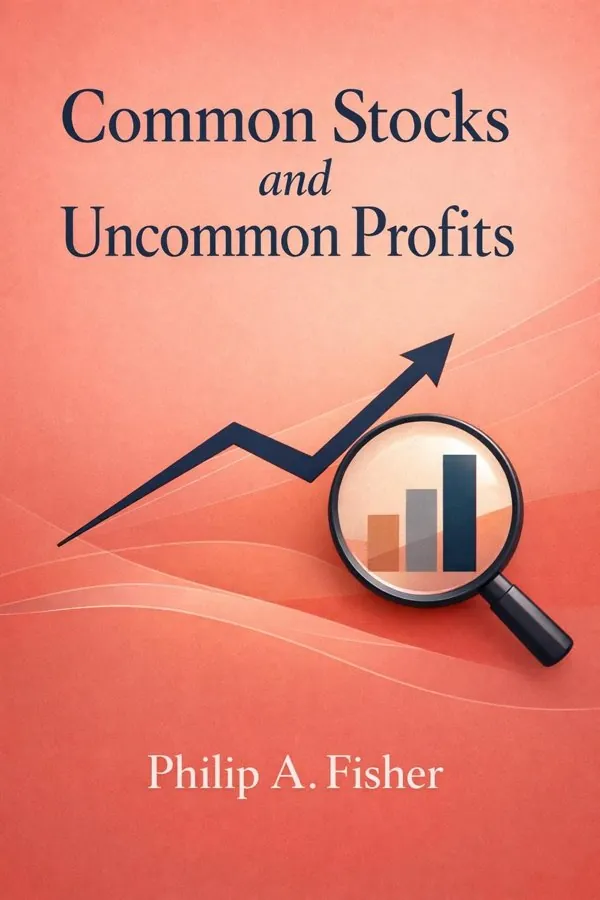
Common Stocks and Uncommon Profits: Summary & Key Insights
 10 min9 chaptersAudio available
Key Takeaways from Common Stocks and Uncommon Profits
The stock market punishes confusion, and one of the costliest confusions is mistaking speculation for investment.
A company’s annual report tells a story, but the world around the company tells the truth.
Great investments are rarely accidents.
A mediocre business can sometimes post good numbers for a while, but only exceptional management can turn opportunity into durable wealth creation.
The biggest gains in investing often come not from frequent buying and selling, but from owning excellent businesses long enough for compounding to work.
What Is Common Stocks and Uncommon Profits About?
Common Stocks and Uncommon Profits by Philip Fisher is a finance book published in 1958 spanning 5 pages. Most investors spend too much time studying stock prices and too little time studying the businesses behind them. In Common Stocks and Uncommon Profits, Philip Fisher argues that truly exceptional investment results come not from chasing bargains or predicting short-term market swings, but from identifying rare companies with the capacity to grow for many years. First published in 1958, the book became one of the foundational texts of growth investing and remains highly relevant in today’s markets. Fisher’s central insight is simple but powerful: outstanding stocks are usually backed by outstanding management, strong products, a culture of innovation, and large opportunities for future expansion. To uncover these qualities, he recommends deep qualitative research, including his famous “scuttlebutt” method of gathering information from customers, suppliers, competitors, employees, and industry experts. This approach goes far beyond reading financial statements. Fisher wrote from authority. He was one of the earliest professional investors to focus on long-term business quality instead of short-term price action, and his ideas later influenced major investors such as Warren Buffett. This book matters because it teaches readers how to think like an owner, not a trader.
This FizzRead summary covers all 9 key chapters of Common Stocks and Uncommon Profits in approximately 10 minutes, distilling the most important ideas, arguments, and takeaways from Philip Fisher's work. Also available as an audio summary and Key Quotes Podcast.
Common Stocks and Uncommon Profits
Most investors spend too much time studying stock prices and too little time studying the businesses behind them. In Common Stocks and Uncommon Profits, Philip Fisher argues that truly exceptional investment results come not from chasing bargains or predicting short-term market swings, but from identifying rare companies with the capacity to grow for many years. First published in 1958, the book became one of the foundational texts of growth investing and remains highly relevant in today’s markets.
Fisher’s central insight is simple but powerful: outstanding stocks are usually backed by outstanding management, strong products, a culture of innovation, and large opportunities for future expansion. To uncover these qualities, he recommends deep qualitative research, including his famous “scuttlebutt” method of gathering information from customers, suppliers, competitors, employees, and industry experts. This approach goes far beyond reading financial statements.
Fisher wrote from authority. He was one of the earliest professional investors to focus on long-term business quality instead of short-term price action, and his ideas later influenced major investors such as Warren Buffett. This book matters because it teaches readers how to think like an owner, not a trader.
Who Should Read Common Stocks and Uncommon Profits?
This book is perfect for anyone interested in finance and looking to gain actionable insights in a short read. Whether you're a student, professional, or lifelong learner, the key ideas from Common Stocks and Uncommon Profits by Philip Fisher will help you think differently.
- ✓Readers who enjoy finance and want practical takeaways
- ✓Professionals looking to apply new ideas to their work and life
- ✓Anyone who wants the core insights of Common Stocks and Uncommon Profits in just 10 minutes
Want the full summary?
Get instant access to this book summary and 100K+ more with Fizz Moment.
Get Free SummaryAvailable on App Store • Free to download
Key Chapters
The stock market punishes confusion, and one of the costliest confusions is mistaking speculation for investment. Fisher draws a firm line between the two. Speculation is driven by guesses about price movements, market mood, or short-term events. Investment, by contrast, is based on disciplined judgment about a company’s long-term business value and its future ability to grow profits.
This distinction matters because many people believe they are investing when they are really making bets. They buy because a stock has fallen, because someone on television likes it, or because the market seems excited about a trend. Fisher warns that such behavior may occasionally produce gains, but it does not create a reliable method for building wealth. Genuine investing requires understanding what the business does, why customers value it, how management thinks, and whether the company has room to expand over time.
Consider two investors. One buys shares in a hot semiconductor stock because the chart looks strong. The other studies the firm’s product pipeline, customer relationships, manufacturing advantages, and management quality before deciding whether its earnings can compound for a decade. The second investor may still be wrong, but the decision rests on evidence rather than impulse.
Fisher does not claim that uncertainty can be removed. Instead, he argues that investors should raise the odds in their favor through research, patience, and selectivity. The market will always tempt people with noise. The serious investor must learn to ignore it.
Actionable takeaway: Before buying any stock, write down whether your reason is based on business fundamentals or expected price movement. If it is the latter, you are speculating, not investing.
A company’s annual report tells a story, but the world around the company tells the truth. Fisher’s famous “scuttlebutt” method is his answer to the limits of financial statements. He believed that investors can gain a far richer understanding of a business by gathering information from the people who interact with it every day.
Scuttlebutt means speaking with customers, suppliers, distributors, former employees, competitors, scientists, trade associations, and industry specialists. The goal is not gossip for its own sake. It is to build a mosaic of evidence about product quality, customer loyalty, sales strength, management reputation, and technological edge. If a company claims to be innovative, ask customers whether its products actually solve problems better than alternatives. If management talks about operational excellence, ask suppliers whether it pays promptly, plans effectively, and behaves professionally.
Imagine researching a medical device company. Financial filings may show rising revenue, but conversations with hospital buyers might reveal that doctors strongly prefer the firm’s products because they are easier to use and produce better patient outcomes. Competitors may grudgingly admit the company’s research team is years ahead. Those details can tell you far more about future staying power than last quarter’s numbers alone.
Scuttlebutt also helps investors avoid deception. A polished management team can present a compelling narrative, but the surrounding ecosystem often reveals whether that narrative is deserved. Used properly, this method turns investing from passive reading into active investigation.
Actionable takeaway: For any company you are considering, identify at least three outside sources—such as customers, competitors, or industry experts—and use them to test management’s claims before investing.
Great investments are rarely accidents. Fisher’s famous fifteen-point checklist provides a framework for identifying the uncommon businesses that can produce uncommon profits. Instead of focusing on low price-to-earnings ratios or temporary market mispricings, he asks whether a company has the qualities needed to grow substantially over many years.
Among his key questions are these: Does the company have products or services with sufficient market potential to increase sales meaningfully? Does management have the determination to continue developing new products or processes when current growth opportunities mature? Are the firm’s research, sales organization, profit margins, labor relations, and executive depth strong enough to support expansion? Does management communicate honestly with shareholders, especially when conditions worsen?
These questions force investors to look at a business as a living system. A company may have a promising product, but if its sales force is weak, growth may stall. Another may show strong current margins, but if management underinvests in innovation, those margins can erode. Fisher’s checklist therefore encourages holistic thinking rather than narrow financial analysis.
A practical example is a software company with recurring revenue. The investor should not stop at revenue growth. Do customers renew at high rates? Is the product mission-critical? Is research and development creating adjacent offerings? Can management recruit capable leaders as the firm scales globally? The checklist turns abstract admiration into structured judgment.
Fisher’s fifteen points are not meant to be followed mechanically. They are a disciplined lens through which to evaluate quality. The more boxes a company checks, the more likely it is to deserve long-term ownership.
Actionable takeaway: Create your own checklist based on Fisher’s fifteen points and score every potential investment before buying, rather than relying on vague enthusiasm.
A mediocre business can sometimes post good numbers for a while, but only exceptional management can turn opportunity into durable wealth creation. Fisher places unusual emphasis on leadership because strategy, capital allocation, culture, and honesty all flow from the people running the company.
He looks for managers who are both ambitious and realistic. They should think beyond the next quarter, invest in future growth, and respond intelligently to changing conditions. Strong management does not simply defend what already works; it prepares for the day when current products mature and new competition appears. Fisher admired leaders who continuously asked, “What should this company become next?”
Equally important is integrity. Investors must trust management’s communication, especially during setbacks. A management team that only shares good news is dangerous. Fisher preferred executives who discussed problems candidly and explained how they would solve them. This honesty gives investors confidence that surprises are less likely to be hidden until they become severe.
Innovation is closely tied to management quality. In growth companies, research and development should not be viewed as a discretionary expense but as the engine of future earnings. A consumer electronics company that repeatedly launches useful products, adapts to changing tastes, and supports them with effective marketing is usually being guided by leaders who understand innovation as a process, not an accident.
For modern investors, this idea remains essential. You can study a business’s margins and market share, but if management lacks vision, discipline, or character, those advantages may fade. Over time, investors own management decisions as much as they own assets.
Actionable takeaway: Before investing, review management’s track record over at least five years and ask whether their actions show honesty, intelligent reinvestment, and preparation for the company’s next phase of growth.
The biggest gains in investing often come not from frequent buying and selling, but from owning excellent businesses long enough for compounding to work. Fisher argues that once you find a truly superior company, patience becomes one of the investor’s greatest advantages.
This idea runs against normal market behavior. Investors often feel pressure to “take profits” after a stock rises or to trade around headlines and economic fears. Fisher believed this urge destroys wealth. If a company continues to strengthen its competitive position, expand its markets, and reinvest effectively, selling simply because the stock has appreciated may be a serious mistake. The market rewards business progress over time, and the investor who exits too early gives up the most powerful phase of long-term compounding.
Fisher also preferred concentration over excessive diversification. He did not advocate reckless betting, but he believed that spreading capital too widely can dilute the benefits of deep research. If an investor has identified only a few truly outstanding companies, owning meaningful positions in them may make more sense than holding dozens of mediocre ideas for the sake of variety.
For example, an investor who bought a leading enterprise software business after carefully studying its product strength, switching costs, and management quality might be tempted to sell after a 40 percent gain. Fisher would ask a better question: Has the company’s long-term value creation potential changed? If not, the recent price move may be irrelevant.
Patience is not passivity. It is active conviction backed by evidence. Fisher teaches that the right holding period for an exceptional company can be measured in years or decades, not weeks.
Actionable takeaway: When a stock you own rises, do not ask, “How much profit can I lock in?” Ask instead, “Has the long-term business case weakened enough to justify selling?”
A stock can look inexpensive and still be a poor investment. Fisher challenges the instinct to focus mainly on buying what appears cheap by conventional metrics. In his view, a fair or even seemingly high price for an exceptional growth business can be far better than a bargain price for a stagnant or declining one.
This is one of Fisher’s most important contributions. Traditional investors often screen for low price-to-book ratios, low price-to-earnings ratios, or depressed share prices. Fisher does not reject valuation entirely, but he argues that numbers must be interpreted in the context of future business potential. A company with large opportunities, strong management, and high returns on reinvested capital may deserve a premium valuation because its earnings power could be much greater several years from now.
Think of two companies. One trades at a low multiple because demand for its products is flat, its industry is mature, and management lacks strategic imagination. The other trades at a higher multiple because it is expanding into new markets, improving products, and benefiting from strong customer retention. The first may look safer based on current valuation, but the second may offer vastly better long-term returns.
Fisher’s approach encourages investors to think in terms of business trajectories rather than static snapshots. Cheapness can be an illusion if the underlying business is deteriorating. Quality growth, on the other hand, can justify paying up when the company’s future economics are strong enough.
Actionable takeaway: Do not reject a stock simply because its valuation looks above average; first ask whether the company’s long-term growth, reinvestment opportunities, and competitive strength make that valuation reasonable.
Behind every enduring business advantage lies a set of habits, incentives, and relationships that outsiders often overlook. Fisher repeatedly points toward culture—though he does not always use the modern term—as a hidden driver of long-term performance. He pays attention to labor relations, executive depth, internal collaboration, and the company’s attitude toward improvement.
Why does culture matter so much? Because execution is not produced by spreadsheets. A company with strong employee relations is often better able to maintain productivity, retain talent, and adapt during periods of growth. A business that promotes thoughtful communication between engineering, manufacturing, and sales is more likely to build products customers actually want. A company with a deep bench of capable managers is less vulnerable if one star executive departs.
Suppose two industrial firms make similar products. One experiences frequent staff turnover, recurring internal conflict, and a blame-oriented environment. The other has stable teams, clear accountability, and managers who solve problems collaboratively. Even if their current financial statements look similar, the second company is more likely to improve margins, serve customers well, and expand successfully over time.
Culture is difficult to measure directly, which is why Fisher’s qualitative approach becomes valuable. Talking to employees, suppliers, and partners can reveal whether the organization functions with pride, discipline, and trust—or with bureaucracy and dysfunction. These subtle differences can compound into major differences in shareholder outcomes.
In long-term investing, soft factors often become hard results. Culture influences innovation, customer service, capital allocation, and resilience. It is not an optional extra; it is part of the business itself.
Actionable takeaway: As you research a company, look for signs of healthy culture—low turnover in key roles, strong internal promotion, good labor relations, and consistent execution across departments.
Selling is often treated as the mirror image of buying, but Fisher saw it differently. Investors usually sell for the wrong reasons: fear, boredom, tax concerns, temporary market weakness, or the simple fact that a stock has gone up. He believed these motives frequently interrupt compounding in great businesses.
According to Fisher, there are only a few sound reasons to sell. One is that you were wrong in your original analysis. Perhaps the company’s market opportunity was overstated, management quality was weaker than expected, or competitive threats are proving more serious than you realized. A second reason is that the business itself has materially deteriorated. Growth prospects may have faded, innovation may have stalled, or management may have begun making poor capital allocation decisions. A third possible reason is opportunity cost: if you find a clearly superior investment and capital is limited, selling a less attractive holding may be justified.
What Fisher discourages is selling solely because a stock has become expensive relative to its past price, or because the market seems nervous. A temporary downturn in share price does not damage the business. If the underlying company remains strong, a falling stock may be more reason for review than for exit.
For example, an investor might sell a high-quality consumer brand after a large gain because it “feels prudent.” But if the company still has pricing power, international expansion opportunities, and excellent management, that sale may sacrifice years of future returns.
Selling requires the same seriousness as buying. It should result from changed facts, not changed emotions.
Actionable takeaway: Create a written sell policy before you invest, limiting yourself to specific triggers such as thesis failure, business deterioration, or a clearly superior use of capital.
The market is full of opinions, but very few are worth following blindly. Fisher’s method requires intellectual independence because superior returns usually come from seeing business quality more clearly than the crowd does. This means resisting stock tips, popular narratives, and the emotional contagion of market cycles.
Independent thinking does not mean being contrarian for show. It means grounding decisions in firsthand research and logical analysis. If your work suggests a company has exceptional long-term prospects, market skepticism may create opportunity. If your research reveals weaknesses hidden behind excitement, popularity should not persuade you to buy.
This mindset is especially useful during extremes. In bull markets, investors tend to justify weak businesses with optimistic stories. In bear markets, they often throw away strong companies because fear dominates attention. Fisher’s process helps investors stay anchored. By focusing on management quality, product strength, industry position, and growth potential, you become less dependent on daily price signals for guidance.
Imagine a period when a leading industrial automation company falls sharply because of macroeconomic concerns. The independent investor revisits customer demand, backlog quality, competitive advantages, and management commentary. If the long-term thesis still holds, the decline may be noise. Conversely, if a fashionable consumer app company is soaring despite weak user retention and no clear monetization path, independent analysis may tell you to stay away.
In Fisher’s world, conviction must be earned. It comes from doing better work, not from louder opinions. The investor who thinks clearly and acts selectively gains a major edge over those reacting to headlines.
Actionable takeaway: Before acting on any market commentary or recommendation, pause and ask whether the idea is supported by your own research into the underlying business.
All Chapters in Common Stocks and Uncommon Profits
About the Author
Philip Arthur Fisher was an American investor, author, and one of the earliest major thinkers in growth investing. Born in 1907, he founded Fisher & Company in 1931 and spent decades building an investment approach centered on long-term business quality rather than short-term market movements. Fisher became known for his emphasis on qualitative research, especially his “scuttlebutt” method of gathering insights from customers, suppliers, competitors, and employees to evaluate a company’s real strengths. His ideas strongly influenced later generations of investors, including Warren Buffett, who credited Fisher with shaping his understanding of growth and quality. Fisher’s most famous book, Common Stocks and Uncommon Profits, remains a classic because it teaches investors to think like owners of businesses, not traders of ticker symbols.
Get This Summary in Your Preferred Format
Read or listen to the Common Stocks and Uncommon Profits summary by Philip Fisher anytime, anywhere. FizzRead offers multiple formats so you can learn on your terms — all free.
Available formats: App · Audio · PDF · EPUB — All included free with FizzRead
Download Common Stocks and Uncommon Profits PDF and EPUB Summary
Key Quotes from Common Stocks and Uncommon Profits
“The stock market punishes confusion, and one of the costliest confusions is mistaking speculation for investment.”
“A company’s annual report tells a story, but the world around the company tells the truth.”
“Fisher’s famous fifteen-point checklist provides a framework for identifying the uncommon businesses that can produce uncommon profits.”
“A mediocre business can sometimes post good numbers for a while, but only exceptional management can turn opportunity into durable wealth creation.”
“The biggest gains in investing often come not from frequent buying and selling, but from owning excellent businesses long enough for compounding to work.”
Frequently Asked Questions about Common Stocks and Uncommon Profits
Common Stocks and Uncommon Profits by Philip Fisher is a finance book that explores key ideas across 9 chapters. Most investors spend too much time studying stock prices and too little time studying the businesses behind them. In Common Stocks and Uncommon Profits, Philip Fisher argues that truly exceptional investment results come not from chasing bargains or predicting short-term market swings, but from identifying rare companies with the capacity to grow for many years. First published in 1958, the book became one of the foundational texts of growth investing and remains highly relevant in today’s markets. Fisher’s central insight is simple but powerful: outstanding stocks are usually backed by outstanding management, strong products, a culture of innovation, and large opportunities for future expansion. To uncover these qualities, he recommends deep qualitative research, including his famous “scuttlebutt” method of gathering information from customers, suppliers, competitors, employees, and industry experts. This approach goes far beyond reading financial statements. Fisher wrote from authority. He was one of the earliest professional investors to focus on long-term business quality instead of short-term price action, and his ideas later influenced major investors such as Warren Buffett. This book matters because it teaches readers how to think like an owner, not a trader.
You Might Also Like




Featured In
Browse by Category
Ready to read Common Stocks and Uncommon Profits?
Get the full summary and 100K+ more books with Fizz Moment.