
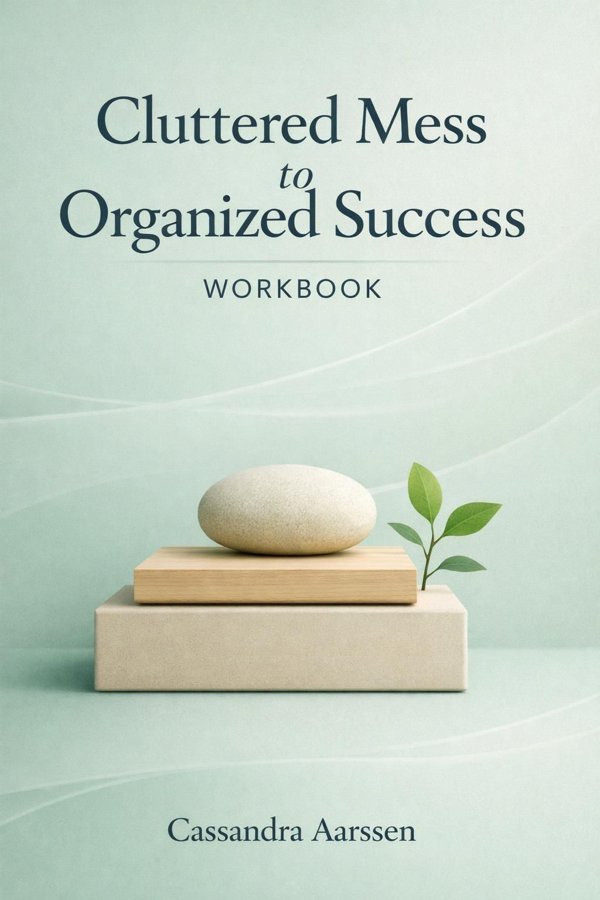
Cluttered Mess to Organized Success Workbook: Summary & Key Insights
 10 min9 chaptersAudio available
Key Takeaways from Cluttered Mess to Organized Success Workbook
A cluttered space is often a visible map of invisible stress.
Many organizing systems fail for a simple reason: they were built for someone else’s brain.
People rarely fail at decluttering because they lack good intentions; they fail because their goals are too vague, too big, or too emotionally loaded.
Trying to make every decision at once is one of the fastest ways to burn out.
An organizing system is successful only if it survives real life.
What Is Cluttered Mess to Organized Success Workbook About?
Cluttered Mess to Organized Success Workbook by Cassandra Aarssen is a productivity book spanning 5 pages. Clutter rarely begins as a housekeeping problem. More often, it starts as delayed decisions, overloaded schedules, emotional attachment, or the simple mismatch between how a person naturally functions and how they think they are “supposed” to organize. In Cluttered Mess to Organized Success Workbook, Cassandra Aarssen turns organization into a practical, compassionate, and highly personalized process. Rather than offering rigid rules or picture-perfect standards, she gives readers exercises, prompts, and step-by-step tools to help them identify what is not working, understand why it is happening, and build systems they can actually maintain. What makes this workbook especially valuable is its focus on sustainable change. Aarssen, best known for her ClutterBug philosophy, argues that organization succeeds only when it fits your personality, habits, and real-life constraints. That insight shifts decluttering from a frustrating cycle of cleaning up to a more lasting transformation in how you manage space, time, and energy. For anyone overwhelmed by mess, ashamed of unfinished organizing projects, or exhausted by methods that never stick, this workbook offers a practical roadmap from chaos to calm, with empathy at its core and action on every page.
This FizzRead summary covers all 9 key chapters of Cluttered Mess to Organized Success Workbook in approximately 10 minutes, distilling the most important ideas, arguments, and takeaways from Cassandra Aarssen's work. Also available as an audio summary and Key Quotes Podcast.
Cluttered Mess to Organized Success Workbook
Clutter rarely begins as a housekeeping problem. More often, it starts as delayed decisions, overloaded schedules, emotional attachment, or the simple mismatch between how a person naturally functions and how they think they are “supposed” to organize. In Cluttered Mess to Organized Success Workbook, Cassandra Aarssen turns organization into a practical, compassionate, and highly personalized process. Rather than offering rigid rules or picture-perfect standards, she gives readers exercises, prompts, and step-by-step tools to help them identify what is not working, understand why it is happening, and build systems they can actually maintain.
What makes this workbook especially valuable is its focus on sustainable change. Aarssen, best known for her ClutterBug philosophy, argues that organization succeeds only when it fits your personality, habits, and real-life constraints. That insight shifts decluttering from a frustrating cycle of cleaning up to a more lasting transformation in how you manage space, time, and energy. For anyone overwhelmed by mess, ashamed of unfinished organizing projects, or exhausted by methods that never stick, this workbook offers a practical roadmap from chaos to calm, with empathy at its core and action on every page.
Who Should Read Cluttered Mess to Organized Success Workbook?
This book is perfect for anyone interested in productivity and looking to gain actionable insights in a short read. Whether you're a student, professional, or lifelong learner, the key ideas from Cluttered Mess to Organized Success Workbook by Cassandra Aarssen will help you think differently.
- ✓Readers who enjoy productivity and want practical takeaways
- ✓Professionals looking to apply new ideas to their work and life
- ✓Anyone who wants the core insights of Cluttered Mess to Organized Success Workbook in just 10 minutes
Want the full summary?
Get instant access to this book summary and 100K+ more with Fizz Moment.
Get Free SummaryAvailable on App Store • Free to download
Key Chapters
A cluttered space is often a visible map of invisible stress. One of the workbook’s most powerful ideas is that clutter is not merely a collection of misplaced objects; it is a form of communication. It reveals postponed choices, competing priorities, unprocessed emotions, and habits that no longer serve you. A pile of unopened mail may signal financial anxiety or decision fatigue. An overflowing closet may reflect attachment to past identities, aspirational purchases, or guilt about money spent. A counter covered in random items can show that your home lacks clear landing zones for everyday life.
Aarssen encourages readers to stop asking, “Why am I so messy?” and start asking better questions: What is this pile trying to tell me? Where does this breakdown begin? What behavior keeps recreating this mess? This shift matters because shame tends to paralyze, while curiosity creates movement. Instead of treating clutter as evidence of failure, the workbook reframes it as feedback. If a room repeatedly becomes chaotic, the problem may not be laziness. It may be that the storage is too complicated, the categories are unclear, or the space is trying to do too many jobs at once.
This perspective also helps readers avoid surface-level fixes. Tidying a desk without addressing paper flow, incoming tasks, or the fear of throwing away “important” documents will only recreate the problem. Aarssen’s method invites readers to identify the meaning behind recurring mess, then design practical solutions that address root causes rather than symptoms.
Actionable takeaway: Choose one clutter hotspot in your home and write down what it might be communicating. Then identify one root cause behind the mess and one system change that could prevent it from returning.
Many organizing systems fail for a simple reason: they were built for someone else’s brain. Aarssen’s signature contribution is the ClutterBug philosophy, which teaches that people organize differently based on how they naturally prefer to see and sort their belongings. Instead of chasing a universal ideal of neatness, the workbook helps readers discover their organizing personality and use it as the foundation for successful systems.
Aarssen identifies four broad styles, each with distinct strengths and struggles. Some people prefer broad categories and visible storage, while others thrive with detailed categories and hidden storage. A person who likes open bins and simple labels may find drawer dividers exhausting. Someone who loves precision may feel stressed by wide, unspecific categories. Problems begin when people adopt systems that conflict with their natural tendencies. For example, a visual person may repeatedly abandon closed cabinets because “out of sight” becomes “out of mind.” A micro-organizer may become irritated by baskets labeled too generally because they crave finer distinctions.
This framework removes moral judgment from organization. It tells readers they are not broken if they dislike filing, folding, or elaborate storage routines. The goal is not to become a different kind of person but to create spaces that support how you already function. That insight alone can save enormous time, money, and frustration. It also makes maintenance easier, because systems based on natural behavior require less willpower.
The workbook uses reflection and exercises to help readers identify these patterns and apply them room by room. A family can also use this understanding to reduce conflict by recognizing that one person’s “organized” may feel impossible to another.
Actionable takeaway: Identify whether you prefer visible or hidden storage, and broad or detailed categories. Then adjust one storage area so it better matches your natural style instead of an idealized system.
People rarely fail at decluttering because they lack good intentions; they fail because their goals are too vague, too big, or too emotionally loaded. Aarssen emphasizes that successful organizing begins with realistic, clearly defined goals that turn overwhelm into momentum. “Get organized” is not a workable plan. “Clear the kitchen counter and create a home for daily mail” is. The workbook repeatedly pushes readers to break large ambitions into concrete actions that can be completed, measured, and repeated.
This approach matters because clutter creates mental fog. When every room feels urgent, it becomes difficult to start anywhere. Aarssen counters this by encouraging readers to prioritize high-impact areas, define what success looks like, and work in manageable stages. Instead of trying to declutter an entire house in a weekend, readers learn to identify spaces that produce the most daily friction: the entryway where shoes pile up, the bedroom chair covered in laundry, the pantry where expired food hides, or the office desk that drains attention.
The workbook also helps readers distinguish between fantasy goals and functional goals. A fantasy goal might be creating a perfectly styled craft room seen on social media. A functional goal might be making it easy to find scissors, tape, and paper within two minutes. Aarssen’s method favors usefulness over perfection, because usable systems endure. She also underscores the motivational power of small wins. Completing a drawer, shelf, or corner builds confidence and creates visible evidence that change is possible.
By anchoring decluttering in specific objectives, readers stop spinning in circles and start building traction. Goals become not just motivational statements, but design criteria for what stays, what goes, and what systems are needed.
Actionable takeaway: Write one organizing goal for this week using a specific space, a specific outcome, and a specific time frame. Make it small enough to finish and visible enough to feel rewarding.
Trying to make every decision at once is one of the fastest ways to burn out. Aarssen presents decluttering as a layered process rather than a single dramatic event. This is a crucial idea, because many people assume they must sort every object, solve every storage problem, and emotionally detach from every sentimental item in one exhausting push. The workbook offers a gentler and more effective model: make progress in passes.
The first layer is often obvious trash and easy removals. Broken items, expired products, duplicates you never use, packaging, and things that clearly belong elsewhere can be handled quickly. This creates breathing room and visible progress. The second layer involves practical decisions about usefulness. What do you actually use? What supports your current life? What creates unnecessary friction? The deeper layers address harder emotional categories: aspirational belongings, inherited items, gifts, identity-based possessions, and “just in case” clutter.
This layered method reduces decision fatigue and allows confidence to build over time. Someone decluttering a closet, for instance, may first remove damaged clothing and obvious non-favorites. Later, they can evaluate items tied to a former job, old size, or idealized future self. In a kitchen, the first pass may eliminate expired spices and duplicate utensils. A later pass may challenge gadgets kept out of guilt because they were expensive.
Aarssen’s workbook structure supports this incremental process by helping readers revisit spaces with more clarity each time. As the home becomes easier to manage, it becomes easier to make higher-quality decisions. Layered decluttering acknowledges that emotional readiness grows with experience.
Actionable takeaway: Revisit one cluttered area using a two-pass method: first remove easy clutter, then return later for the more thoughtful decisions once the space feels calmer and less overwhelming.
An organizing system is successful only if it survives real life. Aarssen insists that function matters more than appearances, a message that cuts through the unrealistic standards many people absorb from social media and home makeover culture. Beautiful bins, matching labels, and styled shelves can be satisfying, but they are not the goal. The goal is to create systems that are easy to use, easy to maintain, and aligned with daily routines.
This idea pushes readers to organize around behavior rather than theory. If everyone drops keys and bags near the door, the solution may be a basket, hooks, and a tray by the entrance, not a strict rule that everything must be put away in another room. If laundry piles in the bedroom because sorting hampers are too far away, moving baskets closer may solve more than repeated reminders ever will. If children resist putting toys away, open bins with picture labels may work better than intricate categories requiring precision.
Aarssen also emphasizes reducing friction. The fewer steps a task requires, the more likely it is to happen consistently. Storing cleaning wipes where spills occur, putting donation bins in closets, or keeping office supplies near the place where bills are handled can transform messy patterns. A well-designed system feels intuitive, not aspirational. It supports the user at their busiest and most distracted, not only on their best day.
This functional lens also protects against over-organizing. Systems can become so detailed that they collapse under normal use. Aarssen teaches readers to ask whether a method is realistic for the household, not whether it looks impressive.
Actionable takeaway: Look at one recurring mess and ask, “Is my system too hard?” Then remove one step, simplify one category, or move storage closer to the point of use.
Decluttering creates space, but routines keep that space from filling up again. Aarssen makes a vital distinction between one-time organizing efforts and the ongoing habits that sustain order. Without maintenance routines, even the best system will eventually collapse under the pressure of everyday life. The workbook therefore treats organizing not as a final destination, but as a set of repeatable behaviors that protect the progress you make.
These routines do not need to be long or rigid to be effective. In fact, Aarssen favors simple, low-resistance practices that fit naturally into existing rhythms. A five-minute evening reset can prevent the kitchen and living room from spiraling. A weekly paper review can stop documents from multiplying on counters. A regular donation habit can keep closets and toy areas from becoming overstuffed. A shopping list that includes checking what you already have can reduce duplicate purchases before they enter the home.
What makes this idea especially useful is that it reframes maintenance as an act of self-support rather than punishment. Many people treat cleaning and tidying as reactions to failure: they wait until things are bad, then feel overwhelmed and ashamed. Aarssen encourages proactive routines that are small enough to feel doable and consistent enough to reduce chaos. The goal is not to live in constant maintenance mode, but to develop rhythms that stop disorder from becoming unmanageable.
Routines also create predictability for households. When everyone knows that backpacks go to one station after school, laundry is folded on a certain day, or the fridge gets checked before grocery shopping, fewer items drift into random, stressful places.
Actionable takeaway: Choose one five- to ten-minute reset routine for a clutter-prone area and attach it to an existing habit, such as after dinner, before bed, or before leaving the house.
The hardest clutter is rarely the heaviest; it is the most emotionally charged. Aarssen recognizes that decluttering often brings readers face to face with guilt, grief, nostalgia, fear, and identity. This is why purely practical advice is often not enough. A person may know they do not need six boxes of inherited china, a closet full of unworn clothes, or stacks of children’s artwork, yet still feel unable to let go. The workbook addresses these emotional barriers directly rather than pretending they are irrational or unimportant.
One common barrier is guilt. People keep gifts they dislike because throwing them away feels disrespectful. They hold onto expensive purchases because letting go feels like admitting a mistake. Another barrier is identity. Belongings can represent who we once were or who we hope to become: the runner, the artist, the gourmet cook, the perfectly tidy parent. Letting go of these items can feel like losing possibility. Fear also plays a role, especially in “just in case” clutter. People worry they may need the item someday, regret the decision, or be wasteful if they release it now.
Aarssen’s strength is that she does not shame these feelings. Instead, she helps readers separate the memory from the object, the money spent from the present usefulness, and the person’s worth from the state of their home. This creates emotional permission to make clearer choices. Sentimental items can be honored selectively rather than stored endlessly. Mistakes can be learned from rather than memorialized in closets and basements.
By naming the emotional side of decluttering, the workbook gives readers language for what has often felt like private failure. It turns letting go into a thoughtful process of alignment with current values and current life.
Actionable takeaway: When you hesitate to release an item, name the emotion attached to it. Then ask whether keeping the object truly serves that emotion or simply stores it.
A home can become cluttered by one person’s habits, but lasting order usually requires shared understanding. Aarssen highlights the importance of involving the whole household in organizing decisions, especially when clutter is created collectively. This is not just about getting help with chores. It is about building systems that match the people who use them and reducing the resentment that develops when one person becomes the full-time manager of everyone else’s belongings.
The workbook encourages realistic collaboration rather than perfectionistic control. Children need systems scaled to their abilities: lower hooks, toy bins with simple labels, fewer categories, and routines they can remember. Partners may need different solutions based on their organizing styles. One person may happily put tools into detailed drawers, while another is more likely to use a clearly labeled catch-all bin. Instead of fighting over whose method is correct, Aarssen suggests designing spaces around shared function. If an area is used by multiple people, it should be understandable to all of them.
This idea also addresses emotional dynamics. Clutter often carries blame in families. One person may feel judged as messy; another may feel unsupported and exhausted. Aarssen’s approach reduces this tension by shifting attention from character flaws to system design. If backpacks always land on the floor, perhaps the entryway lacks an easy solution. If paperwork accumulates in several rooms, perhaps no one knows where it belongs or who is responsible for it.
The most effective systems are not those one person can maintain heroically, but those ordinary household members can follow with minimal effort. Shared buy-in makes maintenance more realistic and more fair.
Actionable takeaway: Pick one shared clutter zone and involve everyone who uses it in creating a simpler, more obvious system that each person can realistically follow.
Organization is not just about managing belongings; it is also about rebuilding trust in yourself. Aarssen repeatedly reinforces the idea that consistency matters more than intensity. Many readers come to the workbook after years of false starts, failed systems, and promises to “finally get everything together.” As a result, they often carry discouragement into the process. One of the workbook’s quiet but important contributions is the way it helps restore confidence through small, repeatable wins.
This matters because overwhelm often creates an all-or-nothing mindset. People believe they must declutter an entire room to count as successful, maintain every space perfectly to be “organized,” or complete a major overhaul before life gets busy again. Aarssen challenges this thinking. A cleared countertop, a donation bag filled, a junk drawer simplified, or a functioning laundry station are meaningful victories. They prove that change is possible and that order does not require a total personality transformation.
Small wins also improve decision-making. As readers see successful results, they become more willing to let go of low-value items, simplify systems, and trust practical solutions. Momentum develops not from dramatic motivation but from evidence. The workbook’s exercise-based format supports this by turning organizing into a series of manageable actions instead of one overwhelming project.
There is also a psychological benefit to visible progress. A functional shelf or tidy entryway can reduce stress, create relief, and inspire action in adjacent spaces. Success becomes contagious. Rather than being crushed by the size of the problem, readers start to identify as people who can make order happen.
Actionable takeaway: End each organizing session by naming one concrete win, however small. Record it somewhere visible so your progress becomes evidence that motivates your next step.
All Chapters in Cluttered Mess to Organized Success Workbook
About the Author
Cassandra Aarssen is a Canadian organizing expert, author, and the creator of the widely known ClutterBug philosophy. She built her reputation by challenging the one-size-fits-all approach to home organization and showing that people have different natural preferences for sorting and storing their belongings. Through her books, videos, and teaching, she has helped a large audience understand that clutter is often tied to behavior, emotion, and lifestyle rather than simple laziness. Aarssen is especially valued for her practical, compassionate style, which combines hands-on strategies with an understanding of the emotional side of letting go. Her work focuses on helping people create organizing systems that fit their personalities, reduce daily stress, and lead to more sustainable order at home.
Get This Summary in Your Preferred Format
Read or listen to the Cluttered Mess to Organized Success Workbook summary by Cassandra Aarssen anytime, anywhere. FizzRead offers multiple formats so you can learn on your terms — all free.
Available formats: App · Audio · PDF · EPUB — All included free with FizzRead
Download Cluttered Mess to Organized Success Workbook PDF and EPUB Summary
Key Quotes from Cluttered Mess to Organized Success Workbook
“A cluttered space is often a visible map of invisible stress.”
“Many organizing systems fail for a simple reason: they were built for someone else’s brain.”
“People rarely fail at decluttering because they lack good intentions; they fail because their goals are too vague, too big, or too emotionally loaded.”
“Trying to make every decision at once is one of the fastest ways to burn out.”
“An organizing system is successful only if it survives real life.”
Frequently Asked Questions about Cluttered Mess to Organized Success Workbook
Cluttered Mess to Organized Success Workbook by Cassandra Aarssen is a productivity book that explores key ideas across 9 chapters. Clutter rarely begins as a housekeeping problem. More often, it starts as delayed decisions, overloaded schedules, emotional attachment, or the simple mismatch between how a person naturally functions and how they think they are “supposed” to organize. In Cluttered Mess to Organized Success Workbook, Cassandra Aarssen turns organization into a practical, compassionate, and highly personalized process. Rather than offering rigid rules or picture-perfect standards, she gives readers exercises, prompts, and step-by-step tools to help them identify what is not working, understand why it is happening, and build systems they can actually maintain. What makes this workbook especially valuable is its focus on sustainable change. Aarssen, best known for her ClutterBug philosophy, argues that organization succeeds only when it fits your personality, habits, and real-life constraints. That insight shifts decluttering from a frustrating cycle of cleaning up to a more lasting transformation in how you manage space, time, and energy. For anyone overwhelmed by mess, ashamed of unfinished organizing projects, or exhausted by methods that never stick, this workbook offers a practical roadmap from chaos to calm, with empathy at its core and action on every page.
More by Cassandra Aarssen
You Might Also Like

Browse by Category
Ready to read Cluttered Mess to Organized Success Workbook?
Get the full summary and 100K+ more books with Fizz Moment.