
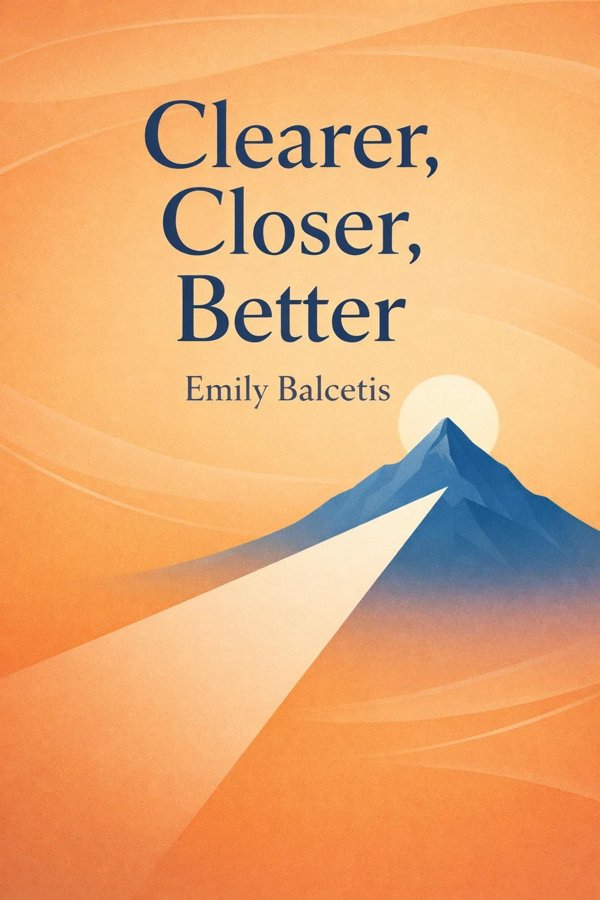
Clearer, Closer, Better: How Successful People See the World: Summary & Key Insights
 10 min11 chaptersAudio available
What Is Clearer, Closer, Better: How Successful People See the World About?
Clearer, Closer, Better: How Successful People See the World by Emily Balcetis is a psychology book spanning 11 pages. A mind-expanding exploration of how perception shapes success, written by social psychologist Emily Balcetis. The book explains how the ways we literally see the world influence our motivation, decision-making, and ability to achieve goals. Drawing on cutting-edge research in visual perception and behavioral science, Balcetis shows how to close the gap between what we see and what we want, offering practical strategies to improve focus, persistence, and performance.
This FizzRead summary covers all 11 key chapters of Clearer, Closer, Better: How Successful People See the World in approximately 10 minutes, distilling the most important ideas, arguments, and takeaways from Emily Balcetis's work. Also available as an audio summary and Key Quotes Podcast.
Clearer, Closer, Better: How Successful People See the World
A mind-expanding exploration of how perception shapes success, written by social psychologist Emily Balcetis. The book explains how the ways we literally see the world influence our motivation, decision-making, and ability to achieve goals. Drawing on cutting-edge research in visual perception and behavioral science, Balcetis shows how to close the gap between what we see and what we want, offering practical strategies to improve focus, persistence, and performance.
Who Should Read Clearer, Closer, Better: How Successful People See the World?
This book is perfect for anyone interested in psychology and looking to gain actionable insights in a short read. Whether you're a student, professional, or lifelong learner, the key ideas from Clearer, Closer, Better: How Successful People See the World by Emily Balcetis will help you think differently.
- ✓Readers who enjoy psychology and want practical takeaways
- ✓Professionals looking to apply new ideas to their work and life
- ✓Anyone who wants the core insights of Clearer, Closer, Better: How Successful People See the World in just 10 minutes
Want the full summary?
Get instant access to this book summary and 100K+ more with Fizz Moment.
Get Free SummaryAvailable on App Store • Free to download
Key Chapters
Our perception begins with physical sight, but it hardly ends there. Vision isn’t a simple projection onto the retina—it’s a selective, interpretive process shaped by our goals, beliefs, and emotions. Decades of psychological and neuroscientific research show that what we attend to visually determines what we experience and, consequently, how we act.
In my laboratory, we examined how perception interacts with motivation. Participants asked to estimate distances or sizes while under different motivational conditions consistently saw what aligned with their goals: distances appeared shorter when they desired the target outcome, challenges looked smaller when they felt confident. This merging of perception and cognition proves that vision is not objective—it is goal-driven.
Seeing, in this sense, becomes a psychological filter. Successful individuals often possess trained perception—they focus on cues that confirm possibility and reduce attention to obstacles. They cultivate what I call ‘motivational vision,’ the capacity to direct sight toward opportunity. The science of seeing reveals that by understanding how our eyes and brain collaborate, we can learn to perceive in ways that support persistence and reduce self-sabotage.
Every day, we interpret the world through filters. Biases function as those invisible lenses, distorting how we judge possibility. People motivated by fear see risks looming larger; people burdened by self-doubt perceive goals as farther away. These distortions are not flaws of character—they are predictable outcomes of how our perceptual systems process information.
I describe an experiment where people were asked to throw a ball at a target. Those who believed in their ability to succeed perceived the target as larger and closer than those who were doubtful. The implication is profound: the way we see changes with belief. Bias, in this context, is both a limitation and an opportunity. Once we recognize that our sight is colored by expectation, we can begin to recalibrate it.
Throughout this chapter, I show how perceptual biases can either discourage or empower us. Success hinges on perceiving manageable challenges instead of insurmountable obstacles. It is not about denying reality; it’s about seeing reality with accuracy that supports forward motion. When your brain interprets the world through a lens of potential instead of defeat, your eyes follow suit.
+ 9 more chapters — available in the FizzRead app
All Chapters in Clearer, Closer, Better: How Successful People See the World
About the Author
Emily Balcetis is an associate professor of psychology at New York University. Her research focuses on visual perception, motivation, and goal pursuit. She has published widely in academic journals and is known for her engaging public talks on how perception influences behavior and success.
Get This Summary in Your Preferred Format
Read or listen to the Clearer, Closer, Better: How Successful People See the World summary by Emily Balcetis anytime, anywhere. FizzRead offers multiple formats so you can learn on your terms — all free.
Available formats: App · Audio · PDF · EPUB — All included free with FizzRead
Download Clearer, Closer, Better: How Successful People See the World PDF and EPUB Summary
Key Quotes from Clearer, Closer, Better: How Successful People See the World
“Our perception begins with physical sight, but it hardly ends there.”
“Every day, we interpret the world through filters.”
Frequently Asked Questions about Clearer, Closer, Better: How Successful People See the World
Clearer, Closer, Better: How Successful People See the World by Emily Balcetis is a psychology book that explores key ideas across 11 chapters. A mind-expanding exploration of how perception shapes success, written by social psychologist Emily Balcetis. The book explains how the ways we literally see the world influence our motivation, decision-making, and ability to achieve goals. Drawing on cutting-edge research in visual perception and behavioral science, Balcetis shows how to close the gap between what we see and what we want, offering practical strategies to improve focus, persistence, and performance.
You Might Also Like
The Body Keeps the Score
Bessel van der Kolk
10 min
Surrounded by Idiots
Thomas Erikson
10 min
Emotional Intelligence
Daniel Goleman
10 min
Attached
Amir Levine
10 min
Why Does He Do That
Lundy Bancroft
10 min
Women Who Run with the Wolves
Clarissa Pinkola Estés
10 minBrowse by Category
Ready to read Clearer, Closer, Better: How Successful People See the World?
Get the full summary and 100K+ more books with Fizz Moment.