
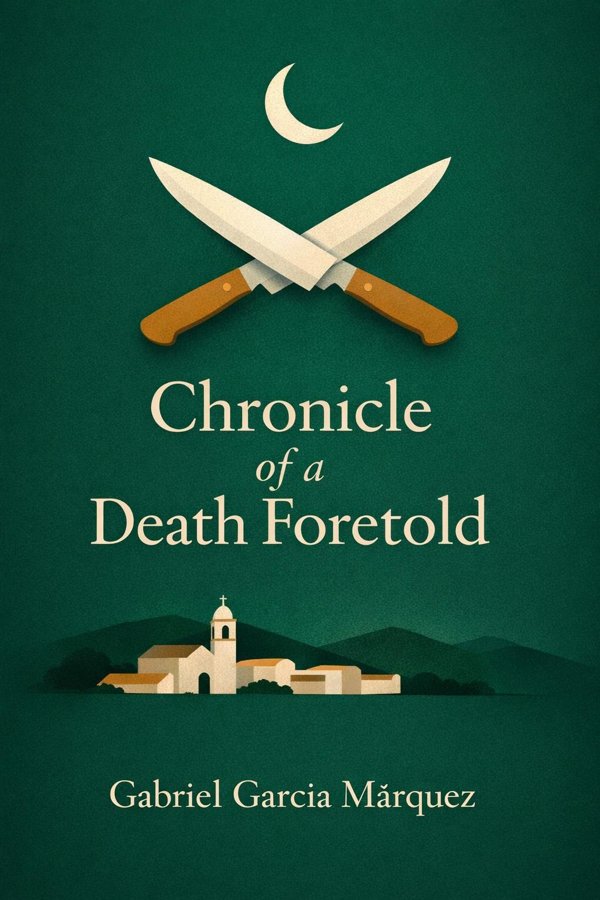
Chronicle of a Death Foretold: Summary & Key Insights
 10 min9 chaptersAudio available
Key Takeaways from Chronicle of a Death Foretold
The novel begins with a paradox: everyone knows how the story ends, yet no one can fully explain how it happened.
One of the novel’s most unsettling achievements is its transformation of an ordinary morning into a ritual of doom.
At the center of the novel lies Angela Vicario’s disastrous marriage to Bayardo San Román, a union built more on social display than emotional truth.
Pedro and Pablo Vicario are not portrayed as monsters in the conventional sense.
The novel’s central horror is not secrecy but publicity.
What Is Chronicle of a Death Foretold About?
Chronicle of a Death Foretold by Gabriel García Márquez is a classics book spanning 8 pages. Chronicle of a Death Foretold is a haunting, brilliantly compressed novel in which Gabriel García Márquez turns a simple murder plot into a profound inquiry into truth, guilt, and fate. Set in a small Caribbean town in Colombia, the story reconstructs the killing of Santiago Nasar, a young man publicly marked for death after Angela Vicario is returned to her family on her wedding night and names him as the man responsible for her dishonor. What makes the novel unforgettable is not suspense about who committed the crime—the killers announce their intentions openly—but the deeper mystery of how an entire community allows the murder to happen. Through fractured memories, contradictory testimonies, and journalistic precision, García Márquez shows how private shame becomes public violence and how collective passivity can be as devastating as direct action. Published in 1981, the book reflects the author’s extraordinary gifts as both novelist and reporter. A Nobel Prize-winning master of Latin American literature, García Márquez combines realism, irony, and mythic intensity to create a work that feels at once like an investigation, a tragedy, and an accusation aimed at society itself.
This FizzRead summary covers all 9 key chapters of Chronicle of a Death Foretold in approximately 10 minutes, distilling the most important ideas, arguments, and takeaways from Gabriel García Márquez's work. Also available as an audio summary and Key Quotes Podcast.
Chronicle of a Death Foretold
Chronicle of a Death Foretold is a haunting, brilliantly compressed novel in which Gabriel García Márquez turns a simple murder plot into a profound inquiry into truth, guilt, and fate. Set in a small Caribbean town in Colombia, the story reconstructs the killing of Santiago Nasar, a young man publicly marked for death after Angela Vicario is returned to her family on her wedding night and names him as the man responsible for her dishonor. What makes the novel unforgettable is not suspense about who committed the crime—the killers announce their intentions openly—but the deeper mystery of how an entire community allows the murder to happen. Through fractured memories, contradictory testimonies, and journalistic precision, García Márquez shows how private shame becomes public violence and how collective passivity can be as devastating as direct action. Published in 1981, the book reflects the author’s extraordinary gifts as both novelist and reporter. A Nobel Prize-winning master of Latin American literature, García Márquez combines realism, irony, and mythic intensity to create a work that feels at once like an investigation, a tragedy, and an accusation aimed at society itself.
Who Should Read Chronicle of a Death Foretold?
This book is perfect for anyone interested in classics and looking to gain actionable insights in a short read. Whether you're a student, professional, or lifelong learner, the key ideas from Chronicle of a Death Foretold by Gabriel García Márquez will help you think differently.
- ✓Readers who enjoy classics and want practical takeaways
- ✓Professionals looking to apply new ideas to their work and life
- ✓Anyone who wants the core insights of Chronicle of a Death Foretold in just 10 minutes
Want the full summary?
Get instant access to this book summary and 100K+ more with Fizz Moment.
Get Free SummaryAvailable on App Store • Free to download
Key Chapters
The novel begins with a paradox: everyone knows how the story ends, yet no one can fully explain how it happened. Decades after Santiago Nasar’s death, the narrator returns to the town to piece together the events of that fatal morning. What he finds is not a clean chain of facts but a landscape of damaged memory, conflicting testimony, and emotional residue. In this sense, the book is less a murder mystery than a study of how people remember tragedy.
García Márquez structures the novel like an investigation, but each witness offers only a shard of truth. Some remember details vividly; others confuse times, motives, or even basic actions. These inconsistencies are not flaws in the book’s design—they are the point. Human memory is selective, self-protective, and shaped by guilt. The town’s recollections reveal not only what happened but what each person can bear to admit.
This has practical relevance beyond literature. In real life, families, institutions, and communities often reconstruct painful events in similarly fragmented ways. After scandals, accidents, or personal conflicts, people tell stories that preserve their innocence, justify inaction, or soften responsibility. The result is often a version of truth that is emotionally believable but factually unstable.
The narrator’s return suggests that understanding the past requires patience with uncertainty. We rarely recover events exactly as they were; instead, we assemble patterns from imperfect evidence. Reading the novel teaches us to listen for omissions, contradictions, and silences as seriously as declarations.
Actionable takeaway: when trying to understand a past conflict, gather multiple perspectives and pay attention not only to what people say, but also to what they avoid saying.
One of the novel’s most unsettling achievements is its transformation of an ordinary morning into a ritual of doom. The day begins with domestic routines, festive expectations, and preparations for the bishop’s arrival. Santiago Nasar wakes, dresses, and moves through familiar spaces without realizing that his death has already become public knowledge. The contrast between routine and catastrophe gives the story its chilling power.
García Márquez shows how tragedy rarely announces itself with dramatic music. Instead, it often emerges amid normal life: breakfast conversations, street errands, polite greetings, and half-heard rumors. Santiago’s final morning is filled with signs, but none are sufficient on their own to stop the machinery moving against him. This creates a terrible irony: readers see the danger everywhere, while the victim remains exposed inside the logic of everyday life.
The morning also reveals how communities normalize alarming information. People hear that the Vicario brothers intend to kill Santiago, but many assume someone else will intervene, or that the threat is not serious, or that the matter belongs to another household. These small assumptions allow violence to proceed unnoticed inside the familiar rhythms of town life.
There is a broader lesson here about risk and complacency. In workplaces, families, and neighborhoods, major failures often begin as signals buried in routine. A health crisis starts with symptoms dismissed as temporary. An ethical breach appears first as gossip. A dangerous conflict survives because everyone expects another person to take responsibility.
Actionable takeaway: do not let routine disguise urgency—when a warning appears, verify it quickly and act before ordinary momentum turns preventable harm into irreversible loss.
At the center of the novel lies Angela Vicario’s disastrous marriage to Bayardo San Román, a union built more on social display than emotional truth. Bayardo arrives as a figure of wealth, confidence, and almost theatrical power. He chooses Angela and pursues her with determined extravagance. Yet beneath the spectacle lies fragility: Angela does not truly love him, and the marriage is burdened by a social code that values appearances above inner reality.
When Bayardo returns Angela to her family on their wedding night because she is not a virgin, the event shatters not only a marriage but the town’s moral facade. Angela’s body becomes the site on which family honor, masculinity, and public reputation are judged. Instead of asking humane questions about coercion, desire, fear, or personal dignity, the community responds through the language of shame and restitution. Angela is beaten by her mother, and the focus turns immediately to identifying a guilty man.
García Márquez exposes the cruelty of cultures that reduce women to symbols. Angela’s experience shows how social systems can transform intimacy into surveillance and marriage into a test of worth. Her later development—especially her mature, persistent love for Bayardo—adds complexity, suggesting that people can evolve beyond the roles assigned to them, even if institutions remain harsh.
Modern readers can see echoes of this dynamic wherever reputation matters more than truth: in families obsessed with appearances, in communities governed by gossip, or in relationships shaped by external expectations rather than honest communication.
Actionable takeaway: question any moral system that values public image over human dignity, and choose honesty and compassion over inherited codes of shame.
Pedro and Pablo Vicario are not portrayed as monsters in the conventional sense. They are butchers by trade, ordinary men shaped by a culture that tells them they must avenge their sister’s dishonor. Their violence is horrifying, but García Márquez complicates it by showing how deeply they are trapped inside a script they did not write. They repeatedly announce their plan, display the knives, and almost seem to hope that someone will stop them.
This is one of the novel’s most disturbing insights: people can commit terrible acts not from personal hatred but from obedience to social expectation. The brothers act because masculinity, family duty, and public opinion leave them few acceptable alternatives. They are both perpetrators and prisoners of the code they enact. Their hesitation matters. It suggests that what looks like determination may actually be submission to custom.
This dynamic has many real-world parallels. Harmful actions in institutions, militaries, workplaces, and families are often carried out by people who believe they are merely fulfilling roles. "I had no choice" is one of history’s most dangerous sentences. García Márquez reveals how collective norms can weaken individual moral judgment until violence feels like responsibility.
The brothers’ behavior also raises a question for readers: what social rules do we continue to obey even when we know they are destructive? Expectations around gender, loyalty, silence, and revenge still shape behavior today, though often in less dramatic forms.
Actionable takeaway: when a role or tradition demands harm, pause and ask whether you are acting from conscience or merely performing a script handed to you by others.
The novel’s central horror is not secrecy but publicity. The Vicario brothers openly tell people that they plan to kill Santiago Nasar. Their intention circulates through the town in conversations, warnings, assumptions, and half-effective interventions. Yet the murder still occurs. This failure is not caused by a single villainous omission; it is produced by a chain of confusion, delay, disbelief, and diffusion of responsibility.
Some characters think the threat is drunken exaggeration. Others believe the authorities have already handled it. Some pass on warnings too late or to the wrong person. A note slips under a door and goes unread. Doors are opened and closed at the wrong moments. Information exists, but action does not align with it. García Márquez turns miscommunication into a moral force.
This mechanism remains painfully relevant. Psychologists call it the bystander effect: the more people know about a problem, the easier it becomes for each individual to assume someone else will act. In organizations, this can allow harassment, corruption, or safety risks to continue in plain sight. In personal life, friends may recognize abuse or distress but hesitate to intervene because the situation feels socially complicated.
The novel also shows that warnings are useless if they are vague, indirect, or unverified. Good intentions without clear action become part of the problem. Saying "someone should do something" is often how responsibility evaporates.
Actionable takeaway: if you encounter a serious threat, do not rely on rumor or assume others will intervene—identify the responsible person, communicate directly, and confirm that action has actually been taken.
A murder can be brutal in body, but in this novel it is also brutal in knowledge. Santiago Nasar’s final moments are marked by confusion: he does not fully understand why he is being hunted, and the readers themselves are never given certainty about his guilt or innocence. Angela names him as the man responsible for her dishonor, but the text never settles the question conclusively. This ambiguity is essential to the book’s power.
Because certainty is withheld, the murder becomes larger than a private act of revenge. It becomes a commentary on judgment itself. A man is killed in public under the authority of a social code, yet the foundation of the accusation remains unstable. García Márquez forces readers to confront how often societies punish first and investigate later, especially when honor, reputation, and emotion are involved.
Santiago’s final walk, his injuries, and his almost impossible physical persistence after the stabbing are narrated with unforgettable force. The body continues moving even after social death has already been pronounced. The effect is grotesque and tragic: the victim seems to inhabit the gap between what the town believes and what can actually be known.
In contemporary terms, this resonates with trial-by-rumor, reputational destruction, and the speed with which communities form conclusions before evidence is tested. The novel reminds us that accusation carries enormous power, especially in tightly bonded social worlds.
Actionable takeaway: resist the impulse to equate allegation with certainty; in conflicts involving blame, insist on evidence, fairness, and the humility to admit what remains unknown.
Chronicle of a Death Foretold often feels like a story governed by destiny. From the opening line, readers know Santiago Nasar will die. Omens, dreams, and retrospective narration deepen the atmosphere of inevitability. Yet García Márquez does not present fate as a supernatural force that erases agency. Instead, fate in this novel is built through human choices, missed chances, and social habits repeated until they feel unavoidable.
This is what makes the tragedy so unsettling. The death seems destined precisely because it is so preventable. If one message had arrived, if one door had remained open, if one authority had acted firmly, if one witness had insisted harder, the ending might have changed. The sense of inevitability emerges only after the fact, when people reassemble events and impose pattern on them. Fate, then, is partly hindsight’s illusion.
At the same time, García Márquez respects the emotional reality of fatalism. In rigid cultures, inherited norms can feel stronger than individual will. People tell themselves "it had to happen" because admitting contingency would force them to acknowledge responsibility. Fatalism becomes a defense against guilt.
This has enduring relevance. People often describe failed relationships, career collapses, or social disasters as inevitable when they were actually the result of tolerated warning signs and avoided decisions. Naming something as fate can conceal the small choices that created it.
Actionable takeaway: when a bad outcome seems inevitable, look closely at the chain of decisions behind it—recognizing contingency is the first step toward changing future outcomes.
One reason the novel feels so distinctive is its fusion of investigative reporting with lyrical storytelling. García Márquez draws on the discipline of journalism—dates, witnesses, contradictions, documentary detail—while also infusing the narrative with symbolic patterns, irony, ritual, and a dreamlike sense of recurrence. The result is a story that feels both factual and mythic.
This blend matters because the book is not interested in mere data. Facts alone cannot explain why an entire town participated in a preventable tragedy. By using a chronicle structure, García Márquez gives the event historical weight; by shaping it like a legend, he reveals its archetypal force. The murder becomes not only a local incident but a timeless drama about honor, denial, and communal guilt.
The technique also reflects how humans process shocking events. We do not remember them as spreadsheets. We remember them as stories charged with images, symbols, and repeated phrases. Journalism records what happened; literature explores what it felt like and what it means. García Márquez proves that these modes are not enemies but allies.
For readers, this is a useful reminder about communication more broadly. Whether explaining a business failure, teaching history, or sharing personal experience, facts become more powerful when placed in meaningful narrative. Precision gives credibility; storytelling gives emotional truth.
Actionable takeaway: when trying to understand or explain a complex event, combine evidence with narrative structure—facts establish reality, but story helps people grasp significance.
All Chapters in Chronicle of a Death Foretold
About the Author
Gabriel García Márquez (1927–2014) was a Colombian novelist, journalist, short-story writer, and screenwriter widely regarded as one of the greatest authors of modern literature. Born in Aracataca, Colombia, he drew deeply on the history, politics, and storytelling traditions of Latin America. His work is often associated with magical realism, though it is equally marked by journalistic precision, irony, and emotional depth. García Márquez achieved worldwide acclaim with One Hundred Years of Solitude and later wrote major works including Love in the Time of Cholera, The Autumn of the Patriarch, and Chronicle of a Death Foretold. In 1982, he was awarded the Nobel Prize in Literature for fiction that fused the fantastic and the real in richly imagined worlds. His influence endures across global literature, journalism, and culture.
Get This Summary in Your Preferred Format
Read or listen to the Chronicle of a Death Foretold summary by Gabriel García Márquez anytime, anywhere. FizzRead offers multiple formats so you can learn on your terms — all free.
Available formats: App · Audio · PDF · EPUB — All included free with FizzRead
Download Chronicle of a Death Foretold PDF and EPUB Summary
Key Quotes from Chronicle of a Death Foretold
“The novel begins with a paradox: everyone knows how the story ends, yet no one can fully explain how it happened.”
“One of the novel’s most unsettling achievements is its transformation of an ordinary morning into a ritual of doom.”
“At the center of the novel lies Angela Vicario’s disastrous marriage to Bayardo San Román, a union built more on social display than emotional truth.”
“Pedro and Pablo Vicario are not portrayed as monsters in the conventional sense.”
“The novel’s central horror is not secrecy but publicity.”
Frequently Asked Questions about Chronicle of a Death Foretold
Chronicle of a Death Foretold by Gabriel García Márquez is a classics book that explores key ideas across 9 chapters. Chronicle of a Death Foretold is a haunting, brilliantly compressed novel in which Gabriel García Márquez turns a simple murder plot into a profound inquiry into truth, guilt, and fate. Set in a small Caribbean town in Colombia, the story reconstructs the killing of Santiago Nasar, a young man publicly marked for death after Angela Vicario is returned to her family on her wedding night and names him as the man responsible for her dishonor. What makes the novel unforgettable is not suspense about who committed the crime—the killers announce their intentions openly—but the deeper mystery of how an entire community allows the murder to happen. Through fractured memories, contradictory testimonies, and journalistic precision, García Márquez shows how private shame becomes public violence and how collective passivity can be as devastating as direct action. Published in 1981, the book reflects the author’s extraordinary gifts as both novelist and reporter. A Nobel Prize-winning master of Latin American literature, García Márquez combines realism, irony, and mythic intensity to create a work that feels at once like an investigation, a tragedy, and an accusation aimed at society itself.
More by Gabriel García Márquez

You Might Also Like



Browse by Category
Ready to read Chronicle of a Death Foretold?
Get the full summary and 100K+ more books with Fizz Moment.