
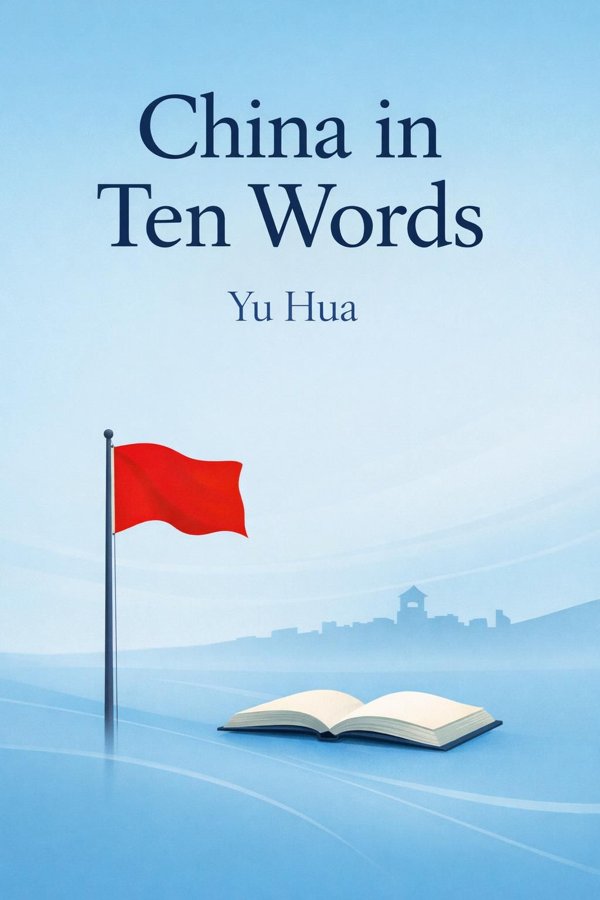
China in Ten Words: Summary & Key Insights
by Yu Hua
 10 min10 chaptersAudio available
Key Takeaways from China in Ten Words
A society is often best understood not by what its rulers proclaim, but by how ordinary people endure.
Power becomes most dangerous when it stops being questioned and starts being adored.
Books matter most where thought has been restricted.
When history is unstable, writing becomes an act of preservation.
Every society needs writers who refuse to flatter it.
What Is China in Ten Words About?
China in Ten Words by Yu Hua is a civilization book spanning 4 pages. What if a nation’s recent history could be understood not through timelines or slogans, but through the everyday words people use to survive, remember, and make sense of change? In China in Ten Words, acclaimed novelist and essayist Yu Hua does exactly that. He takes ten deceptively simple words—such as “People,” “Leader,” “Reading,” “Copycat,” and “Lies”—and uses them as windows into modern Chinese life. The result is not a dry political analysis, but a vivid, deeply personal portrait of a country that has moved from revolutionary collectivism to market-driven individualism in just a few decades. Yu Hua is uniquely qualified to tell this story. Having grown up during the Cultural Revolution and lived through China’s reform era, he writes with the dual vision of witness and artist. He combines childhood memories, historical reflection, social critique, and dark humor to reveal how ordinary people adapt to upheaval, inequality, propaganda, and ambition. This book matters because it humanizes modern China. It helps readers move beyond headlines and statistics to see the emotional, moral, and cultural forces shaping one of the world’s most influential societies.
This FizzRead summary covers all 10 key chapters of China in Ten Words in approximately 10 minutes, distilling the most important ideas, arguments, and takeaways from Yu Hua's work. Also available as an audio summary and Key Quotes Podcast.
China in Ten Words
What if a nation’s recent history could be understood not through timelines or slogans, but through the everyday words people use to survive, remember, and make sense of change? In China in Ten Words, acclaimed novelist and essayist Yu Hua does exactly that. He takes ten deceptively simple words—such as “People,” “Leader,” “Reading,” “Copycat,” and “Lies”—and uses them as windows into modern Chinese life. The result is not a dry political analysis, but a vivid, deeply personal portrait of a country that has moved from revolutionary collectivism to market-driven individualism in just a few decades.
Yu Hua is uniquely qualified to tell this story. Having grown up during the Cultural Revolution and lived through China’s reform era, he writes with the dual vision of witness and artist. He combines childhood memories, historical reflection, social critique, and dark humor to reveal how ordinary people adapt to upheaval, inequality, propaganda, and ambition. This book matters because it humanizes modern China. It helps readers move beyond headlines and statistics to see the emotional, moral, and cultural forces shaping one of the world’s most influential societies.
Who Should Read China in Ten Words?
This book is perfect for anyone interested in civilization and looking to gain actionable insights in a short read. Whether you're a student, professional, or lifelong learner, the key ideas from China in Ten Words by Yu Hua will help you think differently.
- ✓Readers who enjoy civilization and want practical takeaways
- ✓Professionals looking to apply new ideas to their work and life
- ✓Anyone who wants the core insights of China in Ten Words in just 10 minutes
Want the full summary?
Get instant access to this book summary and 100K+ more with Fizz Moment.
Get Free SummaryAvailable on App Store • Free to download
Key Chapters
A society is often best understood not by what its rulers proclaim, but by how ordinary people endure. In Yu Hua’s chapter on “People,” he reflects on the immense resilience of Chinese citizens across decades of political campaigns, poverty, social control, and economic transformation. His point is not sentimental. He does not idealize “the people” as inherently noble or revolutionary. Instead, he shows them as adaptable, practical, and often forced to survive systems they did not create.
Yu Hua grew up seeing the gap between official rhetoric and lived experience. Grand political language promised justice, equality, and collective purpose, yet daily life often meant scarcity, fear, and humiliation. Still, ordinary people found ways to continue: they traded favors, protected family members, adjusted their speech, and learned when to endure and when to bend the rules. This capacity for survival becomes one of the defining traits of modern Chinese society.
The insight matters beyond China. In any rapidly changing system, people develop informal strategies to navigate formal institutions. Workers under pressure, students in rigid schools, and citizens in bureaucratic states all learn the art of adaptation. Yu Hua reminds us that resilience can be admirable, but it can also come at a cost. When survival becomes the highest value, truth, trust, and public ethics may weaken.
A practical way to apply this idea is to look more carefully at the systems around you. Ask not only what policies or ideals claim to do, but how real people cope with them. Notice the hidden work of adjustment, compromise, and silence that keeps institutions functioning. Actionable takeaway: when judging a society—or your own workplace or community—start with the lived experience of ordinary people, because survival often reveals more than slogans.
Power becomes most dangerous when it stops being questioned and starts being adored. In the chapter on “Leader,” Yu Hua explores how political authority in modern China was often transformed into something emotional, theatrical, and sacred. A leader was not merely a government official; he became a symbolic father, a moral compass, and a figure around whom public devotion was organized.
Yu Hua recalls the culture of reverence that surrounded Mao Zedong during his childhood. Portraits, quotations, rituals of loyalty, and public performances of obedience turned politics into an almost religious experience. Children absorbed these norms before they were capable of critical judgment. This is one of Yu Hua’s most powerful observations: political systems do not rely only on coercion; they also shape imagination, language, and memory.
What makes this chapter especially important is that Yu Hua does not treat leader worship as a relic safely locked in the past. He suggests that even when overt cults of personality fade, habits of deference can remain. Institutions may modernize, economies may open, and consumer culture may flourish, yet a deep expectation of authority can persist in public life.
This idea has practical relevance in families, companies, and nations alike. Whenever one figure becomes too central, criticism grows risky and truth becomes distorted. Teams stop solving problems honestly because they begin managing the leader’s image instead. Citizens stop asking what works and start repeating what is acceptable.
A useful application is to examine where reverence has replaced accountability in your environment. Are decisions challenged openly? Are leaders evaluated by outcomes or protected by image? Actionable takeaway: respect authority when it earns trust, but never surrender your capacity to question it, because societies decline when admiration becomes obedience.
Books matter most where thought has been restricted. In “Reading,” Yu Hua describes how reading in China has carried meanings far beyond leisure or education. During periods of ideological control, access to books could be limited, politically filtered, or emotionally charged. To read was not simply to consume information; it was to search for alternative worlds, hidden truths, and a private inner life.
Yu Hua’s own memories show how reading became a form of hunger. In a society where official narratives dominated public speech, literature offered complexity, ambiguity, and human depth. Readers discovered voices unlike propaganda, and that discovery could be thrilling. But Yu Hua also recognizes a historical irony: as censorship eased and market reforms expanded, the scarcity of books gave way to abundance, and abundance sometimes weakened seriousness. Reading became more available, yet not always more valued.
His reflections suggest that reading culture depends not only on supply, but on social purpose. When books help people think independently, remember honestly, and imagine lives beyond material success, they are transformative. When they become mere status symbols or distractions, their deeper power fades.
This idea applies anywhere digital overload competes with sustained attention. Many people today have unprecedented access to information but less patience for reflective reading. Yu Hua’s essay reminds us that reading is not just about collecting facts. It is about building moral imagination and resisting intellectual passivity.
A practical example is to read one serious work not for speed, but for reflection: take notes, compare perspectives, and discuss it with others. In classrooms or workplaces, reading can be used to broaden understanding rather than reinforce consensus. Actionable takeaway: treat reading as a discipline of freedom—choose books that challenge your assumptions, not just those that confirm them.
When history is unstable, writing becomes an act of preservation. In “Writing,” Yu Hua considers what it means to write in a society where political language has often distorted reality. For him, writing is not simply artistic expression. It is a way to resist forgetting, recover nuance, and restore the texture of lives flattened by ideology or official narratives.
Yu Hua came of age in a world where words had enormous public power. Slogans could define loyalty, condemn enemies, and reshape social behavior. In such an environment, language itself became suspect. People learned to say one thing in public and another in private. Writing honestly, then, required more than talent; it required courage and precision. A writer had to find forms capable of expressing what could not be said directly.
This helps explain Yu Hua’s broader literary importance. Across his fiction and essays, he often captures violence, absurdity, and social change through vivid human stories rather than abstract doctrine. In China in Ten Words, he shows that writing can keep memory alive when institutions prefer simplification.
The lesson extends beyond literature. In personal and professional life, writing clarifies reality. Journals, reports, letters, and essays can expose patterns that spoken conversation avoids. Writing also slows thought down, allowing people to examine contradictions instead of rushing past them.
A practical application is to write regularly about events that matter to you—not only what happened, but how language shaped your understanding of it. In organizations, clear writing can counter confusion and euphemism. In personal life, it can preserve experiences before they are rewritten by convenience or shame. Actionable takeaway: use writing to make reality harder to erase, because what is not recorded is easily manipulated or forgotten.
Every society needs writers who refuse to flatter it. In his chapter on “Lu Xun,” Yu Hua pays tribute to one of modern China’s most influential literary figures, a writer renowned for his sharp moral critique and refusal to romanticize national weakness. For Yu Hua, Lu Xun represents more than a canonical author. He embodies the difficult duty of intellectual honesty.
Lu Xun wrote during a period of profound national crisis, when China faced internal decay and external pressure. Rather than offering comforting myths, he exposed cruelty, hypocrisy, passivity, and spiritual numbness. Yu Hua admires this unsparing vision because it treats criticism as a form of care. To diagnose a society’s illness is not to betray it; it is to take it seriously.
This chapter also reveals Yu Hua’s own literary posture. Like Lu Xun, he is skeptical of grand narratives that conceal suffering. He values the writer’s ability to reveal what polite discourse omits. Yet he also understands the risks of critique in a culture shaped by political sensitivity and social conformity. Speaking honestly may invite misunderstanding, hostility, or silence.
The broader lesson is that genuine patriotism and genuine criticism are not opposites. In fact, communities improve when they can tolerate uncomfortable truths. Families, schools, businesses, and nations all stagnate when only praise is rewarded.
A practical example is to distinguish destructive cynicism from responsible criticism. The first mocks without caring; the second identifies problems to make improvement possible. When reading commentary or giving feedback, ask whether it increases clarity and accountability. Actionable takeaway: value voices that tell difficult truths with seriousness, because a culture that cannot endure criticism cannot correct itself.
Prosperity can expand opportunity while also widening distance. In “Disparity,” Yu Hua examines one of the defining contradictions of reform-era China: astonishing economic growth accompanied by dramatic inequality. The country became richer, cities modernized, and consumption surged, yet the benefits were distributed unevenly across class, region, and social status.
Yu Hua’s reflections are especially powerful because he experienced both scarcity and abundance within one lifetime. He remembers a period of collectivist poverty, when material differences were limited but hardship was widespread. He then witnesses a market era in which wealth creation accelerates, but so do visible gaps between winners and losers. Luxury and deprivation begin to coexist in the same national story.
His point is not that growth is meaningless. Economic reform improved millions of lives. But he urges readers to notice what triumphalist narratives often ignore: inequality alters values. It changes how people judge themselves and others, how families plan their futures, and how social trust is built or broken. When disparity becomes too pronounced, people may feel not just poor, but excluded, humiliated, or invisible.
This theme resonates globally. Many societies celebrate innovation and rising GDP while downplaying what unequal access to housing, education, healthcare, and mobility does to civic life. Yu Hua reminds us that numbers alone cannot measure social health.
A practical application is to look beneath aggregate success. In public debate or organizational leadership, ask who benefits, who is left behind, and what invisible burdens accompany visible progress. If you manage people, consider how opportunity and recognition are distributed. Actionable takeaway: judge development not only by how much wealth is created, but by whether dignity and possibility are shared widely enough to sustain social trust.
The most revealing forces in a society often emerge from below, not above. In “Grassroots,” Yu Hua turns his attention to ordinary citizens operating outside elite institutions. The term suggests the unofficial, improvised, practical world of people who lack formal power yet shape daily reality through hustle, creativity, and persistence.
Yu Hua shows that grassroots life in China is full of contradiction. It can be dynamic, resourceful, and entrepreneurial, especially in an era when state control loosens unevenly and market opportunities expand quickly. Informal networks, small traders, migrant workers, and local innovators often move faster than official systems. They are skilled at exploiting openings, surviving uncertainty, and getting things done without waiting for ideal conditions.
But Yu Hua also implies that grassroots energy is not automatically virtuous. Informality can foster corruption, corner-cutting, imitation, and opportunism alongside innovation. When institutions are weak or inconsistently enforced, people may rely on connections and improvisation instead of transparent rules. This creates both vitality and instability.
The relevance is broad. Start-up cultures, informal economies, and community-led problem solving all show how much social life depends on actors outside formal authority. Yet the same flexibility that generates progress can undermine fairness if standards are absent.
A useful example is local problem solving. Communities often address transportation, childcare, or neighborhood safety faster through informal cooperation than through slow bureaucracies. Still, such solutions work best when they eventually connect to accountable systems. Actionable takeaway: respect grassroots creativity as a source of real intelligence, but pair improvisation with ethical standards, so energy from below strengthens society instead of merely bypassing it.
Imitation is often dismissed as fraud, but it can also reveal how modernization actually works. In “Copycat,” Yu Hua examines the Chinese phenomenon of shanzhai, often translated as counterfeit, knockoff, or parody. At first glance, copycat culture seems purely negative: fake brands, copied products, and borrowed designs. Yet Yu Hua sees something more complicated in it—a mix of opportunism, ingenuity, humor, and social commentary.
Copycat culture flourishes in environments of intense competition, rapid consumer demand, and uneven regulation. It reflects a society moving quickly, where many people want access to status and modernity before stable systems of trust, law, and originality are fully developed. A fake phone or imitation brand is not only an economic act; it is also a cultural signal about aspiration, exclusion, and the desire to participate in modern life.
Yu Hua’s deeper insight is that copycat culture exposes the ambiguity of authenticity itself. When an official product is too expensive, inaccessible, or symbolic of elite privilege, imitation becomes a democratized shortcut. At the same time, widespread copying can weaken innovation and normalize shortcuts over craftsmanship.
This idea applies in the digital age everywhere. Online creators imitate formats, businesses replicate competitors, and trends spread faster than original ideas can mature. Borrowing is unavoidable, but the line between adaptation and theft matters.
A practical response is to ask whether imitation adds value. Does it improve access, remix creatively, or solve a local problem? Or does it merely exploit another’s work while reducing quality and trust? In business, education, and art, learning from models is useful; empty copying is limiting. Actionable takeaway: imitate to learn, adapt to improve, and create to contribute—because sustainable progress begins where copying turns into originality.
Revolutions do not end when slogans fade; they continue inside habits, fears, and memories. In “Revolution,” Yu Hua reflects on how deeply revolutionary politics shaped Chinese society, especially during the Mao era. For those who lived through it, revolution was not an abstract historical concept. It organized language, morality, identity, and danger. It determined who was praised, who was denounced, and how public loyalty was performed.
Yu Hua’s perspective is especially compelling because he writes as someone formed by the aftershocks of revolutionary culture. Even after political campaigns ended, their logic lingered. People retained habits of self-censorship, ideological reflexes, and suspicion. Public life had been so saturated with collective struggle that normal trust and ordinary individuality were difficult to rebuild.
One of Yu Hua’s central implications is that historical trauma does not disappear simply because a society shifts course economically. A country can become more prosperous while still carrying unresolved emotional and moral damage from its past. This helps explain why memory is so contested: to remember clearly is to reopen questions about guilt, complicity, suffering, and legitimacy.
The wider lesson is that any institution shaped by crisis can preserve that crisis long after conditions change. Organizations born in scarcity may continue acting defensively in abundance. Families shaped by fear may remain emotionally guarded even in safety.
A practical way to apply this idea is to identify inherited patterns in your own context. Which behaviors belong to the present, and which are residues of older threats? Understanding those residues can improve decision-making and relationships. Actionable takeaway: do not assume change in policy or prosperity erases change’s human cost; lasting renewal requires confronting the emotional legacy of past upheaval.
All Chapters in China in Ten Words
About the Author
Yu Hua is a leading Chinese novelist and essayist born in 1960 in Hangzhou, Zhejiang Province. He grew up during the Cultural Revolution, an experience that deeply shaped his understanding of politics, language, memory, and everyday survival in modern China. Before turning to literature, he worked as a dentist, then emerged as one of the most distinctive voices in contemporary Chinese writing. He is widely known for acclaimed works such as To Live, Chronicle of a Blood Merchant, and Brothers, which combine emotional force, irony, violence, and social critique. Yu Hua’s writing often explores how ordinary people endure historical upheaval and moral contradiction. In both fiction and nonfiction, he is celebrated for transforming personal and national experience into vivid, accessible, and deeply reflective literature.
Get This Summary in Your Preferred Format
Read or listen to the China in Ten Words summary by Yu Hua anytime, anywhere. FizzRead offers multiple formats so you can learn on your terms — all free.
Available formats: App · Audio · PDF · EPUB — All included free with FizzRead
Download China in Ten Words PDF and EPUB Summary
Key Quotes from China in Ten Words
“A society is often best understood not by what its rulers proclaim, but by how ordinary people endure.”
“Power becomes most dangerous when it stops being questioned and starts being adored.”
“Books matter most where thought has been restricted.”
“When history is unstable, writing becomes an act of preservation.”
“Every society needs writers who refuse to flatter it.”
Frequently Asked Questions about China in Ten Words
China in Ten Words by Yu Hua is a civilization book that explores key ideas across 10 chapters. What if a nation’s recent history could be understood not through timelines or slogans, but through the everyday words people use to survive, remember, and make sense of change? In China in Ten Words, acclaimed novelist and essayist Yu Hua does exactly that. He takes ten deceptively simple words—such as “People,” “Leader,” “Reading,” “Copycat,” and “Lies”—and uses them as windows into modern Chinese life. The result is not a dry political analysis, but a vivid, deeply personal portrait of a country that has moved from revolutionary collectivism to market-driven individualism in just a few decades. Yu Hua is uniquely qualified to tell this story. Having grown up during the Cultural Revolution and lived through China’s reform era, he writes with the dual vision of witness and artist. He combines childhood memories, historical reflection, social critique, and dark humor to reveal how ordinary people adapt to upheaval, inequality, propaganda, and ambition. This book matters because it humanizes modern China. It helps readers move beyond headlines and statistics to see the emotional, moral, and cultural forces shaping one of the world’s most influential societies.
You Might Also Like
The Structure of Scientific Revolutions
Thomas S. Kuhn
10 min
Genius
Harold Bloom
10 min
A Cultural History of the Medieval Age
Various Editors
10 min
A History of God: The 4,000-Year Quest of Judaism, Christianity and Islam
Karen Armstrong
10 min
A History of the World in 10½ Chapters
Julian Barnes
10 min
A Short History of Progress
Ronald Wright
10 minBrowse by Category
Ready to read China in Ten Words?
Get the full summary and 100K+ more books with Fizz Moment.