
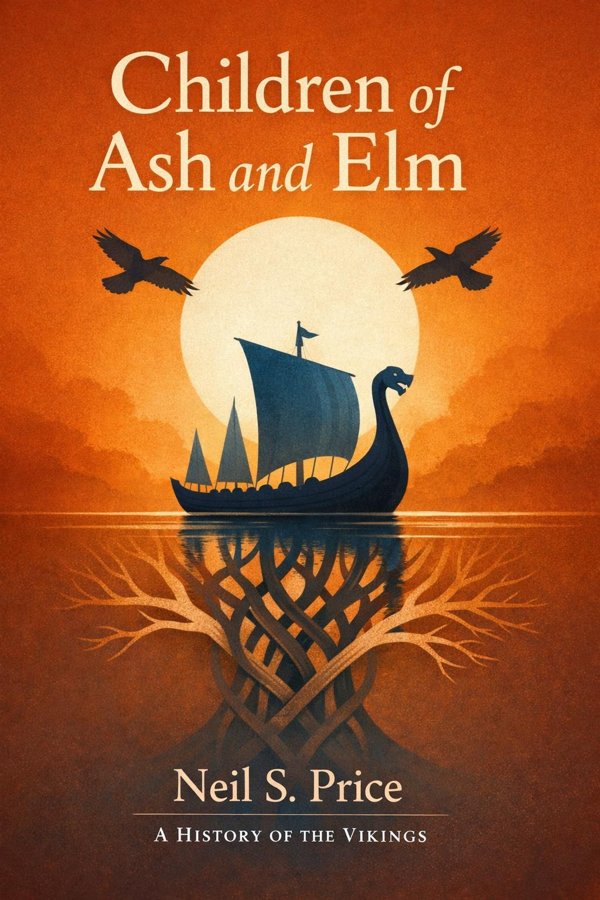
Children of Ash and Elm: A History of the Vikings: Summary & Key Insights
 10 min10 chaptersAudio available
Key Takeaways from Children of Ash and Elm: A History of the Vikings
A people’s environment does not simply surround them; it teaches them what is possible.
Mythology was not entertainment added to Viking life; it was part of the structure of reality.
Simple labels like 'free' and 'unfree' hide more than they reveal.
Early Viking politics was less like a modern state and more like a contest over loyalty, legitimacy, and performance.
The Vikings were feared raiders, but they were also master connectors.
What Is Children of Ash and Elm: A History of the Vikings About?
Children of Ash and Elm: A History of the Vikings by Neil S. Price is a world_history book spanning 11 pages. Children of Ash and Elm: A History of the Vikings is not just another retelling of raids, longships, and famous warrior kings. Neil S. Price uses archaeology, literature, material culture, and comparative history to reconstruct the Viking Age from the inside out. Rather than asking only what the Vikings did, he asks how they understood the world: what they feared, valued, worshipped, traded, built, and imagined. The result is a sweeping portrait of a society that was mobile, violent, creative, hierarchical, spiritually complex, and deeply connected to landscapes both real and mythic. What makes this book especially important is its refusal to reduce the Vikings to stereotypes. Price shows them as settlers, merchants, poets, craftspeople, slavers, ritual specialists, explorers, and political actors living in a world shaped by kinship, cosmology, ambition, and constant negotiation with outsiders. His authority comes from decades of leading scholarship in Viking archaeology and pre-Christian Scandinavian belief. For readers who want a richer and more accurate understanding of the Viking world, this book offers one of the most vivid and intellectually serious accounts available.
This FizzRead summary covers all 10 key chapters of Children of Ash and Elm: A History of the Vikings in approximately 10 minutes, distilling the most important ideas, arguments, and takeaways from Neil S. Price's work. Also available as an audio summary and Key Quotes Podcast.
Children of Ash and Elm: A History of the Vikings
Children of Ash and Elm: A History of the Vikings is not just another retelling of raids, longships, and famous warrior kings. Neil S. Price uses archaeology, literature, material culture, and comparative history to reconstruct the Viking Age from the inside out. Rather than asking only what the Vikings did, he asks how they understood the world: what they feared, valued, worshipped, traded, built, and imagined. The result is a sweeping portrait of a society that was mobile, violent, creative, hierarchical, spiritually complex, and deeply connected to landscapes both real and mythic.
What makes this book especially important is its refusal to reduce the Vikings to stereotypes. Price shows them as settlers, merchants, poets, craftspeople, slavers, ritual specialists, explorers, and political actors living in a world shaped by kinship, cosmology, ambition, and constant negotiation with outsiders. His authority comes from decades of leading scholarship in Viking archaeology and pre-Christian Scandinavian belief. For readers who want a richer and more accurate understanding of the Viking world, this book offers one of the most vivid and intellectually serious accounts available.
Who Should Read Children of Ash and Elm: A History of the Vikings?
This book is perfect for anyone interested in world_history and looking to gain actionable insights in a short read. Whether you're a student, professional, or lifelong learner, the key ideas from Children of Ash and Elm: A History of the Vikings by Neil S. Price will help you think differently.
- ✓Readers who enjoy world_history and want practical takeaways
- ✓Professionals looking to apply new ideas to their work and life
- ✓Anyone who wants the core insights of Children of Ash and Elm: A History of the Vikings in just 10 minutes
Want the full summary?
Get instant access to this book summary and 100K+ more with Fizz Moment.
Get Free SummaryAvailable on App Store • Free to download
Key Chapters
A people’s environment does not simply surround them; it teaches them what is possible. Price begins by showing that Viking society cannot be understood without Scandinavia itself: a fractured geography of mountains, forests, islands, fjords, harsh winters, and long coastlines. These conditions encouraged mobility, seamanship, local autonomy, and practical adaptation. Communities were often separated by difficult terrain but connected by water, making ships not just tools of war but essential instruments of everyday life, trade, communication, and imagination.
This setting also shaped political organization. Power tended to be regional and negotiated rather than fully centralized, at least for much of the Viking Age. Resource constraints encouraged expansion, but not in a simplistic sense of overpopulation. Rather, the environment fostered outward-looking habits: people moved seasonally, traded widely, and learned to read routes across sea and river systems. The landscape also entered belief. Sacred groves, burial mounds, stones, and prominent natural features linked memory, ancestry, and divine presence.
A practical way to apply this idea is to rethink historical behavior in ecological terms. Instead of asking why a society became maritime, expansionist, or decentralized in the abstract, ask what the land and climate rewarded. The Viking world makes more sense when viewed as a network shaped by coasts and waterways rather than a block of territory.
Actionable takeaway: whenever you study a civilization, start with its geography and ask how movement, survival, and power were built into the land itself.
Mythology was not entertainment added to Viking life; it was part of the structure of reality. Price emphasizes that Norse cosmology offered an interpretive map of existence, populated by gods, giants, land-spirits, ancestors, and unseen forces. Yggdrasil, Ragnarök, Odin’s quests, Thor’s violence, and Freyja’s power were not merely stories but frameworks through which people understood fate, honor, danger, and the instability of the world.
One of the book’s strongest contributions is its insistence that Viking belief was not neat or systematized like later organized religion. It was lived, varied, and situational. Different communities likely emphasized different rituals and divine relationships. Seers, poets, and ritual specialists helped mediate between the visible and invisible. This worldview made uncertainty meaningful. War, weather, harvests, and travel all existed within a cosmos where the boundary between human action and supernatural influence was porous.
This matters because modern readers often separate religion from politics or daily life. The Vikings likely did not. A raid, a legal assembly, a burial, or a marriage alliance could all carry cosmological significance. Material remains such as amulets, burial goods, cult sites, and iconography suggest that sacred meaning saturated ordinary existence.
For modern readers, the lesson is interpretive humility. To understand any society, you must try to enter the mental world that made its choices feel rational.
Actionable takeaway: when reading history, ask not only what people did, but what invisible forces they believed were acting alongside them.
Early Viking politics was less like a modern state and more like a contest over loyalty, legitimacy, and performance. Price shows that kings were not all-powerful rulers presiding over fixed national territories. Their authority often depended on personal followings, gift exchange, military success, marriage alliances, feasting, and the ability to turn wealth into obligation. Assemblies, local leaders, and competing claimants could all limit royal power.
This helps explain why Viking politics often appears unstable. Rule was relational. A successful leader had to reward supporters, manage rivals, and cultivate a reputation strong enough to survive setbacks. Ships, silver, prestige objects, and access to trade routes all mattered because they could be converted into political capital. Monumental building, poetry, burial display, and genealogy also reinforced status. Power was remembered as much as it was enforced.
Price’s account is useful beyond Viking studies because it reveals how states form gradually. Centralization is not inevitable; it is assembled from negotiations, coercion, ritual symbolism, and material resources. In Scandinavia, emerging kingdoms developed unevenly, and local identities remained powerful even as larger polities began to take shape.
A practical application is to look at leadership in any era as a problem of sustaining networks. Formal titles matter less than the ability to bind people to a shared project through incentives and meaning.
Actionable takeaway: to understand political power, track the flows of loyalty, wealth, and reputation rather than relying only on official titles or later national histories.
The Vikings were feared raiders, but they were also master connectors. Price demonstrates that the Viking Age was built on movement through trade networks stretching from the North Atlantic to the Islamic world and from Arctic zones to the rivers leading toward Byzantium. Silver, furs, walrus ivory, textiles, weapons, glass beads, slaves, and prestige goods circulated through hubs such as Birka, Hedeby, Ribe, and beyond. Longships made striking possible, but commerce made the wider Viking world sustainable.
This chapter of Viking history matters because it overturns the image of the Norse as isolated barbarians crashing into civilized Europe from the margins. They were active participants in Afro-Eurasian exchange systems. They adapted foreign coins, styles, technologies, and ideas, and they built settlements that depended on craft specialization, regulation, and long-distance contact. Exploration westward to Iceland, Greenland, and Vinland was part of the same outward-facing mentality that carried traders eastward along river routes.
The broader lesson is that expansion usually combines violence and commerce. Networks of exchange create opportunity, intelligence, and ambition. Ports become cultural laboratories where language, religion, fashion, and law mix. The Viking world was not unified by ethnicity alone but by circulation.
Modern readers can apply this by viewing economic systems as cultural systems. Trade does not just move objects; it moves values, skills, and identities.
Actionable takeaway: when studying expansion, follow merchants and market towns alongside warriors, because trade often explains how power endures after conquest or contact.
Religious life in the Viking Age was not confined to temples or fixed doctrines. Price presents Norse religion as a web of rituals embedded in houses, halls, fields, graves, wetlands, ships, and assembly places. Sacrifice, feasting, divination, amulet use, funerary display, and seasonal rites all helped people negotiate with gods, spirits, and the dead. Belief was enacted materially.
One of the most striking elements of the book is its treatment of burial. Graves reveal not only social rank but ideas about transformation, memory, and the afterlife. Ships, horses, weapons, tools, jewelry, and even human sacrifice in some cases suggest that death was a managed passage requiring equipment, symbolism, and public performance. The dead remained socially significant. They could legitimize land claims, lineage, and political authority.
Price also foregrounds ritual specialists, including figures associated with magic, prophecy, and practices such as seiðr. This broadens the picture of Norse religion beyond famous gods and heroic myths. It shows a world where sound, costume, movement, intoxicants, and staged experience may all have contributed to encounters with the sacred.
The wider lesson is that religion often lives most clearly in practice rather than creed. To understand what people believed, examine what they repeated, feared, offered, and commemorated.
Actionable takeaway: study rituals as social technology; they reveal how communities manage uncertainty, grief, legitimacy, and contact with forces they cannot control.
Material culture is never just decoration. Price uses artifacts, buildings, clothing, carvings, and craft traditions to show how the Vikings communicated identity and worldview through things. Art styles with interlacing beasts, gripping animals, twisting forms, and dynamic patterns were not merely aesthetic choices; they expressed values of transformation, motion, tension, and power. Houses, halls, ships, and portable objects created environments in which status and belonging became visible.
The Viking emphasis on display was political and emotional. Swords, brooches, cloaks, beads, silver hoards, and carved monuments signaled wealth, alliances, memory, and aspiration. A hall was not just a building but a stage for hierarchy, feasting, oath-making, and gift distribution. A ship was transport, weapon, symbol, and burial chamber. Craftsmanship itself mattered because skilled making transformed raw material into social value.
Price’s approach teaches readers how archaeologists think. In societies with limited written records, objects become arguments. Wear patterns, deposition, ornament, location, and association all help reconstruct behavior. A buried hoard may indicate insecurity, ritual offering, or strategic wealth storage. A hybrid object may point to migration or cultural blending.
This perspective applies today as well. Material choices still signal belonging and values, from architecture to fashion to digital devices. Objects organize memory and identity.
Actionable takeaway: pay attention to what a society makes visible through objects, because design, placement, and use often reveal beliefs more clearly than formal texts.
No culture meets another and remains untouched. Price shows that Viking encounters with the British Isles, Frankish realms, the Slavic world, the North Atlantic, and lands connected to Byzantium and the caliphates produced mutual transformation. The Vikings borrowed technologies, religious ideas, artistic motifs, political concepts, and economic practices even as they imposed themselves violently on others. Cultural exchange was rarely equal, but it was always consequential.
This is especially important for correcting narratives that portray Viking expansion as one-directional. Settlements in England, Ireland, Normandy, Iceland, and elsewhere became mixed worlds. Languages blended, legal practices adapted, families intermarried, and identities shifted over generations. A person could be Scandinavian in ancestry, Christian in practice, multilingual in trade, and local in political loyalty. The Viking Age was therefore not just about movement from home to abroad; it was about the creation of new societies.
Price also emphasizes slavery and human trafficking as core parts of these contacts. Exchange was not only creative but coercive. Wealth moved through bodies as well as goods. This darker reality is essential to any honest account of Viking expansion.
The practical lesson is that cultural identity is dynamic and often forged at frontiers. Contact zones reveal how quickly customs can be remixed when mobility, pressure, and opportunity collide.
Actionable takeaway: when studying cross-cultural encounters, look for hybrid practices and unequal exchanges rather than assuming one side simply replaced the other.
The end of the Viking Age was not a sudden collapse but a long transformation in belief, institutions, and political order. Price explains that conversion to Christianity unfolded unevenly across Scandinavia and Viking diasporas. It involved persuasion, diplomacy, royal strategy, missionary effort, trade incentives, and at times coercion. New burial practices, church building, literacy, kingship models, and links to European Christendom gradually altered how communities organized time, law, legitimacy, and the sacred.
Yet Price avoids telling this as a simple story of enlightenment replacing pagan darkness. Older beliefs persisted, blended, or resurfaced within Christian settings. Conversion was often pragmatic before it became internalized. Rulers embraced Christianity because it could strengthen authority, connect them to continental powers, and support new administrative structures. Ordinary people may have moved more slowly, carrying older customs into new rituals.
This transition also shaped memory. Much of what later generations knew about the Viking past was filtered through Christian writers and political agendas. That is one reason modern stereotypes are so persistent: the Viking Age survives partly through hostile observers and retrospective mythmaking.
For modern readers, the broader insight is that religious change is usually institutional as much as spiritual. Belief systems transform when they reshape education, law, burial, writing, and power.
Actionable takeaway: treat conversion as a social process, and ask who gained authority, resources, and legitimacy when a new religion took hold.
All Chapters in Children of Ash and Elm: A History of the Vikings
About the Author
Neil S. Price is a British archaeologist, historian, and academic specializing in the Viking Age and the pre-Christian cultures of Scandinavia. He is widely recognized for combining archaeological evidence with literary, anthropological, and historical analysis to reconstruct how Norse societies lived and thought. His research has focused especially on religion, ritual, magic, warfare, burial practices, and social organization in the early medieval North. Over the course of his career, Price has held major university positions and contributed extensively to both scholarly debate and public understanding of Viking history. He is known for making complex material vivid and accessible without sacrificing rigor. In Children of Ash and Elm, his decades of fieldwork and scholarship come together in a sweeping, deeply informed portrait of the Viking world.
Get This Summary in Your Preferred Format
Read or listen to the Children of Ash and Elm: A History of the Vikings summary by Neil S. Price anytime, anywhere. FizzRead offers multiple formats so you can learn on your terms — all free.
Available formats: App · Audio · PDF · EPUB — All included free with FizzRead
Download Children of Ash and Elm: A History of the Vikings PDF and EPUB Summary
Key Quotes from Children of Ash and Elm: A History of the Vikings
“A people’s environment does not simply surround them; it teaches them what is possible.”
“Mythology was not entertainment added to Viking life; it was part of the structure of reality.”
“Simple labels like 'free' and 'unfree' hide more than they reveal.”
“Early Viking politics was less like a modern state and more like a contest over loyalty, legitimacy, and performance.”
“The Vikings were feared raiders, but they were also master connectors.”
Frequently Asked Questions about Children of Ash and Elm: A History of the Vikings
Children of Ash and Elm: A History of the Vikings by Neil S. Price is a world_history book that explores key ideas across 10 chapters. Children of Ash and Elm: A History of the Vikings is not just another retelling of raids, longships, and famous warrior kings. Neil S. Price uses archaeology, literature, material culture, and comparative history to reconstruct the Viking Age from the inside out. Rather than asking only what the Vikings did, he asks how they understood the world: what they feared, valued, worshipped, traded, built, and imagined. The result is a sweeping portrait of a society that was mobile, violent, creative, hierarchical, spiritually complex, and deeply connected to landscapes both real and mythic. What makes this book especially important is its refusal to reduce the Vikings to stereotypes. Price shows them as settlers, merchants, poets, craftspeople, slavers, ritual specialists, explorers, and political actors living in a world shaped by kinship, cosmology, ambition, and constant negotiation with outsiders. His authority comes from decades of leading scholarship in Viking archaeology and pre-Christian Scandinavian belief. For readers who want a richer and more accurate understanding of the Viking world, this book offers one of the most vivid and intellectually serious accounts available.
You Might Also Like
The Age of Capital
Eric Hobsbawm
10 min
The Gulag Archipelago
Aleksandr Solzhenitsyn
10 min
Jerusalem: The Biography
Simon Sebag Montefiore
10 min
The Anglo-Saxons
James Campbell
10 min
The Boer War
Thomas Pakenham
10 min
The Industrial Revolutionaries: The Making of the Modern World 1776–1914
Gavin Weightman
10 minBrowse by Category
Ready to read Children of Ash and Elm: A History of the Vikings?
Get the full summary and 100K+ more books with Fizz Moment.