
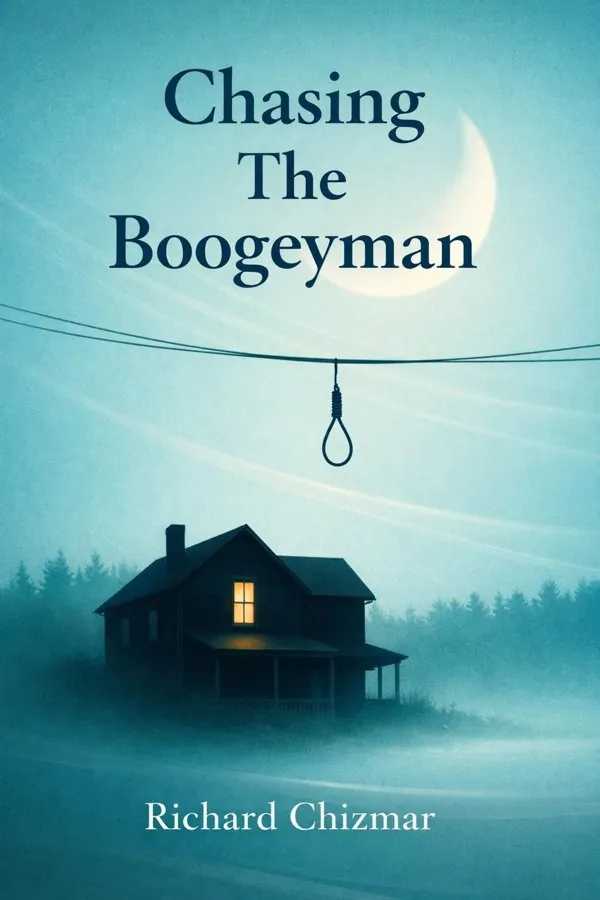
Chasing The Boogeyman: Summary & Key Insights
 10 min4 chaptersAudio available
What Is Chasing The Boogeyman About?
Chasing The Boogeyman by Richard Chizmar is a mystery book spanning 4 pages. In the summer of 1988, the small town of Edgewood, Maryland, is terrorized by a series of brutal murders. As the community descends into fear and paranoia, Richard Chizmar—returning home from college—finds himself drawn into the mystery. Blending true crime and fiction, the novel unfolds as a chilling metafictional narrative where the author becomes part of the story, exploring memory, evil, and the blurred line between reality and imagination.
This FizzRead summary covers all 4 key chapters of Chasing The Boogeyman in approximately 10 minutes, distilling the most important ideas, arguments, and takeaways from Richard Chizmar's work. Also available as an audio summary and Key Quotes Podcast.
Chasing The Boogeyman
In the summer of 1988, the small town of Edgewood, Maryland, is terrorized by a series of brutal murders. As the community descends into fear and paranoia, Richard Chizmar—returning home from college—finds himself drawn into the mystery. Blending true crime and fiction, the novel unfolds as a chilling metafictional narrative where the author becomes part of the story, exploring memory, evil, and the blurred line between reality and imagination.
Who Should Read Chasing The Boogeyman?
This book is perfect for anyone interested in mystery and looking to gain actionable insights in a short read. Whether you're a student, professional, or lifelong learner, the key ideas from Chasing The Boogeyman by Richard Chizmar will help you think differently.
- ✓Readers who enjoy mystery and want practical takeaways
- ✓Professionals looking to apply new ideas to their work and life
- ✓Anyone who wants the core insights of Chasing The Boogeyman in just 10 minutes
Want the full summary?
Get instant access to this book summary and 100K+ more with Fizz Moment.
Get Free SummaryAvailable on App Store • Free to download
Key Chapters
In the summer of 1988, Edgewood felt frozen between two worlds: the innocence of its past and the anxiety of an uncertain future. I came home after graduating college with plans simple and clear—start writing, get my feet under me, maybe find work close to home. It was supposed to be a season of beginnings. Yet the moment I unpacked my bags, I could sense the pulse of something uneasy running beneath the town’s calm surface. The first murder shattered everything. A young woman, brutally killed and left in a way that defied comprehension, threw the entire community into chaos.
The news spread fast, not just through newspapers and radio, but whispered across backyards and grocery aisles. Everyone knew the victim’s name. Everybody had theories. You couldn’t escape the feeling that something had shifted permanently. Returning home had become a confrontation with fragility—the kind hidden behind white picket fences and front porch lights.
I began documenting everything as both participant and observer. I walked the streets with my camera, sat with families who were grieving, listened to the awkward silences of neighbors who now locked their doors for the first time. Edgewood was changing, and so was I. The murders stripped away the protective layer of normalcy, revealing the deeper narrative we all carry—the question of what happens when the place that made you safe suddenly can’t protect you anymore.
As the killings continued, the town’s mood grew heavy, almost suffocating. Fear became a tangible presence—you could taste it in every conversation, feel it beneath every porch light that stayed burning through the night. I found myself drawn deeper into the investigation, fascinated by how ordinary people transform under the pressure of horror. The police were everywhere, their flashing lights painting the streets red and blue, while stories circulated about suspects, strange cars, and basements that no one had noticed before.
I began interviewing residents, collecting fragments of testimony that often contradicted one another. Some swore they’d seen the killer’s face; others insisted evil can’t be recognized until it’s too late. I wasn’t a detective—I was a writer—but there was something intoxicating about chasing the story through a town drowning in terror. The darker it grew, the more I needed to name what I was witnessing. In those interviews, I realized that fear doesn’t just isolate people—it connects them in a twisted kind of intimacy. Every rumor was a lifeline, every suspicion a coping mechanism.
Edgewood was no longer just a setting—it was a psychological landscape. The fences, the woods, the familiar corners of Main Street became symbols of the unknown. As the monster’s shadow lengthened, we were all chasing him, and in doing so, chasing parts of ourselves we’d rather ignore. It was then that my own fascination turned into obsession. I couldn’t tell if I was documenting horror or participating in its creation.
+ 2 more chapters — available in the FizzRead app
All Chapters in Chasing The Boogeyman
About the Author
Richard Chizmar is an American author, editor, and publisher best known for his work in horror and suspense fiction. He founded Cemetery Dance Publications and has collaborated with Stephen King on several projects, including the novella 'Gwendy's Button Box'. His writing often combines psychological depth with elements of supernatural horror.
Get This Summary in Your Preferred Format
Read or listen to the Chasing The Boogeyman summary by Richard Chizmar anytime, anywhere. FizzRead offers multiple formats so you can learn on your terms — all free.
Available formats: App · Audio · PDF · EPUB — All included free with FizzRead
Download Chasing The Boogeyman PDF and EPUB Summary
Key Quotes from Chasing The Boogeyman
“In the summer of 1988, Edgewood felt frozen between two worlds: the innocence of its past and the anxiety of an uncertain future.”
“As the killings continued, the town’s mood grew heavy, almost suffocating.”
Frequently Asked Questions about Chasing The Boogeyman
Chasing The Boogeyman by Richard Chizmar is a mystery book that explores key ideas across 4 chapters. In the summer of 1988, the small town of Edgewood, Maryland, is terrorized by a series of brutal murders. As the community descends into fear and paranoia, Richard Chizmar—returning home from college—finds himself drawn into the mystery. Blending true crime and fiction, the novel unfolds as a chilling metafictional narrative where the author becomes part of the story, exploring memory, evil, and the blurred line between reality and imagination.
More by Richard Chizmar

You Might Also Like


Browse by Category
Ready to read Chasing The Boogeyman?
Get the full summary and 100K+ more books with Fizz Moment.