
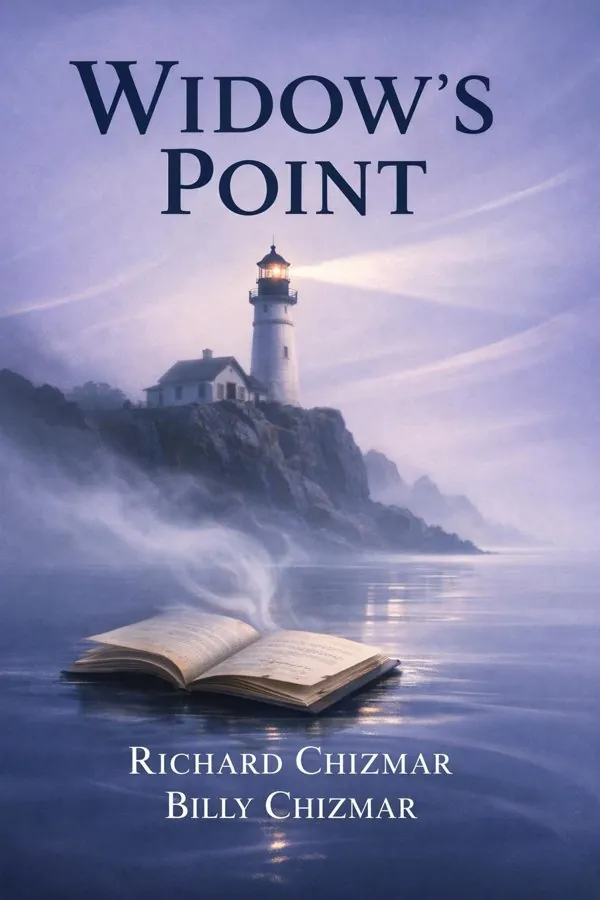
Widow's Point: Summary & Key Insights
by Richard Chizmar, Billy Chizmar
 10 min8 chaptersAudio available
Key Takeaways from Widow's Point
Every haunting begins long before the first ghost appears.
Isolation becomes frightening when ordinary sensations lose their neutrality.
A haunting feels deeper when it is rooted in a human wound.
First-person records are powerful because they make the reader complicit.
Knowledge can prepare us, but it cannot always protect us.
What Is Widow's Point About?
Widow's Point by Richard Chizmar, Billy Chizmar is a bestsellers book spanning 5 pages. Some places seem to collect grief until it hardens into legend. Widow's Point is built on that idea: a lonely lighthouse in Harper’s Cove, a history soaked in death and rumor, and one writer arrogant enough to believe he can document the haunting without becoming part of it. Told largely through journal entries, Richard Chizmar and Billy Chizmar’s novella blends the intimacy of found-footage storytelling with the atmospheric dread of a classic ghost tale. The result is a story that feels both immediate and timeless, where creaking stairs, crashing waves, and unexplained sounds gradually give way to something far more destabilizing: the collapse of certainty itself. What makes the book matter is not just its scares, but its understanding of how obsession works. Thomas Livingston enters the lighthouse as a professional skeptic and emerges as a man stripped down by isolation, memory, and fear. Richard Chizmar’s long-standing reputation in modern horror, combined with Billy Chizmar’s cinematic pacing, gives Widow’s Point a sharp sense of control. It is a compact, highly readable novella that shows how horror becomes most powerful when the setting, the psychology, and the legend are impossible to separate.
This FizzRead summary covers all 8 key chapters of Widow's Point in approximately 10 minutes, distilling the most important ideas, arguments, and takeaways from Richard Chizmar, Billy Chizmar's work. Also available as an audio summary and Key Quotes Podcast.
Widow's Point
Some places seem to collect grief until it hardens into legend. Widow's Point is built on that idea: a lonely lighthouse in Harper’s Cove, a history soaked in death and rumor, and one writer arrogant enough to believe he can document the haunting without becoming part of it. Told largely through journal entries, Richard Chizmar and Billy Chizmar’s novella blends the intimacy of found-footage storytelling with the atmospheric dread of a classic ghost tale. The result is a story that feels both immediate and timeless, where creaking stairs, crashing waves, and unexplained sounds gradually give way to something far more destabilizing: the collapse of certainty itself. What makes the book matter is not just its scares, but its understanding of how obsession works. Thomas Livingston enters the lighthouse as a professional skeptic and emerges as a man stripped down by isolation, memory, and fear. Richard Chizmar’s long-standing reputation in modern horror, combined with Billy Chizmar’s cinematic pacing, gives Widow’s Point a sharp sense of control. It is a compact, highly readable novella that shows how horror becomes most powerful when the setting, the psychology, and the legend are impossible to separate.
Who Should Read Widow's Point?
This book is perfect for anyone interested in bestsellers and looking to gain actionable insights in a short read. Whether you're a student, professional, or lifelong learner, the key ideas from Widow's Point by Richard Chizmar, Billy Chizmar will help you think differently.
- ✓Readers who enjoy bestsellers and want practical takeaways
- ✓Professionals looking to apply new ideas to their work and life
- ✓Anyone who wants the core insights of Widow's Point in just 10 minutes
Want the full summary?
Get instant access to this book summary and 100K+ more with Fizz Moment.
Get Free SummaryAvailable on App Store • Free to download
Key Chapters
Every haunting begins long before the first ghost appears. In Widow’s Point, the lighthouse is not merely a spooky backdrop but a structure layered with tragedy, rumor, and communal memory. Thomas Livingston arrives after studying old archives, newspaper clippings, local testimony, and whispered legends, and all of those sources point toward the same conclusion: this place has never been just a lighthouse. It has served as a grave marker, a cautionary tale, and a vessel for generations of fear.
The history matters because horror grows stronger when it is social, not just personal. The people of Harper’s Cove do not treat Widow’s Point as an abandoned tourist attraction. They treat it as a site that remembers. Stories of death, disappearances, madness, and strange sightings accumulate until the setting seems to develop a personality of its own. The past becomes active rather than inert. This is one reason the novella works so well: the reader senses that Thomas is not discovering a mystery from scratch but stepping into a long-running conversation between the town and the tower.
In practical terms, this reflects how real fear often operates. We rarely fear only what is in front of us; we fear what others have already taught us to fear. A dark house feels darker when we know its history. A lonely road feels more dangerous when tied to stories of violence. Chizmar and Chizmar use that psychology masterfully, showing how inherited narrative can prime the mind for terror.
Actionable takeaway: when reading Widow’s Point, pay close attention to the backstory. The lighthouse’s history is not decoration; it is the engine that makes every later event feel inevitable.
Isolation becomes frightening when ordinary sensations lose their neutrality. Thomas’s arrival at Widow’s Point marks the beginning of this transformation. The sea, the wind, the cramped architecture, and the tower’s relentless verticality all work together to create unease before anything explicitly supernatural happens. That is a key strength of the novella: fear enters through atmosphere first.
The lighthouse is cut off in multiple ways. It stands geographically apart from town life, but it also feels psychologically sealed. Once Thomas commits to staying there, he steps outside the normal rhythms that keep people grounded. There are no easy distractions, no comforting routines, no social buffers to reassure him that what he experiences is explainable. Sounds begin to matter too much. Footsteps, knocks, scraping, gusts of wind, and the pulse of the ocean become charged with possibility. The question is no longer, “Did I hear something?” but “What does that sound want from me?”
This idea has practical resonance beyond horror fiction. In unfamiliar environments, especially when we are alone, our minds amplify sensory data. A building settles, and it sounds intentional. Wind rattles glass, and it feels communicative. The authors understand that fear often begins not with sight but with interpretation. Sound is powerful because it is suggestive. We hear before we know, and in that gap imagination takes over.
The arrival section teaches readers how horror escalates through environmental pressure. You do not need gore or immediate apparitions when setting and sensory detail do the work first.
Actionable takeaway: notice how the book uses sound and space to build dread. If you want to understand why the story is effective, track what Thomas hears before you focus on what he sees.
A haunting feels deeper when it is rooted in a human wound. At the center of Widow’s Point lies the figure of the widow herself, a presence tied to grief, loss, and the emotional residue of catastrophe. The novella gradually suggests that the lighthouse’s darkness may not come only from random death, but from unresolved suffering concentrated around a single tragic legacy. This gives the supernatural events emotional shape.
What makes the widow motif effective is its ambiguity. She is both person and symbol. On one level, she is part of the local history, a figure attached to the lighthouse through stories of mourning and ruin. On another, she embodies the broader theme of lingering sorrow, the kind that refuses to be buried. In many ghost stories, spirits are frightening because they are unnatural intrusions. Here, the widow is frightening because she represents pain that has outlasted explanation.
This idea also speaks to how places become memorials without officially being named as such. People return again and again to sites of loss, not always physically but mentally. They preserve stories, repeat details, and allow grief to define geography. The lighthouse becomes exactly that kind of place. It is not just haunted by a ghost; it is haunted by a narrative of abandonment and anguish.
For readers, this adds richness to the novella. The horror is not shallow spectacle. It is tied to the emotional logic of mourning. Thomas is not merely confronting a spooky building; he is entering a space shaped by unresolved memory.
Actionable takeaway: read the widow not only as a literal element of the plot but as a symbol of grief’s persistence. Doing so reveals why the lighthouse feels so emotionally charged.
First-person records are powerful because they make the reader complicit. Widow’s Point unfolds primarily through Thomas Livingston’s journal entries, and that structure is central to the novella’s effect. A journal promises honesty, intimacy, and immediacy, yet it also raises a troubling possibility: what if the writer cannot be trusted, not because he is lying, but because fear is changing him in real time?
The format places readers inside Thomas’s degrading perspective. We do not receive a stable, all-knowing account of the lighthouse. We receive impressions, revisions, bursts of confidence, moments of denial, and escalating desperation. That means every entry performs two functions at once. It reports events, and it reveals the state of the reporter. In horror, that double function is incredibly effective because it blurs the line between supernatural occurrence and psychological collapse.
This is similar to why found-footage films often feel unsettling. The document itself becomes part of the story. We are not simply watching a character become frightened; we are handling the evidence of that fear. In practical reading terms, this means small shifts in tone matter. A clipped sentence, a repeated phrase, or a sudden confession can signal more than plot development. It can show the erosion of mental stability.
The journal format also mirrors how people try to control anxiety in real life. We write things down to make them manageable. We organize events into chronology so they feel rational. Thomas does exactly that, but the more he writes, the less stable the world appears. His act of documentation becomes proof that documentation is failing.
Actionable takeaway: while reading, treat Thomas’s journal as both testimony and symptom. The story becomes much richer when you ask not only what happened, but what the writing itself reveals about his unraveling.
Knowledge can prepare us, but it cannot always protect us. Thomas arrives at Widow’s Point armed with research, professional confidence, and the assumption that investigation creates distance. He believes that by studying the lighthouse as material for a book, he can remain an observer rather than a participant. The novella dismantles that assumption with chilling precision.
This is one of the story’s most interesting ideas. Thomas is not a reckless teenager wandering into danger for thrills. He is a writer, a collector of facts, a person accustomed to shaping chaos into narrative. He has read the records, spoken to locals, and built a framework through which the haunting should make sense. Yet the lighthouse resists framework. The more he tries to classify what happens, the more those categories fail him.
The practical significance of this theme extends beyond fiction. People often use expertise as a shield against vulnerability. We think if we understand something intellectually, we can withstand it emotionally. But certain experiences, especially those involving grief, trauma, obsession, or fear, do not submit to detached analysis. Thomas’s mistake is not researching the lighthouse. His mistake is assuming that understanding a legend is the same as being immune to its power.
The novella suggests that rationality has limits, particularly in places where history, atmosphere, and psychology combine. That does not make reason useless. It makes reason incomplete. Thomas can catalogue previous incidents, but he cannot stop himself from becoming the next one.
Actionable takeaway: notice how the book challenges the fantasy of safe observation. Entering a dark subject, whether in fiction or life, changes the observer too. Expertise helps, but humility matters more.
Terror rarely arrives all at once; it accumulates through patterns that may or may not be real. One of the novella’s strongest achievements is its portrayal of deterioration. Thomas does not immediately collapse under the lighthouse’s influence. Instead, he endures repeated disturbances, fragmented sleep, suspicious noises, and encounters that are just uncertain enough to keep him doubting himself. That slow grind is what turns fear into paranoia.
The brilliance of this descent lies in the repetition. A single odd event can be dismissed. Two events can be rationalized. But when the same dread returns night after night, the mind begins to reorganize itself around expectation. Thomas starts anticipating the next intrusion, and anticipation is often more damaging than the event itself. He becomes hypervigilant. Every sound matters. Every shadow is loaded. Every gap in memory feels dangerous.
This reflects a real psychological truth. Under stress, repeated ambiguity is exhausting. Human beings can cope with clear danger because it allows for action. Unclear danger is worse because it demands endless interpretation. Is there truly something in the lighthouse, or is Thomas generating meaning from fatigue and obsession? The novella keeps that tension alive while showing how his sense of self weakens under the pressure.
Readers can apply this insight by recognizing how horror manipulates rhythm. A story becomes terrifying not just because frightening things happen, but because those things recur with enough variation to unsettle the nervous system. The authors understand pacing deeply, allowing dread to build in cycles rather than shocks alone.
Actionable takeaway: when reading the deterioration sections, focus on the repeated disturbances. Their pattern is the point. The lighthouse defeats Thomas less through one revelation than through sustained psychological erosion.
Places in horror often function like characters, and Widow’s Point is a perfect example. The lighthouse does more than contain the story; it shapes the story’s emotional and symbolic logic. Traditionally, a lighthouse stands for safety, guidance, and illumination. Ships rely on its beam to avoid destruction. The Chizmars reverse that symbolism. Here, the light does not reassure. It becomes associated with surveillance, entrapment, memory, and dread.
That reversal gives the novella unusual power. A building meant to protect life is recast as a mechanism of torment. Its staircase becomes a ritual of ascent and descent, almost like moving between layers of consciousness. Its windows expose Thomas to darkness rather than opening him to freedom. Its height offers perspective, yet also severance from ordinary reality. The lighthouse becomes a machine for amplifying loneliness.
In a broader interpretive sense, the structure represents what happens when symbols fail us. We expect light to reveal truth, but the truth here is destabilizing. We expect elevated vantage points to provide clarity, but Thomas gains only deeper exposure to fear. This inversion is one reason the novella lingers in the mind. It corrupts a familiar image without overexplaining it.
There is also a practical reading lesson here: strong horror often works by twisting the meaning of familiar objects. A child’s toy, a family home, a camera, a church bell, a lighthouse. When the ordinary function of a thing is subverted, the result feels intimate and uncanny. Widow’s Point executes this beautifully.
Actionable takeaway: think of the lighthouse not simply as setting, but as a symbolic inversion of safety. That perspective helps explain why the story feels oppressive even in moments when little seems to happen.
The most frightening moment in horror is often not the appearance of evil but the surrender to it. As Widow’s Point approaches its climax, Thomas’s resistance weakens. The final night is shaped by inevitability, as if every earlier sound, vision, and fragment of history has been guiding him toward a conclusion he can no longer avoid. The suspense comes not only from what will happen, but from whether he still possesses the selfhood required to oppose it.
This culmination works because the novella has carefully narrowed Thomas’s options. He is exhausted, isolated, and mentally frayed. His journal, once a tool of control, now records his diminishing command over events. By the time the supernatural force makes its fullest claim, the struggle is no longer between belief and disbelief. It is between possession of the will and surrender of it.
In practical terms, this is what gives the ending emotional force. A lesser ghost story might rely solely on a final twist or violent reveal. Widow’s Point instead builds toward psychic capitulation. The terror lies in watching a man cease to be an independent witness and become part of the lighthouse’s story. That is a more haunting outcome than simple death because it implies absorption. The place consumes narrative, identity, and memory.
This theme resonates beyond the novella. Fear becomes most dangerous when it persuades us to stop resisting, stop questioning, stop asserting our own interpretation of reality. Thomas’s end feels tragic because it is both external defeat and internal collapse.
Actionable takeaway: read the ending as a study in surrender, not just spectacle. The final horror lands hardest when you see how thoroughly the lighthouse has worn Thomas down before claiming him.
All Chapters in Widow's Point
About the Authors
Richard Chizmar is an American author, editor, and publisher widely recognized for his major contributions to modern horror. He is the founder of Cemetery Dance Publications, a hugely influential press known for championing horror and dark suspense writers. In addition to publishing, he has written fiction celebrated for its atmosphere, emotional depth, and strong sense of place. Billy Chizmar is a writer and filmmaker who has collaborated with Richard on several projects, bringing a cinematic instinct for pacing and visual tension. Together, they form a compelling creative partnership, blending classic ghost-story craftsmanship with contemporary narrative energy. In Widow’s Point, their combined strengths are especially clear: Richard’s deep experience in horror storytelling and Billy’s sharp structural instincts create a novella that feels both traditional and fresh.
Get This Summary in Your Preferred Format
Read or listen to the Widow's Point summary by Richard Chizmar, Billy Chizmar anytime, anywhere. FizzRead offers multiple formats so you can learn on your terms — all free.
Available formats: App · Audio · PDF · EPUB — All included free with FizzRead
Download Widow's Point PDF and EPUB Summary
Key Quotes from Widow's Point
“Every haunting begins long before the first ghost appears.”
“Isolation becomes frightening when ordinary sensations lose their neutrality.”
“A haunting feels deeper when it is rooted in a human wound.”
“First-person records are powerful because they make the reader complicit.”
“Knowledge can prepare us, but it cannot always protect us.”
Frequently Asked Questions about Widow's Point
Widow's Point by Richard Chizmar, Billy Chizmar is a bestsellers book that explores key ideas across 8 chapters. Some places seem to collect grief until it hardens into legend. Widow's Point is built on that idea: a lonely lighthouse in Harper’s Cove, a history soaked in death and rumor, and one writer arrogant enough to believe he can document the haunting without becoming part of it. Told largely through journal entries, Richard Chizmar and Billy Chizmar’s novella blends the intimacy of found-footage storytelling with the atmospheric dread of a classic ghost tale. The result is a story that feels both immediate and timeless, where creaking stairs, crashing waves, and unexplained sounds gradually give way to something far more destabilizing: the collapse of certainty itself. What makes the book matter is not just its scares, but its understanding of how obsession works. Thomas Livingston enters the lighthouse as a professional skeptic and emerges as a man stripped down by isolation, memory, and fear. Richard Chizmar’s long-standing reputation in modern horror, combined with Billy Chizmar’s cinematic pacing, gives Widow’s Point a sharp sense of control. It is a compact, highly readable novella that shows how horror becomes most powerful when the setting, the psychology, and the legend are impossible to separate.
You Might Also Like
The Godfather
Mario Puzo
10 min
The Handmaid's Tale
Margaret Atwood
10 min
The Hunger Games
Suzanne Collins
10 min
The Nightingale
Kristin Hannah
10 min
The Seven Husbands of Evelyn Hugo
Taylor Jenkins Reid
10 min
Backwater Justice
Fern Michaels
10 minBrowse by Category
Ready to read Widow's Point?
Get the full summary and 100K+ more books with Fizz Moment.