
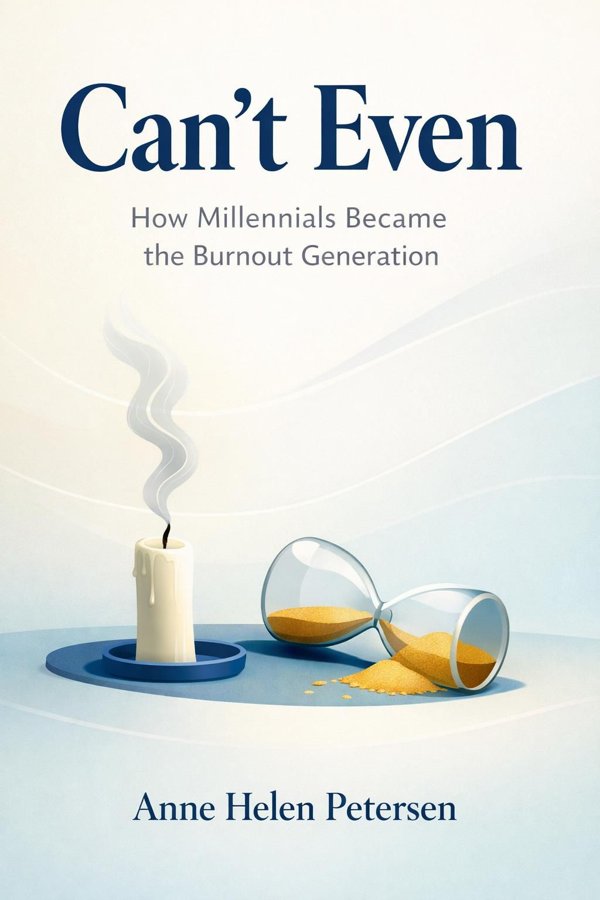
Can't Even: How Millennials Became the Burnout Generation: Summary & Key Insights
 10 min9 chaptersAudio available
Key Takeaways from Can't Even: How Millennials Became the Burnout Generation
Burnout did not appear out of nowhere when millennials entered adulthood; it was built into the economic and cultural transformations that preceded them.
One of Petersen’s most unsettling insights is that many millennials were not merely encouraged to succeed; they were taught that success was evidence of goodness.
For many millennials, higher education was framed as both necessity and salvation.
Modern work is exhausting not only because there is too much of it, but because it now invades identity, time, and emotion.
Social media did not create millennial burnout, but it intensified it by turning identity into an ongoing public project.
What Is Can't Even: How Millennials Became the Burnout Generation About?
Can't Even: How Millennials Became the Burnout Generation by Anne Helen Petersen is a sociology book spanning 13 pages. Anne Helen Petersen’s Can't Even: How Millennials Became the Burnout Generation is a sharp, timely examination of why so many millennials feel permanently exhausted, behind, and unable to keep up with the demands of modern life. Expanding on her widely shared BuzzFeed essay, Petersen argues that burnout is not simply an individual failure of time management or resilience. It is a structural condition produced by economic instability, student debt, shrinking workplace protections, digital overload, and a culture that turns productivity into personal virtue. Through reporting, historical analysis, and interviews with millennials across class backgrounds, genders, and professions, she shows how a generation was taught to optimize itself for a world that no longer offers the stability previous generations expected. The result is a powerful explanation of why ordinary tasks can feel overwhelming and why rest often feels impossible. Petersen’s authority comes from her dual perspective as a cultural critic and reporter: she combines lived generational insight with rigorous attention to labor history, media culture, and social expectations. This book matters because it names a shared condition and insists that the solution is collective, not merely personal.
This FizzRead summary covers all 9 key chapters of Can't Even: How Millennials Became the Burnout Generation in approximately 10 minutes, distilling the most important ideas, arguments, and takeaways from Anne Helen Petersen's work. Also available as an audio summary and Key Quotes Podcast.
Can't Even: How Millennials Became the Burnout Generation
Anne Helen Petersen’s Can't Even: How Millennials Became the Burnout Generation is a sharp, timely examination of why so many millennials feel permanently exhausted, behind, and unable to keep up with the demands of modern life. Expanding on her widely shared BuzzFeed essay, Petersen argues that burnout is not simply an individual failure of time management or resilience. It is a structural condition produced by economic instability, student debt, shrinking workplace protections, digital overload, and a culture that turns productivity into personal virtue. Through reporting, historical analysis, and interviews with millennials across class backgrounds, genders, and professions, she shows how a generation was taught to optimize itself for a world that no longer offers the stability previous generations expected. The result is a powerful explanation of why ordinary tasks can feel overwhelming and why rest often feels impossible. Petersen’s authority comes from her dual perspective as a cultural critic and reporter: she combines lived generational insight with rigorous attention to labor history, media culture, and social expectations. This book matters because it names a shared condition and insists that the solution is collective, not merely personal.
Who Should Read Can't Even: How Millennials Became the Burnout Generation?
This book is perfect for anyone interested in sociology and looking to gain actionable insights in a short read. Whether you're a student, professional, or lifelong learner, the key ideas from Can't Even: How Millennials Became the Burnout Generation by Anne Helen Petersen will help you think differently.
- ✓Readers who enjoy sociology and want practical takeaways
- ✓Professionals looking to apply new ideas to their work and life
- ✓Anyone who wants the core insights of Can't Even: How Millennials Became the Burnout Generation in just 10 minutes
Want the full summary?
Get instant access to this book summary and 100K+ more with Fizz Moment.
Get Free SummaryAvailable on App Store • Free to download
Key Chapters
Burnout did not appear out of nowhere when millennials entered adulthood; it was built into the economic and cultural transformations that preceded them. Petersen shows that to understand millennial exhaustion, we have to go back to the postwar period, when many Americans came to believe in a relatively stable social contract: work hard, get educated, find a secure job, buy a home, and steadily improve your life. Over time, that contract eroded. Union power weakened, wages stagnated, housing costs rose, public goods were hollowed out, and employers shifted risk from institutions onto individuals. Yet the story of personal responsibility remained intact. Millennials inherited both a promise and its collapse. They were raised to believe that discipline and ambition would guarantee security, only to discover that the economy no longer worked that way.
This historical framing matters because it shifts burnout from a personal complaint to a structural diagnosis. If you think your exhaustion comes from laziness or poor choices, you blame yourself. If you understand that you are navigating an economy designed around precarity, overwork starts to make more sense. Consider common millennial experiences: unpaid internships, contract work without benefits, endless credentialing, and moving back home despite doing everything "right." These are not isolated misfortunes; they are symptoms of a larger social transition.
A practical application is to examine your own story historically. Instead of asking, "Why can’t I keep up?" ask, "What conditions made keeping up so difficult in the first place?" That shift can reduce shame and sharpen your ability to seek collective solutions. Actionable takeaway: stop treating burnout as a private failure and start naming the broken systems that produced it.
One of Petersen’s most unsettling insights is that many millennials were not merely encouraged to succeed; they were taught that success was evidence of goodness. In many households, especially middle-class ones, ambition became moralized. Being organized, high-achieving, busy, and future-oriented was not just practical, it was virtuous. Parents and teachers often told children that education would open every door, that extracurriculars built character, and that hard work would always be rewarded. This upbringing created adults who internalized productivity so deeply that resting can feel irresponsible and falling behind can feel like a character flaw.
The problem is not aspiration itself. The problem is what happens when a generation trained to excel meets institutions that are unstable, exploitative, and indifferent. If you believe your worth depends on performance, then every delayed email, unpaid bill, messy room, or unfinished task becomes emotionally charged. Petersen describes burnout not just as physical fatigue but as the collapse of executive function under the pressure of constant self-management. You are not only doing work; you are continuously proving that you deserve to exist in a competitive system.
You can see this in everyday habits: optimizing calendars, monetizing hobbies, feeling guilty during leisure, or treating each choice as a referendum on your future. Even care tasks like cooking, budgeting, or answering messages become sites of moral pressure. The practical lesson is that many millennial habits are rooted in learned scripts, not immutable truths.
Actionable takeaway: identify one area of life where you equate productivity with worth, and consciously practice separating being valuable from being efficient.
For many millennials, higher education was framed as both necessity and salvation. Go to college, work hard, get a degree, and opportunity will follow. Petersen shows how this message became increasingly cruel as tuition soared and student debt exploded. Education remained socially mandatory even as it became financially punishing. Millennials were pushed into borrowing large sums to secure credentials that no longer guaranteed stability. The result was not only financial strain but a reshaping of adulthood itself.
Debt changes behavior. It influences what jobs people accept, whether they can relocate, when they marry, whether they have children, and how much risk they can take. A graduate with debt may stay in a draining job for the health insurance, tolerate underpayment because "experience" is supposed to lead somewhere, or postpone major life decisions because monthly payments consume any margin. Debt also generates psychological burden. It keeps the future occupied. Even when someone appears functional on the surface, they may be making every decision under the pressure of an invisible creditor.
Petersen links this debt burden to burnout because it makes escape harder. Rest feels expensive. Career pivots feel reckless. Collective problems are individualized into repayment plans and budgeting apps. A generation told to invest in itself instead inherited long-term anxiety.
A useful application is to stop interpreting debt-related stress as a sign of personal irresponsibility, especially when it stems from socially prescribed educational choices. On a practical level, this may mean reevaluating what counts as a good career move: the highest-status option is not always the most sustainable one. Actionable takeaway: make at least one financial or career decision based on long-term stability and health, not on prestige or the pressure to justify past educational costs.
Modern work is exhausting not only because there is too much of it, but because it now invades identity, time, and emotion. Petersen explains how millennials entered a labor market transformed by layoffs, freelance culture, startup ideology, digital connectivity, and the decline of clear boundaries between work and life. Many jobs now demand flexibility, enthusiasm, self-branding, and emotional investment in addition to technical competence. Employees are expected to be adaptable, grateful, available, and passionate, even when pay is low and security is minimal.
This creates a particularly damaging form of burnout. If your labor is tied to your identity, workplace disappointment feels deeply personal. If your phone keeps you reachable at all times, you never fully leave work. If every opportunity depends on networking and visibility, downtime can feel like disappearance. Millennials were also early participants in hustle culture, which reframed overwork as ambition and instability as entrepreneurial freedom. But what looked like freedom often meant absorbing risks employers no longer wanted to carry.
Examples are everywhere: answering messages after hours, doing unpaid professional development, maintaining LinkedIn relevance, treating side hustles as backup plans, or staying loyal to jobs that call themselves families. The language of passion often disguises extraction.
A practical response is to identify which parts of your work are actual job requirements and which are culturally rewarded but unsustainable extras. That distinction matters. Not every form of visibility or availability is necessary. Actionable takeaway: establish one firm work boundary this week, such as a no-email hour, a refusal of unpaid extra labor, or a clearer separation between your job and your identity.
A crucial strength of Can't Even is its attention to how burnout is shaped by gender, family roles, and invisible labor. Petersen highlights that many women, especially millennial women, are expected to excel professionally while also managing caregiving, relationship maintenance, domestic administration, and emotional support. This includes not just obvious tasks like childcare or cleaning, but also the mental load: planning meals, scheduling appointments, remembering birthdays, monitoring school updates, researching purchases, managing family logistics, and anticipating everyone else’s needs.
This labor is often dismissed because it is fragmented, repetitive, and hard to measure. Yet it consumes enormous cognitive energy. Burnout becomes especially acute when people are told they should be able to "balance" everything through better organization, as if the problem were insufficient competence rather than excessive demand. Petersen also notes that care labor is stratified by class and race. Some people outsource it; others perform it underpaid for others while still carrying their own households. The burden is social, not merely personal.
The practical importance of this insight is that naming care labor makes it visible and therefore negotiable. In many homes and workplaces, the person doing the invisible coordination is not recognized as doing extra work at all. Once named, tasks can be redistributed, valued, or declined.
A useful exercise is to list not only physical chores but the planning and remembering that support a household or team. That inventory often reveals unequal expectations. Actionable takeaway: identify one category of invisible labor you routinely carry and make it explicit in order to redistribute, reduce, or stop doing it by default.
Millennials are often described as postponing adulthood, but Petersen challenges the moral undertone of that claim. What looks like delay is often adaptation to economic precarity. Buying a home, having children, building savings, or settling into a long-term career all require predictability. When wages are stagnant, rent is high, healthcare is expensive, and employment is unstable, those milestones become harder to reach regardless of effort. Yet public discourse often treats them as matters of maturity or commitment.
This mismatch between expectation and reality deepens burnout. Many millennials feel as though they are constantly working toward a life that never quite arrives. They may be highly educated, fully employed, and still unable to access what previous generations considered ordinary markers of adulthood. The emotional consequence is a lingering sense of being behind, even when the standards themselves are historically contingent and increasingly unattainable.
Petersen’s analysis helps reframe delayed milestones as evidence of systemic change rather than generational deficiency. It also exposes the cruelty of advice culture that tells people to budget harder, optimize more, or wait patiently while ignoring housing markets, childcare costs, and labor instability. Practical examples include couples postponing children because of daycare costs, workers delaying medical care because insurance is tied to employment, or renters unable to save because housing consumes most of their income.
The lesson is not to abandon goals, but to stop using outdated timelines as measures of self-worth. Actionable takeaway: redefine one life milestone on your own terms, based on present realities and values rather than inherited schedules that no longer fit the economy you actually live in.
One of Petersen’s most persuasive arguments is that self-care, as commonly marketed, often individualizes what are actually systemic problems. Baths, meditation apps, skincare routines, and productivity planners may offer temporary relief, but they cannot fix unstable work, unaffordable housing, crushing debt, or the collapse of public support systems. When burnout is treated as a personal wellness problem, the burden of repair falls back on the already exhausted individual.
This does not mean rest is trivial or that personal coping tools are useless. It means we should be honest about their limits. A person cannot habit-stack their way out of labor exploitation. They cannot journal away medical debt or create morning-routine stability in a schedule governed by precarious gig work. Petersen is critical of the way market solutions repackage survival as consumption: if you feel terrible, buy a product, optimize your routine, download an app, and try harder to regulate yourself. This keeps attention away from institutions and policy.
A practical implication is to distinguish between relief and resolution. Relief matters; people need immediate ways to reduce stress. But resolution requires structural change: labor protections, affordable education, childcare support, healthcare access, and stronger social safety nets. On the personal level, this means building self-care practices that actually restore capacity instead of becoming another performance of perfect living.
Ask whether a habit helps you feel more human or merely more manageable to a broken system. Actionable takeaway: keep the forms of self-care that genuinely sustain you, but pair them with at least one collective or structural action, such as workplace organizing, mutual aid, policy advocacy, or honest conversations that politicize burnout rather than privatize it.
Petersen does not end with despair. Her most hopeful claim is that burnout can become politically clarifying if people stop interpreting it as an isolated personal weakness. Once named, burnout reveals how many people are struggling under similar conditions. Interviews and case studies throughout the book show that what feels uniquely shameful is often widely shared: difficulty answering emails, inability to complete basic errands, constant low-grade panic, emotional depletion, and the sense of never being caught up. These experiences become less mystifying when connected to labor systems, care burdens, and economic insecurity.
Naming reality is powerful because it opens the door to solidarity. If burnout is collective, then solutions can also be collective. That might mean workplace organizing, advocating for paid leave, demanding childcare and healthcare support, resisting cultures of total availability, or building communities where mutual aid replaces silent individual coping. It also means reframing success away from endless optimization and toward sustainability, interdependence, and enoughness.
Petersen is especially effective at showing that millennial burnout is not merely a sociological trend but a lived political condition. The exhaustion people feel is data. It tells us something true about how society is organized. Rather than asking how to become better machines, the book invites readers to ask what kind of world would allow people to live without constant depletion.
A practical application is to convert private frustration into shared language. Talk to coworkers, friends, or family about the systems shaping your exhaustion. Compare notes. Patterns will emerge. Actionable takeaway: choose one conversation, community, or action this month that transforms burnout from a solitary feeling into a basis for collective understanding and change.
All Chapters in Can't Even: How Millennials Became the Burnout Generation
About the Author
Anne Helen Petersen is an American journalist, essayist, and cultural critic whose work focuses on labor, media, identity, and the pressures of contemporary life. She first gained broad recognition through her writing at BuzzFeed News, where her essay on millennial burnout became a defining piece of generational commentary. Petersen holds a Ph.D. in media studies, and her academic training informs her ability to connect personal experiences to larger cultural and historical forces. In addition to writing books, she is known for her newsletter Culture Study, where she examines work culture, online life, and social expectations with clarity and wit. Her writing is widely praised for combining rigorous analysis with emotional insight, making complex social issues feel both understandable and urgently relevant.
Get This Summary in Your Preferred Format
Read or listen to the Can't Even: How Millennials Became the Burnout Generation summary by Anne Helen Petersen anytime, anywhere. FizzRead offers multiple formats so you can learn on your terms — all free.
Available formats: App · Audio · PDF · EPUB — All included free with FizzRead
Download Can't Even: How Millennials Became the Burnout Generation PDF and EPUB Summary
Key Quotes from Can't Even: How Millennials Became the Burnout Generation
“Burnout did not appear out of nowhere when millennials entered adulthood; it was built into the economic and cultural transformations that preceded them.”
“One of Petersen’s most unsettling insights is that many millennials were not merely encouraged to succeed; they were taught that success was evidence of goodness.”
“For many millennials, higher education was framed as both necessity and salvation.”
“Modern work is exhausting not only because there is too much of it, but because it now invades identity, time, and emotion.”
“Social media did not create millennial burnout, but it intensified it by turning identity into an ongoing public project.”
Frequently Asked Questions about Can't Even: How Millennials Became the Burnout Generation
Can't Even: How Millennials Became the Burnout Generation by Anne Helen Petersen is a sociology book that explores key ideas across 9 chapters. Anne Helen Petersen’s Can't Even: How Millennials Became the Burnout Generation is a sharp, timely examination of why so many millennials feel permanently exhausted, behind, and unable to keep up with the demands of modern life. Expanding on her widely shared BuzzFeed essay, Petersen argues that burnout is not simply an individual failure of time management or resilience. It is a structural condition produced by economic instability, student debt, shrinking workplace protections, digital overload, and a culture that turns productivity into personal virtue. Through reporting, historical analysis, and interviews with millennials across class backgrounds, genders, and professions, she shows how a generation was taught to optimize itself for a world that no longer offers the stability previous generations expected. The result is a powerful explanation of why ordinary tasks can feel overwhelming and why rest often feels impossible. Petersen’s authority comes from her dual perspective as a cultural critic and reporter: she combines lived generational insight with rigorous attention to labor history, media culture, and social expectations. This book matters because it names a shared condition and insists that the solution is collective, not merely personal.
More by Anne Helen Petersen
You Might Also Like

Between the World and Me
Ta-Nehisi Coates
10 min
Half the Sky
Nicholas D. Kristof, Sheryl WuDunn
10 min
Men Explain Things To Me
Rebecca Solnit
10 min
Rational Ritual
Michael Suk-Young Chwe
10 min
The New Jim Crow
Michelle Alexander
10 min
Beyond Culture
Edward T. Hall
10 minBrowse by Category
Ready to read Can't Even: How Millennials Became the Burnout Generation?
Get the full summary and 100K+ more books with Fizz Moment.