
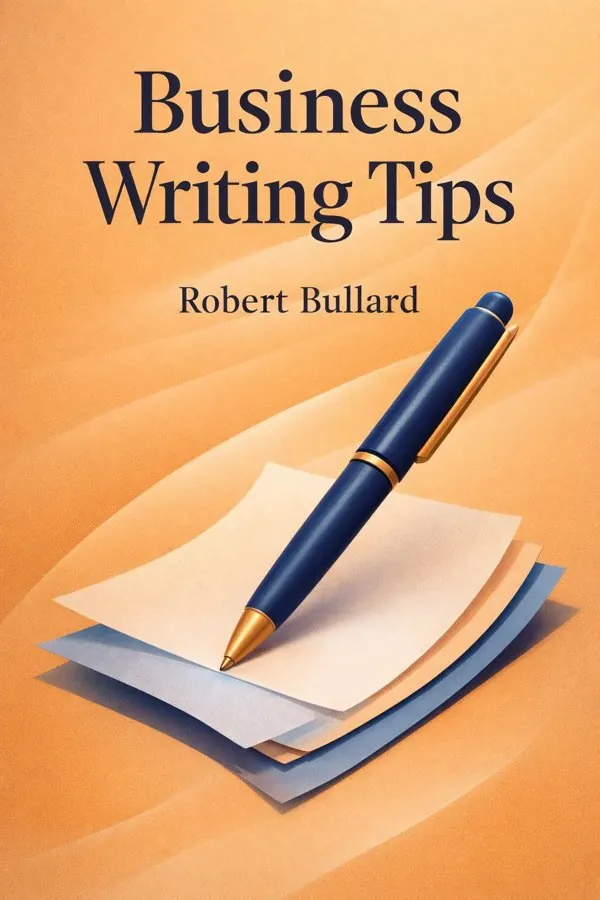
Business Writing Tips: Summary & Key Insights
 10 min8 chaptersAudio available
Key Takeaways from Business Writing Tips
One of the fastest ways to lose influence at work is to make people work too hard to understand you.
Most weak business writing does not fail because the writer lacks ideas; it fails because the ideas are buried.
The same message can open doors or create resistance depending on its tone.
Good business writing is rarely written once.
Strong business writing is not a talent reserved for a gifted few; it is a skill developed through repeated, conscious improvement.
What Is Business Writing Tips About?
Business Writing Tips by Robert Bullard is a communication book spanning 5 pages. Business Writing Tips is a practical guide to one of the most underrated professional skills: the ability to express ideas clearly, confidently, and persuasively in writing. Robert Bullard shows that business writing is not just about grammar or sounding professional. It is about getting results—earning trust, reducing confusion, speeding up decisions, and influencing people without wasting their time. Covering everyday workplace formats such as emails, reports, proposals, and promotional materials, the book explains how strong writing supports both efficiency and credibility. What makes this guide especially useful is its direct, applied approach. Rather than offering abstract rules, Bullard focuses on the real problems professionals face: messages that are too vague, reports that ramble, emails that create misunderstandings, and documents that fail to move readers to action. He breaks effective writing down into core principles such as clarity, structure, tone, persuasion, and editing, then shows how each can be improved immediately. As a business communication consultant and trainer, Bullard writes with practical authority. His advice is grounded in workplace realities, making this a valuable resource for anyone who wants their writing to sound sharper, smarter, and more effective.
This FizzRead summary covers all 8 key chapters of Business Writing Tips in approximately 10 minutes, distilling the most important ideas, arguments, and takeaways from Robert Bullard's work. Also available as an audio summary and Key Quotes Podcast.
Business Writing Tips
Business Writing Tips is a practical guide to one of the most underrated professional skills: the ability to express ideas clearly, confidently, and persuasively in writing. Robert Bullard shows that business writing is not just about grammar or sounding professional. It is about getting results—earning trust, reducing confusion, speeding up decisions, and influencing people without wasting their time. Covering everyday workplace formats such as emails, reports, proposals, and promotional materials, the book explains how strong writing supports both efficiency and credibility.
What makes this guide especially useful is its direct, applied approach. Rather than offering abstract rules, Bullard focuses on the real problems professionals face: messages that are too vague, reports that ramble, emails that create misunderstandings, and documents that fail to move readers to action. He breaks effective writing down into core principles such as clarity, structure, tone, persuasion, and editing, then shows how each can be improved immediately. As a business communication consultant and trainer, Bullard writes with practical authority. His advice is grounded in workplace realities, making this a valuable resource for anyone who wants their writing to sound sharper, smarter, and more effective.
Who Should Read Business Writing Tips?
This book is perfect for anyone interested in communication and looking to gain actionable insights in a short read. Whether you're a student, professional, or lifelong learner, the key ideas from Business Writing Tips by Robert Bullard will help you think differently.
- ✓Readers who enjoy communication and want practical takeaways
- ✓Professionals looking to apply new ideas to their work and life
- ✓Anyone who wants the core insights of Business Writing Tips in just 10 minutes
Want the full summary?
Get instant access to this book summary and 100K+ more with Fizz Moment.
Get Free SummaryAvailable on App Store • Free to download
Key Chapters
One of the fastest ways to lose influence at work is to make people work too hard to understand you. That is the foundation of Robert Bullard’s approach to business writing: professional communication is not judged by how intelligent the writer sounds, but by how easily the reader can grasp the message and act on it. Poor writing creates delays, mistakes, frustration, and lost credibility. Strong writing, by contrast, helps teams align, clients trust, and decisions move forward.
Bullard emphasizes that every business document has a job to do. An email may need to confirm a deadline. A proposal may need to persuade. A report may need to summarize evidence and recommend action. Before writing, the professional must ask three simple questions: Who is this for? What do they need? What do I want them to do next? These questions shift the focus away from self-expression and toward audience-centered communication.
This principle matters because many workplace messages fail not from lack of information, but from lack of intention. For example, a manager who writes a long email explaining background details but never states the required action leaves colleagues uncertain. A salesperson who sends a feature-heavy brochure without connecting benefits to client needs misses the opportunity to persuade. Good writing begins when purpose becomes clear.
Bullard also treats writing as a reflection of professionalism itself. People often assume writing is separate from competence, but in business the two are tightly linked. Readers use your writing to judge your thinking, attention to detail, and reliability. If your message is disorganized or careless, they may assume your work is too.
Actionable takeaway: before drafting any business document, write a one-sentence purpose statement and a one-sentence desired outcome. Let those two sentences guide everything that follows.
Most weak business writing does not fail because the writer lacks ideas; it fails because the ideas are buried. Bullard argues that clutter is the enemy of effective communication. Jargon, repetition, filler phrases, and overlong sentences slow the reader down and hide the main point. In a business environment, where people read quickly and decide even faster, clarity is not a stylistic luxury. It is a competitive advantage.
Clarity begins with word choice. Bullard advises writers to prefer familiar, concrete language over inflated business speak. Instead of saying, “We are endeavoring to facilitate the implementation of the initiative,” say, “We are starting the project.” The second version is shorter, clearer, and more human. Conciseness follows naturally when writers remove what adds no value. Phrases like “in order to,” “at this point in time,” or “it should be noted that” rarely strengthen a message.
Structure is the third pillar. Even clear sentences become ineffective if arranged poorly. Bullard recommends putting the main point early, organizing supporting information logically, and making documents easy to scan. Headings, bullet points, short paragraphs, and strong topic sentences help readers navigate content quickly. For example, a report should not force executives to search for the recommendation on page five. The conclusion or recommendation should be visible early and reinforced throughout.
This approach is especially useful in emails and updates. Compare “Just wanted to touch base regarding the timeline and some of the concerns we’ve been hearing” with “We need to move the launch from 12 June to 19 June because the testing phase is incomplete.” The second sentence saves time and reduces ambiguity.
Actionable takeaway: after drafting, edit every paragraph by asking three questions—what is the point, can it be said in fewer words, and is the most important information placed first?
The same message can open doors or create resistance depending on its tone. Bullard shows that tone in business writing is not about sounding nice for its own sake; it is about matching language to purpose, audience, and situation. Too cold, and you seem dismissive. Too casual, and you seem careless. Too aggressive, and readers may reject the message before considering its content.
A strong business writer learns to balance professionalism with humanity. This means being respectful without sounding stiff, confident without sounding arrogant, and direct without sounding rude. For example, an email that says, “You failed to provide the requested information” may be technically accurate but likely creates defensiveness. A more effective version might say, “I still need the sales figures from your team to complete the report by Thursday.” The focus shifts from blame to action.
Bullard also links tone to persuasion. Readers are more likely to respond positively when they feel understood. In proposals, this means framing ideas around the reader’s needs rather than the writer’s capabilities. Instead of “Our company has 20 years of expertise in logistics,” a more persuasive line might be, “Our process can reduce your delivery delays by simplifying stock coordination across sites.” The latter speaks to the client’s problem and desired outcome.
Tone matters especially in difficult communication: complaints, corrections, refusals, and negotiations. Here, Bullard recommends clear acknowledgment, calm language, and solution-focused phrasing. A poorly judged tone can escalate tension; a measured tone can preserve relationships while still communicating firm boundaries.
Actionable takeaway: before sending an important message, read it once only for tone. Ask yourself how it would sound if you were the recipient, and revise any line that feels harsher, vaguer, or more self-focused than necessary.
Good business writing is rarely written once. Bullard reminds readers that first drafts are for getting ideas down, while editing is what makes those ideas useful to others. Many professionals treat editing as a final grammar check, but in this book it is a deeper discipline: refining purpose, improving flow, eliminating confusion, and making the document easy to trust.
Bullard suggests editing at several levels. First, edit for substance: does the document actually achieve its purpose? If it is a proposal, does it clearly explain the benefit, cost, and next step? If it is a report, does it answer the question the report was meant to answer? Second, edit for structure: are ideas in the best order? Does each section lead naturally to the next? Third, edit for style: can sentences be shortened, jargon removed, and wording simplified? Only after that should the writer edit for grammar, punctuation, and formatting.
Presentation also affects impact. A polished layout signals competence before the reader even begins. Subject lines, headings, spacing, bullet points, and consistent fonts all contribute to readability. In digital communication, etiquette matters just as much. Emails should be concise, purposeful, and easy to act on. Overusing reply-all, writing vague subject lines, or sending emotional responses too quickly weakens professionalism.
Bullard’s broader point is that editing respects the reader. It shows that the writer has done the work of thinking clearly so others do not have to struggle through an unfinished message. A well-edited document builds confidence, while a careless one creates doubt.
Actionable takeaway: build a short editing checklist for every document: purpose, structure, clarity, tone, grammar, and formatting. Review each item before hitting send.
Strong business writing is not a talent reserved for a gifted few; it is a skill developed through repeated, conscious improvement. Bullard’s final message is encouraging: professionals do not need to become literary stylists to communicate well. They need to become more deliberate, more reader-focused, and more willing to learn from each document they produce.
Many people believe they are “bad writers” because they struggle with certain formats or because school writing never felt natural. Bullard challenges this mindset. Workplace writing improves when people study what works, notice where readers get confused, and revise their habits over time. A person who writes unclear emails can become effective by practicing stronger subject lines, clearer requests, and shorter paragraphs. A manager whose reports lack impact can improve by moving recommendations upfront and using evidence more selectively.
Feedback plays an important role here. Bullard encourages professionals to pay attention to how readers respond. Do colleagues ask follow-up questions that the document should already have answered? Do clients misunderstand pricing or scope? Do executives skip parts of reports? These reactions reveal where communication is breaking down. Improvement becomes easier when writing is treated as a business process that can be assessed and strengthened.
Reading strong business documents also helps. Exposure to effective proposals, concise memos, and persuasive reports gives writers practical models to imitate. Over time, confidence grows not from perfection but from consistency. When people know how to plan, draft, and edit with purpose, writing becomes less stressful and more reliable.
Actionable takeaway: choose one writing habit to improve this month—such as shorter emails, clearer openings, or stronger calls to action—and track progress across every document you write.
A document that says everything yet means little to its reader has failed. Bullard repeatedly returns to a vital principle: effective business writing begins with audience awareness. Too many professionals write from their own perspective, filling documents with background, technical language, or internal priorities that matter to them but not to the reader. The result is writing that may be accurate but still ineffective.
Audience awareness means understanding what readers already know, what they care about, what constraints they face, and what level of detail they need. A technical update written for engineers may require precise terminology and data. The same issue presented to senior executives should likely be summarized in terms of cost, timing, risk, and recommendation. Neither version is more correct in the abstract; each must be shaped to its audience.
This principle is especially important in cross-functional communication. Finance, marketing, operations, and leadership often look at the same issue through different lenses. A writer who recognizes this can tailor explanations accordingly. For instance, when proposing new software, an IT team might naturally emphasize system capabilities. But a more audience-aware proposal would explain how the software reduces manual work, shortens turnaround times, lowers error rates, and supports measurable business goals.
Bullard’s approach also improves customer communication. Clients rarely care about internal process details unless those details affect outcomes. They want to know what you recommend, why it helps them, and what happens next. Audience-aware writing is therefore more persuasive because it aligns information with reader interest.
Actionable takeaway: before writing, sketch a quick audience profile that includes the reader’s role, priorities, likely questions, and preferred level of detail. Then shape the message around that profile.
Many business documents lose their impact in the first few lines. Bullard points out that readers are often busy, distracted, and scanning quickly. If your opening does not establish relevance and direction immediately, your message may be ignored or misunderstood. That is why strong openings matter: they set expectations, frame the issue, and tell the reader why this message deserves attention.
In practical terms, Bullard recommends leading with the point rather than circling around it. An effective email might open with, “Please review the attached proposal by 3 p.m. Wednesday so we can submit the final version on Thursday.” In one sentence, the reader knows the task, the document, and the deadline. Compare that with a softer but weaker opening such as, “I hope you are well. I wanted to share some thoughts on the proposal and get your input when you have time.” The second version is polite, but it leaves urgency and next steps unclear.
The same principle applies to reports and proposals. A report opening should identify the issue and purpose of the document. A proposal opening should quickly connect the offering to the client’s need. After that, the document must include a clear call to action. Readers should not have to guess what response is expected—approve, reply, review, schedule, sign, or decide.
Bullard shows that action-oriented writing improves speed and accountability. It reduces the common workplace problem of messages that are read but not acted upon. A clear call to action includes what to do, by when, and sometimes why it matters.
Actionable takeaway: revise the first two lines and the final two lines of every document. Make the opening state the point quickly, and make the ending specify the exact next step.
A business document is useful only if it helps someone think, decide, or act. Bullard applies this insight especially strongly to reports and proposals, which often become overloaded with information but underpowered in terms of decision-making value. Too many reports merely collect data, and too many proposals merely describe services. Effective versions do more: they interpret information and move the reader toward a conclusion.
For reports, Bullard recommends a disciplined structure: define the issue, present relevant facts, interpret what those facts mean, and recommend action. Data without interpretation forces the reader to do unnecessary work. For example, a sales report should not only list regional figures; it should explain where performance is strongest, where risks are emerging, and what action is recommended in response. This makes the report a management tool rather than an archive.
In proposals, the key shift is from description to value. Clients are not just buying a product, service, or plan. They are buying a better outcome. Bullard encourages writers to frame proposals around the client’s problem, desired results, implementation approach, timeline, cost, and next step. Features matter, but only when linked to benefits. A proposal that says, “We provide weekly progress dashboards” becomes more persuasive when it says, “Weekly dashboards will give your team full visibility over timelines, helping prevent delays and budget surprises.”
This decision-oriented mindset also reduces unnecessary length. When writers know the reader’s decision needs, they can include what matters and cut what does not. The document becomes sharper, more persuasive, and easier to use.
Actionable takeaway: for every report or proposal, identify the decision it should support. Then make sure every section contributes directly to helping the reader make that decision.
All Chapters in Business Writing Tips
About the Author
Robert Bullard is a UK-based business communication consultant and trainer with a strong focus on professional writing skills. He has worked with organizations and professionals seeking to improve the clarity, tone, and effectiveness of their written communication, from internal emails and reports to external proposals and marketing materials. Bullard is known for translating communication principles into practical workplace habits that busy professionals can apply immediately. His writing and training emphasize reader-focused messaging, concise expression, and persuasive structure rather than abstract theory. Through guides such as Business Writing Tips and his broader consulting work, he has helped position business writing as a core professional skill—one that directly influences credibility, efficiency, and results in modern organizations.
Get This Summary in Your Preferred Format
Read or listen to the Business Writing Tips summary by Robert Bullard anytime, anywhere. FizzRead offers multiple formats so you can learn on your terms — all free.
Available formats: App · Audio · PDF · EPUB — All included free with FizzRead
Download Business Writing Tips PDF and EPUB Summary
Key Quotes from Business Writing Tips
“One of the fastest ways to lose influence at work is to make people work too hard to understand you.”
“Most weak business writing does not fail because the writer lacks ideas; it fails because the ideas are buried.”
“The same message can open doors or create resistance depending on its tone.”
“Good business writing is rarely written once.”
“Strong business writing is not a talent reserved for a gifted few; it is a skill developed through repeated, conscious improvement.”
Frequently Asked Questions about Business Writing Tips
Business Writing Tips by Robert Bullard is a communication book that explores key ideas across 8 chapters. Business Writing Tips is a practical guide to one of the most underrated professional skills: the ability to express ideas clearly, confidently, and persuasively in writing. Robert Bullard shows that business writing is not just about grammar or sounding professional. It is about getting results—earning trust, reducing confusion, speeding up decisions, and influencing people without wasting their time. Covering everyday workplace formats such as emails, reports, proposals, and promotional materials, the book explains how strong writing supports both efficiency and credibility. What makes this guide especially useful is its direct, applied approach. Rather than offering abstract rules, Bullard focuses on the real problems professionals face: messages that are too vague, reports that ramble, emails that create misunderstandings, and documents that fail to move readers to action. He breaks effective writing down into core principles such as clarity, structure, tone, persuasion, and editing, then shows how each can be improved immediately. As a business communication consultant and trainer, Bullard writes with practical authority. His advice is grounded in workplace realities, making this a valuable resource for anyone who wants their writing to sound sharper, smarter, and more effective.
You Might Also Like

Magic Words: The Science and Secrets Behind Seven Words That Motivate, Engage, and Influence
Tim David
10 min
Talking Across The Divide: How to Communicate with People You Disagree with and Maybe Even Change the World
Justin Lee
10 min
The Exceptional Presenter: A Proven Formula to Open Up! and Own the Room
Timothy J. Koegel
10 min
4 Essential Keys to Effective Communication in Love, Life, Work--Anywhere!: Including the 12-Day Communication Challenge!
Bento C. Leal III
10 min
Active Listening Techniques: 30 Practical Tools to Hone Your Communication Skills
Nisha Gupta
10 min
Bargaining for Advantage: Negotiation Strategies for Reasonable People
G. Richard Shell
10 minFeatured In
Browse by Category
Ready to read Business Writing Tips?
Get the full summary and 100K+ more books with Fizz Moment.