
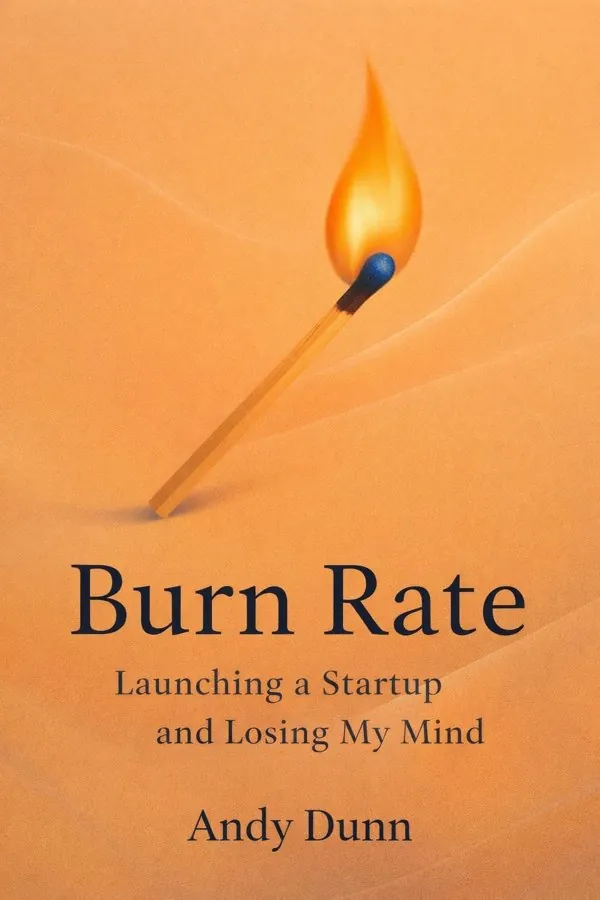
Burn Rate: Launching a Startup and Losing My Mind: Summary & Key Insights
by Andy Dunn
 10 min9 chaptersAudio available
Key Takeaways from Burn Rate: Launching a Startup and Losing My Mind
Before a founder builds a company, he usually builds a story about himself.
High-achieving institutions do more than educate people; they teach them what kind of person deserves admiration.
Many successful companies begin not with a grand theory but with an irritating everyday problem.
A company can be scaling beautifully while its founder is quietly falling apart.
Mental illness is not just emotional pain; it can be a radical break from reality.
What Is Burn Rate: Launching a Startup and Losing My Mind About?
Burn Rate: Launching a Startup and Losing My Mind by Andy Dunn is a biographies book spanning 11 pages. Burn Rate is a startup memoir unlike the usual triumphalist founder story. In this raw, self-examining book, Andy Dunn recounts how he helped build Bonobos from a quirky menswear idea into one of the most influential early e-commerce brands, while privately descending into severe bipolar disorder. The result is both a business narrative and a deeply personal account of mania, delusion, hospitalization, shame, recovery, and hard-won self-understanding. Dunn shows that the same traits often celebrated in entrepreneurs—relentless energy, grand vision, risk tolerance, and persuasive charisma—can also blur into danger when mental illness goes unrecognized. What makes the book matter is its refusal to separate professional success from emotional cost. Dunn writes not just about fundraising, branding, and leadership, but about family pressure, romantic upheaval, secrecy, and the devastating impact of untreated illness on the people closest to him. As Bonobos co-founder and former CEO, he has the authority of someone who lived the startup dream from the inside. As a mental health advocate, he also brings unusual honesty to a subject many leaders still avoid. Burn Rate is powerful because it asks a difficult question: what if success and suffering are more entangled than we want to admit?
This FizzRead summary covers all 9 key chapters of Burn Rate: Launching a Startup and Losing My Mind in approximately 10 minutes, distilling the most important ideas, arguments, and takeaways from Andy Dunn's work. Also available as an audio summary and Key Quotes Podcast.
Burn Rate: Launching a Startup and Losing My Mind
Burn Rate is a startup memoir unlike the usual triumphalist founder story. In this raw, self-examining book, Andy Dunn recounts how he helped build Bonobos from a quirky menswear idea into one of the most influential early e-commerce brands, while privately descending into severe bipolar disorder. The result is both a business narrative and a deeply personal account of mania, delusion, hospitalization, shame, recovery, and hard-won self-understanding. Dunn shows that the same traits often celebrated in entrepreneurs—relentless energy, grand vision, risk tolerance, and persuasive charisma—can also blur into danger when mental illness goes unrecognized.
What makes the book matter is its refusal to separate professional success from emotional cost. Dunn writes not just about fundraising, branding, and leadership, but about family pressure, romantic upheaval, secrecy, and the devastating impact of untreated illness on the people closest to him. As Bonobos co-founder and former CEO, he has the authority of someone who lived the startup dream from the inside. As a mental health advocate, he also brings unusual honesty to a subject many leaders still avoid. Burn Rate is powerful because it asks a difficult question: what if success and suffering are more entangled than we want to admit?
Who Should Read Burn Rate: Launching a Startup and Losing My Mind?
This book is perfect for anyone interested in biographies and looking to gain actionable insights in a short read. Whether you're a student, professional, or lifelong learner, the key ideas from Burn Rate: Launching a Startup and Losing My Mind by Andy Dunn will help you think differently.
- ✓Readers who enjoy biographies and want practical takeaways
- ✓Professionals looking to apply new ideas to their work and life
- ✓Anyone who wants the core insights of Burn Rate: Launching a Startup and Losing My Mind in just 10 minutes
Want the full summary?
Get instant access to this book summary and 100K+ more with Fizz Moment.
Get Free SummaryAvailable on App Store • Free to download
Key Chapters
Before a founder builds a company, he usually builds a story about himself. Dunn traces his entrepreneurial drive back to childhood, where family expectations, academic striving, and a desire to prove his worth quietly shaped his identity. Raised by parents who valued education, discipline, and upward mobility, he learned early that achievement was not just admirable but essential. That belief gave him resilience and hunger, but it also created a subtle danger: when self-worth depends too heavily on performance, ambition can become emotionally expensive.
In Burn Rate, early life is not filler before the “real” startup story begins. It is the foundation of everything that follows. Dunn suggests that the patterns founders carry into business—perfectionism, competitiveness, fear of failure, charm, and intensity—are often old adaptations, not new inventions. The startup world then amplifies those tendencies by rewarding overwork, confidence, and relentless self-belief. What looks like healthy drive from the outside may partly be compensation for insecurity within.
This idea has broad relevance beyond entrepreneurship. Professionals in law, medicine, finance, or academia often discover the same thing: the habits that help them rise can also trap them. A manager who never slows down may be driven less by passion than by fear of not mattering. A student obsessed with winning may be protecting a fragile sense of self.
Dunn’s story invites readers to examine their origin story with honesty. Which beliefs about success were inherited? Which emotional needs are disguised as career goals? Actionable takeaway: map your personal definition of success back to its roots, and identify one expectation you can loosen before it starts running your life.
High-achieving institutions do more than educate people; they teach them what kind of person deserves admiration. Dunn’s years at Northwestern and Stanford placed him inside cultures where intelligence, ambition, and social polish were constantly on display. These environments sharpened his confidence and exposed him to exceptional peers, but they also intensified comparison. In spaces where everyone is talented, identity can become a performance, and the pressure to stand out can distort judgment.
Dunn’s college and early career experiences show how ambition develops in competitive ecosystems. You learn to pitch yourself, network strategically, move fast, and equate busyness with importance. Those skills can be useful, especially for an aspiring entrepreneur, but they can also normalize emotional suppression. If everyone around you seems driven, composed, and upward-bound, admitting confusion or instability feels like weakness. This is one reason mental health issues can hide so well in elite circles: dysfunction is often masked as hustle.
The lesson is practical. Companies and universities frequently celebrate stamina and brilliance while overlooking the human costs of constant evaluation. A founder pulling all-nighters may be praised. A student who never rests may be admired. Yet sustainable excellence requires more than competitiveness; it requires psychological grounding.
Readers can apply this insight by questioning the metrics their environment rewards. Are you building a life or just winning a game designed by others? Leaders can also create healthier cultures by rewarding reflection, not just output. Actionable takeaway: identify one pressure in your current environment that pushes you toward performance over authenticity, and replace it with a habit that reconnects you to your actual values.
Many successful companies begin not with a grand theory but with an irritating everyday problem. Bonobos emerged from a simple observation: men had few good options for well-fitting pants, and the retail experience was often inefficient and uninspiring. Dunn and his co-founders built the business around a narrow but real customer pain point. That focus mattered. Rather than trying to revolutionize everything at once, they targeted a specific frustration and delivered a product that felt meaningfully better.
Burn Rate captures the early startup thrill: the conviction that a small insight can become a large business. Dunn describes the scrappiness of building Bonobos, the excitement of refining the brand, and the intensity of persuading investors, employees, and customers to believe in an unproven idea. He also shows that startup mythology often hides the mundane work beneath innovation. Product tweaks, customer feedback, inventory decisions, and fundraising stress are what turn vision into reality.
One of the book’s strongest entrepreneurial lessons is that brand matters when it expresses a real customer truth. Bonobos was not just selling clothing; it was selling ease, confidence, and a smarter buying experience. That clarity helped the company differentiate itself in crowded markets.
For entrepreneurs, the application is straightforward. Start with an obvious pain point that people already feel, then refine relentlessly based on real behavior rather than abstract strategy. For intrapreneurs inside larger firms, the same principle applies to process improvement and product design. Actionable takeaway: write down one recurring frustration your target audience faces, then test a focused solution before expanding your vision too broadly.
A company can be scaling beautifully while its founder is quietly falling apart. One of Dunn’s most unsettling insights is that external momentum does not guarantee internal stability. As Bonobos grew, the business generated the signals that investors, media, and employees love: traction, narrative, ambition, expansion. Yet beneath those markers of success, Dunn was battling forces he did not fully understand. The startup itself became both a source of pride and a mechanism for concealment.
This is one of the book’s core contributions. It challenges the assumption that visible achievement reflects private well-being. In startup culture especially, intensity is romanticized. Sleep deprivation, impulsive decisions, exaggerated confidence, and obsessive focus can be interpreted as founder magic rather than warning signs. That makes it difficult for teams, boards, and founders themselves to recognize when something is wrong.
Dunn’s experience reveals how easily the language of entrepreneurship can overlap with the language of mania: big vision, unstoppable energy, unusual conviction, and willingness to defy conventional limits. None of those traits are bad in themselves. The problem is that high-growth environments often reward them without asking whether they are grounded in sound judgment.
This idea matters beyond startups. Any fast-moving career can create enough adrenaline and validation to postpone self-recognition. Professionals tell themselves they will rest after the next deal, product launch, exam, or promotion. Often, they never do.
Leaders can respond by normalizing check-ins, encouraging reality-based decision processes, and refusing to equate constant intensity with excellence. Actionable takeaway: if your output is rising but your sleep, relationships, or impulse control are deteriorating, treat that mismatch as a signal to seek support rather than push harder.
Mental illness is not just emotional pain; it can be a radical break from reality. Dunn’s account of bipolar disorder is powerful because he does not romanticize it. He shows how mania can feel exhilarating, expansive, even spiritually significant, while simultaneously becoming dangerous, humiliating, and destructive. Grandiosity, paranoia, racing thoughts, erratic behavior, and fractured judgment can make the person experiencing them feel uniquely clear-headed even as their life becomes unrecognizable to everyone else.
In Burn Rate, the onset and escalation of Dunn’s mental health crisis reveal how hard bipolar disorder can be to identify, especially when it appears in someone already known for charisma, intensity, and ambition. Friends and colleagues may see unusual behavior without understanding its seriousness. The individual may interpret symptoms as insight, destiny, or righteous energy. By the time the crisis becomes undeniable, serious damage may already have been done.
Dunn’s honesty helps dismantle harmful stereotypes. Bipolar disorder is not simply moodiness or eccentric brilliance. It is a severe condition that can devastate careers, relationships, and physical safety if untreated. The book also underscores the importance of diagnosis, medication, medical care, and ongoing support.
For readers, the practical application is awareness. If someone shows dramatic shifts in sleep, speech, spending, impulsivity, confidence, or paranoia, do not reduce it to stress or personality. Learn the signs and take them seriously. If you recognize these patterns in yourself, professional help matters far more than self-management alone. Actionable takeaway: educate yourself on one concrete symptom profile of bipolar disorder and use that knowledge to respond earlier, with compassion and urgency.
Healing often starts not with a breakthrough insight but with the collapse of concealment. For Dunn, recovery required facing the truth that his life could not improve while his illness remained hidden behind professional identity, charm, and selective storytelling. Bipolar disorder had affected not only his own mind but his relationships, reputation, and sense of self. Real recovery meant accepting treatment, naming what had happened, and rebuilding trust slowly rather than trying to outwork the damage.
This part of the memoir is especially valuable because it rejects the fantasy of quick redemption. Dunn does not portray recovery as a clean upward arc. It involves medication, uncertainty, shame, reflection, accountability, and the difficult process of integrating a painful past into a livable future. He must confront not only what illness did to him, but what he did while ill. That distinction matters. Compassion for a condition does not eliminate the need for responsibility.
The broader lesson is that secrecy intensifies suffering. People hide mental health struggles because they fear stigma, professional consequences, or the loss of credibility. Yet the cost of hiding is often delayed care and deeper isolation. In workplaces, families, and friendships, openness does not solve everything, but it creates the conditions for support.
Readers can apply this insight by reconsidering where shame is keeping them silent. That may mean seeing a psychiatrist, telling a trusted friend the truth, or acknowledging that “coping” is no longer working. Actionable takeaway: choose one person or professional with whom you can be fully honest about your mental or emotional state, and make that conversation happen soon rather than waiting for a crisis.
Leadership is often associated with confidence, decisiveness, and control, but Dunn argues that those qualities become brittle when they are disconnected from honesty. One of the most compelling threads in Burn Rate is his evolving understanding that vulnerability is not the opposite of leadership. In many cases, it is what makes leadership credible. By eventually speaking openly about bipolar disorder, he challenged the standard founder script that prizes certainty and invincibility above all else.
This does not mean leaders should overshare indiscriminately or turn every workplace into therapy. The deeper point is that trust grows when people sense congruence between public role and private reality. Teams do not need perfect leaders; they need leaders who can tell the truth, ask for help, and make decisions from a place of self-awareness rather than denial. A founder who admits limits can build healthier systems than one who insists on omnipotence.
Dunn’s experience also reveals the practical business value of vulnerability. It can reduce stigma, encourage employees to seek support earlier, and create a culture where people discuss risk before it becomes disaster. In this sense, emotional openness is not merely moral; it is operationally wise.
For managers, this might mean acknowledging burnout, discussing sustainable work norms, or being candid about mistakes. For entrepreneurs, it may mean building governance structures that do not depend on a single heroic personality. Actionable takeaway: practice one form of leadership transparency this week—admit a limitation, ask for informed support, or name a challenge clearly instead of hiding it behind confidence.
No founder builds a company alone, and no mental health crisis affects only one person. Dunn’s memoir shows how entrepreneurship and illness both reverberate through intimate relationships. Family members, romantic partners, friends, and colleagues absorb the consequences of obsession, absence, secrecy, erratic behavior, and emotional volatility. In his marriage especially, the book explores how love can coexist with confusion, fear, and strain when one partner is unwell and the other is left trying to understand what is happening.
This is a crucial corrective to self-centered success narratives. Ambition is often described as a personal journey, but the costs are social. Every hour given to work is taken from somewhere else. Every untreated symptom becomes a burden others must interpret, manage, or survive. Dunn does not flatten these complexities into easy lessons. Instead, he highlights the painful truth that support from loved ones is invaluable but not infinitely durable, especially when illness and denial persist together.
Readers can draw two practical insights here. First, major professional goals should be discussed as relational realities, not private quests. Second, mental health care is an act of care toward others, not just oneself. The healthiest relationships involve boundaries, communication, and shared recognition of what each person can and cannot carry.
Whether you are pursuing a startup, a demanding career, or another high-stakes goal, ask not only what it requires from you, but what it extracts from those around you. Actionable takeaway: have one honest conversation with someone close to you about how your work intensity or emotional state is affecting them, and listen without defensiveness.
Selling a company can look like the perfect ending, but Dunn shows that external milestones do not automatically produce inner resolution. Bonobos’ sale to Walmart marked a major business achievement and validated years of effort, sacrifice, and risk. Yet even a landmark exit could not, by itself, repair the fractures created by mental illness, shame, and a divided self. This is one of the memoir’s most mature insights: accomplishment can change your circumstances while leaving deeper psychological questions untouched.
Dunn’s transition after Bonobos underscores how many professionals organize their identity around striving. When the startup chapter changes, a person is forced to confront what remains beyond the role. If success has functioned as proof of worth, then even victory can feel disorienting. The same is true after promotions, awards, tenure, or financial windfalls. Achievement often removes one set of anxieties only to expose another: Who am I without the chase? What did it cost? What parts of me were neglected along the way?
The later parts of Burn Rate suggest that integration matters more than image. Public disclosure, advocacy, and reflection become ways for Dunn to align his story rather than splitting it into glamorous success and hidden suffering. That integration does not erase pain, but it creates coherence.
Readers can apply this by resisting the belief that the next milestone will settle every internal conflict. Ambition is useful; salvation is too much to ask of it. Actionable takeaway: define one measure of a good life that is not based on status or achievement, and begin investing in it now rather than after your next professional win.
All Chapters in Burn Rate: Launching a Startup and Losing My Mind
About the Author
Andy Dunn is an American entrepreneur, author, and advocate best known as the co-founder of Bonobos, a pioneering direct-to-consumer menswear brand that helped reshape online retail. As CEO, he played a central role in building Bonobos from a startup into a widely recognized ecommerce company later acquired by Walmart. Educated at Northwestern University and Stanford Graduate School of Business, Dunn became known for his sharp thinking on branding, digital commerce, and consumer experience. He is also widely respected for speaking openly about his experience with bipolar disorder, helping bring mental health conversations into the business and startup worlds. Through Burn Rate, Dunn has expanded his influence beyond entrepreneurship, offering a candid perspective on leadership, identity, ambition, and recovery.
Get This Summary in Your Preferred Format
Read or listen to the Burn Rate: Launching a Startup and Losing My Mind summary by Andy Dunn anytime, anywhere. FizzRead offers multiple formats so you can learn on your terms — all free.
Available formats: App · Audio · PDF · EPUB — All included free with FizzRead
Download Burn Rate: Launching a Startup and Losing My Mind PDF and EPUB Summary
Key Quotes from Burn Rate: Launching a Startup and Losing My Mind
“Before a founder builds a company, he usually builds a story about himself.”
“High-achieving institutions do more than educate people; they teach them what kind of person deserves admiration.”
“Many successful companies begin not with a grand theory but with an irritating everyday problem.”
“A company can be scaling beautifully while its founder is quietly falling apart.”
“Mental illness is not just emotional pain; it can be a radical break from reality.”
Frequently Asked Questions about Burn Rate: Launching a Startup and Losing My Mind
Burn Rate: Launching a Startup and Losing My Mind by Andy Dunn is a biographies book that explores key ideas across 9 chapters. Burn Rate is a startup memoir unlike the usual triumphalist founder story. In this raw, self-examining book, Andy Dunn recounts how he helped build Bonobos from a quirky menswear idea into one of the most influential early e-commerce brands, while privately descending into severe bipolar disorder. The result is both a business narrative and a deeply personal account of mania, delusion, hospitalization, shame, recovery, and hard-won self-understanding. Dunn shows that the same traits often celebrated in entrepreneurs—relentless energy, grand vision, risk tolerance, and persuasive charisma—can also blur into danger when mental illness goes unrecognized. What makes the book matter is its refusal to separate professional success from emotional cost. Dunn writes not just about fundraising, branding, and leadership, but about family pressure, romantic upheaval, secrecy, and the devastating impact of untreated illness on the people closest to him. As Bonobos co-founder and former CEO, he has the authority of someone who lived the startup dream from the inside. As a mental health advocate, he also brings unusual honesty to a subject many leaders still avoid. Burn Rate is powerful because it asks a difficult question: what if success and suffering are more entangled than we want to admit?
You Might Also Like

An American Marriage
Tayari Jones
10 min
Benjamin Franklin: An American Life
Walter Isaacson
10 min
I Know Why The Caged Bird Sings
Maya Angelou
10 min
Long Walk to Freedom
Nelson Mandela
10 min
Persepolis
Marjane Satrapi
10 min
Surely You're Joking, Mr. Feynman!
Richard P. Feynman
10 minBrowse by Category
Ready to read Burn Rate: Launching a Startup and Losing My Mind?
Get the full summary and 100K+ more books with Fizz Moment.