
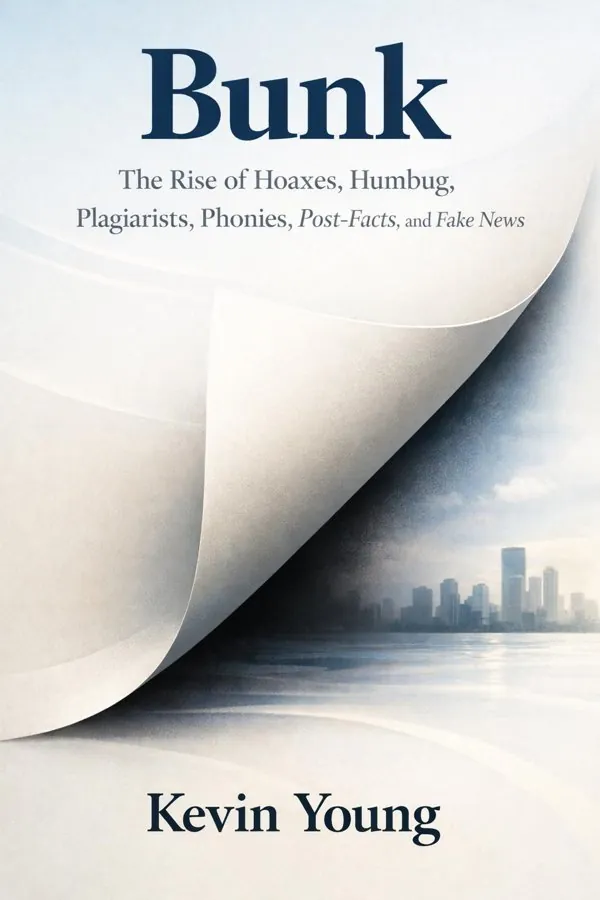
Bunk: The Rise of Hoaxes, Humbug, Plagiarists, Phonies, Post-Facts, and Fake News: Summary & Key Insights
by Kevin Young
 10 min9 chaptersAudio available
Key Takeaways from Bunk: The Rise of Hoaxes, Humbug, Plagiarists, Phonies, Post-Facts, and Fake News
A society that loves entertainment more than evidence becomes easy to fool.
When fiction disguises itself as fact, it reveals how fragile public trust can be.
Few deceptions are more damaging than those that turn identity into spectacle.
Every successful fraud depends on a relationship, not just a lie.
Some fakes do not invent from nothing; they steal the labor and identity of others.
What Is Bunk: The Rise of Hoaxes, Humbug, Plagiarists, Phonies, Post-Facts, and Fake News About?
Bunk: The Rise of Hoaxes, Humbug, Plagiarists, Phonies, Post-Facts, and Fake News by Kevin Young is a civilization book spanning 11 pages. Kevin Young’s Bunk is a sweeping cultural history of American deception, showing that fake news did not begin with social media and political disinformation did not appear out of nowhere. Instead, Young traces a long national tradition of humbug, fraud, impersonation, plagiarism, forgery, and spectacle—from P. T. Barnum and Edgar Allan Poe to fabricated memoirs, political lies, and internet-age misinformation. His argument is not simply that America has always had hoaxes, but that deception is woven into the country’s ideas about race, celebrity, authenticity, and power. What makes the book especially urgent is its insistence that fakery is never just entertainment. Hoaxes shape public belief, influence policy, distort history, and often exploit the most vulnerable. Young pays particular attention to how race has been central to American fraud, from blackface performance to false claims of authority over Black stories and identities. As a poet, critic, and leading cultural historian, Young brings literary sensitivity, historical range, and moral clarity to the subject. Bunk matters because it helps readers understand why lies spread so easily, why spectacle often beats truth, and how a culture obsessed with the “real” becomes especially vulnerable to the fake.
This FizzRead summary covers all 9 key chapters of Bunk: The Rise of Hoaxes, Humbug, Plagiarists, Phonies, Post-Facts, and Fake News in approximately 10 minutes, distilling the most important ideas, arguments, and takeaways from Kevin Young's work. Also available as an audio summary and Key Quotes Podcast.
Bunk: The Rise of Hoaxes, Humbug, Plagiarists, Phonies, Post-Facts, and Fake News
Kevin Young’s Bunk is a sweeping cultural history of American deception, showing that fake news did not begin with social media and political disinformation did not appear out of nowhere. Instead, Young traces a long national tradition of humbug, fraud, impersonation, plagiarism, forgery, and spectacle—from P. T. Barnum and Edgar Allan Poe to fabricated memoirs, political lies, and internet-age misinformation. His argument is not simply that America has always had hoaxes, but that deception is woven into the country’s ideas about race, celebrity, authenticity, and power.
What makes the book especially urgent is its insistence that fakery is never just entertainment. Hoaxes shape public belief, influence policy, distort history, and often exploit the most vulnerable. Young pays particular attention to how race has been central to American fraud, from blackface performance to false claims of authority over Black stories and identities. As a poet, critic, and leading cultural historian, Young brings literary sensitivity, historical range, and moral clarity to the subject. Bunk matters because it helps readers understand why lies spread so easily, why spectacle often beats truth, and how a culture obsessed with the “real” becomes especially vulnerable to the fake.
Who Should Read Bunk: The Rise of Hoaxes, Humbug, Plagiarists, Phonies, Post-Facts, and Fake News?
This book is perfect for anyone interested in civilization and looking to gain actionable insights in a short read. Whether you're a student, professional, or lifelong learner, the key ideas from Bunk: The Rise of Hoaxes, Humbug, Plagiarists, Phonies, Post-Facts, and Fake News by Kevin Young will help you think differently.
- ✓Readers who enjoy civilization and want practical takeaways
- ✓Professionals looking to apply new ideas to their work and life
- ✓Anyone who wants the core insights of Bunk: The Rise of Hoaxes, Humbug, Plagiarists, Phonies, Post-Facts, and Fake News in just 10 minutes
Want the full summary?
Get instant access to this book summary and 100K+ more with Fizz Moment.
Get Free SummaryAvailable on App Store • Free to download
Key Chapters
A society that loves entertainment more than evidence becomes easy to fool. Kevin Young begins with P. T. Barnum because Barnum understood a lasting truth about American culture: people are often willing participants in deception when it is packaged as wonder, novelty, and excitement. Barnum’s genius was not merely inventing frauds, but selling them as a form of mutual play. He called it “humbug,” a softer, almost charming label that made deception seem harmless, even democratic.
Barnum’s exhibitions blurred the line between trickery and consent. Audiences came to see curiosities that were exaggerated, manipulated, or entirely fabricated, but many enjoyed the experience anyway. That is the deeper lesson Young draws: fraud succeeds not only because liars exist, but because publics often want to be delighted, affirmed, or shocked. The hoax becomes a performance, and belief becomes part of the ticket price.
This pattern still shapes modern media. Clickbait headlines, celebrity scandals, manipulated images, and sensational “breaking news” all depend on the Barnum formula: create urgency, promise access to something extraordinary, and let curiosity outrun skepticism. Even when audiences later discover the truth, the emotional effect of the spectacle often lingers.
In daily life, this means we should be wary of claims designed to overwhelm us before we can think. Ask what incentive is driving the presentation. Is the message trying to inform, or merely provoke reaction? Young’s insight is that humbug survives because it flatters the audience’s appetite for amazement.
Actionable takeaway: whenever something seems perfectly engineered to shock, flatter, or entertain you, pause before believing it and examine who benefits from your attention.
When fiction disguises itself as fact, it reveals how fragile public trust can be. Young shows that the nineteenth century was not just an age of newspapers and expanding literacy, but also an age in which writers learned to exploit the authority of print. Figures such as Edgar Allan Poe and other newspaper-era authors played with fabricated reports, invented discoveries, and false firsthand accounts. These literary hoaxes were clever, but they also exposed how easily readers confuse style, confidence, and publication with truth.
Print culture gave lies a powerful disguise. A story that appeared in a newspaper looked official simply because it was typeset and circulated. Readers often lacked the tools, time, or access needed to verify claims. In that environment, fabrication thrived. Young is interested in more than isolated pranks; he shows how the literary hoax became training ground for a wider culture of misinformation. Once readers become accustomed to uncertainty, the distinction between report and performance weakens.
The modern parallel is obvious. Viral posts, AI-generated text, doctored screenshots, and pseudonymous commentary often borrow the appearance of legitimacy. A polished format, a familiar tone, or a platform logo can create trust before any evidence is examined. The same instincts that made nineteenth-century readers vulnerable operate online today.
Young’s broader point is that media literacy is not a new problem. Every communication technology creates fresh opportunities for imitation and manipulation. Readers must learn not only to interpret content, but to question context: where did this originate, who is vouching for it, and what signs of verification are missing?
Actionable takeaway: do not confuse professional presentation with credibility; always trace dramatic claims back to a reliable original source before sharing or repeating them.
Few deceptions are more damaging than those that turn identity into spectacle. One of Young’s most original contributions is his argument that race lies at the center of America’s history of fakery. He examines blackface minstrelsy, passing, impersonation, and the long tradition of white figures claiming authority over Black voice, Black pain, and Black creativity. In these cases, fraud is not incidental. It is a structure of cultural power.
Blackface is a prime example. It presented false versions of Black life as entertainment for white audiences while excluding real Black people from power over their own representation. The lie was profitable because it seemed authentic to those who wanted it to be. Young shows that this pattern extends beyond stage performance into publishing, music, politics, and journalism. Again and again, fabricated Blackness has been rewarded while real Black testimony has been ignored, doubted, or commodified.
This helps explain why debates about authenticity are never merely aesthetic. Who gets believed? Who gets published? Who is allowed to represent whom? Fraud in matters of race often works by exploiting unequal power: one group controls the story while another bears the consequences.
Today, similar issues appear in identity fraud scandals, appropriated narratives, and branding that borrows from marginalized cultures without accountability. Young pushes readers to see that “fake” is not only about false facts. It can also mean false authority, false ownership, and false performance of experience.
Actionable takeaway: when evaluating cultural work or public testimony, ask not just whether it sounds convincing, but who is speaking, whose story is being used, and who has the power to define what counts as authentic.
Every successful fraud depends on a relationship, not just a lie. Young draws on the American figure of the confidence man to show that deception often works through trust, intimacy, and emotional reading. The con artist does not simply invent false information; he studies desire. He identifies what people hope for—status, profit, moral superiority, belonging, rescue—and then offers a story tailored to that need.
This is why fraud can feel persuasive even when evidence is thin. Confidence men project certainty, charisma, and personal connection. They make victims feel specially chosen rather than manipulated. In Young’s account, the confidence man becomes a larger metaphor for American social and political culture. Advertising, celebrity branding, financial speculation, and campaign rhetoric all rely, to some extent, on winning belief before delivering proof.
The concept also helps explain why smart people fall for bad claims. Fraud is rarely about ignorance alone. It often succeeds because it aligns with a person’s hopes or identity. A miracle investment, a too-perfect memoir, a political savior, or an exclusive insider narrative can all function like confidence schemes. The victim is not merely tricked; they are recruited into the emotional world of the deception.
This insight has practical value. To resist manipulation, people must understand their own susceptibilities. Which messages make you feel uniquely seen, morally righteous, or urgently lucky? Those are often the moments when critical judgment weakens.
Young suggests that American culture rewards confidence so strongly that we often mistake performance for credibility. The bold speaker appears truer than the careful one.
Actionable takeaway: when someone asks for your trust before offering verification, slow down and test the claim against evidence rather than charisma.
A fake can reveal what a culture is prepared to value. Young extends his study beyond journalism and literature into art, music, and cultural memory, where forgery often flourishes because audiences desperately want access to genius, rarity, or origin. A forged painting, a fabricated folk tradition, or a misattributed song succeeds when institutions and consumers are eager for a meaningful artifact and unwilling to examine the evidence too closely.
Forgery is especially revealing because it mimics not just an object, but a whole system of belief. For a fake artwork to circulate, experts, collectors, critics, and markets must participate in assigning value. The forgery exposes the social machinery behind authenticity. Why does one object command reverence? How much of that reverence comes from the story attached to it rather than the object itself?
Young connects this to broader American habits of mythmaking. The desire for origins—for the first, the pure, the undiscovered, the truly native—creates a market for inventions. Cultural products become loaded with fantasies of authenticity, especially when linked to race and national identity. In that sense, forgery is never just an isolated crime; it is also a mirror reflecting collective desire.
For readers, this lesson applies well beyond museums. Brands manufacture heritage. Public figures craft backstories. Institutions build symbolic legitimacy through selective storytelling. We encounter “authenticity” as a sales pitch every day.
Young encourages skepticism without cynicism. The goal is not to assume everything is fake, but to ask how authenticity is being constructed. Evidence, provenance, and institutional accountability matter.
Actionable takeaway: whenever value depends heavily on a compelling origin story, investigate the chain of evidence behind that story instead of accepting authenticity as a marketing aura.
Political deception succeeds best where everyday deception has already normalized confusion. Young links fake news and post-fact politics to a much longer history of American mythmaking. Politicians do not invent the public’s susceptibility from scratch. They inherit a culture trained by advertising, spectacle, racial fictions, conspiracy thinking, and sensational media to accept performance as reality.
This helps explain why some political lies endure even when thoroughly debunked. They are not sustained by evidence but by usefulness. A false story can justify exclusion, inflame resentment, simplify complex problems, or protect existing power. Young insists that lies are never neutral. They serve interests. In the American context, many of the most durable lies have supported racial hierarchy, nationalist fantasy, or institutional self-protection.
Post-fact culture, then, is not a condition where facts literally disappear. It is a condition where facts lose authority compared with narrative, tribe, and repetition. Political actors exploit this by flooding the public sphere with claims, counterclaims, and emotional slogans until citizens feel exhausted and uncertain. Once truth seems inaccessible, manipulation becomes easier.
The practical lesson is that truth requires institutions and habits: honest reporting, historical memory, archival integrity, and public willingness to tolerate complexity. Democracy depends on more than free expression; it depends on shared standards for evaluating competing claims.
Young does not offer simplistic optimism, but he does suggest that recognizing the long lineage of political deception can help readers resist fatalism. If lies are made, they can also be exposed.
Actionable takeaway: evaluate political claims by asking what material interest they serve, what evidence supports them, and whether they rely on fear, simplification, or scapegoating to gain power.
The most unsettling fact about deception is that it often meets a genuine human need. Young’s history of bunk ultimately becomes a study of belief itself. Why do people accept fabrications, even after repeated disappointments? His answer is subtle: hoaxes thrive because they satisfy emotional desires that plain truth often cannot. People want wonder, certainty, identity, explanation, and connection. A good fake offers these in concentrated form.
That does not mean victims are foolish. It means belief is social and psychological. We rely on shortcuts, trust familiar signals, defer to authority, and seek stories that fit what we already suspect. In anxious times, these tendencies intensify. Ambiguous reality is tiring; a vivid lie can feel clarifying. This is why conspiracy theories and sensational myths can become addictive. They transform confusion into pattern.
Young’s treatment pushes readers beyond easy moralizing. The challenge is not simply to condemn liars, though liars deserve condemnation. It is also to understand the conditions that make lies attractive. If institutions are untrustworthy, if communities feel unseen, if information systems are chaotic, bunk finds fertile ground.
That insight has practical importance for families, workplaces, classrooms, and civic life. Correcting people effectively often requires addressing the need the false belief is serving. Facts matter, but so do trust, tone, and belonging.
In the end, Young suggests that the desire for authenticity can itself make us vulnerable. The more desperately we want the pure, the hidden, the finally real, the more likely we are to fall for those who package certainty.
Actionable takeaway: when a claim feels instantly satisfying, ask what emotional need it fulfills in you before deciding whether it is true.
All Chapters in Bunk: The Rise of Hoaxes, Humbug, Plagiarists, Phonies, Post-Facts, and Fake News
About the Author
Kevin Young is an American poet, essayist, editor, and cultural historian whose work often explores memory, race, art, and the making of American identity. He has published multiple acclaimed books of poetry and nonfiction, earning recognition for combining lyrical intelligence with sharp critical insight. Young has also played major roles in American literary and cultural life, including serving as poetry editor of The New Yorker and as director of the Smithsonian’s National Museum of African American History and Culture. His scholarship frequently examines how stories, archives, and public narratives shape collective memory. In Bunk, Young brings together his strengths as a literary critic and historian, offering a rich account of hoaxes and fakery in American culture while showing how closely questions of truth are tied to power, performance, and representation.
Get This Summary in Your Preferred Format
Read or listen to the Bunk: The Rise of Hoaxes, Humbug, Plagiarists, Phonies, Post-Facts, and Fake News summary by Kevin Young anytime, anywhere. FizzRead offers multiple formats so you can learn on your terms — all free.
Available formats: App · Audio · PDF · EPUB — All included free with FizzRead
Download Bunk: The Rise of Hoaxes, Humbug, Plagiarists, Phonies, Post-Facts, and Fake News PDF and EPUB Summary
Key Quotes from Bunk: The Rise of Hoaxes, Humbug, Plagiarists, Phonies, Post-Facts, and Fake News
“A society that loves entertainment more than evidence becomes easy to fool.”
“When fiction disguises itself as fact, it reveals how fragile public trust can be.”
“Few deceptions are more damaging than those that turn identity into spectacle.”
“Every successful fraud depends on a relationship, not just a lie.”
“Some fakes do not invent from nothing; they steal the labor and identity of others.”
Frequently Asked Questions about Bunk: The Rise of Hoaxes, Humbug, Plagiarists, Phonies, Post-Facts, and Fake News
Bunk: The Rise of Hoaxes, Humbug, Plagiarists, Phonies, Post-Facts, and Fake News by Kevin Young is a civilization book that explores key ideas across 9 chapters. Kevin Young’s Bunk is a sweeping cultural history of American deception, showing that fake news did not begin with social media and political disinformation did not appear out of nowhere. Instead, Young traces a long national tradition of humbug, fraud, impersonation, plagiarism, forgery, and spectacle—from P. T. Barnum and Edgar Allan Poe to fabricated memoirs, political lies, and internet-age misinformation. His argument is not simply that America has always had hoaxes, but that deception is woven into the country’s ideas about race, celebrity, authenticity, and power. What makes the book especially urgent is its insistence that fakery is never just entertainment. Hoaxes shape public belief, influence policy, distort history, and often exploit the most vulnerable. Young pays particular attention to how race has been central to American fraud, from blackface performance to false claims of authority over Black stories and identities. As a poet, critic, and leading cultural historian, Young brings literary sensitivity, historical range, and moral clarity to the subject. Bunk matters because it helps readers understand why lies spread so easily, why spectacle often beats truth, and how a culture obsessed with the “real” becomes especially vulnerable to the fake.
You Might Also Like
The Structure of Scientific Revolutions
Thomas S. Kuhn
10 min
Genius
Harold Bloom
10 min
A Cultural History of the Medieval Age
Various Editors
10 min
A History of God: The 4,000-Year Quest of Judaism, Christianity and Islam
Karen Armstrong
10 min
A History of the World in 10½ Chapters
Julian Barnes
10 min
A Short History of Progress
Ronald Wright
10 minBrowse by Category
Ready to read Bunk: The Rise of Hoaxes, Humbug, Plagiarists, Phonies, Post-Facts, and Fake News?
Get the full summary and 100K+ more books with Fizz Moment.