
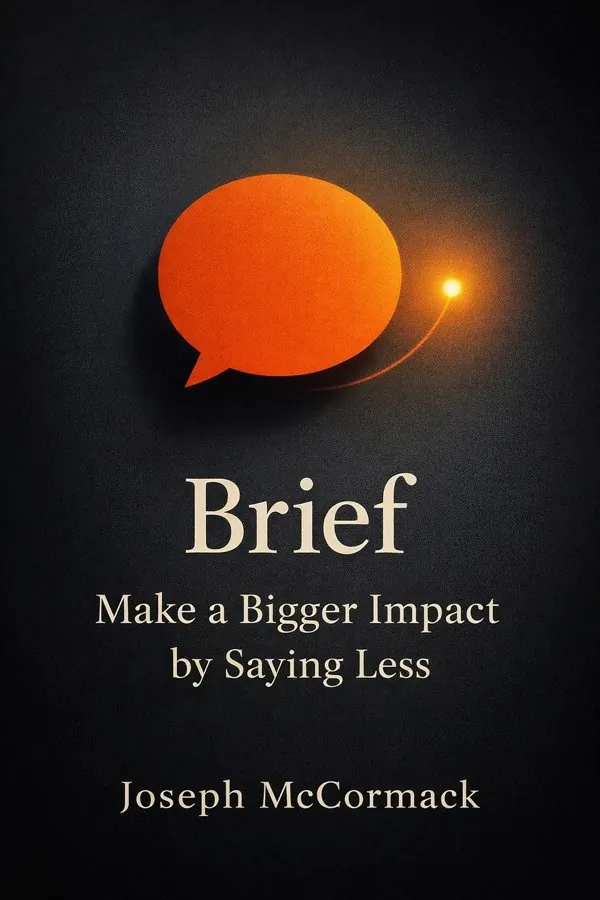
Brief: Make a Bigger Impact by Saying Less: Summary & Key Insights
 10 min9 chaptersAudio available
Key Takeaways from Brief: Make a Bigger Impact by Saying Less
Most people assume that being brief means leaving out substance.
The modern workplace does not suffer from a lack of communication.
People often speak too long because they have not thought deeply enough beforehand.
A message becomes brief and effective not just by cutting words, but by arranging ideas well.
One of the smartest ideas in the book is that brevity begins with empathy.
What Is Brief: Make a Bigger Impact by Saying Less About?
Brief: Make a Bigger Impact by Saying Less by Joseph McCormack is a communication book spanning 7 pages. In Brief: Make a Bigger Impact by Saying Less, Joseph McCormack argues that one of the most valuable professional skills today is not speaking more, but communicating with precision. In a world crowded with emails, presentations, meetings, reports, and endless digital interruptions, people are overwhelmed by information and starved for clarity. McCormack shows that brevity is not about being simplistic or cutting important details. It is about delivering the right message, in the right amount, at the right time, so people can quickly understand and act. Drawing on his experience as a communication strategist and founder of The BRIEF Lab, McCormack explains why long-winded communication wastes attention, reduces impact, and often hides weak thinking. He offers practical frameworks for preparing ideas, structuring messages, understanding audiences, and speaking with discipline in high-stakes situations. The book is especially useful for leaders, managers, sales professionals, consultants, and anyone who needs to persuade others under time pressure. Its central promise is compelling: when you learn to say less with greater intention, your message becomes more memorable, more persuasive, and far more effective.
This FizzRead summary covers all 9 key chapters of Brief: Make a Bigger Impact by Saying Less in approximately 10 minutes, distilling the most important ideas, arguments, and takeaways from Joseph McCormack's work. Also available as an audio summary and Key Quotes Podcast.
Brief: Make a Bigger Impact by Saying Less
In Brief: Make a Bigger Impact by Saying Less, Joseph McCormack argues that one of the most valuable professional skills today is not speaking more, but communicating with precision. In a world crowded with emails, presentations, meetings, reports, and endless digital interruptions, people are overwhelmed by information and starved for clarity. McCormack shows that brevity is not about being simplistic or cutting important details. It is about delivering the right message, in the right amount, at the right time, so people can quickly understand and act.
Drawing on his experience as a communication strategist and founder of The BRIEF Lab, McCormack explains why long-winded communication wastes attention, reduces impact, and often hides weak thinking. He offers practical frameworks for preparing ideas, structuring messages, understanding audiences, and speaking with discipline in high-stakes situations. The book is especially useful for leaders, managers, sales professionals, consultants, and anyone who needs to persuade others under time pressure. Its central promise is compelling: when you learn to say less with greater intention, your message becomes more memorable, more persuasive, and far more effective.
Who Should Read Brief: Make a Bigger Impact by Saying Less?
This book is perfect for anyone interested in communication and looking to gain actionable insights in a short read. Whether you're a student, professional, or lifelong learner, the key ideas from Brief: Make a Bigger Impact by Saying Less by Joseph McCormack will help you think differently.
- ✓Readers who enjoy communication and want practical takeaways
- ✓Professionals looking to apply new ideas to their work and life
- ✓Anyone who wants the core insights of Brief: Make a Bigger Impact by Saying Less in just 10 minutes
Want the full summary?
Get instant access to this book summary and 100K+ more with Fizz Moment.
Get Free SummaryAvailable on App Store • Free to download
Key Chapters
Most people assume that being brief means leaving out substance. McCormack challenges that assumption from the start. Real brevity is not empty minimalism. It is disciplined clarity. A short message can be rich with meaning if it is organized, purposeful, and shaped around what the audience truly needs to know.
This distinction matters because many professionals hide behind complexity. They overload emails with background, fill presentations with extra slides, and speak too long in meetings because they confuse volume with value. But audiences rarely reward effort alone. They reward understanding. If your message is hard to follow, people will not admire its depth; they will simply tune out. Brevity forces you to think harder before you speak. It demands that you identify the essential point, remove what is unnecessary, and express the core message in language that is easy to grasp.
Consider a manager explaining a new initiative. One version includes ten minutes of history, side issues, and technical details. Another opens with: “We are changing our process to reduce delays, improve customer response time, and save costs. Here are the three changes that affect your team.” The second version does not lack depth. It simply respects attention and leads with relevance.
McCormack’s insight is that concise communication often reflects stronger thinking, not weaker thinking. The ability to summarize, prioritize, and simplify is evidence that you understand your own message.
Actionable takeaway: Before speaking or writing, ask yourself, “What is the one thing my audience must understand?” Build everything around that answer.
The modern workplace does not suffer from a lack of communication. It suffers from too much of the wrong kind. McCormack describes information overload as a hidden threat to effectiveness because when people are flooded with words, updates, and data, their ability to focus collapses. Attention becomes fragmented, decisions slow down, and important messages get buried under less important ones.
This is why long communication often backfires. When people receive a dense email, a sprawling status update, or a presentation packed with detail, they do not necessarily become better informed. More often, they become confused, fatigued, or disengaged. The sender may feel thorough, but the receiver feels overwhelmed. In that gap, impact is lost.
Think about how this appears in everyday work. An executive sends a two-page email about a strategic shift, but the team only remembers one unclear paragraph. A sales professional gives a product overview with twenty features, and the prospect leaves without understanding the main benefit. A project lead spends most of a meeting reviewing background while the real decision never gets enough time. In each case, excess content weakens the result.
McCormack argues that brevity is not merely a style preference. It is a response to the reality of limited human attention. In overloaded environments, the communicators who win are not the ones who say everything. They are the ones who make the important things impossible to miss.
Actionable takeaway: Audit your communication for overload. Shorten emails, reduce presentation slides, and cut nonessential context so the main point stands out immediately.
People often speak too long because they have not thought deeply enough beforehand. McCormack emphasizes that brevity requires preparation. A concise message rarely appears by accident. It is usually the result of planning, sorting, refining, and rehearsing until the message becomes clear enough to deliver without clutter.
This idea runs against a common professional habit: improvising under the assumption that expertise alone is enough. But knowing a subject is not the same as communicating it well. Experts often carry too much in their heads and struggle to separate what is essential from what is merely interesting. Preparation helps close that gap. It allows you to decide what the audience needs first, what can wait until later, and what should be removed entirely.
For example, before a client meeting, a consultant may know dozens of data points, risks, and recommendations. Without preparation, the conversation can become meandering and dense. With preparation, the consultant can open with a crisp statement: “We found three issues hurting performance, and here is the highest-return fix.” That kind of clarity comes from disciplined pre-work.
McCormack encourages communicators to outline their message, define the purpose, anticipate questions, and practice concise delivery. Preparation also reduces anxiety. When you know your structure and key point, you are less likely to ramble, repeat yourself, or fill silence with unnecessary explanation.
In short, brevity is earned. The shorter and clearer your communication appears, the more thought often went into creating it.
Actionable takeaway: Before any important conversation, write down your objective, your main point, and the top three supporting ideas. Edit until each can be stated simply.
A message becomes brief and effective not just by cutting words, but by arranging ideas well. McCormack stresses that structure is the hidden engine of brevity. Without structure, even a short message can feel scattered. With structure, complex ideas become easier to follow, remember, and act on.
Good structure helps the audience answer three questions quickly: What is this about? Why does it matter? What should happen next? When those questions are answered early, people feel oriented. When they are not, listeners spend mental energy trying to decode the message instead of absorbing it.
This is especially important in meetings, presentations, and executive communication. Imagine two updates on the same project. One jumps from timeline to budget to risks and then back to staffing. The other says: “We are on schedule overall. There are two risks to address. I need one decision from you today.” The second update is not just shorter; it is easier to process because it is logically organized.
McCormack advocates creating strong openings, grouping ideas into a few clear categories, and ending with a specific conclusion or request. This can be as simple as using a three-part structure: situation, key point, next step. A structured message feels confident and intentional, which increases credibility.
People remember patterns better than piles of detail. When communication has shape, audiences can hold onto it. This is one reason concise communicators often appear more persuasive: their message has been built, not dumped.
Actionable takeaway: Use a simple framework for important communication: state the context, deliver the main message, and close with the action or decision required.
One of the smartest ideas in the book is that brevity begins with empathy. McCormack argues that concise communication is not mainly about your desire to be efficient. It is about respect for the audience’s time, attention, and needs. When you understand what the other person cares about, you become much better at deciding what belongs in the message and what does not.
Many people communicate from their own perspective rather than the listener’s. They include details that prove how much work they did, explain points that matter mainly to them, or provide unnecessary background because they are emotionally attached to it. But audiences are silently asking different questions: Why should I care? What does this mean for me? What do you want me to do?
Empathy helps answer those questions. A CFO needs different information from a frontline manager. A customer needs a different explanation than an engineer. A busy executive may want a recommendation first and evidence second. A new employee may need more context and less jargon. Brevity depends on tailoring.
For example, if you are pitching a proposal to senior leadership, starting with technical process details may lose them. Starting with business impact, cost, and risk is more audience-centered. If you are writing an email to a colleague who is swamped, a short bullet list may serve them better than a long narrative.
McCormack’s point is simple but powerful: the more you care about how others receive your message, the more concise and effective you become.
Actionable takeaway: Before communicating, ask, “What does this audience need to know, care about, and do?” Use the answer to eliminate everything that does not serve those goals.
Meetings are one of the clearest places where poor communication wastes time. McCormack shows how overexplaining, meandering updates, and vague discussion create longer meetings with weaker outcomes. Brevity changes this by forcing participants to focus on what matters most: information, decisions, and action.
A common meeting problem is that people arrive without a clear point. They give background instead of insight, repeat what others already know, and drift away from the agenda. As this continues, attention fades and decisions get postponed. In contrast, brief communication turns meetings into working sessions rather than talking sessions.
McCormack recommends entering meetings with a prepared headline, a few supporting points, and a clear ask. For example, instead of saying, “I wanted to walk everyone through the history of this issue and then maybe get thoughts,” a better contribution would be: “We have a delivery delay caused by one vendor. I see two options. I recommend option A because it protects the timeline. I need approval today.” That style accelerates alignment.
The same principle applies to presentations. Too many presenters bury the insight under long introductions and too many slides. A brief presenter gets to the point early, uses only evidence that advances the message, and ends with a clear conclusion. Audiences appreciate speakers who respect their cognitive load.
Brevity in meetings does not mean rushing people. It means reducing waste so the real conversation can happen. When everyone communicates more directly, meetings become shorter, smarter, and more useful.
Actionable takeaway: In every meeting, prepare a one-sentence headline, three supporting points, and one decision or next step you want from the group.
Being brief is not a one-time technique. McCormack presents it as a professional discipline that must be practiced consistently. It is easy to communicate well when you have lots of time, a familiar audience, and a simple message. The real test comes under stress, complexity, and pressure, when most people slip back into overexplaining.
That is why sustaining brevity matters. Organizations often talk about clarity, but their habits reinforce the opposite: long decks, bloated reports, endless status meetings, and reply-all email chains. Individuals do the same thing when they become too comfortable with their own verbosity. McCormack suggests that strong communicators make brevity part of their operating style, not just an occasional effort.
Sustaining brevity means building routines. You review messages before sending them. You ask whether the subject line is clear. You trim openings that delay the point. You stop using ten slides where three would do. You develop the habit of pausing before speaking so you can lead with the conclusion rather than think aloud in public. Over time, this creates a reputation. People begin to trust that when you speak, it will be relevant and worth their attention.
Leaders especially benefit from this. Their communication shapes the culture around them. If they model concise updates, focused meetings, and clear priorities, others often follow. If they ramble, the organization absorbs that behavior too.
McCormack’s larger message is that brevity is not just an individual skill. It can become a cultural advantage.
Actionable takeaway: Create one personal brevity habit this week, such as cutting every important email by 25 percent before sending it or opening meetings with the conclusion first.
One of the most practical lessons in the book is that people should hear your main point early, not at the end. McCormack argues that too many communicators build up to the conclusion slowly, as if suspense improves business communication. In reality, delayed conclusions frustrate busy audiences. If people do not know your point, they cannot organize the details that follow.
Leading with the point is especially important in executive settings, sales conversations, and written communication. A decision-maker usually wants to know the recommendation first. A customer wants the key value first. A reader wants to understand why an email matters before investing time in it. When communicators reverse this order, they make the audience work too hard.
This does not mean abandoning nuance. It means sequencing information strategically. Start with the headline, recommendation, or core insight. Then provide the evidence, reasoning, and details needed to support it. For example, instead of saying, “After reviewing multiple scenarios, several staffing constraints, and market conditions, we think there may be an opportunity,” say, “We recommend expanding into this market next quarter. Here are the three reasons.”
This approach has two advantages. First, it improves comprehension because listeners can attach details to a clear frame. Second, it invites sharper discussion because everyone understands the main issue from the beginning. It also signals confidence. People trust communicators who can state their point plainly.
Actionable takeaway: For your next presentation, email, or meeting update, put the main conclusion in the first sentence and move supporting details after it.
Great communication is often created in revision, not in the first draft. McCormack highlights the importance of editing because most people’s initial version of a message includes extra wording, repeated ideas, weak openings, and detail that obscures the main point. Editing is how brevity turns raw thought into sharp expression.
This applies to speaking as much as writing. In writing, editing may mean shortening paragraphs, removing jargon, tightening subject lines, or replacing abstract language with concrete statements. In speaking, it may mean trimming stories, rehearsing transitions, or reducing a ten-minute explanation to three minutes without losing the point. The act of revision forces honesty: what truly needs to stay, and what is there only because you are reluctant to let it go?
Professionals often resist editing because they equate length with completeness. But McCormack suggests that edited communication is usually more complete in the way that matters most: it is more likely to be understood. A concise proposal with a sharp recommendation can achieve more than a detailed document no one finishes. A five-slide presentation can win more support than a thirty-slide one if every slide earns its place.
A useful editing mindset is to treat attention as expensive. Every sentence, slide, or talking point should justify its cost. If it does not move the audience toward understanding or action, it should probably be cut.
Editing also improves confidence. When you know each part of the message has purpose, you communicate with greater control and less clutter.
Actionable takeaway: After drafting any important communication, do one full editing pass focused only on removal. Cut repetition, trim weak openings, and delete anything that does not strengthen the core message.
All Chapters in Brief: Make a Bigger Impact by Saying Less
About the Author
Joseph McCormack is a communication strategist, author, and founder of The BRIEF Lab, a firm dedicated to helping professionals communicate with greater clarity and impact. He has built his reputation around a simple but increasingly important idea: in a world overloaded with information, the ability to be concise is a serious competitive advantage. McCormack has worked with leaders across business, government, and military settings, helping them improve meetings, presentations, executive briefings, and written communication. His background in strategic messaging and professional communication informs his practical, no-nonsense approach. Rather than treating brevity as a stylistic preference, he presents it as a disciplined skill that improves decision-making, leadership, and influence. Through his books, workshops, and consulting work, he has become a recognized voice on concise communication.
Get This Summary in Your Preferred Format
Read or listen to the Brief: Make a Bigger Impact by Saying Less summary by Joseph McCormack anytime, anywhere. FizzRead offers multiple formats so you can learn on your terms — all free.
Available formats: App · Audio · PDF · EPUB — All included free with FizzRead
Download Brief: Make a Bigger Impact by Saying Less PDF and EPUB Summary
Key Quotes from Brief: Make a Bigger Impact by Saying Less
“Most people assume that being brief means leaving out substance.”
“The modern workplace does not suffer from a lack of communication.”
“People often speak too long because they have not thought deeply enough beforehand.”
“A message becomes brief and effective not just by cutting words, but by arranging ideas well.”
“One of the smartest ideas in the book is that brevity begins with empathy.”
Frequently Asked Questions about Brief: Make a Bigger Impact by Saying Less
Brief: Make a Bigger Impact by Saying Less by Joseph McCormack is a communication book that explores key ideas across 9 chapters. In Brief: Make a Bigger Impact by Saying Less, Joseph McCormack argues that one of the most valuable professional skills today is not speaking more, but communicating with precision. In a world crowded with emails, presentations, meetings, reports, and endless digital interruptions, people are overwhelmed by information and starved for clarity. McCormack shows that brevity is not about being simplistic or cutting important details. It is about delivering the right message, in the right amount, at the right time, so people can quickly understand and act. Drawing on his experience as a communication strategist and founder of The BRIEF Lab, McCormack explains why long-winded communication wastes attention, reduces impact, and often hides weak thinking. He offers practical frameworks for preparing ideas, structuring messages, understanding audiences, and speaking with discipline in high-stakes situations. The book is especially useful for leaders, managers, sales professionals, consultants, and anyone who needs to persuade others under time pressure. Its central promise is compelling: when you learn to say less with greater intention, your message becomes more memorable, more persuasive, and far more effective.
You Might Also Like

Magic Words: The Science and Secrets Behind Seven Words That Motivate, Engage, and Influence
Tim David
10 min
Talking Across The Divide: How to Communicate with People You Disagree with and Maybe Even Change the World
Justin Lee
10 min
The Exceptional Presenter: A Proven Formula to Open Up! and Own the Room
Timothy J. Koegel
10 min
4 Essential Keys to Effective Communication in Love, Life, Work--Anywhere!: Including the 12-Day Communication Challenge!
Bento C. Leal III
10 min
Active Listening Techniques: 30 Practical Tools to Hone Your Communication Skills
Nisha Gupta
10 min
Bargaining for Advantage: Negotiation Strategies for Reasonable People
G. Richard Shell
10 minFeatured In
Browse by Category
Ready to read Brief: Make a Bigger Impact by Saying Less?
Get the full summary and 100K+ more books with Fizz Moment.