
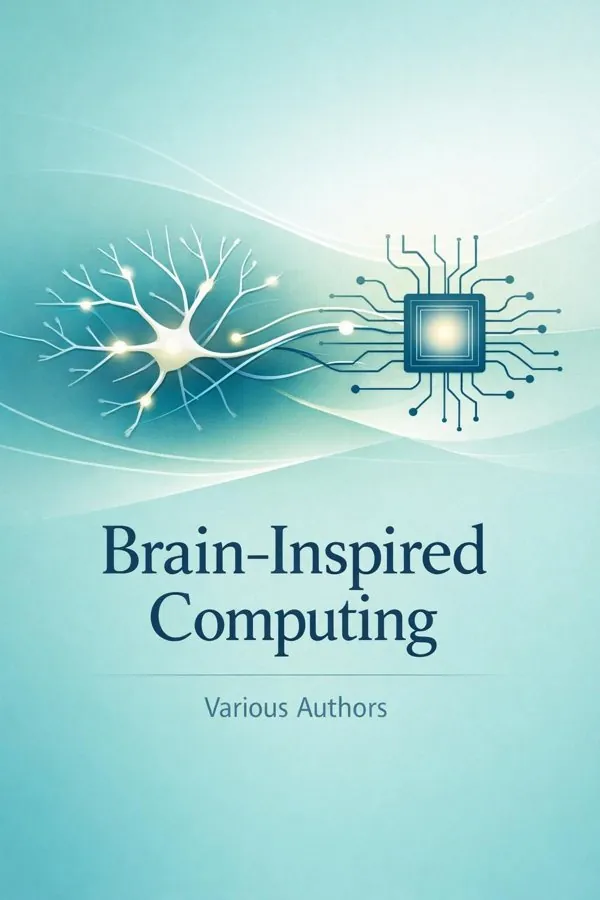
Brain-Inspired Computing: Summary & Key Insights
 10 min5 chaptersAudio available
What Is Brain-Inspired Computing About?
Brain-Inspired Computing by Various Authors is a ai_ml book spanning 5 pages. This book explores computational architectures and algorithms inspired by the structure and function of the human brain. It covers neuromorphic engineering, spiking neural networks, and cognitive computing models that aim to bridge neuroscience and computer science. The volume includes contributions from multiple researchers discussing theoretical foundations, hardware implementations, and applications in artificial intelligence.
This FizzRead summary covers all 5 key chapters of Brain-Inspired Computing in approximately 10 minutes, distilling the most important ideas, arguments, and takeaways from Various Authors's work. Also available as an audio summary and Key Quotes Podcast.
Brain-Inspired Computing
This book explores computational architectures and algorithms inspired by the structure and function of the human brain. It covers neuromorphic engineering, spiking neural networks, and cognitive computing models that aim to bridge neuroscience and computer science. The volume includes contributions from multiple researchers discussing theoretical foundations, hardware implementations, and applications in artificial intelligence.
Who Should Read Brain-Inspired Computing?
This book is perfect for anyone interested in ai_ml and looking to gain actionable insights in a short read. Whether you're a student, professional, or lifelong learner, the key ideas from Brain-Inspired Computing by Various Authors will help you think differently.
- ✓Readers who enjoy ai_ml and want practical takeaways
- ✓Professionals looking to apply new ideas to their work and life
- ✓Anyone who wants the core insights of Brain-Inspired Computing in just 10 minutes
Want the full summary?
Get instant access to this book summary and 100K+ more with Fizz Moment.
Get Free SummaryAvailable on App Store • Free to download
Key Chapters
To inspire computing through the brain’s architecture, we must first understand how the brain computes. Biological neurons are not merely logic gates; they are dynamic entities governed by electrochemical processes that encode and transmit information through spikes — brief electrical pulses. The authors begin by exploring neural coding, the principle by which complex sensory experiences are represented in patterns of spiking activity. They discuss how information is conveyed not only by whether a neuron fires, but by when it fires — its timing, frequency, and synchronization with other neurons.
Central to this exploration is synaptic plasticity. Synapses are the adjustable connections between neurons, capable of strengthening or weakening over time in response to stimuli. This adaptive capability is the essence of learning. When neuroscientists observe how neuronal networks change during memory formation or skill acquisition, they see plasticity at work — a kind of biological optimization that ensures survival and adaptation.
From a computational standpoint, plasticity translates into learning algorithms. A network that adjusts connection weights according to experience captures the spirit of Hebbian learning: 'cells that fire together, wire together.' Through this lens, the authors show how principles such as long-term potentiation, short-term depression, and spike-timing dependency can be expressed mathematically and implemented in computational models.
Reading through this section, one feels a growing respect for the elegance of biological computation. The brain does not separate storage and processing like a von Neumann machine; it performs both simultaneously. Memory is dynamic, encoded in connection patterns, constantly reshaped by activity. This realization serves as the cornerstone for every subsequent idea — from spiking neural networks to cognitive computing frameworks. The authors make clear that to build machines that think more naturally, we must first understand how nature built machines that think.
The authors describe spiking neural networks (SNNs) as the bridge between biology and silicon — models that treat information not as static vectors, but as dynamic streams of discrete events. In an SNN, neurons communicate through spikes, each carrying temporal significance. This means computation is event-driven, sparse, and inherently parallel.
What makes SNNs revolutionary is their efficiency and biological realism. Traditional neural nets absorb continuous values and use them in large matrix multiplications, demanding enormous power. SNNs, conversely, function more like the brain itself: they remain mostly silent until an input triggers spikes, conserving energy. They model time directly, carrying memory of past inputs without explicit recurrence.
The authors demonstrate how this paradigm can solve problems that conventional deep networks find challenging, such as real-time sensory processing, sound localization, and tactile perception. For example, in robotics applications, SNNs allow adaptive control based on temporal patterns of touch or vision, responding instantly to changes in the environment without heavy computational overhead.
Underlying these successes are learning rules inspired by biology — spike-timing-dependent plasticity (STDP), reward-modulated learning, and homeostatic adjustments. They enable SNNs to refine connections autonomously. The book’s narrative intertwines mathematics with intuition: it describes how differential equations map onto neuronal dynamics, how hardware circuits emulate membrane potentials, and how system-level architectures integrate multiple layers of spiking computation.
Through SNNs, we glimpse not only technical innovation but a philosophical shift: intelligence is not a continuous signal but a rhythm, a choreography of events unfolding in time. Computation becomes a dance of causes and consequences, grounded in biology yet reaching out toward the future of artificial systems.
+ 3 more chapters — available in the FizzRead app
All Chapters in Brain-Inspired Computing
About the Author
The contributing authors are researchers and engineers specializing in neuroscience, computer science, and artificial intelligence. They work in academic institutions and technology organizations focused on developing brain-inspired computational systems.
Get This Summary in Your Preferred Format
Read or listen to the Brain-Inspired Computing summary by Various Authors anytime, anywhere. FizzRead offers multiple formats so you can learn on your terms — all free.
Available formats: App · Audio · PDF · EPUB — All included free with FizzRead
Download Brain-Inspired Computing PDF and EPUB Summary
Key Quotes from Brain-Inspired Computing
“To inspire computing through the brain’s architecture, we must first understand how the brain computes.”
“The authors describe spiking neural networks (SNNs) as the bridge between biology and silicon — models that treat information not as static vectors, but as dynamic streams of discrete events.”
Frequently Asked Questions about Brain-Inspired Computing
Brain-Inspired Computing by Various Authors is a ai_ml book that explores key ideas across 5 chapters. This book explores computational architectures and algorithms inspired by the structure and function of the human brain. It covers neuromorphic engineering, spiking neural networks, and cognitive computing models that aim to bridge neuroscience and computer science. The volume includes contributions from multiple researchers discussing theoretical foundations, hardware implementations, and applications in artificial intelligence.
More by Various Authors



You Might Also Like
Life 3.0
Max Tegmark
10 min
Superintelligence
Nick Bostrom
10 min
TensorFlow in Action
Thushan Ganegedara
10 min
AI Made Simple: A Beginner’s Guide to Generative AI, ChatGPT, and the Future of Work
Rajeev Kapur
10 min
AI Snake Oil
Arvind Narayanan, Sayash Kapoor
10 min
AI Superpowers: China, Silicon Valley, and the New World Order
Kai-Fu Lee
10 minBrowse by Category
Ready to read Brain-Inspired Computing?
Get the full summary and 100K+ more books with Fizz Moment.