
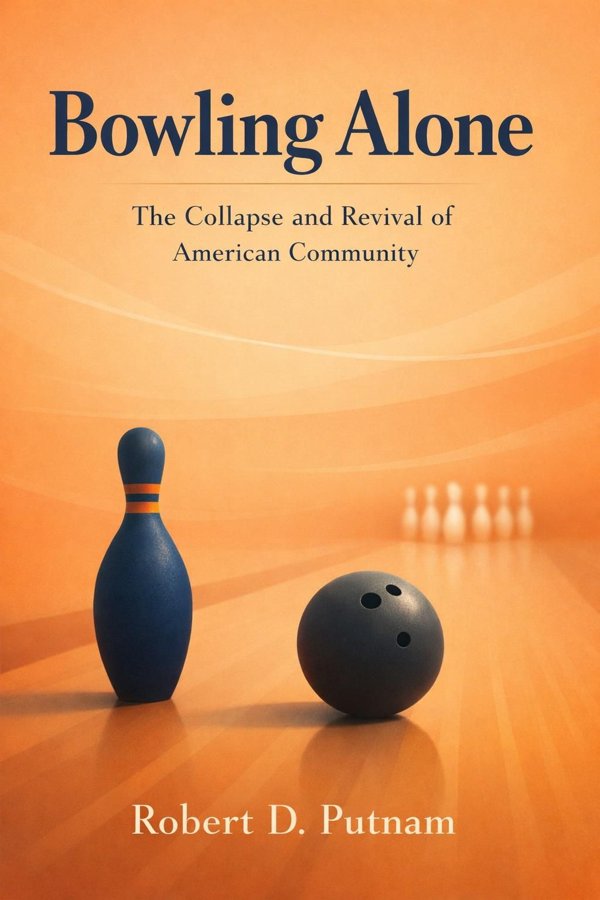
Bowling Alone: The Collapse and Revival of American Community: Summary & Key Insights
 10 min9 chaptersAudio available
Key Takeaways from Bowling Alone: The Collapse and Revival of American Community
A healthy democracy is built not only in legislatures and courtrooms, but in church basements, school committees, sports leagues, and neighborhood groups.
Sometimes a simple image reveals a national crisis better than a stack of statistics.
The invisible bonds between people often matter as much as formal institutions.
Social change becomes harder to ignore when it appears across dozens of unrelated measures.
One of Putnam’s most important insights is that the decline of community cannot be explained simply by people getting busier or older.
What Is Bowling Alone: The Collapse and Revival of American Community About?
Bowling Alone: The Collapse and Revival of American Community by Robert D. Putnam is a sociology book spanning 6 pages. What happens to a democracy when people stop showing up for one another? In Bowling Alone, Robert D. Putnam offers a powerful answer: public life weakens when the everyday habits of connection begin to disappear. Using decades of survey data, membership records, voting trends, and social research, Putnam argues that Americans have experienced a major decline in civic engagement, social trust, and community participation since the mid-twentieth century. The book’s now-famous image of people bowling alone instead of in leagues captures a broader transformation: individuals may still pursue private activities, but the shared institutions that once tied neighbors, families, and citizens together have eroded. This book matters because it links seemingly small social changes to large democratic consequences. Putnam shows that social capital, the networks and norms that help people cooperate, affects education, health, safety, economic opportunity, and political life. His analysis reaches far beyond nostalgia, offering a rigorous diagnosis of why communities fray and what can be done to restore them. As a leading political scientist and Harvard professor, Putnam brings exceptional authority to this subject, making Bowling Alone one of the most influential works on modern American society.
This FizzRead summary covers all 9 key chapters of Bowling Alone: The Collapse and Revival of American Community in approximately 10 minutes, distilling the most important ideas, arguments, and takeaways from Robert D. Putnam's work. Also available as an audio summary and Key Quotes Podcast.
Bowling Alone: The Collapse and Revival of American Community
What happens to a democracy when people stop showing up for one another? In Bowling Alone, Robert D. Putnam offers a powerful answer: public life weakens when the everyday habits of connection begin to disappear. Using decades of survey data, membership records, voting trends, and social research, Putnam argues that Americans have experienced a major decline in civic engagement, social trust, and community participation since the mid-twentieth century. The book’s now-famous image of people bowling alone instead of in leagues captures a broader transformation: individuals may still pursue private activities, but the shared institutions that once tied neighbors, families, and citizens together have eroded.
This book matters because it links seemingly small social changes to large democratic consequences. Putnam shows that social capital, the networks and norms that help people cooperate, affects education, health, safety, economic opportunity, and political life. His analysis reaches far beyond nostalgia, offering a rigorous diagnosis of why communities fray and what can be done to restore them. As a leading political scientist and Harvard professor, Putnam brings exceptional authority to this subject, making Bowling Alone one of the most influential works on modern American society.
Who Should Read Bowling Alone: The Collapse and Revival of American Community?
This book is perfect for anyone interested in sociology and looking to gain actionable insights in a short read. Whether you're a student, professional, or lifelong learner, the key ideas from Bowling Alone: The Collapse and Revival of American Community by Robert D. Putnam will help you think differently.
- ✓Readers who enjoy sociology and want practical takeaways
- ✓Professionals looking to apply new ideas to their work and life
- ✓Anyone who wants the core insights of Bowling Alone: The Collapse and Revival of American Community in just 10 minutes
Want the full summary?
Get instant access to this book summary and 100K+ more with Fizz Moment.
Get Free SummaryAvailable on App Store • Free to download
Key Chapters
A healthy democracy is built not only in legislatures and courtrooms, but in church basements, school committees, sports leagues, and neighborhood groups. Putnam begins by reminding readers that the United States was once exceptionally rich in civic participation. Americans joined fraternal orders, women’s clubs, labor unions, parent-teacher associations, veterans’ groups, and local charities in remarkable numbers. These organizations did more than fill leisure time. They taught cooperation, leadership, compromise, and public responsibility.
Putnam draws on a long tradition of thinking about civic life, including Alexis de Tocqueville’s observation that Americans were unusually inclined to form associations. This habit of joining gave people practice in solving problems together. It also created a culture of reciprocity: if you helped your community today, someone would help you tomorrow. In this sense, associations acted as schools of citizenship. They connected people across class and occupational lines and made democracy feel local, practical, and personal.
The importance of this historical overview is that decline can only be understood against a baseline of strength. Without seeing how dense and participatory American community life once was, current fragmentation may seem normal. Putnam’s point is not that the past was perfect, but that broad participation produced measurable social benefits. Town improvement clubs, local newspapers, school boards, and volunteer groups all helped create trust and shared purpose.
A practical way to apply this idea is to look at your own community and ask which institutions still create regular face-to-face contact. The actionable takeaway: don’t treat civic organizations as old-fashioned leftovers; treat them as essential infrastructure for democracy and everyday belonging.
Sometimes a simple image reveals a national crisis better than a stack of statistics. Putnam’s metaphor of “bowling alone” captures a central paradox of modern America: more people were bowling, but fewer were joining bowling leagues. In other words, participation in the activity continued while participation in the social structure around it declined. Americans were not necessarily becoming inactive; they were becoming disconnected.
This distinction is crucial. Social capital is not just about doing things, but about doing things with others in ways that create trust, obligation, and shared identity. A person who jogs alone, streams entertainment alone, or works remotely without wider community ties may still be busy, but busyness is not the same as connection. Putnam shows that across many domains, league memberships, club participation, public meeting attendance, and informal socializing all weakened over time.
The metaphor works because it translates abstract sociology into lived experience. When people stop gathering in structured, recurring groups, they lose opportunities to develop relationships that extend beyond immediate family or close friends. This weakens the habits that support democratic life, such as listening to others, handling disagreement, and organizing for common goals.
A practical example is the difference between donating money online and regularly volunteering with a local group. Both matter, but the second builds relationships and repeated cooperation. Putnam’s larger lesson is that private convenience often comes at a public cost.
The actionable takeaway: whenever possible, choose forms of participation that include recurring, face-to-face interaction, because community is strengthened less by isolated activity than by shared routines.
Social change becomes harder to ignore when it appears across dozens of unrelated measures. Putnam’s argument is persuasive not because of one dramatic example, but because of the breadth of the evidence. He documents declines in voter turnout, public meeting attendance, party activism, union membership, club participation, family dinners, informal entertaining, and trust in others. The pattern is cumulative: Americans became less involved not in one area, but in many.
This breadth matters because critics might dismiss the decline of any single organization as a natural cultural shift. If one fraternal club fades, perhaps another type of community replaces it. But Putnam shows that much of the replacement never fully occurs. While some new forms of connection emerge, they often do not generate the same depth, durability, or cross-cutting contact as older forms. A looser network may provide information, but it may not create obligation or shared responsibility.
He also examines trends in religion, volunteering, and political participation, finding that many institutions once central to community life lost members and energy over the late twentieth century. This does not mean every place declined equally or every group weakened at the same rate. Rather, the national direction was unmistakable.
A practical lesson from this data-driven approach is that social well-being should be measured with the same seriousness as economic growth. If a city tracks jobs, crime, and housing, it should also pay attention to volunteering, trust, participation, and neighborhood engagement.
The actionable takeaway: don’t rely on vague impressions about community health; look for concrete signs of connection, because what gets measured is more likely to be protected and rebuilt.
One of Putnam’s most important insights is that the decline of community cannot be explained simply by people getting busier or older. The deepest shift, he argues, is generational. Americans who came of age during the Depression and World War II developed unusually strong habits of collective action, public service, and institutional loyalty. Later generations, especially those shaped by postwar individualism, entered adulthood with weaker attachments to civic organizations.
This generational argument matters because it points to culture and socialization rather than just temporary lifestyle pressures. The civic generation learned to join, serve, and trust partly because historical events demanded sacrifice and coordination. In contrast, later cohorts often encountered a more privatized social world, one that emphasized personal fulfillment, mobility, and autonomy over membership and duty.
Putnam does not claim that younger generations are selfish by nature. Rather, they inherited different institutions, incentives, and norms. If fewer parents belong to community organizations, fewer children grow up seeing civic participation modeled as ordinary adult behavior. If schools reduce civic education and neighborhoods become more transient, civic habits weaken further.
A practical example is how two families may approach the same school: one sees the PTA, school board, and community events as expected obligations; the other sees them as optional extras, secondary to private schedules. Over time, these choices shape the entire culture of an institution.
The actionable takeaway: if civic habits are generationally learned, then rebuilding community requires intentional modeling, especially through schools, families, and local organizations that teach participation by making it routine.
Disconnection rarely comes from a single cause; more often it emerges when many small shifts pull people away from shared life. Putnam explores several forces behind the erosion of social capital, including suburbanization, commuting, television, changing work patterns, and the broader reorganization of leisure. His argument is not that technology is evil or that modern life is uniquely selfish. It is that environments shape habits, and many modern environments reward private consumption over public participation.
Television occupies a prominent place in his analysis because it consumes time that might otherwise be spent in clubs, meetings, or informal socializing. Even more important, it changes the character of leisure from participatory to passive. Commuting and suburban sprawl create similar effects by increasing time pressure and reducing spontaneous contact with neighbors. Long distances between home, work, and community institutions make involvement more difficult, especially for families balancing jobs and caregiving.
These changes are practical, not merely symbolic. A person who spends two hours commuting and unwinds alone in front of a screen is less likely to coach a youth team, attend a neighborhood meeting, or host friends. The issue is cumulative. A society can become less connected not because people reject community outright, but because community becomes less convenient than private entertainment.
Today, the same logic can be applied to smartphones, algorithmic media, and remote routines. Digital tools can connect, but they can also fragment attention and replace embodied presence.
The actionable takeaway: audit how your time and technologies shape your social world, and deliberately protect recurring spaces for in-person participation before convenience quietly erodes community.
Community is harder to sustain when people are constantly moving or struggling to find common ground across differences. Putnam addresses the challenges posed by residential mobility, social change, and diversity, noting that trust and participation can become more fragile when people lack stable ties or shared expectations. Frequent relocation disrupts local relationships. Diverse societies may require more intentional work to build trust across cultural, ethnic, or class boundaries.
Yet Putnam’s argument is often misunderstood if reduced to pessimism. He does not suggest that diversity is undesirable or that homogeneity is the solution. Rather, he argues that social cohesion does not arise automatically. Bridging social capital, ties that connect people across differences, must be built deliberately. Bonding social capital, which strengthens close-knit groups, can offer support and identity, but it can also become insular. Healthy societies need both: strong internal solidarity and meaningful connections across lines of difference.
A practical application can be seen in schools, sports leagues, religious coalitions, and neighborhood projects that bring diverse people together around shared tasks. Trust tends to grow not from abstract slogans, but from repeated cooperation. People become more willing to trust those who were once strangers when they solve problems side by side.
Mobility adds another challenge. If people view every place as temporary, they may invest less in long-term institutions. That makes portable forms of civic belonging especially important, such as local volunteer networks, parent organizations, or faith communities that welcome newcomers quickly.
The actionable takeaway: don’t assume trust will emerge on its own in diverse or mobile settings; create shared projects and repeated contact that turn difference from a barrier into a basis for cooperation.
Communities do not renew themselves by accident; they are rebuilt through choices, institutions, and habits. Although Bowling Alone is famous for diagnosing decline, Putnam also points toward revival. He suggests that periods of civic renewal in American history were often driven by deliberate reforms, public leadership, and cultural shifts that made participation easier, more honorable, and more expected.
This means rebuilding social capital requires more than telling people to be nicer. It involves designing schools, workplaces, neighborhoods, and public spaces in ways that encourage interaction. Schools can prioritize civic education and service learning. Employers can support volunteerism and flexible schedules for community involvement. Urban planners can create parks, walkable streets, and common spaces where people meet naturally. Local governments can make participation accessible rather than bureaucratic and discouraging.
Putnam’s framework also invites experimentation. New institutions need not look exactly like old ones. The goal is not to recreate every fraternal lodge of the past, but to recover the social functions those organizations served: repeated contact, mutual obligation, leadership development, and shared purpose. A neighborhood garden, a community makerspace, a youth mentorship network, or a local mutual-aid group can all generate social capital if they bring people together consistently.
On an individual level, revival begins with choosing membership over spectatorship. Joining one committee, attending one local event, or hosting one recurring gathering may seem small, but civic cultures are built through accumulated acts.
The actionable takeaway: if you want stronger communities, design for participation in concrete ways, because social capital grows where institutions make connection regular, visible, and worthwhile.
All Chapters in Bowling Alone: The Collapse and Revival of American Community
About the Author
Robert D. Putnam is an American political scientist, public policy scholar, and professor best known for his influential research on civic engagement and social capital. A longtime faculty member at Harvard University, he has written widely on how trust, networks, and community participation shape democratic institutions and social outcomes. He first gained major recognition with Making Democracy Work, a study of civic traditions and government performance in Italy, and later reached a broad public audience with Bowling Alone. Putnam’s work stands out for combining rigorous empirical research with accessible insights about everyday social life. Across his career, he has explored how communities succeed, why civic bonds weaken, and what can be done to strengthen social cohesion in modern societies.
Get This Summary in Your Preferred Format
Read or listen to the Bowling Alone: The Collapse and Revival of American Community summary by Robert D. Putnam anytime, anywhere. FizzRead offers multiple formats so you can learn on your terms — all free.
Available formats: App · Audio · PDF · EPUB — All included free with FizzRead
Download Bowling Alone: The Collapse and Revival of American Community PDF and EPUB Summary
Key Quotes from Bowling Alone: The Collapse and Revival of American Community
“A healthy democracy is built not only in legislatures and courtrooms, but in church basements, school committees, sports leagues, and neighborhood groups.”
“Sometimes a simple image reveals a national crisis better than a stack of statistics.”
“The invisible bonds between people often matter as much as formal institutions.”
“Social change becomes harder to ignore when it appears across dozens of unrelated measures.”
“One of Putnam’s most important insights is that the decline of community cannot be explained simply by people getting busier or older.”
Frequently Asked Questions about Bowling Alone: The Collapse and Revival of American Community
Bowling Alone: The Collapse and Revival of American Community by Robert D. Putnam is a sociology book that explores key ideas across 9 chapters. What happens to a democracy when people stop showing up for one another? In Bowling Alone, Robert D. Putnam offers a powerful answer: public life weakens when the everyday habits of connection begin to disappear. Using decades of survey data, membership records, voting trends, and social research, Putnam argues that Americans have experienced a major decline in civic engagement, social trust, and community participation since the mid-twentieth century. The book’s now-famous image of people bowling alone instead of in leagues captures a broader transformation: individuals may still pursue private activities, but the shared institutions that once tied neighbors, families, and citizens together have eroded. This book matters because it links seemingly small social changes to large democratic consequences. Putnam shows that social capital, the networks and norms that help people cooperate, affects education, health, safety, economic opportunity, and political life. His analysis reaches far beyond nostalgia, offering a rigorous diagnosis of why communities fray and what can be done to restore them. As a leading political scientist and Harvard professor, Putnam brings exceptional authority to this subject, making Bowling Alone one of the most influential works on modern American society.
More by Robert D. Putnam
You Might Also Like
Between the World and Me
Ta-Nehisi Coates
10 min
Half the Sky
Nicholas D. Kristof, Sheryl WuDunn
10 min
Men Explain Things To Me
Rebecca Solnit
10 min
Rational Ritual
Michael Suk-Young Chwe
10 min
The New Jim Crow
Michelle Alexander
10 min
Beyond Culture
Edward T. Hall
10 minBrowse by Category
Ready to read Bowling Alone: The Collapse and Revival of American Community?
Get the full summary and 100K+ more books with Fizz Moment.