
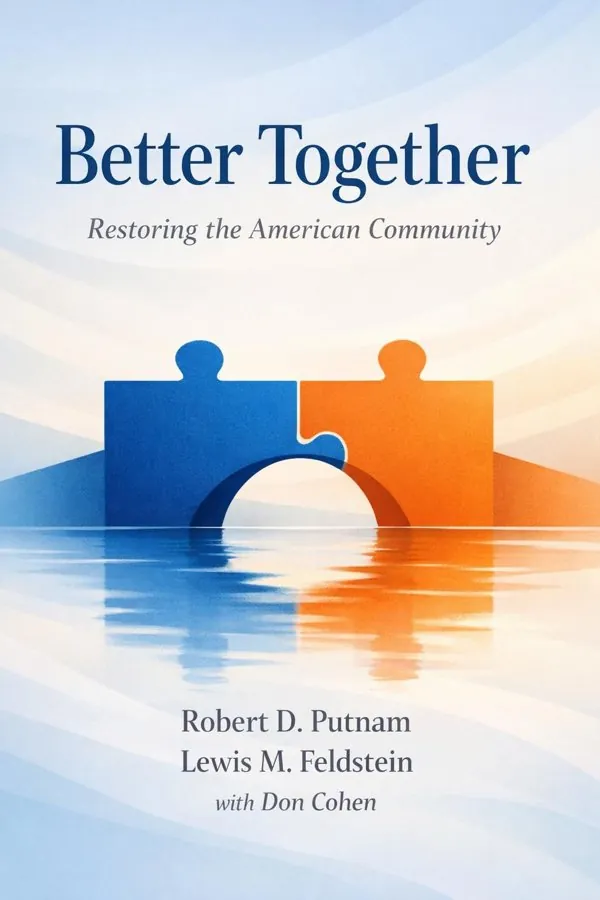
Better Together: Restoring the American Community: Summary & Key Insights
by Robert D. Putnam, Lewis M. Feldstein, with Don Cohen
 10 min11 chaptersAudio available
What Is Better Together: Restoring the American Community About?
Better Together: Restoring the American Community by Robert D. Putnam, Lewis M. Feldstein, with Don Cohen is a sociology book spanning 11 pages. Better Together: Restoring the American Community explores how Americans are rebuilding social capital and civic engagement through innovative community initiatives. The authors present case studies from across the United States, highlighting grassroots efforts that strengthen local ties and foster collaboration among diverse groups. The book serves as a follow-up to Putnam’s earlier work, Bowling Alone, offering a more optimistic view of civic renewal.
This FizzRead summary covers all 11 key chapters of Better Together: Restoring the American Community in approximately 10 minutes, distilling the most important ideas, arguments, and takeaways from Robert D. Putnam, Lewis M. Feldstein, with Don Cohen's work. Also available as an audio summary and Key Quotes Podcast.
Better Together: Restoring the American Community
Better Together: Restoring the American Community explores how Americans are rebuilding social capital and civic engagement through innovative community initiatives. The authors present case studies from across the United States, highlighting grassroots efforts that strengthen local ties and foster collaboration among diverse groups. The book serves as a follow-up to Putnam’s earlier work, Bowling Alone, offering a more optimistic view of civic renewal.
Who Should Read Better Together: Restoring the American Community?
This book is perfect for anyone interested in sociology and looking to gain actionable insights in a short read. Whether you're a student, professional, or lifelong learner, the key ideas from Better Together: Restoring the American Community by Robert D. Putnam, Lewis M. Feldstein, with Don Cohen will help you think differently.
- ✓Readers who enjoy sociology and want practical takeaways
- ✓Professionals looking to apply new ideas to their work and life
- ✓Anyone who wants the core insights of Better Together: Restoring the American Community in just 10 minutes
Want the full summary?
Get instant access to this book summary and 100K+ more with Fizz Moment.
Get Free SummaryAvailable on App Store • Free to download
Key Chapters
To understand civic renewal, we first needed to rethink what we meant by community. Social capital, as we define it, is the network of relationships that allow people to act together more effectively to pursue shared objectives. It is not merely about friendliness or sentiment; it is about trust that enables cooperation. We distinguish between ‘bonding’ social capital—ties that bring together people who are alike in crucial respects—and ‘bridging’ social capital—ties that connect people across diverse social cleavages. Healthy communities balance the two, nurturing solidarity while reaching outward to difference.
The renewal of social capital must happen in an era of unprecedented individualism, mobility, and technological change. Traditional institutions such as unions, churches, and civic clubs have weakened, but new forms are emerging. We propose that the key is intentional community-building—structures and practices that invite participation, cultivate trust, and yield tangible benefits. Renewal does not mean returning to a nostalgic past; it means inventing modern equivalents that serve a pluralistic society.
Our framework asks three questions: Where and how does civic regeneration begin? What personal and institutional resources sustain it? And how do these local successes inform national renewal? Again and again, we found that action starts small—when a few people recognize shared problems and decide that together they can change them. Over time, as networks deepen and trust grows, collective capacity expands. Institutions—foundations, governments, corporations—can then amplify these efforts when they respect local wisdom and help scale what works. This iterative process, from grassroots to structure and back again, is the fabric of community restoration.
Our journey began in Portland, Oregon, a city widely recognized for its democratic spirit and participatory culture. In the 1970s, citizens there struggled to find a way to influence urban planning and governance. Out of that struggle emerged neighborhood associations—grassroots entities officially recognized by the city, empowered to deliberate on zoning, budgeting, and community development. These associations, supported but not controlled by city government, became laboratories of civic engagement.
In Portland, citizens turned planning meetings into community-building events. Decision-making became not just about traffic lights and sidewalks but about identity—what it meant to live together in a city that valued conversation. Over time, the neighborhood associations nurtured local leaders and created networks of mutual trust among residents, nonprofits, and city officials. Participation bred a sense of agency, and agency strengthened trust. Even when disagreements arose, the process itself built legitimacy.
The lesson from Portland is that civic engagement thrives when citizens have real power and clear channels for voice. Engagement is learned through doing, and institutional structures can either enable or stifle that learning. By embedding participation in everyday governance, Portland demonstrated how democracy can be made tangible, continuous, and local.
+ 9 more chapters — available in the FizzRead app
All Chapters in Better Together: Restoring the American Community
About the Authors
Robert D. Putnam is a political scientist and professor of public policy at Harvard University, known for his research on social capital and civic engagement. Lewis M. Feldstein served as president of the New Hampshire Charitable Foundation and has been active in community development. Don Cohen is a writer and editor specializing in public policy and community issues.
Get This Summary in Your Preferred Format
Read or listen to the Better Together: Restoring the American Community summary by Robert D. Putnam, Lewis M. Feldstein, with Don Cohen anytime, anywhere. FizzRead offers multiple formats so you can learn on your terms — all free.
Available formats: App · Audio · PDF · EPUB — All included free with FizzRead
Download Better Together: Restoring the American Community PDF and EPUB Summary
Key Quotes from Better Together: Restoring the American Community
“To understand civic renewal, we first needed to rethink what we meant by community.”
“Our journey began in Portland, Oregon, a city widely recognized for its democratic spirit and participatory culture.”
Frequently Asked Questions about Better Together: Restoring the American Community
Better Together: Restoring the American Community by Robert D. Putnam, Lewis M. Feldstein, with Don Cohen is a sociology book that explores key ideas across 11 chapters. Better Together: Restoring the American Community explores how Americans are rebuilding social capital and civic engagement through innovative community initiatives. The authors present case studies from across the United States, highlighting grassroots efforts that strengthen local ties and foster collaboration among diverse groups. The book serves as a follow-up to Putnam’s earlier work, Bowling Alone, offering a more optimistic view of civic renewal.
You Might Also Like
Between the World and Me
Ta-Nehisi Coates
10 min
Half the Sky
Nicholas D. Kristof, Sheryl WuDunn
10 min
Men Explain Things To Me
Rebecca Solnit
10 min
Rational Ritual
Michael Suk-Young Chwe
10 min
The New Jim Crow
Michelle Alexander
10 min
Beyond Culture
Edward T. Hall
10 minBrowse by Category
Ready to read Better Together: Restoring the American Community?
Get the full summary and 100K+ more books with Fizz Moment.