
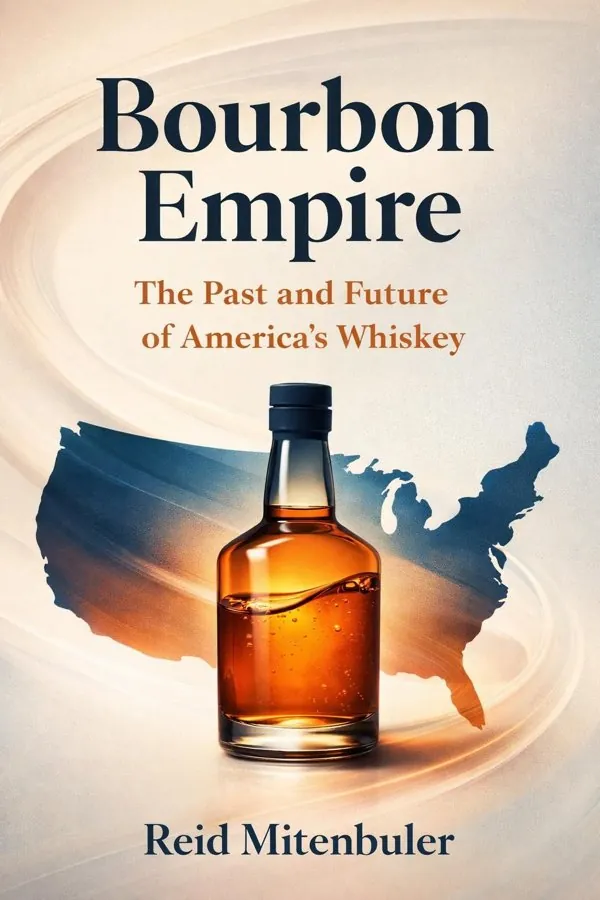
Bourbon Empire: The Past and Future of America's Whiskey: Summary & Key Insights
 10 min9 chaptersAudio available
Key Takeaways from Bourbon Empire: The Past and Future of America's Whiskey
One of the book’s most revealing insights is that early American whiskey was less a glamorous indulgence than a practical technology for survival.
Bourbon did not become bourbon simply because someone invented a recipe; it emerged because geography, migration, and storytelling converged.
A striking lesson from Bourbon Empire is that bourbon’s rise depended not only on distilling skill but on the invention of trust at scale.
Few events reveal the fragility of an industry more clearly than Prohibition.
After World War II, bourbon entered a new phase: modernization made it more efficient, more stable, and more widely available, but it also risked making it culturally bland.
What Is Bourbon Empire: The Past and Future of America's Whiskey About?
Bourbon Empire: The Past and Future of America's Whiskey by Reid Mitenbuler is a world_history book spanning 11 pages. Bourbon Empire tells the story of America through one of its most symbolic products: whiskey. In this lively and deeply researched history, Reid Mitenbuler traces bourbon from practical frontier alcohol to industrial commodity, from near-collapse to luxury revival. Along the way, he shows that bourbon is not just a drink but a lens for understanding American expansion, marketing, class aspiration, mythmaking, and capitalism. The book reveals how distillers, politicians, bootleggers, advertisers, and corporate owners all helped shape the spirit’s identity, often blurring the line between fact and legend. What makes this book matter is its refusal to romanticize bourbon while still appreciating its cultural power. Mitenbuler explores the labor, agriculture, environmental pressures, and business strategies behind every bottle, asking what “authenticity” really means in a modern branded economy. He also examines bourbon’s recent resurgence, showing how scarcity, heritage storytelling, and craft culture transformed an old-fashioned drink into a global prestige product. As a journalist and cultural historian with extensive writing on spirits and American industry, Mitenbuler brings both narrative skill and critical distance, making this an essential read for anyone interested in history, business, or the myths America tells about itself.
This FizzRead summary covers all 9 key chapters of Bourbon Empire: The Past and Future of America's Whiskey in approximately 10 minutes, distilling the most important ideas, arguments, and takeaways from Reid Mitenbuler's work. Also available as an audio summary and Key Quotes Podcast.
Bourbon Empire: The Past and Future of America's Whiskey
Bourbon Empire tells the story of America through one of its most symbolic products: whiskey. In this lively and deeply researched history, Reid Mitenbuler traces bourbon from practical frontier alcohol to industrial commodity, from near-collapse to luxury revival. Along the way, he shows that bourbon is not just a drink but a lens for understanding American expansion, marketing, class aspiration, mythmaking, and capitalism. The book reveals how distillers, politicians, bootleggers, advertisers, and corporate owners all helped shape the spirit’s identity, often blurring the line between fact and legend.
What makes this book matter is its refusal to romanticize bourbon while still appreciating its cultural power. Mitenbuler explores the labor, agriculture, environmental pressures, and business strategies behind every bottle, asking what “authenticity” really means in a modern branded economy. He also examines bourbon’s recent resurgence, showing how scarcity, heritage storytelling, and craft culture transformed an old-fashioned drink into a global prestige product. As a journalist and cultural historian with extensive writing on spirits and American industry, Mitenbuler brings both narrative skill and critical distance, making this an essential read for anyone interested in history, business, or the myths America tells about itself.
Who Should Read Bourbon Empire: The Past and Future of America's Whiskey?
This book is perfect for anyone interested in world_history and looking to gain actionable insights in a short read. Whether you're a student, professional, or lifelong learner, the key ideas from Bourbon Empire: The Past and Future of America's Whiskey by Reid Mitenbuler will help you think differently.
- ✓Readers who enjoy world_history and want practical takeaways
- ✓Professionals looking to apply new ideas to their work and life
- ✓Anyone who wants the core insights of Bourbon Empire: The Past and Future of America's Whiskey in just 10 minutes
Want the full summary?
Get instant access to this book summary and 100K+ more with Fizz Moment.
Get Free SummaryAvailable on App Store • Free to download
Key Chapters
One of the book’s most revealing insights is that early American whiskey was less a glamorous indulgence than a practical technology for survival. In colonial and early republican America, farmers often faced a basic problem: grain was bulky, perishable, and difficult to transport over poor roads. Distilling solved all three issues. Corn, rye, and other grains could be turned into whiskey that stored well, traveled more easily, and carried greater value per barrel than raw crops. In that sense, whiskey functioned as a kind of rural financial tool.
Mitenbuler uses this history to show how deeply bourbon’s roots are tied to agrarian life. Distilling was woven into household economies, local trade, and frontier settlement. Whiskey could be consumed, sold, bartered, or used to preserve wealth in regions where cash was scarce. That reality helps explain why government attempts to tax whiskey, most famously during the Whiskey Rebellion, touched such a nerve. Taxation was not merely an inconvenience; it was experienced as an attack on local livelihood and autonomy.
This practical origin also challenges the modern image of bourbon as purely artisanal or elite. Before it became an icon of refinement, it was a utilitarian product born from necessity. Understanding that gives readers a more grounded view of American enterprise: innovation often starts with adaptation, not romance.
A useful modern parallel is how businesses today turn waste or low-margin materials into higher-value products through processing and branding. The underlying logic is the same: transform what is hard to move or sell into something durable and profitable.
Actionable takeaway: when studying any industry, look first at the material problem it originally solved; that usually explains its long-term power better than its later mythology does.
Bourbon did not become bourbon simply because someone invented a recipe; it emerged because geography, migration, and storytelling converged. As settlers moved west into Kentucky, they found conditions unusually favorable for distilling: abundant corn, access to oak, and limestone-filtered water prized for fermentation. These advantages mattered, but Mitenbuler shows that natural resources alone did not create bourbon’s reputation. Reputation was built when regional production became linked to identity.
Kentucky’s isolation from eastern markets initially made distilling even more attractive, since whiskey condensed agricultural value into a more tradable form. Over time, the region’s products gained distinction, and “bourbon” became associated with place as much as process. Yet the book emphasizes that bourbon’s birth story is messy. There is no single inventor, no tidy founding moment, and no pure line from frontier stills to modern brands. Instead, there are competing claims, half-remembered legends, and later efforts to impose order on a complicated past.
That uncertainty is part of the point. American products often acquire authority not because their origins are simple, but because later institutions package complexity into memorable narratives. Kentucky became bourbon’s symbolic homeland through repetition, promotion, and legal standardization as much as through natural suitability.
You can see the same pattern today in food and drink industries that emphasize terroir, provenance, and local heritage. Place adds value, but only when producers and consumers agree on what that place means.
Actionable takeaway: be skeptical of neat origin stories. When a product seems inseparable from a region, ask how much of that bond comes from environment and how much comes from strategic storytelling.
A striking lesson from Bourbon Empire is that bourbon’s rise depended not only on distilling skill but on the invention of trust at scale. As the United States industrialized in the nineteenth century, whiskey moved from local production toward larger, more standardized operations. That shift created opportunities for efficiency and broader distribution, but it also produced confusion. Consumers often had no idea what was actually in the bottle. Adulteration, blending, and deceptive labeling were common, and reputations could be fragile.
This is where branding became transformative. Distillers and merchants learned that names, labels, and origin claims could reassure buyers and separate one whiskey from another. A recognizable brand promised consistency in an age when industrial abundance often bred suspicion. Mitenbuler shows that bourbon’s commercial history is inseparable from advertising, trademark battles, and legal efforts to define what “straight” or “authentic” whiskey meant.
The emergence of brands like Old Forester and later iconic labels helped bourbon travel beyond regional markets into the national imagination. Industrialization did not destroy bourbon’s identity; in many ways, it manufactured it. The bottle, the story, and the guarantee became as important as the liquid itself.
This pattern still defines modern markets. Consumers regularly pay more for signals of reliability, transparency, and heritage, whether they are buying coffee, skincare, or software. Standards and narratives reduce uncertainty.
For readers interested in business, the broader lesson is that scaling a product requires scaling credibility. Operational excellence matters, but so does a persuasive answer to the question: why should anyone trust this over the alternatives?
Actionable takeaway: if you want a product to endure, invest not just in quality but in verifiable standards and a brand story that makes quality believable.
Few events reveal the fragility of an industry more clearly than Prohibition. When the legal production and sale of alcohol were largely banned in the United States, bourbon did not simply pause and later resume unchanged. Mitenbuler shows that Prohibition shattered business structures, erased distilling knowledge, and rewarded only a few companies lucky or connected enough to survive through medicinal licenses or alternative ventures. It was a cultural and economic rupture, not a temporary inconvenience.
At the same time, Prohibition intensified bourbon’s mythology. What the law attempted to suppress became more alluring, and whiskey’s association with vice, rebellion, and authenticity deepened. Illegal production and smuggling flourished, but quality often suffered. Consumers adapted to whatever alcohol they could get, and tastes shifted. When repeal finally came, the bourbon world had to rebuild in a transformed market with altered consumer habits, broken supply chains, and fewer established players.
Mitenbuler’s account is especially useful because it shows how policy can produce unintended consequences. Prohibition aimed to solve social problems through blanket restriction, yet it strengthened organized crime, degraded product standards, and reconfigured legitimate markets in ways that lasted for decades.
This history offers a practical lens for evaluating regulation today. When lawmakers intervene in industries tied to culture and consumption, the results often depend less on stated intention than on enforcement realities, loopholes, and consumer adaptation.
For businesses, the period is a reminder that resilience often comes from diversification, political awareness, and the ability to preserve institutional knowledge during crisis.
Actionable takeaway: when assessing any regulatory shock, ask not only what is being banned or constrained, but who can realistically adapt, survive, and shape the market that emerges afterward.
After World War II, bourbon entered a new phase: modernization made it more efficient, more stable, and more widely available, but it also risked making it culturally bland. Mitenbuler explains how large distillers embraced scientific production methods, streamlined operations, and mass marketing to reach a growing middle-class audience. Whiskey became cleaner, more predictable, and easier to distribute. In commercial terms, this was a success.
But success came with tradeoffs. As bourbon was positioned against vodka, gin, and lighter spirits, many producers softened its image and emphasized uniformity over regional distinction. The old roughness and local specificity that once defined American whiskey were increasingly flattened into a national consumer product. In trying to become modern, bourbon also became less mysterious.
This period matters because it shows a recurring tension in capitalism: industries often gain scale by reducing variation, yet they later rediscover that variation is what consumers romanticize and pay premiums for. Standardization can build markets, but over-standardization can strip products of the very character that once made them meaningful.
Examples of this cycle appear everywhere today. Food chains standardize recipes, streaming platforms standardize entertainment, and technology platforms standardize experience. Consumers initially welcome convenience, then begin searching for alternatives that feel local, distinctive, or handcrafted.
Mitenbuler does not argue that modernization was a mistake. Rather, he shows that it was necessary for survival while also planting the seeds of later backlash and revival. The bourbon boom of the twenty-first century makes more sense when viewed as a reaction to this earlier homogenization.
Actionable takeaway: efficiency is valuable, but if you manage a product or brand, protect some form of distinctiveness before convenience turns into sameness.
Bourbon’s cultural power comes not just from taste or tradition, but from its ability to symbolize a particular version of America. Mitenbuler argues that bourbon became linked to ideals such as self-reliance, masculinity, frontier grit, and entrepreneurial freedom. These associations were not accidental. They were cultivated through advertising, journalism, tourism, and political rhetoric that framed bourbon as a native spirit expressing the nation’s character.
The book is especially strong in showing how selective these narratives are. The romance of the white male frontiersman often overshadowed the contributions of enslaved laborers, immigrant distillers, industrial chemists, warehouse workers, and corporate strategists. What gets remembered as heritage is often the product of omission. Bourbon’s mythology turns a complicated supply chain into a story of authenticity and independence.
That does not mean the myths are meaningless. Myths work because they organize emotion and belonging. A bottle of bourbon can serve as a ritual object at family gatherings, business dinners, or patriotic celebrations. But Mitenbuler wants readers to see that identity is being packaged along with the liquid.
This insight applies far beyond whiskey. Many brands sell not merely products but moral self-images: rugged outdoorsmanship, ethical consumption, rebellion, sophistication, or rootedness. The product succeeds when it helps consumers narrate who they are.
Readers can use this idea to become more conscious consumers. Instead of asking only whether a product is good, ask what story it invites you to join, and whose interests that story serves.
Actionable takeaway: whenever a brand claims authenticity or national character, examine both the emotional appeal and the historical omissions behind that claim.
Not every iconic industry rises in a straight line. One of the most important chapters in bourbon’s history is its long decline in the late twentieth century. Consumer tastes shifted toward vodka, tequila, wine, and beer. Younger drinkers often saw bourbon as old-fashioned, heavy, or associated with their parents’ generation. Sales dropped, warehouses filled with unsold stock, and some producers struggled to maintain relevance.
Mitenbuler shows that decline is rarely just about product quality. It usually reflects broader cultural repositioning. Bourbon had become trapped by its own image: traditional, masculine, regional, and somewhat outdated. Yet this downturn also created the conditions for later revival. Excess aged inventory became a future asset. Forgotten brands could be rediscovered. Historical depth, once viewed as stale, could be reinterpreted as heritage.
This is a valuable lesson in business and cultural history. Decline often reveals which parts of an industry are structural and which are cyclical. Companies that survive downturns sometimes emerge with stronger stories, scarcer goods, and clearer identities than those riding trend waves.
We see similar patterns when old media formats return as premium collectibles, when legacy fashion brands become stylish again, or when neglected neighborhoods are rebranded as authentic cultural centers. What appears obsolete can become desirable once context changes.
Mitenbuler therefore treats bourbon’s slump not as an embarrassing interlude but as a necessary stage in its transformation. The industry’s eventual rebound was not a miracle. It was built from surplus stock, archival memory, and the ability to convert weakness into uniqueness.
Actionable takeaway: when something seems unfashionable, look for dormant assets others are ignoring; decline often hides the raw material for a future comeback.
Bourbon’s twenty-first-century revival is often celebrated as a triumph of craftsmanship, but Mitenbuler complicates that story in productive ways. He describes how renewed interest in cocktail culture, culinary authenticity, local production, and premium experiences helped transform bourbon into a coveted spirit again. Distillery tourism grew, limited releases generated hype, and small producers positioned themselves against faceless corporations. Consumers embraced age statements, single barrels, mash bills, and production details once considered niche.
Yet the book refuses to equate “craft” with purity. Some new brands sourced whiskey from large established distillers while marketing themselves as artisanal. Others emphasized rustic aesthetics more than distinctive production methods. In many cases, authenticity itself became a performance carefully designed for modern consumers seeking intimacy, scarcity, and story.
This is not necessarily cynical; it is simply how contemporary markets work. People do want real quality, but they also want visible signs of care, individuality, and place. The craft movement succeeded because it met both desires. It gave bourbon a language of rediscovery while opening space for experimentation in finishing, blending, and local identity.
For readers, the practical value lies in learning how to separate substantive craftsmanship from decorative symbolism. Ask who made the product, where it came from, what processes matter, and which details are mainly theatrical. Those questions apply to coffee roasters, fashion labels, restaurants, and digital creator brands just as much as to whiskey.
Mitenbuler’s broader point is that revival industries often combine genuine passion with strategic image-making. The two are not opposites; they are frequently intertwined.
Actionable takeaway: appreciate craft, but verify the substance behind the storytelling before treating authenticity as proof rather than as a claim.
The most forward-looking argument in Bourbon Empire is that bourbon’s future cannot be understood through branding alone. Behind every celebrated bottle lies an agricultural, environmental, logistical, and labor system that shapes what is possible. Mitenbuler highlights how bourbon depends on grain supply, barrel production, water, warehouse space, transport networks, and long maturation timelines. Unlike many products, bourbon requires years of patience, meaning decisions made today will affect inventories far into the future.
This time horizon makes the industry especially vulnerable to miscalculation. Overproduction can flood the market years later. Underproduction can create shortages that drive speculation and distort consumer access. Climate pressures, changing crop conditions, and resource constraints further complicate the picture. Even the romantic image of charred oak barrels points to forestry and manufacturing demands that are easy to overlook.
The book also explores bourbon’s broader economic and cultural impact. Distilleries fuel tourism, regional pride, export growth, and local employment. At the same time, consolidation raises questions about who benefits from bourbon’s prestige and whether small producers can compete in a market dominated by distribution power and corporate ownership.
For modern readers, this systems view is perhaps the most useful. Products are never only what they appear to be at point of sale. They are networks of extraction, labor, regulation, and delayed risk. Understanding those networks leads to better consumer choices and sharper strategic thinking.
Whether you are a drinker, entrepreneur, or historian, bourbon becomes more interesting when seen as an ecosystem rather than an object.
Actionable takeaway: whenever a product seems simple, trace the supply chain, time horizon, and resource dependencies behind it; that is where its real vulnerabilities and future opportunities usually reside.
All Chapters in Bourbon Empire: The Past and Future of America's Whiskey
About the Author
Reid Mitenbuler is an American writer and journalist whose work explores culture, history, business, and the spirits world. He has contributed to publications including The Atlantic, Slate, and Whisky Advocate, building a reputation for clear reporting and engaging long-form storytelling. His writing often focuses on how familiar products and traditions reveal larger truths about American identity and economic life. In Bourbon Empire, he brings that approach to whiskey, combining historical research with cultural criticism to show how bourbon became both a major industry and a national symbol. Mitenbuler is especially adept at separating legend from fact without stripping away the fascination of the subject, making his work appealing to both specialists and general readers.
Get This Summary in Your Preferred Format
Read or listen to the Bourbon Empire: The Past and Future of America's Whiskey summary by Reid Mitenbuler anytime, anywhere. FizzRead offers multiple formats so you can learn on your terms — all free.
Available formats: App · Audio · PDF · EPUB — All included free with FizzRead
Download Bourbon Empire: The Past and Future of America's Whiskey PDF and EPUB Summary
Key Quotes from Bourbon Empire: The Past and Future of America's Whiskey
“One of the book’s most revealing insights is that early American whiskey was less a glamorous indulgence than a practical technology for survival.”
“Bourbon did not become bourbon simply because someone invented a recipe; it emerged because geography, migration, and storytelling converged.”
“A striking lesson from Bourbon Empire is that bourbon’s rise depended not only on distilling skill but on the invention of trust at scale.”
“Few events reveal the fragility of an industry more clearly than Prohibition.”
“After World War II, bourbon entered a new phase: modernization made it more efficient, more stable, and more widely available, but it also risked making it culturally bland.”
Frequently Asked Questions about Bourbon Empire: The Past and Future of America's Whiskey
Bourbon Empire: The Past and Future of America's Whiskey by Reid Mitenbuler is a world_history book that explores key ideas across 9 chapters. Bourbon Empire tells the story of America through one of its most symbolic products: whiskey. In this lively and deeply researched history, Reid Mitenbuler traces bourbon from practical frontier alcohol to industrial commodity, from near-collapse to luxury revival. Along the way, he shows that bourbon is not just a drink but a lens for understanding American expansion, marketing, class aspiration, mythmaking, and capitalism. The book reveals how distillers, politicians, bootleggers, advertisers, and corporate owners all helped shape the spirit’s identity, often blurring the line between fact and legend. What makes this book matter is its refusal to romanticize bourbon while still appreciating its cultural power. Mitenbuler explores the labor, agriculture, environmental pressures, and business strategies behind every bottle, asking what “authenticity” really means in a modern branded economy. He also examines bourbon’s recent resurgence, showing how scarcity, heritage storytelling, and craft culture transformed an old-fashioned drink into a global prestige product. As a journalist and cultural historian with extensive writing on spirits and American industry, Mitenbuler brings both narrative skill and critical distance, making this an essential read for anyone interested in history, business, or the myths America tells about itself.
You Might Also Like
The Age of Capital
Eric Hobsbawm
10 min
The Gulag Archipelago
Aleksandr Solzhenitsyn
10 min
Jerusalem: The Biography
Simon Sebag Montefiore
10 min
The Anglo-Saxons
James Campbell
10 min
The Boer War
Thomas Pakenham
10 min
The Industrial Revolutionaries: The Making of the Modern World 1776–1914
Gavin Weightman
10 minBrowse by Category
Ready to read Bourbon Empire: The Past and Future of America's Whiskey?
Get the full summary and 100K+ more books with Fizz Moment.