
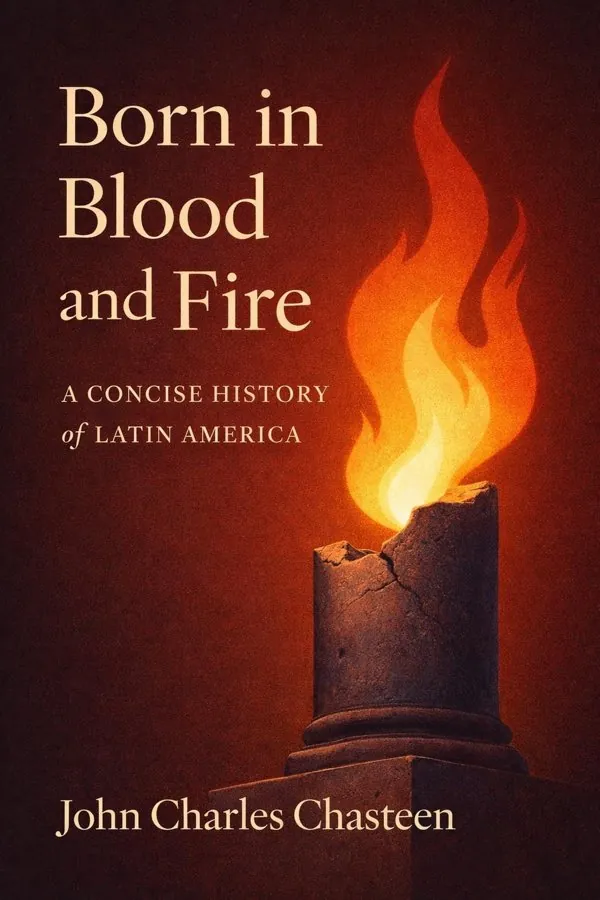
Born in Blood and Fire: A Concise History of Latin America: Summary & Key Insights
 10 min11 chaptersAudio available
What Is Born in Blood and Fire: A Concise History of Latin America About?
Born in Blood and Fire: A Concise History of Latin America by John Charles Chasteen is a world_history book spanning 11 pages. This book offers a comprehensive yet concise overview of Latin American history from pre-Columbian times to the present. John Charles Chasteen explores the region’s political, social, and cultural evolution, emphasizing themes of colonialism, independence, revolution, and modernization. Written in accessible prose, it serves as a foundational text for understanding Latin America’s complex identity and historical trajectory.
This FizzRead summary covers all 11 key chapters of Born in Blood and Fire: A Concise History of Latin America in approximately 10 minutes, distilling the most important ideas, arguments, and takeaways from John Charles Chasteen's work. Also available as an audio summary and Key Quotes Podcast.
Born in Blood and Fire: A Concise History of Latin America
This book offers a comprehensive yet concise overview of Latin American history from pre-Columbian times to the present. John Charles Chasteen explores the region’s political, social, and cultural evolution, emphasizing themes of colonialism, independence, revolution, and modernization. Written in accessible prose, it serves as a foundational text for understanding Latin America’s complex identity and historical trajectory.
Who Should Read Born in Blood and Fire: A Concise History of Latin America?
This book is perfect for anyone interested in world_history and looking to gain actionable insights in a short read. Whether you're a student, professional, or lifelong learner, the key ideas from Born in Blood and Fire: A Concise History of Latin America by John Charles Chasteen will help you think differently.
- ✓Readers who enjoy world_history and want practical takeaways
- ✓Professionals looking to apply new ideas to their work and life
- ✓Anyone who wants the core insights of Born in Blood and Fire: A Concise History of Latin America in just 10 minutes
Want the full summary?
Get instant access to this book summary and 100K+ more with Fizz Moment.
Get Free SummaryAvailable on App Store • Free to download
Key Chapters
Before the European ships appeared on the horizon, Latin America was home to vibrant civilizations whose complexity remains awe inspiring even today. The Aztecs in central Mexico, the Mayas across Mesoamerica, and the Incas spanning the Andes were builders of empires shaped by distinct geographies but united by a deep integration of spirituality and social organization. In writing about them, I wanted readers to feel the presence of these societies as living worlds, not vanished curiosities.
Each civilization managed resources with remarkable sophistication. The Maya’s cities were intellectual centers where mathematics and observational astronomy guided ritual and governance. The Aztecs built an empire sustained by tribute networks and a mythic belief in cosmic balance—a vision where sacrifice was not cruelty but cosmic duty. The Inca state was a marvel of engineering and redistribution, linking highland and coastal peoples through the vast road systems that symbolized imperial unity.
Underlying these structures was a worldview where humanity and nature belonged to the same sacred order. European observers, encountering this world, often mistook its complexity for paganism. But to understand the roots of Latin America’s identity, one must begin here—with societies that blended rational planning, collective labor, and spiritual imagination into integrated models of life.
Their legacies remained long after conquest. Indigenous languages, agricultural techniques, and ritual patterns continued to pulse through rural life and even urban folklore. Thus, Latin America’s pre-Columbian foundations were never obliterated—they were absorbed, reshaped, and concealed beneath new forms of power and belief. The story was not of disappearance but of transformation, and it is this continuity that gives the region its layered cultural depth.
The arrival of Europeans in the sixteenth century brought a profound rupture. Spaniards and Portuguese, driven by the twin motives of faith and fortune, redrew the map of the Americas in a matter of decades. But conquest was not merely military—it was a psychological and spiritual reordering of entire worlds. I have always seen this period as one of collision: between empires and cosmos, steel and stone, and worldviews that misunderstood each other profoundly.
The Spanish crown established a vast imperial structure resting on viceroyalties, missions, and ecclesiastical power. The Portuguese, claiming Brazil, developed a plantation economy intertwined with the Atlantic slave trade. Both systems relied on subjugation of native populations and systematic extraction of wealth—gold, silver, sugar—all flowing toward Europe. Yet colonization did not produce a simple domination. It created hybrid societies—mestizo cultures where indigenous, African, and European traditions fused into new social realities.
For me, the conquest’s deeper meaning lay in its contradictions. The same missionaries who imposed Christianity also preserved native languages through catechisms and grammars. The same miners who exploited indigenous labor produced urban centers that became cradles of literary and artistic fusion. Out of this paradox grew Latin America’s enduring duality: a region wounded by coercion but quickened by cultural syncretism. From the colonial crucible emerged a world distinctly Latin American—neither European nor purely native, but a new civilization forged in duress and adaptation.
+ 9 more chapters — available in the FizzRead app
All Chapters in Born in Blood and Fire: A Concise History of Latin America
About the Author
John Charles Chasteen is an American historian and professor specializing in Latin American history. He teaches at the University of North Carolina at Chapel Hill and has authored several works on Latin American culture and politics, including translations and historical syntheses that make the region’s past accessible to a broad audience.
Get This Summary in Your Preferred Format
Read or listen to the Born in Blood and Fire: A Concise History of Latin America summary by John Charles Chasteen anytime, anywhere. FizzRead offers multiple formats so you can learn on your terms — all free.
Available formats: App · Audio · PDF · EPUB — All included free with FizzRead
Download Born in Blood and Fire: A Concise History of Latin America PDF and EPUB Summary
Key Quotes from Born in Blood and Fire: A Concise History of Latin America
“Before the European ships appeared on the horizon, Latin America was home to vibrant civilizations whose complexity remains awe inspiring even today.”
“The arrival of Europeans in the sixteenth century brought a profound rupture.”
Frequently Asked Questions about Born in Blood and Fire: A Concise History of Latin America
Born in Blood and Fire: A Concise History of Latin America by John Charles Chasteen is a world_history book that explores key ideas across 11 chapters. This book offers a comprehensive yet concise overview of Latin American history from pre-Columbian times to the present. John Charles Chasteen explores the region’s political, social, and cultural evolution, emphasizing themes of colonialism, independence, revolution, and modernization. Written in accessible prose, it serves as a foundational text for understanding Latin America’s complex identity and historical trajectory.
You Might Also Like
The Age of Capital
Eric Hobsbawm
10 min
The Gulag Archipelago
Aleksandr Solzhenitsyn
10 min
Jerusalem: The Biography
Simon Sebag Montefiore
10 min
The Anglo-Saxons
James Campbell
10 min
The Boer War
Thomas Pakenham
10 min
The Industrial Revolutionaries: The Making of the Modern World 1776–1914
Gavin Weightman
10 minBrowse by Category
Ready to read Born in Blood and Fire: A Concise History of Latin America?
Get the full summary and 100K+ more books with Fizz Moment.