
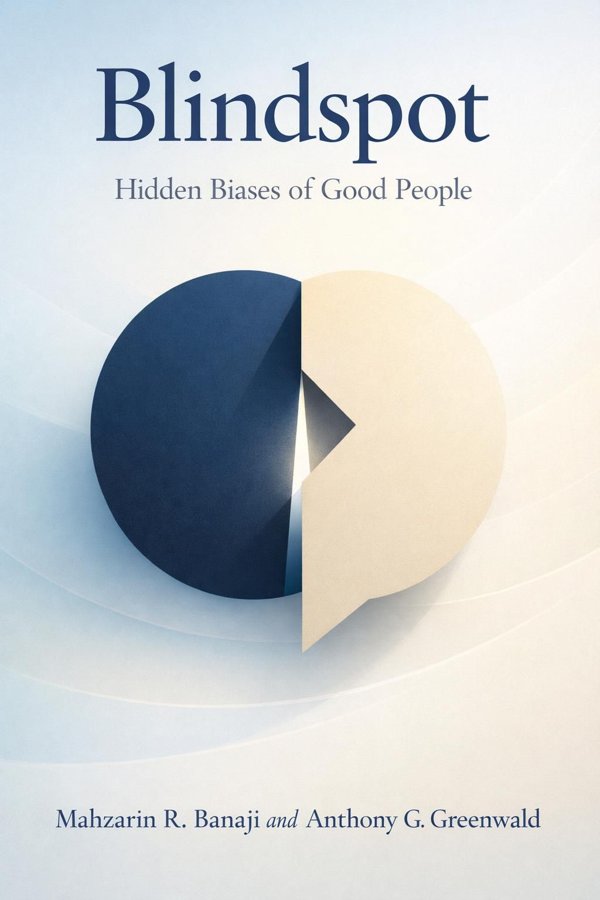
Blindspot: Hidden Biases of Good People: Summary & Key Insights
by Mahzarin R. Banaji, Anthony G. Greenwald
 10 min7 chaptersAudio available
What Is Blindspot: Hidden Biases of Good People About?
Blindspot: Hidden Biases of Good People by Mahzarin R. Banaji and Anthony G. Greenwald is a psychology book spanning 7 pages. Blindspot: Hidden Biases of Good People explores the concept of implicit social bias—unconscious attitudes and stereotypes that affect how people perceive and act toward others. Drawing on decades of psychological research, Banaji and Greenwald reveal how these hidden biases shape decisions and behaviors, even among well-intentioned individuals. The book encourages readers to recognize and mitigate their own implicit biases to promote fairness and equality.
This FizzRead summary covers all 7 key chapters of Blindspot: Hidden Biases of Good People in approximately 10 minutes, distilling the most important ideas, arguments, and takeaways from Mahzarin R. Banaji and Anthony G. Greenwald's work. Also available as an audio summary and Key Quotes Podcast.
Blindspot: Hidden Biases of Good People
Blindspot: Hidden Biases of Good People explores the concept of implicit social bias—unconscious attitudes and stereotypes that affect how people perceive and act toward others. Drawing on decades of psychological research, Banaji and Greenwald reveal how these hidden biases shape decisions and behaviors, even among well-intentioned individuals. The book encourages readers to recognize and mitigate their own implicit biases to promote fairness and equality.
Who Should Read Blindspot: Hidden Biases of Good People?
This book is perfect for anyone interested in psychology and looking to gain actionable insights in a short read. Whether you're a student, professional, or lifelong learner, the key ideas from Blindspot: Hidden Biases of Good People by Mahzarin R. Banaji and Anthony G. Greenwald will help you think differently.
- ✓Readers who enjoy psychology and want practical takeaways
- ✓Professionals looking to apply new ideas to their work and life
- ✓Anyone who wants the core insights of Blindspot: Hidden Biases of Good People in just 10 minutes
Want the full summary?
Get instant access to this book summary and 100K+ more with Fizz Moment.
Get Free SummaryAvailable on App Store • Free to download
Key Chapters
One might assume that consistency between values and behavior defines moral integrity. Yet psychology teaches us that the human mind can harbor contradictions without noticing them. Explicit beliefs reside in deliberate thought—they are the principles we articulate, the positions we defend. Implicit biases are their silent counterparts, shaped through early experiences, cultural exposure, and repeated associations. Both coexist within us, sometimes harmoniously, sometimes in tension.
I have often said that good people are not immune to bias; rather, bias is a natural byproduct of a mind built to categorize. We sort people automatically—by race, gender, age, profession—not out of malice but because the brain seeks efficiency. The problem arises when these shortcuts subtly distort fairness. A hiring manager might believe in equality yet still ‘see’ a male candidate as more competent because cultural narratives have repeatedly linked masculinity with leadership. This disconnection between values and perception explains why discrimination can persist without overt prejudice.
Science reveals that implicit biases influence milliseconds of processing, shaping whom we trust, whom we fear, whom we consider capable. Recognizing this duality leads to an important insight: moral behavior requires more than good intentions; it demands awareness of automatic cognition. The challenge is not simply to profess fairness but to practice it through conscious correction. We must learn to pause, to question first impressions, and to seek evidence beyond instinct. In doing so, we gradually align our implicit patterns with our explicit ideals.
As I reflect on decades of research, I find this duality humbling. It reminds us that human goodness is not a static trait but an ongoing negotiation between deliberate and automatic processes. Understanding this interplay is the first step toward genuine moral development.
+ 5 more chapters — available in the FizzRead app
All Chapters in Blindspot: Hidden Biases of Good People
About the Authors
Mahzarin R. Banaji is a social psychologist and professor at Harvard University known for her pioneering work on implicit social cognition. Anthony G. Greenwald is a professor of psychology at the University of Washington and co-developer of the Implicit Association Test (IAT). Together, they have advanced the study of unconscious bias and its impact on social behavior.
Get This Summary in Your Preferred Format
Read or listen to the Blindspot: Hidden Biases of Good People summary by Mahzarin R. Banaji and Anthony G. Greenwald anytime, anywhere. FizzRead offers multiple formats so you can learn on your terms — all free.
Available formats: App · Audio · PDF · EPUB — All included free with FizzRead
Download Blindspot: Hidden Biases of Good People PDF and EPUB Summary
Key Quotes from Blindspot: Hidden Biases of Good People
“When we first introduced the concept of implicit social cognition, the scientific community was only beginning to understand how unconscious thought shapes social behavior.”
“One might assume that consistency between values and behavior defines moral integrity.”
Frequently Asked Questions about Blindspot: Hidden Biases of Good People
Blindspot: Hidden Biases of Good People by Mahzarin R. Banaji and Anthony G. Greenwald is a psychology book that explores key ideas across 7 chapters. Blindspot: Hidden Biases of Good People explores the concept of implicit social bias—unconscious attitudes and stereotypes that affect how people perceive and act toward others. Drawing on decades of psychological research, Banaji and Greenwald reveal how these hidden biases shape decisions and behaviors, even among well-intentioned individuals. The book encourages readers to recognize and mitigate their own implicit biases to promote fairness and equality.
You Might Also Like
The Body Keeps the Score
Bessel van der Kolk
10 min
Surrounded by Idiots
Thomas Erikson
10 min
Emotional Intelligence
Daniel Goleman
10 min
Attached
Amir Levine
10 min
Why Does He Do That
Lundy Bancroft
10 min
Women Who Run with the Wolves
Clarissa Pinkola Estés
10 minBrowse by Category
Ready to read Blindspot: Hidden Biases of Good People?
Get the full summary and 100K+ more books with Fizz Moment.