
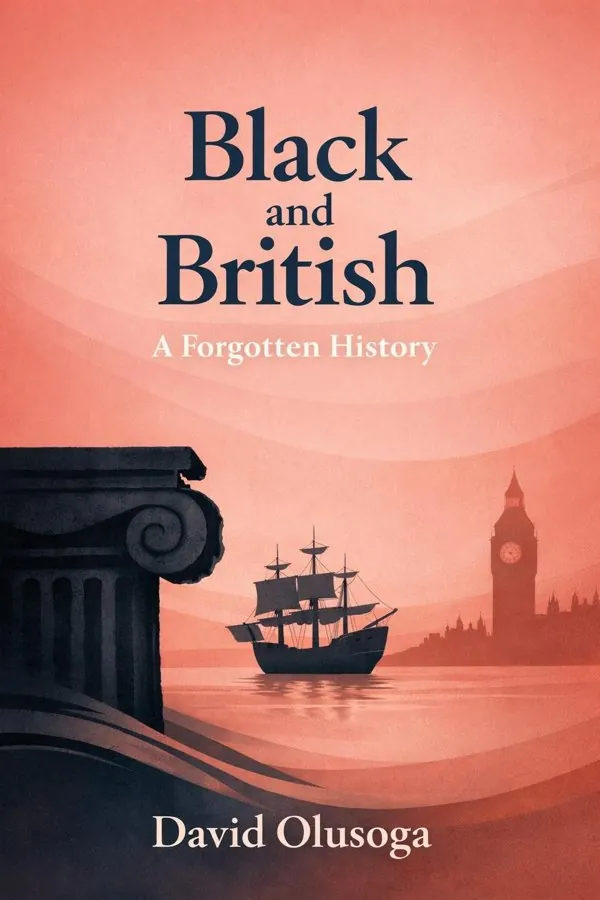
Black and British: A Forgotten History: Summary & Key Insights
 10 min9 chaptersAudio available
What Is Black and British: A Forgotten History About?
Black and British: A Forgotten History by David Olusoga is a world_history book spanning 9 pages. A groundbreaking history that explores the long and complex relationship between Britain and people of African descent, from the Roman era to the present day. David Olusoga reveals how Black Britons have been an integral part of the nation’s story, challenging conventional narratives and uncovering forgotten histories of slavery, empire, and identity.
This FizzRead summary covers all 9 key chapters of Black and British: A Forgotten History in approximately 10 minutes, distilling the most important ideas, arguments, and takeaways from David Olusoga's work. Also available as an audio summary and Key Quotes Podcast.
Black and British: A Forgotten History
A groundbreaking history that explores the long and complex relationship between Britain and people of African descent, from the Roman era to the present day. David Olusoga reveals how Black Britons have been an integral part of the nation’s story, challenging conventional narratives and uncovering forgotten histories of slavery, empire, and identity.
Who Should Read Black and British: A Forgotten History?
This book is perfect for anyone interested in world_history and looking to gain actionable insights in a short read. Whether you're a student, professional, or lifelong learner, the key ideas from Black and British: A Forgotten History by David Olusoga will help you think differently.
- ✓Readers who enjoy world_history and want practical takeaways
- ✓Professionals looking to apply new ideas to their work and life
- ✓Anyone who wants the core insights of Black and British: A Forgotten History in just 10 minutes
Want the full summary?
Get instant access to this book summary and 100K+ more with Fizz Moment.
Get Free SummaryAvailable on App Store • Free to download
Key Chapters
When most people imagine Roman Britain, they picture pale soldiers standing guard on gray walls in a northern wilderness. But the archaeological record tells another story. Evidence from sites near Hadrian’s Wall, inscriptions from York, and skeletal analyses reveal people of African descent living and working in Roman Britain nearly two millennia ago. Among them were soldiers from North Africa serving in Roman garrisons, merchants, craftsmen, and possibly settlers who made lives here long before the English nation was conceived.
Their presence is vital because it breaks the illusion that Britain’s connection to Africa is solely an imperial or postcolonial phenomenon. From the very beginning, the British Isles were part of an interconnected world shaped by trade routes and imperial movement. When African soldiers guarded the northern frontier, they were not foreigners in isolation — they were citizens of an empire that imagined itself united under one rule, albeit a rule built on conquest.
Recognizing this ancient diversity is more than a historical curiosity; it dismantles the notion that Blackness in Britain is new or alien. The Roman empire itself was multiethnic, and Britain, as one province among many, reflected that complexity. The idea of racial difference had not yet hardened into modern hierarchies, and these early encounters remind us that human movement and mixture predated racial categorization.
To me, uncovering these early traces of Africans in Roman Britain was a revelation. It proved that the island has always been part of a wider human story of migration and belonging — a truth forgotten not because it was trivial, but because modern racial thinking later demanded a more uniform past. The fragments of bones and artifacts unearthed from Roman ruins show that the roots of Black British history run deeper than anyone once dared to imagine.
If Roman Britain shows that Black presence on the island is ancient, the Tudor and Stuart eras reveal something equally significant: the beginnings of racial consciousness. During these centuries, the numbers of Africans in Britain grew, particularly in London, where they worked as servants, musicians, sailors, and craftsmen. They were not enslaved in law, yet their social status was precarious, shaped by attitudes imported through expanding contact with Africa and the early slave trade.
Documents from Elizabethan England mention 'Blackamoors' living among white households, baptized in parish churches, and occasionally married locally. Some were valued for their skills or exotic appeal; others were forcibly deported when royal decrees expressed discomfort at their presence. This ambivalence marks the dawn of racial categorization — a time when color became a marker of difference but not yet of systematic exclusion.
Looking back at this era, I often reflect on how these early Black Britons navigated a society that had no stable concept of race. They existed in a strange liminal space between curiosity and acceptance, suspicion and tolerance. Figures like John Blanke, the Black trumpeter who performed for Henry VIII, show mobility and recognition — yet his story, like so many, disappeared from mainstream memory.
The Tudor and Stuart periods matter because they reveal the conceptual seeds of race that would later grow into institutional structures. The language of 'otherness' began to take shape, entwined with trading ambitions and Christian rhetoric. It was Britain’s first step toward rationalizing racial exploitation — a step that would soon culminate in the transatlantic slave trade. But within these centuries also lies the proof that Black Britons were already part of the social fabric: visible, active, and undeniably present.
+ 7 more chapters — available in the FizzRead app
All Chapters in Black and British: A Forgotten History
About the Author
David Olusoga is a British historian, writer, and broadcaster, known for his work on the history of race, empire, and slavery. He is a professor of public history at the University of Manchester and has presented numerous BBC documentaries, including those based on his books.
Get This Summary in Your Preferred Format
Read or listen to the Black and British: A Forgotten History summary by David Olusoga anytime, anywhere. FizzRead offers multiple formats so you can learn on your terms — all free.
Available formats: App · Audio · PDF · EPUB — All included free with FizzRead
Download Black and British: A Forgotten History PDF and EPUB Summary
Key Quotes from Black and British: A Forgotten History
“When most people imagine Roman Britain, they picture pale soldiers standing guard on gray walls in a northern wilderness.”
“If Roman Britain shows that Black presence on the island is ancient, the Tudor and Stuart eras reveal something equally significant: the beginnings of racial consciousness.”
Frequently Asked Questions about Black and British: A Forgotten History
Black and British: A Forgotten History by David Olusoga is a world_history book that explores key ideas across 9 chapters. A groundbreaking history that explores the long and complex relationship between Britain and people of African descent, from the Roman era to the present day. David Olusoga reveals how Black Britons have been an integral part of the nation’s story, challenging conventional narratives and uncovering forgotten histories of slavery, empire, and identity.
You Might Also Like
The Age of Capital
Eric Hobsbawm
10 min
The Gulag Archipelago
Aleksandr Solzhenitsyn
10 min
Jerusalem: The Biography
Simon Sebag Montefiore
10 min
The Anglo-Saxons
James Campbell
10 min
The Boer War
Thomas Pakenham
10 min
The Industrial Revolutionaries: The Making of the Modern World 1776–1914
Gavin Weightman
10 minBrowse by Category
Ready to read Black and British: A Forgotten History?
Get the full summary and 100K+ more books with Fizz Moment.