
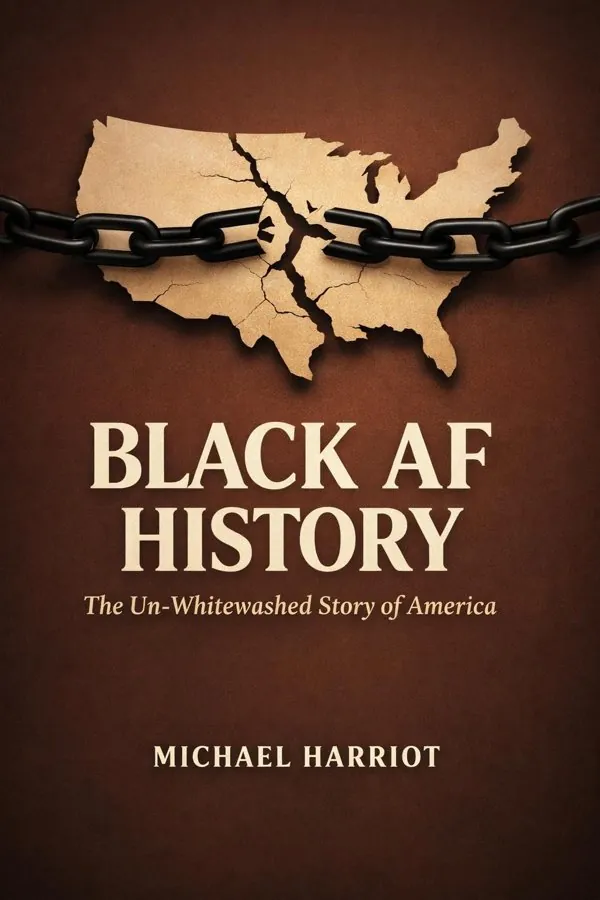
Black AF History: The Un-Whitewashed Story of America: Summary & Key Insights
 10 min9 chaptersAudio available
Key Takeaways from Black AF History: The Un-Whitewashed Story of America
A nation’s first lie is often the story it tells about its beginning.
Empires rarely move for ideals first; they move for money.
Revolutions often promise universal liberty while quietly securing power for a select few.
Founding documents can be visionary and compromised at the same time.
Legal emancipation is not the same as social transformation.
What Is Black AF History: The Un-Whitewashed Story of America About?
Black AF History: The Un-Whitewashed Story of America by Michael Harriot is a world_history book spanning 11 pages. Black AF History: The Un-Whitewashed Story of America is Michael Harriot’s sharp, funny, and deeply researched retelling of American history from the perspective that traditional textbooks have too often ignored, distorted, or erased: the Black experience. Rather than treating Black people as side characters who appear only during slavery, the Civil War, or the civil rights era, Harriot places Black life at the center of the national story and shows that America cannot be understood without it. He revisits familiar milestones, challenges patriotic myths, and exposes how power shaped what generations were taught to remember. What makes this book matter is not only its argument, but its method. Harriot combines journalism, historical analysis, cultural criticism, and biting humor to make difficult truths impossible to dismiss. He asks readers to rethink who gets called a founder, who gets labeled dangerous, and whose labor built the nation while others claimed the credit. The result is both corrective and liberating. Harriot writes with the authority of a seasoned journalist and commentator on race, politics, and culture, offering a history that is not merely more inclusive, but far more honest.
This FizzRead summary covers all 9 key chapters of Black AF History: The Un-Whitewashed Story of America in approximately 10 minutes, distilling the most important ideas, arguments, and takeaways from Michael Harriot's work. Also available as an audio summary and Key Quotes Podcast.
Black AF History: The Un-Whitewashed Story of America
Black AF History: The Un-Whitewashed Story of America is Michael Harriot’s sharp, funny, and deeply researched retelling of American history from the perspective that traditional textbooks have too often ignored, distorted, or erased: the Black experience. Rather than treating Black people as side characters who appear only during slavery, the Civil War, or the civil rights era, Harriot places Black life at the center of the national story and shows that America cannot be understood without it. He revisits familiar milestones, challenges patriotic myths, and exposes how power shaped what generations were taught to remember.
What makes this book matter is not only its argument, but its method. Harriot combines journalism, historical analysis, cultural criticism, and biting humor to make difficult truths impossible to dismiss. He asks readers to rethink who gets called a founder, who gets labeled dangerous, and whose labor built the nation while others claimed the credit. The result is both corrective and liberating. Harriot writes with the authority of a seasoned journalist and commentator on race, politics, and culture, offering a history that is not merely more inclusive, but far more honest.
Who Should Read Black AF History: The Un-Whitewashed Story of America?
This book is perfect for anyone interested in world_history and looking to gain actionable insights in a short read. Whether you're a student, professional, or lifelong learner, the key ideas from Black AF History: The Un-Whitewashed Story of America by Michael Harriot will help you think differently.
- ✓Readers who enjoy world_history and want practical takeaways
- ✓Professionals looking to apply new ideas to their work and life
- ✓Anyone who wants the core insights of Black AF History: The Un-Whitewashed Story of America in just 10 minutes
Want the full summary?
Get instant access to this book summary and 100K+ more with Fizz Moment.
Get Free SummaryAvailable on App Store • Free to download
Key Chapters
A nation’s first lie is often the story it tells about its beginning. Harriot argues that American history cannot honestly start at Plymouth Rock, Jamestown, or even with Columbus. Those starting points are convenient because they center European arrival as the beginning of civilization, political legitimacy, and historical importance. But long before colonists claimed the land, Indigenous societies had political systems, trade networks, agricultural knowledge, and sophisticated cultures. And long before the United States defined itself as a republic, the conditions that would shape it were already being formed through conquest, extraction, and racial hierarchy.
This reframing matters because origin stories shape moral memory. If America begins as a noble experiment, then its injustices seem like unfortunate deviations. If it begins with invasion, theft, and forced labor, then inequality looks less accidental and more foundational. Harriot pushes readers to see that Black history is not an add-on to the national narrative; it is part of the architecture of the story from the start. The categories of race, freedom, citizenship, and property were built together.
In practical terms, this changes how we read everything from school curricula to national holidays. It encourages readers to ask what happened before the “official” beginning, whose voices were excluded, and which facts were simplified to protect national pride. In classrooms, media, and everyday conversation, this means replacing heroic shorthand with fuller timelines and harder questions.
Actionable takeaway: Whenever you encounter a historical origin story, ask who benefits from that starting point and what earlier realities have been pushed out of view.
Empires rarely move for ideals first; they move for money. Harriot emphasizes that the American colonies did not emerge as noble laboratories of liberty. They were business ventures organized around land seizure, labor exploitation, and wealth extraction. The rhetoric of freedom came later, and even then it was unevenly distributed. For Black people, the colonial economy was not a backdrop to history but its engine. Their forced labor made plantations profitable, enriched merchants, stabilized local economies, and helped create the wealth that would later support institutions celebrated as pillars of the young nation.
This perspective reveals a central contradiction: a society praising independence while depending on domination. Roads, ports, farms, homes, and commercial systems were not built by abstract values; they were built by real bodies under coercive systems. Harriot shows that race was not just a prejudice floating around the colonies. It became a tool of governance, a way to divide workers, justify violence, and convert human beings into economic assets. That logic outlived slavery because it was always useful to power.
A practical way to apply this insight is to read economic history alongside political history. When a colony, state, or industry is described as “growing,” ask who performed the labor, who owned the gains, and which laws enforced that arrangement. This also helps explain why racial inequality persisted after formal legal changes. The incentives never disappeared; they were repackaged.
Actionable takeaway: Pair every story about early American freedom with a question about labor, ownership, and who paid the real cost of prosperity.
Revolutions often promise universal liberty while quietly securing power for a select few. Harriot reexamines the American Revolution not as a pure struggle for freedom, but as a movement shaped by elite fears, economic interests, and racial control. The language of independence was soaring, but its application was narrow. Many of the men demanding liberty from Britain had no intention of extending that liberty to enslaved people, Indigenous nations, women, or poor laborers. In that sense, the Revolution was radical in rhetoric and conservative in structure.
Harriot’s point is not that the Revolution did nothing important, but that its mythology has hidden its boundaries. Black people were forced to navigate a world in which both sides could speak of freedom while treating them as property or political threats. Some sought liberation by joining British lines when promised emancipation; others fought in revolutionary ranks only to see the new nation preserve slavery. This exposes the gap between principle and practice at the country’s founding.
This idea has modern relevance because political language still works this way. Words such as liberty, order, patriotism, and rights often sound universal while policies distribute them unevenly. Harriot teaches readers to listen for who is included in moral language and who is merely being used to decorate it.
In everyday life, this means becoming more precise when evaluating political claims. A movement can use inspiring language and still protect inequality. A constitution can establish rights while excluding entire populations from them.
Actionable takeaway: When leaders invoke freedom, ask a second question immediately: freedom for whom, and at whose expense?
Founding documents can be visionary and compromised at the same time. Harriot argues that the United States was not corrupted after its creation; contradiction was present at its creation. The Constitution, often treated as sacred proof of democratic genius, emerged from negotiations that protected property, preserved slavery, and balanced power in ways that advantaged white elites. The republic did not simply fail to live up to its ideals later. It encoded conflict between its ideals and its practices from the beginning.
This matters because many Americans are taught to imagine democracy as a finished gift handed down by flawless founders. Harriot instead presents democracy as a contested terrain. Black Americans were not passive recipients waiting for inclusion; they were active challengers of a system designed to limit them. From legal petitions to abolitionist organizing to military service, they consistently forced the country to confront the distance between its stated values and lived reality.
Seeing the republic this way also clarifies why progress has always been unstable. If exclusion is built into institutions, then reform requires more than symbolic celebration. It demands structural change: voting rights protections, equitable law enforcement, fair housing, access to education, and accountability in how public policy is made and enforced.
A practical application is to stop treating institutions as neutral simply because they are old or constitutional. Historical legitimacy does not guarantee justice. Citizens, teachers, and readers should examine how rules were created, who shaped them, and whom they still burden.
Actionable takeaway: Evaluate democratic institutions not by their promises alone, but by the people they historically empowered, excluded, or silenced.
Legal emancipation is not the same as social transformation. Harriot treats the Civil War and Reconstruction as one of the clearest examples of how America changes just enough to preserve old hierarchies in new forms. Slavery was abolished, and that mattered immensely. But the end of bondage did not end the desire for control over Black labor, mobility, and political power. Reconstruction briefly opened extraordinary possibilities: Black officeholders, schools, civic institutions, and experiments in interracial democracy. Then came backlash.
Harriot shows how terror, legal manipulation, and political compromise dismantled much of that progress. White supremacy adapted through sharecropping, convict leasing, voter suppression, and targeted violence. The myth that Reconstruction failed because Black people were unprepared is exactly that: a myth. It was attacked because it threatened the racial order that had long organized wealth and power.
The larger lesson is that progress invites reaction, especially when it redistributes authority. This pattern repeats across history. Gains in civil rights, labor rights, or representation are often followed by campaigns to redefine, weaken, or reverse them. Understanding Reconstruction helps readers interpret the present, where voting rules, court decisions, and public narratives still determine who can fully participate in democracy.
Practically, Harriot’s analysis encourages sustained attention after symbolic victories. A law can pass and still be undermined. A constitutional amendment can exist while local systems sabotage its meaning.
Actionable takeaway: Treat every major reform as the beginning of a struggle over enforcement, not the end of the story.
Segregation did not emerge from vague social discomfort; it was built through deliberate design. Harriot explains Jim Crow as a system of laws, customs, punishments, and stories created to preserve white dominance after slavery’s formal end. It governed schools, housing, transportation, employment, policing, voting, and public life. Just as important, it produced a moral narrative that treated Black exclusion as natural, necessary, and even beneficial. In other words, inequality was not just enforced by force; it was defended by ideology.
This matters because people often talk about racism as if it were mainly a matter of individual bad attitudes. Harriot insists that racism in America has always been institutional as well as personal. If a Black family could not buy a home in a neighborhood, if a Black voter faced intimidation at the polls, if a Black child attended a deliberately underfunded school, those were not isolated incidents. They were linked parts of a governing system.
Understanding Jim Crow helps explain modern disparities that are often blamed on culture or effort alone. Wealth gaps, school segregation, unequal access to credit, and distrust of legal institutions did not appear out of nowhere. They were produced over generations by policy choices.
A practical application is to analyze current inequality historically. When you see a neighborhood with concentrated poverty or a school district divided by race and class, look backward. Housing covenants, highway placement, policing patterns, and tax structures often tell the real story.
Actionable takeaway: When confronted with inequality, ask not just who is suffering, but which rules, institutions, and narratives created the conditions.
Movements become easier to admire once they are stripped of their radical demands. Harriot pushes back against the sanitized version of the civil rights era that reduces it to a few iconic leaders, a few speeches, and a neat moral victory. The real movement was broader, messier, more local, and more disruptive. It involved students, workers, organizers, domestic laborers, clergy, artists, and ordinary people who risked jobs, safety, and life itself. It challenged not only segregation in buses and lunch counters, but also economic injustice, state violence, and democratic exclusion.
By widening the lens, Harriot restores agency to the people history often sidelines. He also shows how quickly institutions celebrate the movement’s symbols while resisting its substance. It is easy to quote Martin Luther King Jr. on harmony; it is harder to engage his critique of militarism, poverty, and structural racism. It is easy to admire Rosa Parks as tired; it is harder to acknowledge her as a trained activist in a sustained political struggle.
This insight has immediate relevance for anyone trying to understand social change today. Progress rarely comes from a single charismatic figure. It comes from organization, strategy, sacrifice, and persistence. It also means that public memory can domesticate movements by turning them into stories of national redemption rather than ongoing demands for justice.
Practically, readers can apply this by learning local movement histories, supporting institutions that preserve them, and resisting oversimplified narratives that erase collective action.
Actionable takeaway: Study social movements by following the organizers, networks, and demands, not just the famous faces attached to them.
America often consumes Black creativity while ignoring Black humanity. Harriot highlights a paradox at the center of national culture: Black music, language, style, humor, political insight, and artistic innovation have profoundly shaped what the world recognizes as American, yet Black people themselves have repeatedly been marginalized, stereotyped, or denied equal power. This is not a minor cultural side note. It is a core feature of the American story.
From vernacular speech and musical forms to fashion, sports, literature, and digital culture, Black expression has generated trends, industries, and identities that others profit from and repackage. Harriot’s analysis helps readers see culture not merely as entertainment, but as a site of resistance, survival, invention, and political commentary. Black culture records truths that official history often suppresses. It turns pain into language, exclusion into community, and struggle into forms the nation cannot stop borrowing from.
This idea also asks readers to think carefully about appropriation, authorship, and recognition. Celebrating cultural products while ignoring the conditions under which they were created is another form of erasure. Real appreciation requires context: who made the work, what history it responds to, and how institutions distribute credit and profit.
In practical life, this means tracing influences rather than treating trends as spontaneous. It means supporting Black creators, reading beyond mainstream gatekeepers, and asking harder questions about representation in publishing, film, media, and education.
Actionable takeaway: When you enjoy something labeled broadly as “American culture,” pause to ask what Black histories, communities, and creators made it possible.
The past is not gone if its rules still organize the present. Harriot connects historical whitewashing to contemporary politics, showing that debates over voting rights, policing, education, crime, patriotism, and national identity are not separate from history; they are history continuing in updated language. The same country that underreported Black contributions and normalized Black dispossession still struggles over whose suffering counts, whose citizenship is trusted, and whose version of America becomes official.
One of Harriot’s strongest contributions is showing how historical myths become political tools. If people believe racism ended with emancipation, the civil rights laws, or the election of Black officials, then modern inequities can be dismissed as individual failures. If people believe America has always steadily perfected itself, then calls for structural reform sound unnecessary or divisive. Whitewashed history does real work in the present: it protects comfort, excuses inequality, and narrows democratic imagination.
That is why reclaiming narrative is not merely academic. It affects school standards, public monuments, media framing, family conversations, and policy debates. Harriot invites readers to understand history as a contested public resource. The story a nation tells about itself determines what remedies it finds reasonable.
Practically, this means becoming an active consumer of history. Read beyond standard textbooks. Compare sources. Notice who is quoted, whose experiences are generalized, and which events are treated as central or marginal. Historical literacy is civic literacy.
Actionable takeaway: Challenge present-day injustice by interrogating the historical stories that make it seem normal, inevitable, or already solved.
All Chapters in Black AF History: The Un-Whitewashed Story of America
About the Author
Michael Harriot is an American journalist, author, and cultural commentator known for his incisive writing on race, politics, history, and Black culture. He built a strong public profile through essays and commentary for major media outlets, including The Root, where his work often blended investigative thinking, historical context, and sharp humor. Harriot has become especially recognized for challenging conventional narratives about the United States and exposing the ways mainstream storytelling distorts or erases Black experiences. His voice is both accessible and confrontational, making complex historical and political ideas understandable without softening their implications. In Black AF History, he brings together his strengths as a reporter, essayist, and critic to offer a bold reinterpretation of the American past and its continuing impact on the present.
Get This Summary in Your Preferred Format
Read or listen to the Black AF History: The Un-Whitewashed Story of America summary by Michael Harriot anytime, anywhere. FizzRead offers multiple formats so you can learn on your terms — all free.
Available formats: App · Audio · PDF · EPUB — All included free with FizzRead
Download Black AF History: The Un-Whitewashed Story of America PDF and EPUB Summary
Key Quotes from Black AF History: The Un-Whitewashed Story of America
“A nation’s first lie is often the story it tells about its beginning.”
“Empires rarely move for ideals first; they move for money.”
“Revolutions often promise universal liberty while quietly securing power for a select few.”
“Founding documents can be visionary and compromised at the same time.”
“Legal emancipation is not the same as social transformation.”
Frequently Asked Questions about Black AF History: The Un-Whitewashed Story of America
Black AF History: The Un-Whitewashed Story of America by Michael Harriot is a world_history book that explores key ideas across 9 chapters. Black AF History: The Un-Whitewashed Story of America is Michael Harriot’s sharp, funny, and deeply researched retelling of American history from the perspective that traditional textbooks have too often ignored, distorted, or erased: the Black experience. Rather than treating Black people as side characters who appear only during slavery, the Civil War, or the civil rights era, Harriot places Black life at the center of the national story and shows that America cannot be understood without it. He revisits familiar milestones, challenges patriotic myths, and exposes how power shaped what generations were taught to remember. What makes this book matter is not only its argument, but its method. Harriot combines journalism, historical analysis, cultural criticism, and biting humor to make difficult truths impossible to dismiss. He asks readers to rethink who gets called a founder, who gets labeled dangerous, and whose labor built the nation while others claimed the credit. The result is both corrective and liberating. Harriot writes with the authority of a seasoned journalist and commentator on race, politics, and culture, offering a history that is not merely more inclusive, but far more honest.
You Might Also Like
The Age of Capital
Eric Hobsbawm
10 min
The Gulag Archipelago
Aleksandr Solzhenitsyn
10 min
Jerusalem: The Biography
Simon Sebag Montefiore
10 min
The Anglo-Saxons
James Campbell
10 min
The Boer War
Thomas Pakenham
10 min
The Industrial Revolutionaries: The Making of the Modern World 1776–1914
Gavin Weightman
10 minBrowse by Category
Ready to read Black AF History: The Un-Whitewashed Story of America?
Get the full summary and 100K+ more books with Fizz Moment.