
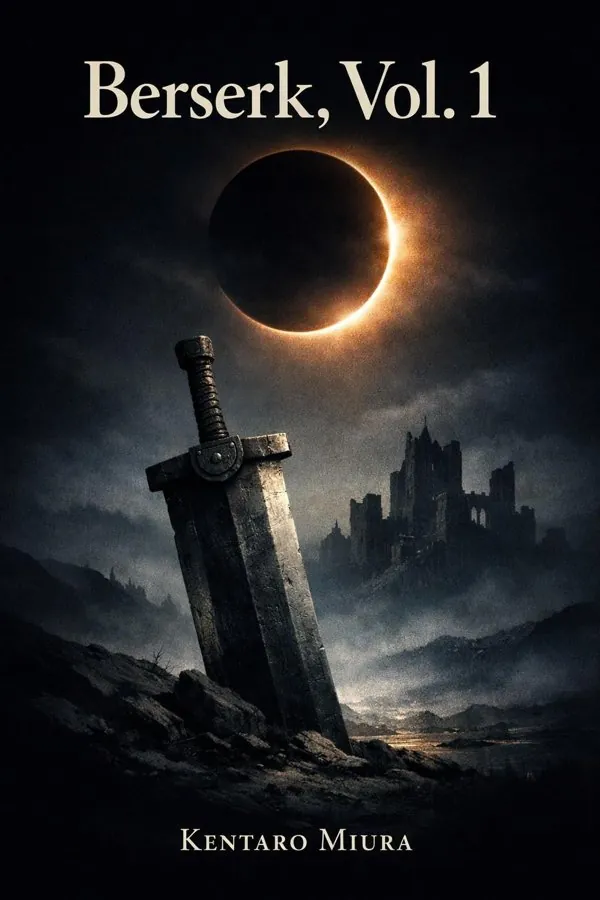
Berserk, Vol. 1: Summary & Key Insights
 10 min9 chaptersAudio available
Key Takeaways from Berserk, Vol. 1
Some heroes inspire trust immediately; Guts is designed to unsettle you first.
Evil is most frightening when it feels structural rather than accidental.
Power gained through despair never stays contained.
The past does not stay behind us just because we want it to.
Darkness becomes meaningful only when some spark of light remains.
What Is Berserk, Vol. 1 About?
Berserk, Vol. 1 by Kentaro Miura is a scifi_fantasy book spanning 8 pages. Berserk, Vol. 1 throws readers into a brutal dark fantasy world where violence is constant, power is corrupting, and survival often comes at the cost of innocence. At the center stands Guts, the Black Swordsman: a towering lone warrior carrying an enormous blade, a mechanical arm, and a fury that seems deeper than any ordinary thirst for revenge. In this opening volume, Kentaro Miura introduces not just a protagonist, but an entire moral landscape shaped by trauma, demonic evil, and the question of whether a person can keep moving forward after being marked by unbearable suffering. What makes this volume matter is that it does more than shock. Beneath the bloodshed and monstrous imagery lies a story about obsession, fate, corruption, and resistance. Miura uses horror and action to explore how people respond when confronted with cruelty from both human institutions and supernatural forces. The result is a manga that feels epic from the very beginning. Miura, widely regarded as one of the masters of dark fantasy storytelling, combines extraordinary visual detail with emotional intensity, making this first volume a powerful introduction to one of manga’s most influential and enduring sagas.
This FizzRead summary covers all 9 key chapters of Berserk, Vol. 1 in approximately 10 minutes, distilling the most important ideas, arguments, and takeaways from Kentaro Miura's work. Also available as an audio summary and Key Quotes Podcast.
Berserk, Vol. 1
Berserk, Vol. 1 throws readers into a brutal dark fantasy world where violence is constant, power is corrupting, and survival often comes at the cost of innocence. At the center stands Guts, the Black Swordsman: a towering lone warrior carrying an enormous blade, a mechanical arm, and a fury that seems deeper than any ordinary thirst for revenge. In this opening volume, Kentaro Miura introduces not just a protagonist, but an entire moral landscape shaped by trauma, demonic evil, and the question of whether a person can keep moving forward after being marked by unbearable suffering.
What makes this volume matter is that it does more than shock. Beneath the bloodshed and monstrous imagery lies a story about obsession, fate, corruption, and resistance. Miura uses horror and action to explore how people respond when confronted with cruelty from both human institutions and supernatural forces. The result is a manga that feels epic from the very beginning. Miura, widely regarded as one of the masters of dark fantasy storytelling, combines extraordinary visual detail with emotional intensity, making this first volume a powerful introduction to one of manga’s most influential and enduring sagas.
Who Should Read Berserk, Vol. 1?
This book is perfect for anyone interested in scifi_fantasy and looking to gain actionable insights in a short read. Whether you're a student, professional, or lifelong learner, the key ideas from Berserk, Vol. 1 by Kentaro Miura will help you think differently.
- ✓Readers who enjoy scifi_fantasy and want practical takeaways
- ✓Professionals looking to apply new ideas to their work and life
- ✓Anyone who wants the core insights of Berserk, Vol. 1 in just 10 minutes
Want the full summary?
Get instant access to this book summary and 100K+ more with Fizz Moment.
Get Free SummaryAvailable on App Store • Free to download
Key Chapters
Some heroes inspire trust immediately; Guts is designed to unsettle you first. Berserk, Vol. 1 opens by presenting him not as a noble knight or idealistic savior, but as a grim, intimidating drifter moving through a world where brutality is normal. He is known as the Black Swordsman, and everything about him suggests damage: his giant sword, his missing arm, his cold demeanor, and the way danger seems magnetized to him. Miura’s choice is important because it teaches readers how to approach the series. This is not a story about clean morality. It is a story about survival after catastrophe.
Guts’s introduction establishes two truths at once. First, he is extraordinarily capable. He can confront soldiers, monsters, and impossible odds with terrifying efficiency. Second, his strength does not make him whole. His rage, sarcasm, and refusal to trust others show a man driven less by hope than by pain. Rather than making him less compelling, this contradiction makes him unforgettable. He is powerful because he has suffered, but he is also trapped by that suffering.
In practical terms, Guts represents a type of resilience many people recognize: functioning through pain rather than having fully healed from it. In life, someone may appear strong at work, disciplined under pressure, or unstoppable in a crisis while privately carrying deep unresolved wounds. Miura asks readers to look beyond surface competence and notice the cost of endurance.
The takeaway is simple: strength and suffering often coexist. When judging yourself or others, look past appearances. Real resilience is not the absence of wounds, but the decision to keep moving while carrying them.
Evil is most frightening when it feels structural rather than accidental. One of the most striking achievements of Berserk, Vol. 1 is how quickly it builds a world in which cruelty is woven into everyday life. The setting resembles a medieval landscape of castles, roads, soldiers, taverns, and feudal power, but everything feels diseased. Violence is casual. Authority is predatory. Religion and governance offer little protection. The environment itself seems to participate in despair.
This matters because Guts is not fighting inside a stable society with occasional monsters. He exists in a realm where human corruption prepares the ground for supernatural horror. Miura suggests that the demonic does not simply invade from outside; it often grows where greed, cowardice, fear, and abuse have already hollowed out human institutions. The monsters are terrifying, but the world is ready for them.
Readers can apply this idea beyond fantasy. In organizations, communities, or even personal habits, major breakdowns rarely come from one dramatic event alone. They often emerge after long neglect, tolerated dysfunction, and repeated compromises. A toxic workplace, for example, does not become harmful overnight. Small acts of intimidation, dishonesty, and indifference create a culture where larger harms flourish. Berserk dramatizes that process by showing a society that has already surrendered many of its moral defenses.
Miura’s worldbuilding is therefore not only atmospheric but thematic. It asks what happens when systems meant to protect life become tools of domination. The answer is a world in which ordinary people suffer while predators thrive.
The actionable takeaway: pay attention to the early signs of corruption in your own environment. Small tolerated wrongs often become the foundation for much larger disasters.
Power gained through despair never stays contained. The Count, one of the first major antagonists in Berserk, Vol. 1, embodies this principle with horrifying clarity. He is more than a villain to be defeated; he is a warning about what happens when pain, pride, and fear combine with the desire for absolute control. Once human, he has transformed into something grotesque and inhuman, ruling through terror while feeding on the suffering around him.
What makes the Count compelling is that Miura does not treat him as evil in a simplistic way. His monstrosity implies a history of weakness, temptation, and moral surrender. He becomes the kind of figure who justifies any atrocity in the name of preserving himself. This is why he matters thematically. Berserk repeatedly suggests that the most dangerous evil is not random destruction but corruption that begins with a human decision: the willingness to sacrifice conscience for power.
This has real-world parallels. Leaders under pressure may tell themselves they are making one necessary compromise, one strategic betrayal, one harsh decision for the greater good. But once the line is crossed, self-preservation can become the governing principle. A manager who manipulates employees to maintain authority, a politician who exploits fear to consolidate power, or an individual who betrays personal values for status all follow the Count’s logic in miniature.
The Count’s presence also sharpens Guts’s role. Guts is brutal, but he still fights against those who have embraced domination completely. That contrast helps readers distinguish wounded ferocity from predatory corruption.
The takeaway: watch what suffering tempts you to become. Pain can explain your choices, but it should never be allowed to excuse your surrender to cruelty.
The past does not stay behind us just because we want it to. One of the most haunting symbols in Berserk, Vol. 1 is the Brand carried by Guts, a mark that identifies him as prey to demonic forces. It is not merely a fantasy device meant to generate danger. It functions as a visual expression of trauma, memory, and inescapable consequence. Guts cannot simply walk away from what happened to him. His body itself announces that history remains active.
The brilliance of this symbol lies in how many layers it holds. On the surface, the Brand attracts monsters and intensifies the story’s tension. At a deeper level, it shows that certain experiences reshape a person permanently. Guts’s rage, vigilance, and inability to rest are not personality quirks; they are adaptive responses to a world that literally hunts him. Miura presents trauma not as a private emotional wound alone but as an ongoing condition that affects how one moves, trusts, sleeps, and survives.
Many readers connect with this metaphor even outside the series’ supernatural context. People carry their own invisible brands: grief, betrayal, abuse, failure, or public humiliation. These experiences can shape future relationships and reactions long after the original event has passed. Someone who has been deeply betrayed may remain suspicious. Someone who has lived through chaos may struggle to relax even in safety. The mark may not be visible, but it is real.
Berserk does not romanticize this. The Brand is painful, isolating, and dangerous. Yet Guts continues despite it. That makes the symbol tragic, but also strangely empowering.
The actionable takeaway: acknowledge the marks your past has left on you. Healing starts not by pretending they are gone, but by learning how to live consciously instead of letting old wounds control every choice.
Darkness becomes meaningful only when some spark of light remains. In a story as severe as Berserk, Vol. 1, Puck serves an essential function. At first glance, the elf seems like comic relief: small, talkative, expressive, and often bewildered by the scale of violence around Guts. But Puck is far more than a tonal break. He is the volume’s reminder that empathy, curiosity, and companionship still exist in a world built on fear.
Puck’s importance comes from contrast. Guts is guarded, cynical, and emotionally barricaded. Puck responds to pain with concern rather than suspicion. He asks questions, reacts visibly to cruelty, and refuses to treat suffering as ordinary. Through him, readers gain a moral reference point inside a setting that otherwise risks becoming numbingly bleak. If Guts shows what it looks like to endure trauma, Puck shows what it means to remain open-hearted in spite of horror.
There is a practical life lesson here. In high-pressure environments, people often admire the person who appears toughest and least affected. Yet emotional numbness is not the same as wisdom. Teams, friendships, and families need figures like Puck: those who humanize the room, notice suffering, and keep others from collapsing into pure functionality. A small gesture of concern can interrupt cycles of bitterness more effectively than grand speeches.
Puck also helps reveal hidden dimensions of Guts. The Black Swordsman may reject help, but his interactions with Puck gradually expose cracks in his armor. That dynamic becomes one of the series’ emotional foundations.
The takeaway: never underestimate the power of a compassionate presence. Even in harsh conditions, empathy can preserve the part of us that violence, stress, or despair tries hardest to erase.
The most dangerous objects are often those that promise escape at the exact moment we feel helpless. In Berserk, Vol. 1, the Behelit appears as a strange, unsettling artifact linked to destiny, sacrifice, and transformation. It is one of the volume’s most important symbols because it introduces a frightening possibility: when someone reaches the edge of despair, a door may open to power, but only at a monstrous price.
The Behelit is fascinating because it blurs the line between fate and decision. It seems connected to forces larger than any individual, yet it still requires human consent. That tension lies at the core of Berserk. Are people trapped by destiny, or do they damn themselves through the choices they make under pressure? Miura does not offer a simple answer. Instead, he shows that moments of extreme suffering are exactly when ethical clarity becomes hardest and most important.
This idea applies broadly. When people feel cornered, they become vulnerable to destructive bargains. A professional under financial stress may justify dishonest behavior. A lonely person may stay in a harmful relationship because any connection feels better than none. A leader facing collapse may embrace authoritarian methods in the name of survival. The Behelit stands for all these seductive shortcuts: solutions that solve immediate pain by destroying something deeper.
By introducing the Behelit early, Miura signals that Berserk is not only about combat but about the soul under pressure. What someone does at their lowest point may define everything that follows.
The takeaway: be especially cautious when desperate. Hard moments create the strongest temptation to trade long-term integrity for short-term relief.
True horror begins when suffering appears to have an intelligence behind it. Near the end of Berserk, Vol. 1, the idea of the God Hand expands the series from violent fantasy into cosmic terror. These entities are not just stronger demons. They represent a level of power so vast and indifferent that ordinary notions of justice begin to collapse. Through them, Miura suggests that evil may be organized, metaphysical, and woven into the logic of the world itself.
This shift matters because it changes the stakes of Guts’s struggle. He is no longer merely hunting monsters or confronting one corrupted ruler. He is entangled in a reality where human pain may be observed, manipulated, and judged by beings beyond conventional morality. The fear here is not just physical annihilation. It is the possibility that the universe itself may not be fair, and that innocence offers no guaranteed protection.
Readers often encounter versions of this feeling in non-fantasy forms. A person may face illness, injustice, or loss that seems disconnected from merit or effort. In those moments, the world can feel vast, impersonal, and terrifyingly indifferent. Berserk gives shape to that existential dread. It dramatizes the fear that pain is not random chaos alone, but part of a system too large to challenge easily.
Yet this revelation also clarifies why Guts matters. The more impossible the structure of evil becomes, the more significant resistance becomes. His struggle gains meaning precisely because success is uncertain.
The actionable takeaway: when life feels unfair or overwhelming, do not wait for the world to become just before acting. Meaning often begins with resistance, even when complete victory is impossible.
Anger can keep a person alive long after hope has vanished, but it rarely teaches them how to live well. Guts is driven by hatred in Berserk, Vol. 1, and Miura portrays that hatred with unusual honesty. It is not decorative intensity. It is fuel. It sharpens Guts’s focus, sustains his mission, and enables him to confront horrors that would paralyze others. In that sense, rage has a survival function. It gives him direction in a world that has taken almost everything from him.
But the volume also shows the cost. Hatred isolates Guts. It narrows his emotional range, strains any possibility of trust, and keeps him chained to the forces he opposes. He is moving forward, yet he is also trapped in a relationship with the past. The people and powers he hunts still govern him because they define his purpose. Miura’s insight is subtle: revenge can produce momentum without producing freedom.
This is relevant in everyday life whenever hurt becomes identity. Someone betrayed in business may build a career around proving others wrong. Someone humiliated in youth may become successful through relentless discipline, yet remain inwardly ruled by old wounds. The outward result can look impressive, but the inner life remains captive. Anger helps people endure, but if never transformed, it becomes another prison.
Berserk does not ask readers to condemn Guts for his rage. It asks them to understand both its necessity and its danger. That balance is one reason the character feels so human.
The takeaway: if anger is helping you survive, respect its role—but do not let it become your only source of purpose. Healing begins when you build an identity larger than what hurt you.
All Chapters in Berserk, Vol. 1
About the Author
Kentaro Miura (1966–2021) was a Japanese manga artist and writer whose name became synonymous with dark fantasy excellence through his masterpiece, Berserk. He began drawing at a young age and developed a reputation for exceptional artistic precision, cinematic paneling, and emotionally intense storytelling. First launched in 1989, Berserk grew into one of the most acclaimed manga series ever created, admired for its detailed artwork, mythic scale, and deep exploration of trauma, ambition, fate, and human brutality. Miura’s influence extended far beyond manga, shaping fantasy illustration, video games, anime, and global popular culture. His work stands out for combining visceral action with philosophical and psychological depth. Even after his death in 2021, Miura remains one of the most respected and influential creators in modern graphic storytelling.
Get This Summary in Your Preferred Format
Read or listen to the Berserk, Vol. 1 summary by Kentaro Miura anytime, anywhere. FizzRead offers multiple formats so you can learn on your terms — all free.
Available formats: App · Audio · PDF · EPUB — All included free with FizzRead
Download Berserk, Vol. 1 PDF and EPUB Summary
Key Quotes from Berserk, Vol. 1
“Some heroes inspire trust immediately; Guts is designed to unsettle you first.”
“Evil is most frightening when it feels structural rather than accidental.”
“Power gained through despair never stays contained.”
“The past does not stay behind us just because we want it to.”
“Darkness becomes meaningful only when some spark of light remains.”
Frequently Asked Questions about Berserk, Vol. 1
Berserk, Vol. 1 by Kentaro Miura is a scifi_fantasy book that explores key ideas across 9 chapters. Berserk, Vol. 1 throws readers into a brutal dark fantasy world where violence is constant, power is corrupting, and survival often comes at the cost of innocence. At the center stands Guts, the Black Swordsman: a towering lone warrior carrying an enormous blade, a mechanical arm, and a fury that seems deeper than any ordinary thirst for revenge. In this opening volume, Kentaro Miura introduces not just a protagonist, but an entire moral landscape shaped by trauma, demonic evil, and the question of whether a person can keep moving forward after being marked by unbearable suffering. What makes this volume matter is that it does more than shock. Beneath the bloodshed and monstrous imagery lies a story about obsession, fate, corruption, and resistance. Miura uses horror and action to explore how people respond when confronted with cruelty from both human institutions and supernatural forces. The result is a manga that feels epic from the very beginning. Miura, widely regarded as one of the masters of dark fantasy storytelling, combines extraordinary visual detail with emotional intensity, making this first volume a powerful introduction to one of manga’s most influential and enduring sagas.
You Might Also Like
Red Rising
Pierce Brown
10 min
Stranger in a Strange Land
Robert A. Heinlein
10 min
AI Valley
Chen Qiufan
10 min
Bloodchild
Octavia E. Butler
10 min
Do Androids Dream of Electric Sheep?
Philip K. Dick
10 min
Jujutsu Kaisen, Vol. 24
Gege Akutami
10 minBrowse by Category
Ready to read Berserk, Vol. 1?
Get the full summary and 100K+ more books with Fizz Moment.