
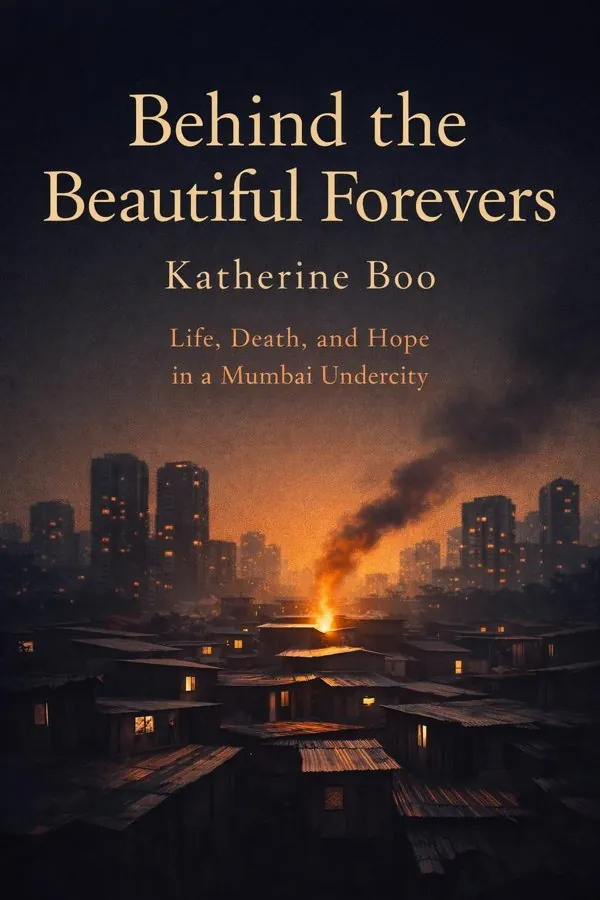
Behind the Beautiful Forevers: Summary & Key Insights
 10 min9 chaptersAudio available
Key Takeaways from Behind the Beautiful Forevers
A city can advertise beauty while hiding suffering just a few feet away.
Poverty often demands business skill long before it offers security.
Ambition does not disappear in broken systems; it adapts to them.
In unequal societies, a single incident can expose the entire machinery of injustice.
Hope in poverty is rarely grand; it is often improvised from small acts of endurance.
What Is Behind the Beautiful Forevers About?
Behind the Beautiful Forevers by Katherine Boo is a non-fiction book published in 2012 spanning 7 pages. Behind the Beautiful Forevers is a work of narrative nonfiction that enters one of the world’s fastest-growing cities through one of its most neglected communities. Katherine Boo chronicles several years in Annawadi, a makeshift settlement near Mumbai’s international airport, where residents survive by sorting garbage, navigating bureaucracy, and chasing fragile opportunities in an economy that seems to promise growth while withholding security. Rather than treating poverty as an abstract policy problem, Boo renders it as lived experience: intimate, exhausting, strategic, and deeply human. What makes the book so powerful is its refusal to flatten people into victims or symbols. In Annawadi, children become entrepreneurs, mothers become political operators, and small disputes spiral into life-altering legal battles. Boo shows how aspiration persists even where institutions routinely fail, and how corruption, inequality, and prejudice shape who gets to move forward. The book matters because it exposes the moral contradictions of global urban development with unusual clarity. Boo’s authority comes from years of immersive reporting, meticulous fact-checking, and a distinguished career covering poverty and social inequality. The result is a vivid, compassionate, and unsparing portrait of survival in modern India.
This FizzRead summary covers all 9 key chapters of Behind the Beautiful Forevers in approximately 10 minutes, distilling the most important ideas, arguments, and takeaways from Katherine Boo's work. Also available as an audio summary and Key Quotes Podcast.
Behind the Beautiful Forevers
Behind the Beautiful Forevers is a work of narrative nonfiction that enters one of the world’s fastest-growing cities through one of its most neglected communities. Katherine Boo chronicles several years in Annawadi, a makeshift settlement near Mumbai’s international airport, where residents survive by sorting garbage, navigating bureaucracy, and chasing fragile opportunities in an economy that seems to promise growth while withholding security. Rather than treating poverty as an abstract policy problem, Boo renders it as lived experience: intimate, exhausting, strategic, and deeply human.
What makes the book so powerful is its refusal to flatten people into victims or symbols. In Annawadi, children become entrepreneurs, mothers become political operators, and small disputes spiral into life-altering legal battles. Boo shows how aspiration persists even where institutions routinely fail, and how corruption, inequality, and prejudice shape who gets to move forward.
The book matters because it exposes the moral contradictions of global urban development with unusual clarity. Boo’s authority comes from years of immersive reporting, meticulous fact-checking, and a distinguished career covering poverty and social inequality. The result is a vivid, compassionate, and unsparing portrait of survival in modern India.
Who Should Read Behind the Beautiful Forevers?
This book is perfect for anyone interested in non-fiction and looking to gain actionable insights in a short read. Whether you're a student, professional, or lifelong learner, the key ideas from Behind the Beautiful Forevers by Katherine Boo will help you think differently.
- ✓Readers who enjoy non-fiction and want practical takeaways
- ✓Professionals looking to apply new ideas to their work and life
- ✓Anyone who wants the core insights of Behind the Beautiful Forevers in just 10 minutes
Want the full summary?
Get instant access to this book summary and 100K+ more with Fizz Moment.
Get Free SummaryAvailable on App Store • Free to download
Key Chapters
A city can advertise beauty while hiding suffering just a few feet away. That is the first unsettling truth of Annawadi, a settlement pressed up against Mumbai’s international airport, where luxury hotels, glossy billboards, and global commerce coexist beside sewage, unstable shelters, and chronic insecurity. Boo uses this geography to reveal a larger reality: economic growth does not automatically improve life for those living at the margins. In fact, proximity to wealth can sharpen exclusion, because people see every day what they are denied.
Annawadi is not portrayed as a static slum, but as a restless ecosystem. Families migrate in search of work, children contribute to household survival, and every narrow lane contains its own informal economy. Waste picking, recycling, casual labor, and petty political mediation create a fragile web of livelihood. The community is invisible to elites, yet intensely visible to police, officials, and local power brokers whenever money can be extracted.
One practical lesson from this section is the importance of looking past surface narratives about development. Airports, hotels, and investment statistics can suggest progress, but Boo reminds us to ask who benefits, who remains excluded, and what hidden labor supports visible prosperity. Similar patterns appear in cities around the world, where low-income workers sustain urban growth without sharing in its rewards.
The broader application is simple but demanding: when evaluating any claim of modernization, look at the nearest margins. Progress should be measured not only by infrastructure and consumption, but by sanitation, justice, housing stability, and opportunity for the poorest residents.
Actionable takeaway: The next time you encounter a story about urban success, ask what lies behind the wall, and who is paying the human cost of that success.
Poverty often demands business skill long before it offers security. Abdul Husain, one of the book’s central figures, embodies this contradiction. As a teenage garbage sorter, he develops a sharp eye for value, learning how to identify, collect, clean, and sell recyclable waste in a way that helps support his family. He is disciplined, observant, and unusually reflective. In another setting, those traits might have made him a celebrated young entrepreneur. In Annawadi, they merely help him survive a little better than others.
Abdul’s story shows that deprivation does not erase intelligence or ambition; it simply forces both into harsher forms. He seeks dignity through work, trying to avoid conflict and improve his family’s circumstances. Yet even his modest success makes him vulnerable. In environments where resources are scarce and institutions are unreliable, advancement can provoke envy, suspicion, and exploitation. A single accusation, especially when filtered through corrupt police and legal systems, can undo years of effort.
Boo uses Abdul to challenge comforting assumptions about meritocracy. Hard work matters, but it is not enough when systems are arbitrary. The lesson extends beyond Annawadi. Many people in precarious economies display extraordinary discipline and ingenuity, but lack legal protection, educational access, and social trust. Their effort produces motion without real mobility.
For readers, Abdul’s life offers a practical way to rethink success. It encourages us to distinguish between individual capability and structural opportunity. A person may be capable, ethical, and industrious while still being trapped by circumstances beyond his control.
Actionable takeaway: When judging achievement, ask not only who worked hard, but who had protection, legitimacy, and room to fail without being destroyed.
Ambition does not disappear in broken systems; it adapts to them. Asha, a politically connected woman in Annawadi, understands this better than almost anyone. She seeks influence through informal brokerage, favors, manipulation, and strategic alliances. Her daughter Manju, by contrast, turns toward education and respectability, hoping that schooling can provide a cleaner route out of poverty. Together, they represent two different responses to the same environment: one navigates corruption as reality, while the other tries to transcend it.
Asha’s rise is not reducible to villainy. Boo presents her as shrewd, energetic, and deeply shaped by a world where formal institutions rarely reward honesty. She helps some neighbors, exploits others, and constantly recalculates where power lies. Manju sees both the necessity and the moral cost of this approach. Her education gives her language for a different future, but education alone does not erase caste, class stigma, or the expectations imposed by family and community.
This mother-daughter dynamic offers a practical lens on institutional failure. When public systems are inconsistent, people rely on personal networks, patronage, and unofficial intermediaries. That pattern is not unique to Annawadi; it appears anywhere bureaucracies are weak and opportunity is rationed. Readers can also see how mobility is rarely a single decision. It is negotiated between generations, values, and available tools.
The deeper insight is that ethical compromise often grows from survival logic, not abstract immorality. Understanding that does not excuse corruption, but it helps explain why reform is so difficult. People cling to flawed systems when those systems are the only ones that function at all.
Actionable takeaway: When analyzing corruption, look beyond individual blame and ask what legitimate pathways are missing that make manipulation seem necessary.
In unequal societies, a single incident can expose the entire machinery of injustice. The conflict that erupts after a disabled neighbor, Fatima, sets herself on fire and implicates Abdul’s family becomes the book’s central legal and moral crisis. What follows is not a straightforward investigation but a cascade of accusation, rumor, bribery, intimidation, and procedural distortion. The court system, police force, and medical bureaucracy do not clarify truth; they turn truth into something negotiable.
Boo shows how vulnerable people are trapped by institutions designed, in theory, to protect them. Police seek payments. Witness statements shift under pressure. Lawyers treat the case as a transaction. Time itself becomes punishment, as families lose income, peace, and social standing while waiting for hearings and outcomes. Even innocence offers limited protection when due process is expensive, slow, and manipulable.
This key idea matters because it redefines what injustice looks like. It is not only wrongful conviction or explicit brutality. It is also delay, ambiguity, extortion, and the psychological burden of navigating systems no poor family can control. Similar dynamics are visible in overburdened legal systems worldwide, where the poor are punished through process rather than verdict.
For readers, the case illustrates why institutional quality matters as much as economic opportunity. A family can work hard, save money, and avoid trouble, yet still be shattered by arbitrary legal exposure. Real development requires trustworthy courts, transparent policing, and accessible public services.
Actionable takeaway: Judge a society not only by how it creates wealth, but by whether ordinary people can seek justice without bribery, fear, or financial ruin.
Hope in poverty is rarely grand; it is often improvised from small acts of endurance. Through figures like Kalu and Sunil, Boo expands the emotional and social world of Annawadi beyond its best-known characters. Kalu, scarred by violence and instability, reflects the damage that poverty inflicts on the body and psyche. Sunil, younger and more fluid in his identity, moves through the settlement and the city with curiosity, alertness, and a kind of vulnerable independence. Their lives reveal how children and young adults absorb deprivation differently depending on temperament, chance, and social ties.
What makes these portraits memorable is Boo’s attention to the fragility of aspiration. A meal, a beating, a brief job, a sickness, or a chance encounter can alter a trajectory. There is little cushion between survival and collapse. Yet these characters are not defined solely by suffering. They form friendships, imagine futures, make mistakes, and search for moments of meaning in a world that offers few stable scripts for growing up.
The practical insight here is that resilience should not be romanticized. Sunil’s adaptability and Kalu’s persistence are impressive, but they emerge under pressure no one should have to endure. Policymakers and readers alike often praise the poor for resilience while ignoring the preventable conditions that make such resilience necessary. Boo asks us to admire human strength without normalizing the circumstances that test it.
This idea applies broadly to how we think about youth disadvantage. Talent and grit matter, but so do nutrition, safety, schooling, and protection from violence. Hope becomes durable only when supported by institutions.
Actionable takeaway: Celebrate resilience, but do not mistake it for justice; ask what supports are needed so survival does not depend on extraordinary toughness.
Large political events often become intimate forms of fear for the poor. In Annawadi, broader tensions around terrorism, religion, and national security do not remain distant headlines. They filter into daily life through suspicion, surveillance, communal anxiety, and renewed vulnerability for already precarious families. For Muslim residents in particular, public fear can deepen existing prejudice and make ordinary interactions with authority even more dangerous.
Boo demonstrates that insecurity is layered. There is the obvious insecurity of food, housing, and work, but also the more diffuse insecurity of being misread, targeted, or collectively blamed. In places where legal protections are thin, national crises can quickly intensify local harassment. A family that already fears eviction or police extortion may now also fear ideological suspicion. This changes how people speak, move, trust, and imagine the future.
The broader lesson is that social fractures rarely affect everyone equally. Public narratives about security often overlook who bears the heaviest burden when fear enters policy and policing. Annawadi’s residents have little power to shape these narratives, yet they live with their consequences. The same pattern appears globally whenever marginalized communities are made to absorb the social costs of collective panic.
For readers, this section is a reminder to connect macro politics with micro experience. Terrorism, communal conflict, and state response are not only matters of strategy and ideology. They also influence whether a child gets questioned by police, whether a worker is trusted, and whether a family feels safe in its own neighborhood.
Actionable takeaway: When evaluating security policies or public fear campaigns, ask which communities are made more vulnerable and whose dignity becomes easier to disregard.
Economic growth can transform skylines without transforming fate. In the later movement of the book, Boo shows how Annawadi continues under the looming promise of a new India that seems perpetually just out of reach. Construction expands, investment flows, and public rhetoric celebrates opportunity, yet residents remain trapped in unstable work, political manipulation, and uncertain legal standing. The future is visible all around them, but rarely available to them.
This is one of the book’s most important contributions. Boo refuses the easy storyline that modernization gradually lifts all boats. Instead, she shows a world where growth creates aspiration faster than it creates justice. People compare themselves not to abstract poverty lines but to the wealth and mobility they can literally see across the road. That proximity intensifies longing and shame while also feeding relentless effort.
The aftermath of Annawadi’s major conflicts is not closure but continuation. Families absorb loss, recalibrate, and keep moving. Some opportunities emerge, but they are partial and easily reversed. This unsettled ending feels honest because it mirrors the reality of structural inequality: there is no tidy resolution, only adaptation.
The practical application for readers is to think more critically about national success stories. GDP growth, urban development, and consumer expansion can coexist with severe exclusion. If policy does not address justice, health, education, and secure housing, growth may widen the emotional gap between promise and lived reality.
Actionable takeaway: Treat stories of development with disciplined curiosity, and ask whether prosperity is broadening real capability or merely producing more visible contrasts between winners and losers.
When resources are scarce, solidarity is often weaker than outsiders imagine. One of Boo’s sharpest observations is that extreme poverty does not automatically produce collective political action or communal harmony. In Annawadi, neighbors help one another at times, but they also compete fiercely for work, patronage, favors, and status. Grievances accumulate quickly, and even minor disputes can become explosive because so much is at stake.
This matters because many readers approach poor communities with simplistic expectations. Some expect noble unity; others expect chaos. Boo offers something more credible: social life shaped by scarcity, where cooperation and betrayal coexist. People calculate survival constantly. Who gets a job, a loan, a political connection, or a favorable police response may determine whether another family falls behind. Under those conditions, envy can become as powerful as empathy.
The practical lesson is that poverty is not only a lack of money; it is a pressure system that distorts relationships. Competition can erode trust, making collective improvement harder to achieve. This helps explain why organizing, reform, and civic action are so difficult in marginalized settings. People are not irrational or apolitical; they are responding to immediate incentives in a system that rewards short-term maneuvering over long-term cooperation.
Readers can apply this insight whenever they evaluate social policy or charitable interventions. Programs that assume stable trust networks may fail if they ignore how scarcity fragments communities. Effective support often requires reducing zero-sum pressures so people can afford to think beyond immediate survival.
Actionable takeaway: Avoid romanticizing poverty; if you want stronger community outcomes, look for ways to reduce the scarcity and insecurity that pit neighbors against one another.
How we look at poverty shapes what we believe should be done about it. Boo’s reporting stands out because she neither sentimentalizes nor distances her subjects. She treats Annawadi’s residents as full persons: contradictory, ambitious, flawed, intelligent, funny, exhausted, and morally complex. This method is not just literary; it is ethical. It challenges the habit of reducing poor people to case studies, moral lessons, or policy categories.
By staying close to daily decisions, Boo reveals how structural injustice works through ordinary moments. A child sorting scrap, a mother negotiating with an official, a student trying to preserve self-respect, a family calculating legal costs: these scenes make inequality concrete. They also force readers to confront their own preferences for clean narratives. We often want heroes, villains, and solutions. Boo offers none in pure form.
The practical application of this idea reaches beyond the book. In journalism, policy, philanthropy, and everyday conversation, there is value in resisting oversimplification. Clear seeing means asking better questions: What constraints shape behavior? What incentives distort institutions? What capacities are present but unsupported? It also means recognizing that empathy is strongest when paired with precision.
For readers, this key idea transforms the book from a story about one slum into a lesson about attention itself. To see people clearly is to grant them complexity without denying the forces arrayed against them. That balance is rare and necessary.
Actionable takeaway: When encountering stories of poverty, resist labels and ask what fuller, more complicated reality might exist beyond the first emotional impression.
All Chapters in Behind the Beautiful Forevers
About the Author
Katherine Boo is an American journalist and author acclaimed for her deeply reported work on poverty, inequality, and institutional failure. She has written for The New Yorker and The Washington Post, where her reporting helped earn a Pulitzer Prize for Public Service. Boo is known for immersive, long-form journalism that combines investigative rigor with vivid narrative storytelling. Her work often focuses on people whose lives are shaped by systems that wealthier societies ignore or misunderstand. Behind the Beautiful Forevers, her first book, grew out of years of reporting in Mumbai and received widespread praise for its precision, humanity, and literary power. The book won the National Book Award for Nonfiction and established Boo as one of the most important nonfiction writers of her generation.
Get This Summary in Your Preferred Format
Read or listen to the Behind the Beautiful Forevers summary by Katherine Boo anytime, anywhere. FizzRead offers multiple formats so you can learn on your terms — all free.
Available formats: App · Audio · PDF · EPUB — All included free with FizzRead
Download Behind the Beautiful Forevers PDF and EPUB Summary
Key Quotes from Behind the Beautiful Forevers
“A city can advertise beauty while hiding suffering just a few feet away.”
“Poverty often demands business skill long before it offers security.”
“Ambition does not disappear in broken systems; it adapts to them.”
“In unequal societies, a single incident can expose the entire machinery of injustice.”
“Hope in poverty is rarely grand; it is often improvised from small acts of endurance.”
Frequently Asked Questions about Behind the Beautiful Forevers
Behind the Beautiful Forevers by Katherine Boo is a non-fiction book that explores key ideas across 9 chapters. Behind the Beautiful Forevers is a work of narrative nonfiction that enters one of the world’s fastest-growing cities through one of its most neglected communities. Katherine Boo chronicles several years in Annawadi, a makeshift settlement near Mumbai’s international airport, where residents survive by sorting garbage, navigating bureaucracy, and chasing fragile opportunities in an economy that seems to promise growth while withholding security. Rather than treating poverty as an abstract policy problem, Boo renders it as lived experience: intimate, exhausting, strategic, and deeply human. What makes the book so powerful is its refusal to flatten people into victims or symbols. In Annawadi, children become entrepreneurs, mothers become political operators, and small disputes spiral into life-altering legal battles. Boo shows how aspiration persists even where institutions routinely fail, and how corruption, inequality, and prejudice shape who gets to move forward. The book matters because it exposes the moral contradictions of global urban development with unusual clarity. Boo’s authority comes from years of immersive reporting, meticulous fact-checking, and a distinguished career covering poverty and social inequality. The result is a vivid, compassionate, and unsparing portrait of survival in modern India.
You Might Also Like


Browse by Category
Ready to read Behind the Beautiful Forevers?
Get the full summary and 100K+ more books with Fizz Moment.