
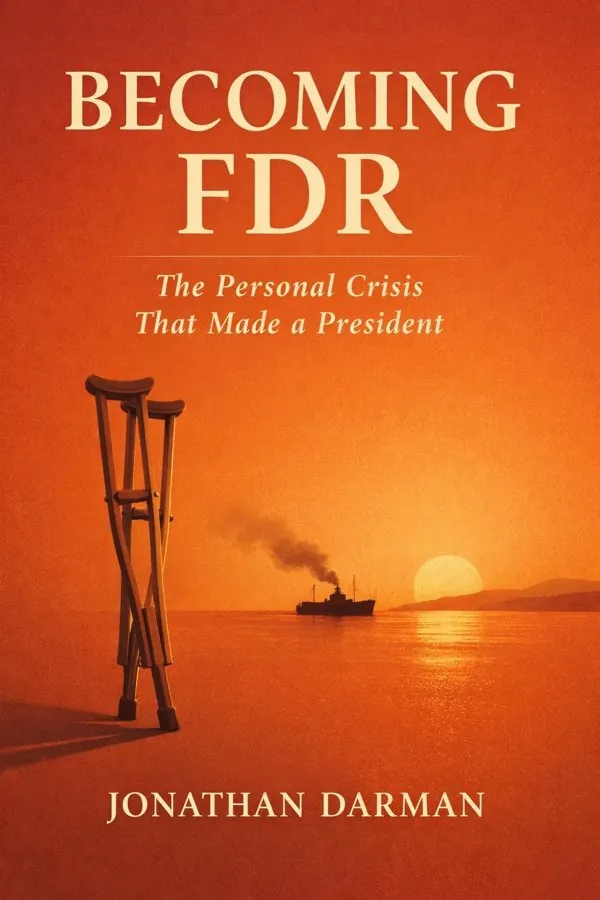
Becoming FDR: The Personal Crisis That Made a President: Summary & Key Insights
 10 min9 chaptersAudio available
What Is Becoming FDR: The Personal Crisis That Made a President About?
Becoming FDR: The Personal Crisis That Made a President by Jonathan Darman is a biographies book spanning 9 pages. A revelatory biography that explores how Franklin D. Roosevelt’s personal struggles with illness and adversity shaped his character and leadership, ultimately preparing him to guide the United States through the Great Depression and World War II. Jonathan Darman traces how Roosevelt’s battle with polio transformed his empathy, resilience, and political vision, turning personal hardship into a source of national strength.
This FizzRead summary covers all 9 key chapters of Becoming FDR: The Personal Crisis That Made a President in approximately 10 minutes, distilling the most important ideas, arguments, and takeaways from Jonathan Darman's work. Also available as an audio summary and Key Quotes Podcast.
Becoming FDR: The Personal Crisis That Made a President
A revelatory biography that explores how Franklin D. Roosevelt’s personal struggles with illness and adversity shaped his character and leadership, ultimately preparing him to guide the United States through the Great Depression and World War II. Jonathan Darman traces how Roosevelt’s battle with polio transformed his empathy, resilience, and political vision, turning personal hardship into a source of national strength.
Who Should Read Becoming FDR: The Personal Crisis That Made a President?
This book is perfect for anyone interested in biographies and looking to gain actionable insights in a short read. Whether you're a student, professional, or lifelong learner, the key ideas from Becoming FDR: The Personal Crisis That Made a President by Jonathan Darman will help you think differently.
- ✓Readers who enjoy biographies and want practical takeaways
- ✓Professionals looking to apply new ideas to their work and life
- ✓Anyone who wants the core insights of Becoming FDR: The Personal Crisis That Made a President in just 10 minutes
Want the full summary?
Get instant access to this book summary and 100K+ more with Fizz Moment.
Get Free SummaryAvailable on App Store • Free to download
Key Chapters
Born into privilege at Hyde Park, Franklin Roosevelt’s early life was defined by assurance and advantage. He grew up in an environment that promoted confidence—a world where ambition was not merely encouraged but assumed. At Harvard and later Columbia Law School, he thrived within circles of influence, learning the rhythms of elite society and the language of politics. It was a life that seemed destined for success, especially when he married Eleanor Roosevelt, the niece of President Theodore Roosevelt.
In his early political career, Franklin carried forward a belief that leadership was about position and performance. His role as Assistant Secretary of the Navy during World War I gave him a taste of administrative power and public recognition. He mirrored his cousin Theodore’s vigor, obsessed with visibility and progress. Yet, beneath his charm, there existed a gap—a lack of deep empathy, a distance from genuine hardship. He was talented and ambitious, but untested by true vulnerability.
This period set the ground for contrast. Darman’s narrative emphasizes how youthful Franklin embodied confidence without introspection. He was playing the role of ‘Roosevelt,’ believing energy and optimism alone could move the world. The turning point would come when such confidence met an immovable obstacle: the virus that would attack his body and dismantle the very foundation of his identity. The pre-polio Roosevelt was a man in motion, always ascending. What followed was a fall—and then, a remarkable evolution.
The summer of 1921 changed everything. Franklin Roosevelt, robust and lively at age thirty-nine, contracted poliomyelitis while vacationing at Campobello Island. Within days, the once-participative man who swam, sailed, and exuded vitality found his legs paralyzed. The description of his physical downward spiral is heartbreaking. Nurses, doctors, and his devoted wife watched him struggle between hope and disbelief. For Roosevelt, whose life had revolved around movement and visibility, loss of mobility was more than a physical blow—it was an existential fracture.
Darman captures the moment as a turning point not only for Roosevelt but for the future of American leadership. The disease stripped away pretenses. Suddenly, the instruments of privilege—money, influence, reputation—could not buy back the use of his legs. Facing this helplessness, Roosevelt embarked on a psychological transformation. He could no longer rely on charm or social ease; he would have to find inner strength.
Polio forced him to confront vulnerability in its rawest form. It isolated him, took him out of the public eye, and left him dependent on others—a painful reversal for a man so accustomed to independence. Yet in this crucible of illness, seeds of empathy were planted. The experience would later teach him what it meant to suffer silently and to rebuild from nothing. His political instincts, once sharp and calculating, began to absorb human sensitivity. What polio took from his body, it gave to his soul.
+ 7 more chapters — available in the FizzRead app
All Chapters in Becoming FDR: The Personal Crisis That Made a President
About the Author
Jonathan Darman is an American journalist and historian known for his works on U.S. political history. A former correspondent for Newsweek and The New York Times, he specializes in the intersection of personal narrative and political transformation in twentieth-century America.
Get This Summary in Your Preferred Format
Read or listen to the Becoming FDR: The Personal Crisis That Made a President summary by Jonathan Darman anytime, anywhere. FizzRead offers multiple formats so you can learn on your terms — all free.
Available formats: App · Audio · PDF · EPUB — All included free with FizzRead
Download Becoming FDR: The Personal Crisis That Made a President PDF and EPUB Summary
Key Quotes from Becoming FDR: The Personal Crisis That Made a President
“Born into privilege at Hyde Park, Franklin Roosevelt’s early life was defined by assurance and advantage.”
“Franklin Roosevelt, robust and lively at age thirty-nine, contracted poliomyelitis while vacationing at Campobello Island.”
Frequently Asked Questions about Becoming FDR: The Personal Crisis That Made a President
Becoming FDR: The Personal Crisis That Made a President by Jonathan Darman is a biographies book that explores key ideas across 9 chapters. A revelatory biography that explores how Franklin D. Roosevelt’s personal struggles with illness and adversity shaped his character and leadership, ultimately preparing him to guide the United States through the Great Depression and World War II. Jonathan Darman traces how Roosevelt’s battle with polio transformed his empathy, resilience, and political vision, turning personal hardship into a source of national strength.
You Might Also Like

An American Marriage
Tayari Jones
10 min
Benjamin Franklin: An American Life
Walter Isaacson
10 min
I Know Why The Caged Bird Sings
Maya Angelou
10 min
Long Walk to Freedom
Nelson Mandela
10 min
Persepolis
Marjane Satrapi
10 min
Surely You're Joking, Mr. Feynman!
Richard P. Feynman
10 minBrowse by Category
Ready to read Becoming FDR: The Personal Crisis That Made a President?
Get the full summary and 100K+ more books with Fizz Moment.