
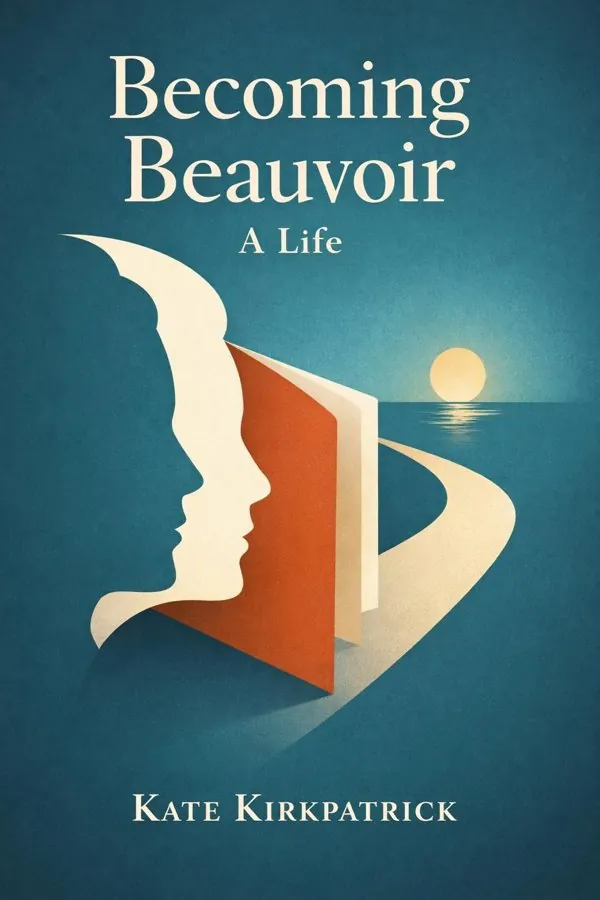
Becoming Beauvoir: A Life: Summary & Key Insights
 10 min9 chaptersAudio available
What Is Becoming Beauvoir: A Life About?
Becoming Beauvoir: A Life by Kate Kirkpatrick is a biographies book spanning 9 pages. A comprehensive biography of Simone de Beauvoir that reexamines her life, philosophy, and legacy. Drawing on newly available letters and diaries, Kate Kirkpatrick presents Beauvoir as a philosopher in her own right, exploring her intellectual development, relationships, and the evolution of her feminist thought.
This FizzRead summary covers all 9 key chapters of Becoming Beauvoir: A Life in approximately 10 minutes, distilling the most important ideas, arguments, and takeaways from Kate Kirkpatrick's work. Also available as an audio summary and Key Quotes Podcast.
Becoming Beauvoir: A Life
A comprehensive biography of Simone de Beauvoir that reexamines her life, philosophy, and legacy. Drawing on newly available letters and diaries, Kate Kirkpatrick presents Beauvoir as a philosopher in her own right, exploring her intellectual development, relationships, and the evolution of her feminist thought.
Who Should Read Becoming Beauvoir: A Life?
This book is perfect for anyone interested in biographies and looking to gain actionable insights in a short read. Whether you're a student, professional, or lifelong learner, the key ideas from Becoming Beauvoir: A Life by Kate Kirkpatrick will help you think differently.
- ✓Readers who enjoy biographies and want practical takeaways
- ✓Professionals looking to apply new ideas to their work and life
- ✓Anyone who wants the core insights of Becoming Beauvoir: A Life in just 10 minutes
Want the full summary?
Get instant access to this book summary and 100K+ more with Fizz Moment.
Get Free SummaryAvailable on App Store • Free to download
Key Chapters
Beauvoir’s childhood was steeped in bourgeois respectability and Catholic devotion. Born in 1908 to a family that prized tradition, she was an unusually curious child — drawn not to submission but to exploration. I trace her early intellectual hunger, nourished by her father’s library and frustrated by the narrow horizons offered to women. She excelled at the Sorbonne, where she studied philosophy among peers who would later define twentieth-century French intellectual life. The experience of realizing that women were often dismissed as incapable of abstract thought imprinted on her a quiet defiance.
Her rejection of religion marked the first decisive act of freedom. The God of her youth had demanded obedience, but she discovered early that meaning could not be found through submission. This was not merely a youthful rebellion; it was the birth of her philosophical independence. The Catholic morality she had inherited posited transcendence as a gift bestowed from above, while Beauvoir’s growing sense of existential thought led her to see transcendence as a project of becoming — something achieved through action and reflection. When she sat for the agrégation, ranking among the top philosophy students of her generation, she took her first steps toward intellectual equality in a male-dominated world. I emphasize that from this foundation, her later feminist insights were not retrospective inventions; they grew directly from her lived experience of exclusion and effort.
Before she ever met Sartre, Beauvoir was already thinking existentially. The late 1920s and early 1930s were years of philosophical experimentation: she engaged deeply with phenomenology, reading Husserl’s ideas about consciousness and intentionality, and with ethics, seeking a framework that could preserve moral seriousness without religious foundations. In these formative years, she began constructing an account of subjectivity — how the self exists in relation to others — that prefigured the existential focus on interdependence.
I depict Beauvoir as grappling with questions central to her later work: what does it mean to choose, and what are we responsible for when we act? For her, freedom was not isolation but situatedness. The individual is always enmeshed in a web of social and historical conditions that shape (but do not determine) what one can become. This delicate balance between constraint and autonomy would become a cornerstone of *The Second Sex*. By illuminating these early philosophical developments, we see that Beauvoir was never simply adopting Sartre’s framework. On the contrary, her attention to the lived experience of embodiment and relationality provided existentialism with its most human dimension.
+ 7 more chapters — available in the FizzRead app
All Chapters in Becoming Beauvoir: A Life
About the Author
Kate Kirkpatrick is a British philosopher and biographer specializing in existentialism and feminist philosophy. She teaches at the University of Oxford and has written extensively on Jean-Paul Sartre and Simone de Beauvoir.
Get This Summary in Your Preferred Format
Read or listen to the Becoming Beauvoir: A Life summary by Kate Kirkpatrick anytime, anywhere. FizzRead offers multiple formats so you can learn on your terms — all free.
Available formats: App · Audio · PDF · EPUB — All included free with FizzRead
Download Becoming Beauvoir: A Life PDF and EPUB Summary
Key Quotes from Becoming Beauvoir: A Life
“Beauvoir’s childhood was steeped in bourgeois respectability and Catholic devotion.”
“Before she ever met Sartre, Beauvoir was already thinking existentially.”
Frequently Asked Questions about Becoming Beauvoir: A Life
Becoming Beauvoir: A Life by Kate Kirkpatrick is a biographies book that explores key ideas across 9 chapters. A comprehensive biography of Simone de Beauvoir that reexamines her life, philosophy, and legacy. Drawing on newly available letters and diaries, Kate Kirkpatrick presents Beauvoir as a philosopher in her own right, exploring her intellectual development, relationships, and the evolution of her feminist thought.
You Might Also Like

An American Marriage
Tayari Jones
10 min
Benjamin Franklin: An American Life
Walter Isaacson
10 min
I Know Why The Caged Bird Sings
Maya Angelou
10 min
Long Walk to Freedom
Nelson Mandela
10 min
Persepolis
Marjane Satrapi
10 min
Surely You're Joking, Mr. Feynman!
Richard P. Feynman
10 minBrowse by Category
Ready to read Becoming Beauvoir: A Life?
Get the full summary and 100K+ more books with Fizz Moment.