
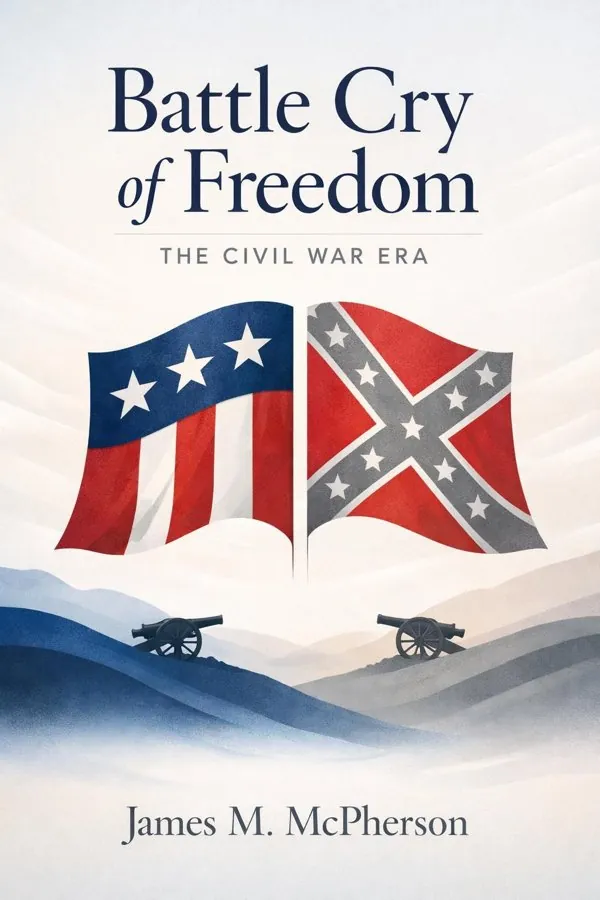
Battle Cry of Freedom: The Civil War Era: Summary & Key Insights
 10 min9 chaptersAudio available
What Is Battle Cry of Freedom: The Civil War Era About?
Battle Cry of Freedom: The Civil War Era by James M. McPherson is a world_history book spanning 9 pages. Battle Cry of Freedom es una obra de historia que ofrece una visión integral de la Guerra Civil estadounidense, desde sus raíces políticas y sociales hasta sus consecuencias. McPherson combina un análisis riguroso con una narrativa vívida, explorando las causas del conflicto, las estrategias militares y el impacto humano de la guerra. El libro se destaca por su equilibrio entre la erudición y la accesibilidad, convirtiéndose en una referencia fundamental sobre el período.
This FizzRead summary covers all 9 key chapters of Battle Cry of Freedom: The Civil War Era in approximately 10 minutes, distilling the most important ideas, arguments, and takeaways from James M. McPherson's work. Also available as an audio summary and Key Quotes Podcast.
Battle Cry of Freedom: The Civil War Era
Battle Cry of Freedom es una obra de historia que ofrece una visión integral de la Guerra Civil estadounidense, desde sus raíces políticas y sociales hasta sus consecuencias. McPherson combina un análisis riguroso con una narrativa vívida, explorando las causas del conflicto, las estrategias militares y el impacto humano de la guerra. El libro se destaca por su equilibrio entre la erudición y la accesibilidad, convirtiéndose en una referencia fundamental sobre el período.
Who Should Read Battle Cry of Freedom: The Civil War Era?
This book is perfect for anyone interested in world_history and looking to gain actionable insights in a short read. Whether you're a student, professional, or lifelong learner, the key ideas from Battle Cry of Freedom: The Civil War Era by James M. McPherson will help you think differently.
- ✓Readers who enjoy world_history and want practical takeaways
- ✓Professionals looking to apply new ideas to their work and life
- ✓Anyone who wants the core insights of Battle Cry of Freedom: The Civil War Era in just 10 minutes
Want the full summary?
Get instant access to this book summary and 100K+ more with Fizz Moment.
Get Free SummaryAvailable on App Store • Free to download
Key Chapters
Long before the first cannon fired at Fort Sumter, the United States was already divided in spirit. In the antebellum decades, the North industrialized at a breathtaking pace. Railroads stitched together cities, factories hummed with immigrant labor, and an ethos of progress pervaded society. Meanwhile, the South remained a largely agrarian world, defined by plantation slavery and the production of cotton. This wasn’t simply a difference of economics—it was a difference of identity. The South’s wealth and social structure depended on a labor system that contradicted the North’s idea of free labor, mobility, and self-made success.
In the halls of Congress, each territorial acquisition or statehood proposal brought forth the same question: would slavery expand or be contained? From the Missouri Compromise to the Compromise of 1850, I show how every attempt to paper over the contradiction between freedom and bondage only deepened the sectional rift. As I explain in the book, these weren’t isolated political disputes; they reflected opposing worldviews. The North increasingly saw slavery as a moral blight and a backward system hindering national progress, whereas the South came to defend it as a positive good—an institution aligned with both racial ideology and Christian paternalism.
By the 1850s, the moral argument had become impossible to separate from the political one. The Fugitive Slave Act inflamed Northern abolitionists; the Kansas-Nebraska Act effectively erased previous compromises, leading to violence in what came to be called “Bleeding Kansas.” In this prelude to war, I wanted readers to grasp the deep sense of grievance that animated both regions. The Southern planter saw the North’s industrial capitalism and antislavery rhetoric as threats to his way of life, while many Northerners came to believe that slavery’s power was choking democracy itself.
American expansion was one of the great engines of conflict. The territorial gains from the Mexican-American War in the 1840s brought the question of slavery’s extension to new frontiers. In *Battle Cry of Freedom*, I emphasize how the ideology of Manifest Destiny intertwined with sectional politics. Each stretch of land acquired—California, New Mexico, Utah—became a test case in the nation’s moral geography.
The Wilmot Proviso, which sought to ban slavery in territories taken from Mexico, marked a critical turning point. Though it failed legislatively, it revealed how irreconcilable North and South had become. The land itself was not the real prize; what mattered was the balance of power in Congress, and with it, the future of freedom as Americans understood it.
The crisis deepened as the political class lost its capacity for compromise. The Compromise of 1850, meant to preserve harmony through concessions, offered temporary calm but at the cost of principle. California entered as a free state, but the Fugitive Slave Law outraged Northern sensibilities, forcing them to confront slavery on their own streets. The episode demonstrated that slavery could not be confined to the South—it was a national institution demanding a national reckoning.
Through these years, the rhetoric of expansion masked the Republic’s deeper struggle. Westward growth no longer symbolized opportunity alone; it came to embody the clash between labor systems, ideologies, and visions of what America should become.
+ 7 more chapters — available in the FizzRead app
All Chapters in Battle Cry of Freedom: The Civil War Era
About the Author
James M. McPherson es un historiador estadounidense especializado en la Guerra Civil de los Estados Unidos. Profesor emérito en la Universidad de Princeton, ha recibido numerosos premios, incluido el Premio Pulitzer de Historia por Battle Cry of Freedom. Su trabajo se caracteriza por su claridad narrativa y su profundo conocimiento del contexto político y social del siglo XIX estadounidense.
Get This Summary in Your Preferred Format
Read or listen to the Battle Cry of Freedom: The Civil War Era summary by James M. McPherson anytime, anywhere. FizzRead offers multiple formats so you can learn on your terms — all free.
Available formats: App · Audio · PDF · EPUB — All included free with FizzRead
Download Battle Cry of Freedom: The Civil War Era PDF and EPUB Summary
Key Quotes from Battle Cry of Freedom: The Civil War Era
“Long before the first cannon fired at Fort Sumter, the United States was already divided in spirit.”
“American expansion was one of the great engines of conflict.”
Frequently Asked Questions about Battle Cry of Freedom: The Civil War Era
Battle Cry of Freedom: The Civil War Era by James M. McPherson is a world_history book that explores key ideas across 9 chapters. Battle Cry of Freedom es una obra de historia que ofrece una visión integral de la Guerra Civil estadounidense, desde sus raíces políticas y sociales hasta sus consecuencias. McPherson combina un análisis riguroso con una narrativa vívida, explorando las causas del conflicto, las estrategias militares y el impacto humano de la guerra. El libro se destaca por su equilibrio entre la erudición y la accesibilidad, convirtiéndose en una referencia fundamental sobre el período.
You Might Also Like
The Age of Capital
Eric Hobsbawm
10 min
The Gulag Archipelago
Aleksandr Solzhenitsyn
10 min
Jerusalem: The Biography
Simon Sebag Montefiore
10 min
The Anglo-Saxons
James Campbell
10 min
The Boer War
Thomas Pakenham
10 min
The Industrial Revolutionaries: The Making of the Modern World 1776–1914
Gavin Weightman
10 minBrowse by Category
Ready to read Battle Cry of Freedom: The Civil War Era?
Get the full summary and 100K+ more books with Fizz Moment.