
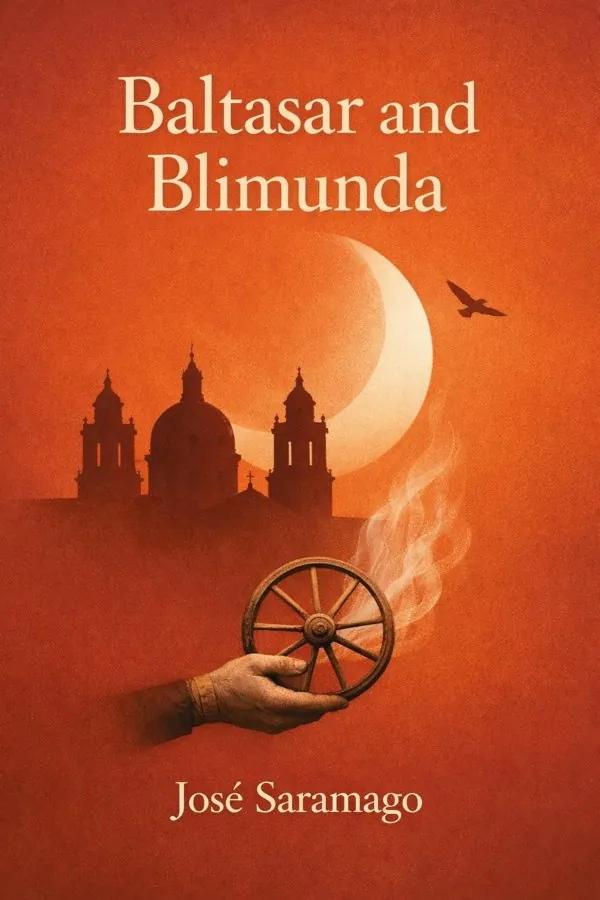
Baltasar and Blimunda: Summary & Key Insights
 10 min9 chaptersAudio available
Key Takeaways from Baltasar and Blimunda
Power often presents itself as sacred when it wants obedience without resistance.
Love becomes transformative when two damaged or marginal people recognize each other beyond society’s categories.
Imagination becomes dangerous the moment it challenges the limits that power declares natural.
Monuments are often praised for their beauty while the suffering that made them possible is forgotten.
What if the deepest truth about a person is not what they say or own, but the force that keeps them moving?
What Is Baltasar and Blimunda About?
Baltasar and Blimunda by José Saramago is a classics book spanning 6 pages. José Saramago’s Baltasar and Blimunda is a sweeping historical novel that turns eighteenth-century Portugal into a stage where love, tyranny, faith, invention, and human endurance collide. Set during the reign of King John V, the book follows Baltasar, a former soldier maimed in war, and Blimunda, a woman with an uncanny ability to see what lies inside people when she fasts. Around them rises the monumental Convent of Mafra, built through royal vanity and religious fervor, while a visionary priest, Bartolomeu de Gusmão, dreams of human flight. From these elements, Saramago creates something larger than historical fiction: a meditation on who pays for grandeur, who gets remembered, and what forms of freedom remain possible under oppression. The novel matters because it gives dignity to the anonymous laborers and lovers usually pushed aside by official history. It also showcases the qualities that made Saramago one of world literature’s great voices: irony, moral seriousness, political intelligence, and a style that blends myth with realism. Baltasar and Blimunda is both an unforgettable story and a profound critique of power.
This FizzRead summary covers all 9 key chapters of Baltasar and Blimunda in approximately 10 minutes, distilling the most important ideas, arguments, and takeaways from José Saramago's work. Also available as an audio summary and Key Quotes Podcast.
Baltasar and Blimunda
José Saramago’s Baltasar and Blimunda is a sweeping historical novel that turns eighteenth-century Portugal into a stage where love, tyranny, faith, invention, and human endurance collide. Set during the reign of King John V, the book follows Baltasar, a former soldier maimed in war, and Blimunda, a woman with an uncanny ability to see what lies inside people when she fasts. Around them rises the monumental Convent of Mafra, built through royal vanity and religious fervor, while a visionary priest, Bartolomeu de Gusmão, dreams of human flight. From these elements, Saramago creates something larger than historical fiction: a meditation on who pays for grandeur, who gets remembered, and what forms of freedom remain possible under oppression. The novel matters because it gives dignity to the anonymous laborers and lovers usually pushed aside by official history. It also showcases the qualities that made Saramago one of world literature’s great voices: irony, moral seriousness, political intelligence, and a style that blends myth with realism. Baltasar and Blimunda is both an unforgettable story and a profound critique of power.
Who Should Read Baltasar and Blimunda?
This book is perfect for anyone interested in classics and looking to gain actionable insights in a short read. Whether you're a student, professional, or lifelong learner, the key ideas from Baltasar and Blimunda by José Saramago will help you think differently.
- ✓Readers who enjoy classics and want practical takeaways
- ✓Professionals looking to apply new ideas to their work and life
- ✓Anyone who wants the core insights of Baltasar and Blimunda in just 10 minutes
Want the full summary?
Get instant access to this book summary and 100K+ more with Fizz Moment.
Get Free SummaryAvailable on App Store • Free to download
Key Chapters
Power often presents itself as sacred when it wants obedience without resistance. In Baltasar and Blimunda, eighteenth-century Portugal is ruled by King John V, whose authority is reinforced by the Catholic Church, imperial wealth, and a public culture of spectacle. The king promises to build the massive Convent of Mafra if his queen bears him an heir, turning private desire into national burden. What appears to be an act of piety is also an act of self-glorification: religion becomes political theater, and architecture becomes propaganda.
Saramago exposes how institutions cooperate to make inequality look natural. The Crown commands, the Church sanctifies, and the people suffer the cost. Soldiers, peasants, artisans, and laborers are drawn into projects that benefit the powerful while draining the lives of the poor. Instead of celebrating royal accomplishment, the novel asks a harder question: who lifted the stones, who starved, and who died so a king could seem eternal?
This idea remains deeply relevant. Modern societies may not build convents by royal vow, but governments and corporations still justify grand projects with lofty language while ordinary people absorb the hidden costs. National pride, economic development, and moral rhetoric can still mask exploitation.
A practical way to read this section is to notice how often institutions claim virtue while relying on invisible labor. Ask not only what is being built, but also whose bodies, time, and hope are paying for it. Actionable takeaway: whenever you encounter a celebrated public achievement, look beyond the official story and identify the human cost behind the monument.
Love becomes transformative when two damaged or marginal people recognize each other beyond society’s categories. Baltasar Mateus returns from war missing his left hand, a living contradiction of heroic mythology. He has served the state and been discarded by it. Blimunda, meanwhile, carries a gift that sets her apart: when she fasts, she can see inside bodies and perceive the hidden will of human beings. He is marked by visible loss; she is marked by invisible knowledge. Together they form one of literature’s most unusual and moving partnerships.
Saramago does not present them as idealized lovers untouched by reality. Their bond grows in a harsh world shaped by poverty, suspicion, and violence. Yet their relationship resists those forces because it is built on mutual recognition rather than social approval. Baltasar does not seek to dominate Blimunda’s mystery, and Blimunda does not treat Baltasar’s wound as deficiency. Each gives the other a way to endure history without being consumed by it.
Their nicknames, Seven Suns and Seven Moons, suggest complementarity rather than sameness. They embody different forms of perception: practical survival and visionary insight, earthly labor and transcendent intuition. In everyday life, this pairing reminds us that strong relationships often join unlike strengths rather than mirror identical ones.
A practical application is to think about how we respond to visible and invisible wounds in others. Do we reduce people to what is missing, or do we see what they can become in relation to us? Actionable takeaway: practice honoring both the scars people carry and the unseen capacities they bring.
Imagination becomes dangerous the moment it challenges the limits that power declares natural. Father Bartolomeu de Gusmão, based on a historical figure, enters the novel as a priest, inventor, and intellectual dissenter. He dreams of building the passarola, a flying machine that might lift human beings into the sky. His project is scientific, spiritual, and symbolic all at once. It expresses a hunger to escape gravity, but also the heavier forces of dogma, fear, and political control.
Saramago treats Bartolomeu with sympathy, though never with naivety. The priest is brilliant yet vulnerable, inspired yet hunted by a world that tolerates ideas only when they reinforce orthodoxy. His dream depends not on official institutions but on fragile collaboration, especially with Baltasar and Blimunda. In this way, invention is shown not as solitary genius but as shared labor among people excluded from formal power.
The passarola is more than a machine. It represents the possibility that human beings can imagine realities beyond those imposed on them. Scientific curiosity here is not opposed to mystery; rather, it coexists with it. Saramago suggests that progress requires both disciplined making and radical hope.
This has clear modern applications. New ideas, whether in technology, education, art, or social life, often meet resistance not because they are impossible but because they unsettle existing hierarchies. Creative work frequently depends on alliances among outsiders.
Actionable takeaway: protect one audacious idea in your own life from cynicism and premature dismissal. Give it collaborators, structure, and time before the world convinces you it cannot fly.
Monuments are often praised for their beauty while the suffering that made them possible is forgotten. The construction of the Convent of Mafra is the novel’s central image of collective labor turned into imperial vanity. Thousands of workers are mobilized, often brutally, to haul stone, transport materials, and endure exhaustion so that royal devotion can take material form. Saramago shifts attention away from kings and architects toward the anonymous multitude who actually build history with their bodies.
This is one of the book’s deepest ethical achievements. It restores narrative dignity to people usually erased from official memory. The novel lingers on physical strain, accidents, hunger, and displacement, refusing to let grandeur hide violence. A convent that might appear in history books as a cultural masterpiece is revealed here as a structure soaked in sweat and grief.
Saramago’s insight applies far beyond eighteenth-century Portugal. Modern systems still celebrate finished products while obscuring supply chains, precarious workers, and environmental cost. Whether we admire luxury buildings, digital convenience, or national infrastructure, we are often shielded from the labor conditions that sustain them.
Reading this section well means learning to see every finished object as a social story. Who assembled it? Under what pressure? Who profited, and who was replaceable? This does not require rejecting all achievement; it requires ethical attention.
Actionable takeaway: the next time you admire an institution, product, or landmark, pause to investigate the labor behind it. Respect begins when invisible workers are brought back into view.
What if the deepest truth about a person is not what they say or own, but the force that keeps them moving? Blimunda’s supernatural gift allows her, under specific conditions, to see inside bodies and perceive the human will. In Saramago’s world, will is almost tangible, a mysterious essence that can be gathered and used. This idea blends mysticism with philosophy: the novel treats human desire, intention, and vitality as the hidden energy of history.
Blimunda’s power makes her more than an observer. She becomes a witness to inner reality in a society obsessed with external control. The Church polices belief, the monarchy commands appearances, and the Inquisition punishes deviation, yet Blimunda sees what cannot be legislated: fear, longing, resolve, fragility. Her vision cuts through the false surfaces maintained by authority.
This is also why her role in the passarola matters. The machine does not fly through mechanical engineering alone; it depends on gathered wills, suggesting that human aspiration itself is a generative force. Saramago invites readers to imagine history not merely as institutions and events, but as accumulated inner energies.
In practical terms, this idea encourages a different way of reading people and situations. Surface behavior matters, but beneath it lie motives, griefs, hopes, and forms of perseverance that shape outcomes more than official labels do. Leadership, teaching, caregiving, and friendship all improve when we attend to inner life rather than outward function.
Actionable takeaway: in your next important interaction, listen for the person’s underlying will—the fear, hope, or need driving them—rather than reacting only to their visible behavior.
Freedom is rarely secure; often it appears only in brief acts of defiance before power closes in again. The ascent of the passarola is one of the novel’s most unforgettable episodes because it unites wonder with danger. For a moment, human beings transcend physical and political limits. They rise above the world that has confined them, and the dream of flight becomes real. Yet this triumph is precarious. Innovation attracts suspicion, and those tied to it are forced toward concealment, separation, or exile.
Saramago refuses the comforting fantasy that transcendence permanently defeats oppression. Instead, he shows that freedom often comes as an interval: a glimpse, a breath, a moment of altered possibility. That does not make it meaningless. On the contrary, brief freedom can sustain a lifetime of resistance because it proves another world is imaginable.
The theme resonates in any society where creativity, dissent, or unconventional love is pressured by institutions. A person may experience freedom in art, friendship, migration, political action, or private moral choice, even when broader structures remain hostile. The value of such moments lies not in their permanence but in their truth.
The novel also teaches that escape has costs. To rise is to leave something behind, and visionary people are often punished for what they reveal. Still, Saramago honors the attempt. Human dignity includes the refusal to accept every imposed limit.
Actionable takeaway: identify one area of your life where you have accepted unnecessary confinement, and create one concrete act of imaginative freedom, even if it is small and temporary.
A regime does not need to watch everyone all the time if it can persuade people to fear being seen. The Inquisition in Baltasar and Blimunda functions as more than a historical institution; it is the machinery of ideological terror. Through surveillance, accusation, spectacle, and punishment, it enforces conformity not only in public behavior but in thought and imagination. Fear becomes social discipline.
Saramago understands that repression works most effectively when it enters ordinary life. People censor themselves, distrust neighbors, and silence curiosity before official power even intervenes. Under such conditions, difference becomes dangerous. Bartolomeu’s scientific ambition, Blimunda’s unusual powers, and any deviation from accepted norms carry the threat of exposure.
The novel is therefore not only about religious persecution in the past. It is also about the recurring human tendency to build systems that punish ambiguity, originality, and moral independence. Modern forms may include political authoritarianism, social shaming, bureaucratic coercion, or cultural environments where dissent is quickly stigmatized.
A practical lesson here is to recognize how fear narrows both language and imagination. When people feel they must always perform correctness before a judging audience, truth becomes harder to speak. Courage does not always look dramatic; often it begins with refusing inherited falsehoods in private conversation, work, study, or art.
Actionable takeaway: notice one fear-based conformity in your environment and choose a measured, thoughtful way to resist it—by asking a question, defending nuance, or refusing to join collective intimidation.
In a world organized by hierarchy, genuine love can become a quiet form of rebellion. Baltasar and Blimunda’s relationship unfolds amid war, forced labor, superstition, institutional violence, and death. Yet Saramago never treats love as an escape from reality. Instead, he shows it as a way of enduring reality without surrendering one’s humanity. Their union creates a moral space untouched by the king’s vanity or the Church’s authority.
What makes their love powerful is its practical nature. It is not made of grand speeches or idealized passion. It is built through work, waiting, companionship, bodily presence, trust, and shared risk. They help build the passarola, they navigate poverty, and they remain bound to one another even when time and circumstance pull them apart. Love here is not abstract sentiment; it is fidelity enacted in the material world.
This matters because history often crushes people by isolating them. Oppressive systems weaken resistance when individuals become lonely, replaceable, and afraid. Saramago counters this by showing that intimate solidarity gives people strength no institution can fully command. To be seen, chosen, and remembered by another person is itself a refusal of erasure.
Modern readers can apply this insight broadly. Love as resistance includes friendship, family loyalty, caregiving, and communities of mutual aid. Wherever people protect one another’s dignity against dehumanizing systems, this novel’s truth reappears.
Actionable takeaway: treat one important relationship not as background comfort but as deliberate resistance to a world that rewards distraction, utility, and emotional disposability.
How a story is told can be as political as what the story says. One reason Baltasar and Blimunda endures is Saramago’s singular narrative style: long flowing sentences, sparse punctuation, ironic shifts in tone, and a voice that moves freely between intimacy, satire, philosophy, and historical commentary. This style does more than sound distinctive. It challenges the authority of neat, official narratives.
Rather than presenting history as a clean sequence of facts, Saramago makes it feel alive, unstable, and contested. Kings, priests, laborers, inventors, and lovers occupy the same narrative field, but not with equal moral weight. The narrator often undercuts pomposity, exposes hypocrisy, and redirects sympathy toward the overlooked. In doing so, the novel becomes an act of historical revision from below.
Readers sometimes find Saramago demanding at first. Dialogue blends into narration, and the prose asks for attention. But this difficulty is rewarding because it trains a different kind of reading—slower, more alert, less passive. You do not simply consume the story; you participate in assembling its rhythms and meanings.
There is a practical lesson here for reading and for life. Dominant stories often come packaged as simple, polished, and final. More truthful stories are messier, layered, and resistant to easy closure. Learning to stay with complexity is a civic and moral skill.
Actionable takeaway: when reading difficult but important work, resist the urge to simplify too quickly. Let form teach you how to think as well as what to think.
All Chapters in Baltasar and Blimunda
About the Author
José Saramago (1922–2010) was a Portuguese novelist, essayist, journalist, and playwright whose work reshaped modern literature. Born into a poor rural family, he worked in a range of jobs before gaining international recognition as a writer. Saramago became known for his distinctive prose style, marked by long flowing sentences, minimal punctuation, and a voice that blends irony, allegory, and philosophical reflection. His novels often explore power, religion, injustice, memory, and the moral choices of ordinary people under pressure. Major works include Baltasar and Blimunda, The Gospel According to Jesus Christ, Blindness, and All the Names. In 1998, he received the Nobel Prize in Literature for fiction that illuminates reality with imagination, compassion, and skepticism. He remains one of Portugal’s most influential and widely read authors.
Get This Summary in Your Preferred Format
Read or listen to the Baltasar and Blimunda summary by José Saramago anytime, anywhere. FizzRead offers multiple formats so you can learn on your terms — all free.
Available formats: App · Audio · PDF · EPUB — All included free with FizzRead
Download Baltasar and Blimunda PDF and EPUB Summary
Key Quotes from Baltasar and Blimunda
“Power often presents itself as sacred when it wants obedience without resistance.”
“Love becomes transformative when two damaged or marginal people recognize each other beyond society’s categories.”
“Imagination becomes dangerous the moment it challenges the limits that power declares natural.”
“Monuments are often praised for their beauty while the suffering that made them possible is forgotten.”
“What if the deepest truth about a person is not what they say or own, but the force that keeps them moving?”
Frequently Asked Questions about Baltasar and Blimunda
Baltasar and Blimunda by José Saramago is a classics book that explores key ideas across 9 chapters. José Saramago’s Baltasar and Blimunda is a sweeping historical novel that turns eighteenth-century Portugal into a stage where love, tyranny, faith, invention, and human endurance collide. Set during the reign of King John V, the book follows Baltasar, a former soldier maimed in war, and Blimunda, a woman with an uncanny ability to see what lies inside people when she fasts. Around them rises the monumental Convent of Mafra, built through royal vanity and religious fervor, while a visionary priest, Bartolomeu de Gusmão, dreams of human flight. From these elements, Saramago creates something larger than historical fiction: a meditation on who pays for grandeur, who gets remembered, and what forms of freedom remain possible under oppression. The novel matters because it gives dignity to the anonymous laborers and lovers usually pushed aside by official history. It also showcases the qualities that made Saramago one of world literature’s great voices: irony, moral seriousness, political intelligence, and a style that blends myth with realism. Baltasar and Blimunda is both an unforgettable story and a profound critique of power.
More by José Saramago

You Might Also Like




Browse by Category
Ready to read Baltasar and Blimunda?
Get the full summary and 100K+ more books with Fizz Moment.