
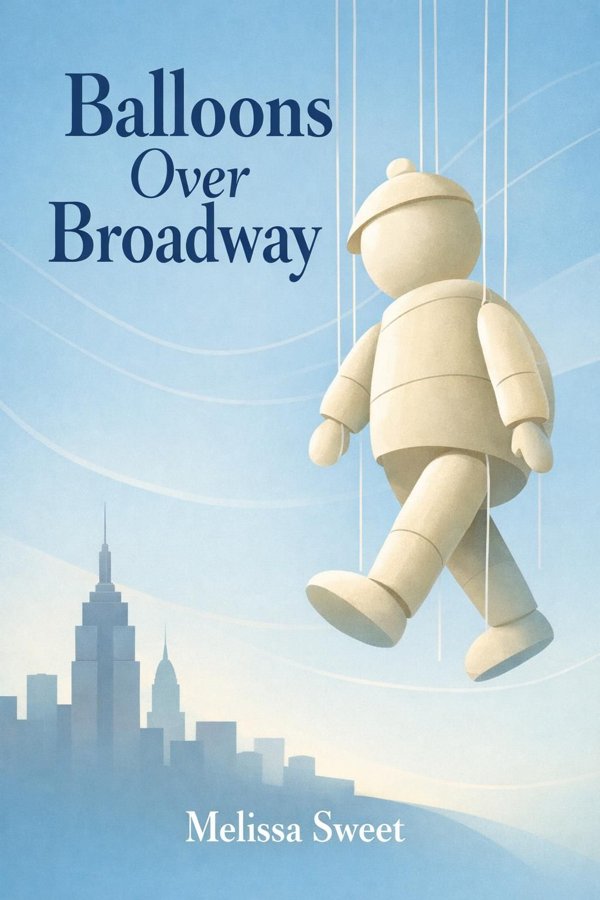
Balloons Over Broadway: The True Story of the Puppeteer of Macy's Parade: Summary & Key Insights
 10 min9 chaptersAudio available
Key Takeaways from Balloons Over Broadway: The True Story of the Puppeteer of Macy's Parade
Great inventions often begin not with grand ambition but with close attention.
What looks like play from the outside is often preparation on the inside.
Creative talent often needs a wider stage before it can fully develop.
An idea becomes culturally significant when it moves from the studio into public life.
Sometimes innovation comes from treating a practical assignment as a creative laboratory.
What Is Balloons Over Broadway: The True Story of the Puppeteer of Macy's Parade About?
Balloons Over Broadway: The True Story of the Puppeteer of Macy's Parade by Melissa Sweet is a biographies book spanning 8 pages. Balloons Over Broadway: The True Story of the Puppeteer of Macy's Parade tells the remarkable story of Tony Sarg, the inventive artist who transformed simple parade figures into the giant floating balloons that became the signature spectacle of Macy’s Thanksgiving Day Parade. Melissa Sweet brings his journey to life through lively prose and richly layered collage illustrations, showing how a child’s fascination with movement, mechanics, and play grew into an idea that changed a beloved American tradition forever. More than a historical picture book, this is a celebration of imagination in action. It reveals how creativity often begins with noticing small things—how strings pull, how objects rise, how motion creates delight—and then daring to scale those observations into something bold. The book matters because it gives readers, especially young ones, a vivid example of innovation rooted in curiosity, persistence, and joyful experimentation. Sweet is uniquely suited to tell this story: an award-winning author-illustrator known for her mixed-media style, she combines visual inventiveness with careful research to create a biography that feels both playful and deeply informative.
This FizzRead summary covers all 9 key chapters of Balloons Over Broadway: The True Story of the Puppeteer of Macy's Parade in approximately 10 minutes, distilling the most important ideas, arguments, and takeaways from Melissa Sweet's work. Also available as an audio summary and Key Quotes Podcast.
Balloons Over Broadway: The True Story of the Puppeteer of Macy's Parade
Balloons Over Broadway: The True Story of the Puppeteer of Macy's Parade tells the remarkable story of Tony Sarg, the inventive artist who transformed simple parade figures into the giant floating balloons that became the signature spectacle of Macy’s Thanksgiving Day Parade. Melissa Sweet brings his journey to life through lively prose and richly layered collage illustrations, showing how a child’s fascination with movement, mechanics, and play grew into an idea that changed a beloved American tradition forever. More than a historical picture book, this is a celebration of imagination in action. It reveals how creativity often begins with noticing small things—how strings pull, how objects rise, how motion creates delight—and then daring to scale those observations into something bold. The book matters because it gives readers, especially young ones, a vivid example of innovation rooted in curiosity, persistence, and joyful experimentation. Sweet is uniquely suited to tell this story: an award-winning author-illustrator known for her mixed-media style, she combines visual inventiveness with careful research to create a biography that feels both playful and deeply informative.
Who Should Read Balloons Over Broadway: The True Story of the Puppeteer of Macy's Parade?
This book is perfect for anyone interested in biographies and looking to gain actionable insights in a short read. Whether you're a student, professional, or lifelong learner, the key ideas from Balloons Over Broadway: The True Story of the Puppeteer of Macy's Parade by Melissa Sweet will help you think differently.
- ✓Readers who enjoy biographies and want practical takeaways
- ✓Professionals looking to apply new ideas to their work and life
- ✓Anyone who wants the core insights of Balloons Over Broadway: The True Story of the Puppeteer of Macy's Parade in just 10 minutes
Want the full summary?
Get instant access to this book summary and 100K+ more with Fizz Moment.
Get Free SummaryAvailable on App Store • Free to download
Key Chapters
Great inventions often begin not with grand ambition but with close attention. Tony Sarg’s story starts in childhood, when he became fascinated by motion—how strings could pull, how pulleys could lift, how gears could turn lifeless materials into something that appeared animated. Born in 1880, Sarg grew up in an environment that gave him room to tinker, observe, and ask questions. That early freedom mattered. Instead of treating toys as finished objects, he treated them as mysteries to solve. How did they work? What made them seem alive? What could be changed to make them move differently?
Melissa Sweet presents this early curiosity as the foundation of everything that followed. Sarg did not stumble into innovation by accident; he trained his imagination by paying attention to mechanics and delight at the same time. That combination is powerful. Many people separate art from engineering, but Sarg’s childhood interests show that the two can feed each other. The beauty of movement depends on structure, and structure becomes exciting when it creates surprise.
This idea applies well beyond parade balloons. A child who takes apart a wind-up toy, a student who studies how stage lights change mood, or an adult who notices how people respond to a storefront display is already building creative skill. Innovation begins when we stop accepting familiar things as fixed and start asking how they function.
The deeper lesson is that curiosity is not passive. It is a habit of engaged looking. Sarg’s future success came from years of observing ordinary mechanisms and imagining extraordinary possibilities.
Actionable takeaway: Spend time this week studying how one everyday object works, then ask yourself how its movement or design could be reimagined into something more playful, useful, or beautiful.
What looks like play from the outside is often preparation on the inside. As Tony Sarg grew older, he began designing mechanical toys and experimenting with puppets, not simply for amusement but as a way to turn curiosity into craft. Puppet-making became the perfect medium for him because it joined visual artistry with engineering. A puppet had to be expressive, but it also had to function. Every string, hinge, weight, and gesture mattered.
Melissa Sweet shows how these experiments helped Sarg develop a maker’s mindset. He learned by doing, revising, and trying again. A puppet that moved awkwardly was not a failure; it was feedback. A toy that failed to delight invited a redesign. This kind of iterative creativity is one of the most valuable themes in the book. Sarg did not wait until he was an expert to begin. He became an expert because he kept building.
That lesson remains relevant today. Young readers can see that hobbies are not trivial. Drawing comic strips, coding a simple game, sewing costumes, building models, or making stop-motion videos all train the same muscles Sarg used: observation, patience, problem-solving, and imagination. Adults can learn from this too. Many innovative careers start in side interests that look unserious at first.
Sweet’s portrait of Sarg also reminds us that making things by hand teaches resilience. Physical materials resist you. Strings tangle. Shapes sag. Pieces break. Working through those frustrations develops both technical skill and emotional endurance.
Actionable takeaway: Choose one playful project—such as making a paper puppet, a simple mechanism, or a moving illustration—and treat it as practice, not performance. Let experimentation teach you what books alone cannot.
Creative talent often needs a wider stage before it can fully develop. Tony Sarg’s move to London marked an important turning point because it placed his interests in a larger cultural setting where puppetry, illustration, and theatrical design could flourish. In London, he refined his skills and gained recognition as both a puppeteer and an illustrator. He was no longer just a curious maker experimenting in private; he was becoming a professional artist whose work could entertain, enchant, and communicate with broad audiences.
Melissa Sweet uses this phase of Sarg’s life to show how environment influences ambition. When people enter communities that value their work, their sense of possibility expands. London exposed Sarg to artistic traditions, performance culture, and audiences who appreciated visual spectacle. It gave him the chance to sharpen not only his technique but also his sense of scale. Performing for others changes how an artist thinks. The question shifts from “How do I make this?” to “How do I make people feel something?”
This part of the story carries an important practical insight: growth often happens when we move toward challenge. That move may be geographic, like Sarg’s, but it can also mean joining a new workshop, applying to a fellowship, sharing work publicly, or collaborating with more experienced people. Talent grows faster in contact with possibility.
Sweet also suggests that careers are rarely linear. Sarg’s skills in illustration, mechanics, and storytelling strengthened one another. His future innovations depended on this layered background.
Actionable takeaway: Look for one environment—physical or social—that could stretch your creative skills. Join a group, take a class, or share your work where thoughtful feedback and higher standards can help you grow.
An idea becomes culturally significant when it moves from the studio into public life. After arriving in New York, Tony Sarg found the ideal setting for his imaginative talents. The city was energetic, theatrical, commercial, and crowded with people eager for novelty. His marionette performances became popular because they combined technical skill with charm. Audiences were not simply watching objects move; they were experiencing carefully orchestrated illusion.
Melissa Sweet highlights how Sarg’s New York years brought him into closer contact with spectacle on a grander scale. In a city of storefronts, theaters, and public celebration, performance was everywhere. That environment rewarded originality and encouraged artists to think bigger. Sarg’s puppetry was perfectly suited to this world because it transformed inanimate materials into lively personalities. His work showed that engineering could be emotional and that precision could generate delight.
This stage of the story offers a practical lesson about visibility. It is not enough to have talent; people must be able to encounter it. New York gave Sarg an audience, but he also gave that audience something memorable. Creative work gains power when it is designed with public experience in mind.
For modern readers, this could mean presenting a project in a school exhibition, posting a polished portfolio online, staging a community event, or designing work for an audience rather than keeping it private. Public presentation teaches timing, clarity, and emotional impact—skills as essential as the craft itself.
Actionable takeaway: Take one project you have kept small or private and ask how it could be shared more publicly in a way that creates delight, connection, or conversation.
Sometimes innovation comes from treating a practical assignment as a creative laboratory. Tony Sarg’s work on Macy’s window displays was exactly that. Department store windows were commercial spaces, meant to attract customers, but Sarg approached them as stages for motion, storytelling, and wonder. By animating displays and creating scenes that captured public attention, he learned how objects in space could stop people in their tracks.
Melissa Sweet presents these windows as a crucial bridge between puppetry and parade design. In a store window, every detail counts: visibility, movement, scale, timing, and the ability to communicate instantly to passersby. Sarg’s genius was to understand that entertainment and design could work together. He did not dismiss retail display as lesser art; he used it as an opportunity to test ideas about public spectacle.
This episode teaches a valuable lesson about reframing ordinary work. Many breakthrough ideas emerge while solving a seemingly modest problem. A teacher planning a classroom bulletin board, a designer working on signage, or a small business owner arranging a display may discover principles that later apply far more widely. Constraints can sharpen imagination.
The Macy’s windows also reveal Sarg’s ability to think from the audience’s perspective. What will make someone pause? What will surprise them? What will feel alive? Those questions eventually led him beyond static display toward something much more ambitious.
Actionable takeaway: Look at one routine task in your life—a presentation, display, lesson, or workspace—and ask how you could redesign it to create surprise and engagement. Treat it as a chance to experiment, not just to complete a duty.
What people later call magic usually begins as a series of concrete problems. When Macy’s sought a grander attraction for its Thanksgiving parade, Tony Sarg saw an opportunity to rethink scale, movement, and crowd experience. The existing parade elements had energy, but he imagined something more astonishing: figures that could rise above the street and be seen from blocks away. This was not merely an artistic leap. It was a design challenge involving weight, structure, control, visibility, and safety.
Melissa Sweet does an excellent job showing that Sarg’s vision grew directly from his background in puppetry. Traditional marionettes are controlled from above, with strings descending from a fixed support. Sarg’s breakthrough was conceptual as much as technical: what if the puppet were inverted? What if the support came from below, and the figure floated overhead? This simple but radical shift turned puppetry inside out and opened the door to an entirely new form of performance.
The broader lesson here is that creative breakthroughs often come from transferring an old idea into a new context. Innovation does not always require inventing from nothing. Sometimes it means asking, “What happens if I flip the system?” A teacher might reverse a lecture into a discussion. A team might redesign a workflow from the customer’s point of view. An artist might scale a sketch into an installation.
Sarg’s genius lay in seeing that public delight could be engineered if he rethought the frame of the problem.
Actionable takeaway: Identify one problem you are facing and deliberately reverse a core assumption. Ask what would happen if the process, direction, or perspective were turned upside down.
The most memorable spectacles often depend on invisible problem-solving. Designing the first giant helium balloons for the Macy’s parade was not a smooth or easy process. Tony Sarg had to work through numerous practical obstacles: what materials were light enough, what shapes would hold form, how the figures could be guided through city streets, and how to make them expressive rather than merely large. The result seems effortless in retrospect, but Melissa Sweet reminds readers that enchantment is built through trial, error, and persistence.
This part of the book is especially powerful because it demystifies invention. Sarg’s balloons did not emerge fully formed from inspiration alone. They came from testing ideas, learning from mistakes, and balancing imagination with physical reality. That is how real innovation works. The creator has a vision, but the materials answer back. Wind matters. Weight matters. Public space matters. To create something magical, Sarg had to become deeply practical.
For readers of any age, this is one of the book’s most useful lessons. We often admire finished creations and overlook the process behind them. But progress depends on staying engaged when first attempts disappoint. A science fair project, a school play set, a startup prototype, or a new lesson plan all improve through iteration.
Sweet’s storytelling makes clear that persistence is not the opposite of creativity; it is part of creativity. Vision without revision stays small. Sarg succeeded because he kept refining until the dream could actually fly.
Actionable takeaway: The next time a project stalls, write down three specific problems it presents and brainstorm one experiment for each. Treat obstacles as design prompts rather than signs to quit.
Some inventions outgrow their original moment and become part of a culture’s emotional memory. When Tony Sarg’s giant balloons debuted in the Macy’s Thanksgiving Day Parade, they did more than entertain spectators in New York. They changed what a parade could be. The figures floating above the city created a sense of scale, joy, and shared wonder that people instantly recognized as special. A one-time creative solution became the beginning of an enduring American tradition.
Melissa Sweet captures this transformation beautifully. The parade was no longer just a procession; it became a theatrical experience in the sky. Sarg’s work gave crowds something larger than life yet warmly familiar. It connected engineering to festivity, design to emotion, and public space to collective imagination. The balloons made celebration visible from a distance and memorable across generations.
This development shows how innovations spread when they create both practical value and emotional resonance. The balloons were useful because they were visible and dramatic. But they endured because they made people feel wonder. Lasting traditions often begin where function and feeling meet.
This idea has wide application. Whether you are planning a family ritual, designing a school event, launching a product, or leading a community program, people remember experiences that combine thoughtful structure with delight. Technical success matters, but emotional meaning is what turns an event into a tradition.
Actionable takeaway: Think about one recurring event in your home, school, or workplace. Add one imaginative element that makes it more memorable, participatory, or joyful so it has the potential to become a tradition people genuinely look forward to.
One of the book’s most enduring insights is that creativity thrives when disciplines overlap. Tony Sarg was not only an artist, and not only an engineer. He was both, along with being a performer, designer, and problem-solver. Melissa Sweet uses his life to challenge the false divide between technical thinking and artistic expression. The Macy’s balloons were successful precisely because they required both. Beauty without mechanics would not float; mechanics without imagination would not inspire.
This message is especially valuable for young readers who may feel pushed to identify as either “creative” or “practical.” Sarg’s example suggests that the strongest ideas often come from combining talents. Someone who loves drawing and math, theater and physics, crafts and coding, may be particularly well equipped to invent something new. Interdisciplinary thinking creates unusual solutions because it allows insights from one field to reshape another.
Melissa Sweet’s own approach reinforces this point. Her collage illustrations blend text, image, texture, and historical detail, mirroring the very spirit of Sarg’s work. The book itself becomes evidence that biography can be informative and visually inventive at once.
In modern life, this lesson applies everywhere. User experience design, filmmaking, architecture, game design, robotics, museum work, and education all benefit from people who can connect aesthetics with systems.
Actionable takeaway: Make a list of two skills or interests you usually keep separate. Then design one small project—a presentation, model, artwork, lesson, or event—that intentionally combines them into something new.
All Chapters in Balloons Over Broadway: The True Story of the Puppeteer of Macy's Parade
About the Author
Melissa Sweet is an American author and illustrator celebrated for her richly textured mixed-media collage artwork and her gift for making nonfiction vivid and emotionally engaging. She has created numerous acclaimed children’s books, many of them biographies and history-based works that blend careful research with playful visual storytelling. Her illustrations often combine watercolor, paper collage, hand-lettering, and found materials, giving her books a distinctive handmade energy. Sweet has received major recognition for her work, including Caldecott Honors, and is widely admired for her ability to present complex real-life subjects in ways that feel accessible to young readers without losing depth. In Balloons Over Broadway, her inventive style is an ideal match for Tony Sarg’s story, capturing both the mechanics and the magic behind one of America’s most beloved parade traditions.
Get This Summary in Your Preferred Format
Read or listen to the Balloons Over Broadway: The True Story of the Puppeteer of Macy's Parade summary by Melissa Sweet anytime, anywhere. FizzRead offers multiple formats so you can learn on your terms — all free.
Available formats: App · Audio · PDF · EPUB — All included free with FizzRead
Download Balloons Over Broadway: The True Story of the Puppeteer of Macy's Parade PDF and EPUB Summary
Key Quotes from Balloons Over Broadway: The True Story of the Puppeteer of Macy's Parade
“Great inventions often begin not with grand ambition but with close attention.”
“What looks like play from the outside is often preparation on the inside.”
“Creative talent often needs a wider stage before it can fully develop.”
“An idea becomes culturally significant when it moves from the studio into public life.”
“Sometimes innovation comes from treating a practical assignment as a creative laboratory.”
Frequently Asked Questions about Balloons Over Broadway: The True Story of the Puppeteer of Macy's Parade
Balloons Over Broadway: The True Story of the Puppeteer of Macy's Parade by Melissa Sweet is a biographies book that explores key ideas across 9 chapters. Balloons Over Broadway: The True Story of the Puppeteer of Macy's Parade tells the remarkable story of Tony Sarg, the inventive artist who transformed simple parade figures into the giant floating balloons that became the signature spectacle of Macy’s Thanksgiving Day Parade. Melissa Sweet brings his journey to life through lively prose and richly layered collage illustrations, showing how a child’s fascination with movement, mechanics, and play grew into an idea that changed a beloved American tradition forever. More than a historical picture book, this is a celebration of imagination in action. It reveals how creativity often begins with noticing small things—how strings pull, how objects rise, how motion creates delight—and then daring to scale those observations into something bold. The book matters because it gives readers, especially young ones, a vivid example of innovation rooted in curiosity, persistence, and joyful experimentation. Sweet is uniquely suited to tell this story: an award-winning author-illustrator known for her mixed-media style, she combines visual inventiveness with careful research to create a biography that feels both playful and deeply informative.
You Might Also Like

An American Marriage
Tayari Jones
10 min
Benjamin Franklin: An American Life
Walter Isaacson
10 min
I Know Why The Caged Bird Sings
Maya Angelou
10 min
Long Walk to Freedom
Nelson Mandela
10 min
Persepolis
Marjane Satrapi
10 min
Surely You're Joking, Mr. Feynman!
Richard P. Feynman
10 minBrowse by Category
Ready to read Balloons Over Broadway: The True Story of the Puppeteer of Macy's Parade?
Get the full summary and 100K+ more books with Fizz Moment.