
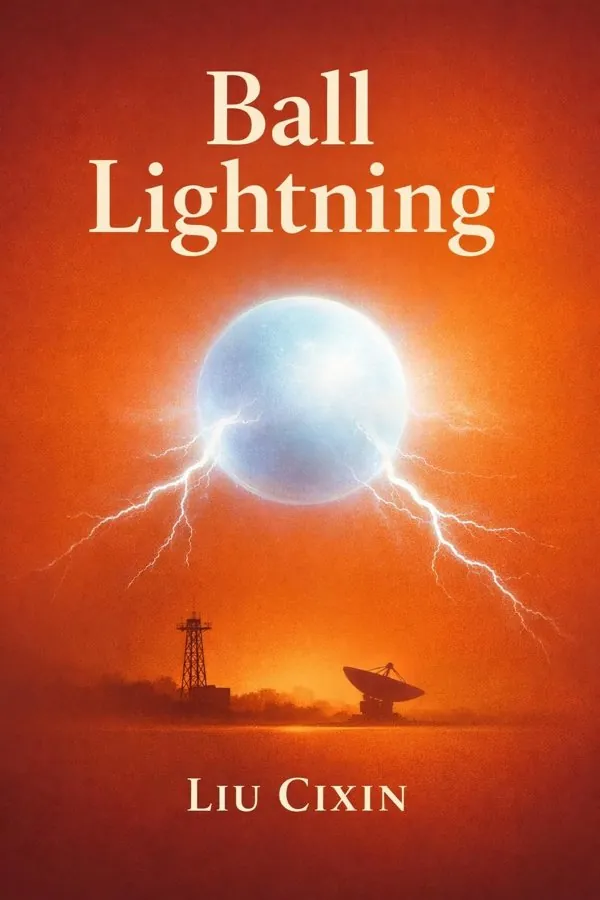
Ball Lightning: Summary & Key Insights
by Liu Cixin
 10 min9 chaptersAudio available
Key Takeaways from Ball Lightning
A single unexplained event can become the axis of an entire life.
Knowledge changes character when institutions seize it.
The deepest mysteries often resist the categories we trust most.
Every discovery carries a shadow version of itself.
Some truths are too powerful to remain theoretical.
What Is Ball Lightning About?
Ball Lightning by Liu Cixin is a scifi_fantasy book spanning 5 pages. Ball Lightning by Liu Cixin is a gripping work of science fiction that begins with a private tragedy and expands into a vast meditation on science, war, and the cost of obsession. The novel follows Chen, a young man whose parents are killed by the mysterious phenomenon known as ball lightning. Haunted by what he witnessed, he devotes his life to understanding it, moving from grief-stricken curiosity to rigorous scientific pursuit. What starts as a personal quest soon becomes entangled with military ambition, experimental physics, and unsettling discoveries about the nature of reality itself. What makes Ball Lightning matter is not only its inventive scientific imagination but also its emotional seriousness. Liu Cixin uses speculative ideas about quantum states, energy weapons, and observation to ask timeless human questions: What happens when knowledge outruns ethics? Can understanding the universe heal trauma, or does it sometimes deepen it? Liu, one of the most influential voices in contemporary Chinese science fiction and the author of The Three-Body Problem, brings unusual authority to these themes. His hallmark blend of hard science, philosophical depth, and epic consequence makes Ball Lightning both intellectually exciting and morally unsettling.
This FizzRead summary covers all 9 key chapters of Ball Lightning in approximately 10 minutes, distilling the most important ideas, arguments, and takeaways from Liu Cixin's work. Also available as an audio summary and Key Quotes Podcast.
Ball Lightning
Ball Lightning by Liu Cixin is a gripping work of science fiction that begins with a private tragedy and expands into a vast meditation on science, war, and the cost of obsession. The novel follows Chen, a young man whose parents are killed by the mysterious phenomenon known as ball lightning. Haunted by what he witnessed, he devotes his life to understanding it, moving from grief-stricken curiosity to rigorous scientific pursuit. What starts as a personal quest soon becomes entangled with military ambition, experimental physics, and unsettling discoveries about the nature of reality itself.
What makes Ball Lightning matter is not only its inventive scientific imagination but also its emotional seriousness. Liu Cixin uses speculative ideas about quantum states, energy weapons, and observation to ask timeless human questions: What happens when knowledge outruns ethics? Can understanding the universe heal trauma, or does it sometimes deepen it? Liu, one of the most influential voices in contemporary Chinese science fiction and the author of The Three-Body Problem, brings unusual authority to these themes. His hallmark blend of hard science, philosophical depth, and epic consequence makes Ball Lightning both intellectually exciting and morally unsettling.
Who Should Read Ball Lightning?
This book is perfect for anyone interested in scifi_fantasy and looking to gain actionable insights in a short read. Whether you're a student, professional, or lifelong learner, the key ideas from Ball Lightning by Liu Cixin will help you think differently.
- ✓Readers who enjoy scifi_fantasy and want practical takeaways
- ✓Professionals looking to apply new ideas to their work and life
- ✓Anyone who wants the core insights of Ball Lightning in just 10 minutes
Want the full summary?
Get instant access to this book summary and 100K+ more with Fizz Moment.
Get Free SummaryAvailable on App Store • Free to download
Key Chapters
A single unexplained event can become the axis of an entire life. In Ball Lightning, young Chen witnesses the horrifying moment when ball lightning enters his home and kills his parents in an instant. The phenomenon is beautiful, silent, and incomprehensible, and that mixture of wonder and devastation becomes the emotional engine of the novel. Chen does not merely want revenge or closure. He wants understanding. His grief turns into a scientific mission, showing how trauma can transform into disciplined curiosity.
Liu Cixin presents obsession as both noble and dangerous. On one hand, Chen’s fixation gives him purpose. It drives him to study meteorology, physics, and experimental science with rare intensity. Many breakthroughs in real life begin this way: a researcher confronts a mystery that others ignore and refuses to let go. On the other hand, obsession narrows his world. Personal relationships, ordinary joys, and moral hesitation all risk being subordinated to the quest.
This dynamic is recognizable outside fiction. People often build careers or identities around a formative wound: a doctor inspired by family illness, an activist shaped by injustice, an entrepreneur driven by childhood scarcity. Such motivation can produce extraordinary work, but it can also trap a person in a past moment they never fully leave.
The novel’s opening idea is that curiosity is rarely pure. It is often mixed with pain, longing, and the desire to impose meaning on chaos. Chen’s pursuit of ball lightning is not simply scientific. It is existential. He wants the universe to answer for what it took from him.
Actionable takeaway: Examine the obsessions driving your own ambitions. Ask whether they are helping you grow, or merely keeping you emotionally tied to an old catastrophe.
Knowledge changes character when institutions seize it. When Chen meets Lin Yun, the novel introduces a second kind of obsession, one defined not by grief but by strategic imagination. Lin Yun is brilliant, relentless, and deeply committed to the military application of ball lightning research. Where Chen seeks truth, she seeks utility. To her, scientific discovery becomes meaningful when it can alter the balance of power.
Lin Yun is one of Liu Cixin’s most compelling creations because she is not a simple villain. She embodies a familiar logic: if a phenomenon exists, someone will weaponize it, so responsible actors must get there first. This argument has shaped nuclear programs, cyberwarfare, artificial intelligence, and biotechnology. Her stance forces readers to confront an uncomfortable reality: pure science rarely stays pure for long.
The tension between Chen and Lin Yun dramatizes the split between inquiry and application. Scientists may hope to pursue understanding for its own sake, but governments, militaries, and corporations often evaluate discovery through the lens of advantage. Lin Yun represents the impatience of power. She does not want to marvel at ball lightning. She wants to deploy it.
In practical terms, the novel invites us to think about dual-use technologies in our own world. Facial recognition can aid security or enable surveillance. Gene editing can cure disease or be abused. Machine learning can optimize medicine or automate warfare. The issue is rarely whether a tool is powerful. The issue is who governs it, under what values, and with what limits.
Lin Yun’s role makes the novel sharper and more political. She reminds us that science unfolds inside systems of competition, fear, and ambition. Discovery does not enter a moral vacuum; it enters history.
Actionable takeaway: Whenever you evaluate a breakthrough, ask two questions at once: What can this do, and who will be most motivated to use it?
The deepest mysteries often resist the categories we trust most. Ball lightning in the novel is not treated as mere folklore or atmospheric oddity. Liu Cixin turns it into a doorway to a startling scientific framework involving quantum states, observation, and matter existing on the edge of visibility. As Chen and his colleagues investigate the phenomenon, they discover that understanding it requires abandoning ordinary intuitions about reality.
This is one of the book’s most distinctive achievements: it makes abstract physics feel emotionally charged. The mystery is not just technical. It destabilizes the everyday world. If ball lightning behaves according to laws stranger than conventional experience allows, then the universe is far less solid and knowable than we assume. That revelation excites Chen, but it also unsettles him, because each new explanation distances him from simple human meaning.
Liu excels at showing how advanced science can feel almost supernatural without ceasing to be scientific. Readers do not need formal training in quantum physics to grasp the deeper point. Much of reality operates beyond immediate perception, and our models of the world are often provisional. The history of science repeatedly confirms this. Light is both wave and particle. Time is relative. Observation can alter experimental outcomes. The novel extends this tradition of conceptual shock.
In everyday life, this idea encourages intellectual humility. We often mistake familiarity for understanding. We assume that because something appears stable, it is fully comprehended. But whether in medicine, climate science, psychology, or economics, hidden variables and unseen mechanisms frequently shape visible outcomes.
By turning ball lightning into a scientific and philosophical puzzle, Liu asks readers to tolerate uncertainty rather than flee from it. Mystery is not the enemy of reason. It is the invitation that reason follows.
Actionable takeaway: When confronting something confusing, resist the urge to simplify too quickly. Stay with the uncertainty long enough for a better model to emerge.
Every discovery carries a shadow version of itself. In Ball Lightning, the transition from research to weaponization is gradual but unmistakable. What begins as a quest to understand a rare natural phenomenon becomes an effort to harness it for military use. This transformation is not presented as an anomaly. It is portrayed as one of the recurring patterns of human civilization: curiosity leads to capability, and capability invites control, exploitation, and violence.
Liu Cixin does not moralize in a simplistic way. He shows how weaponization can arise from fear, patriotism, deterrence logic, and institutional momentum. Once a technology appears strategically significant, it becomes difficult for any nation or organization to ignore. Even individuals who begin with noble intentions may rationalize harmful applications because they fear what others might do first.
This is why the novel feels so relevant. The same pattern shapes current debates around autonomous weapons, synthetic biology, and AI. A tool designed for exploration or efficiency can quickly be absorbed into systems of coercion. The ethical question is rarely asked at the beginning with enough seriousness. By the time society recognizes the danger, the infrastructure of use may already be in place.
The novel also captures a psychological truth: technical mastery can create moral distance. Once a phenomenon is translated into equations, prototypes, and strategic scenarios, it becomes easier to forget the human bodies at the receiving end. Abstraction can anesthetize conscience.
For readers, this key idea is not anti-science. It is a call for ethical imagination to keep pace with technical imagination. Expertise alone is not wisdom. A breakthrough is not automatically progress.
In practical terms, this means supporting ethical review, interdisciplinary oversight, and public accountability in research and innovation. It means asking not only whether something can be built, but what world its existence makes more likely.
Actionable takeaway: Before celebrating a new capability, map its best-case and worst-case uses. If the harms are profound, ethics must enter the conversation early, not after deployment.
Some truths are too powerful to remain theoretical. As Ball Lightning moves toward testing and real-world demonstration, the novel shifts from speculation to reckoning. Scientific ideas that once seemed abstract begin producing irreversible consequences. This is where the emotional and philosophical stakes sharpen. Discovery is no longer exciting in the safe way of a lab notebook or thought experiment. It becomes embodied in decisions, casualties, and moral aftermath.
Liu uses the testing phase to expose the distance between imagination and experience. People often assume they understand the implications of a technology while it is still conceptual. But direct use changes everything. Theories meet fear. Clean models meet messy reality. A weapon that appears elegant on paper may produce horror in practice, especially when its effects challenge normal expectations of life, death, and matter.
Chen’s response to these developments is crucial. He cannot remain a detached observer forever. The closer he gets to mastering ball lightning, the more he must confront what that mastery means. The novel suggests that the real test is not merely scientific validity but moral endurance. Can a person live with what they have made possible? Can they still recognize themselves after participating in systems larger than their intentions?
This pattern applies beyond warfare. In business, medicine, engineering, and policy, leaders often praise innovation before confronting secondary effects. A platform meant to connect people may amplify misinformation. A drug may save lives yet create dependency. A financial instrument may improve efficiency while increasing fragility. The reckoning often comes after adoption, not before.
Ball Lightning insists that accountability must include emotional honesty. It is not enough to say outcomes were unintended. If foreseeable harm was ignored, responsibility remains.
Actionable takeaway: Build a habit of post-decision review. After any major action, ask what actually happened, who was affected, and what responsibility you now carry.
The universe does not arrange itself around human comfort. One of the most haunting ideas in Ball Lightning is that nature can be breathtaking and lethal at the same time. The phenomenon that kills Chen’s parents is visually mesmerizing, almost sublime, which makes it more disturbing, not less. Liu repeatedly explores this tension between beauty and destruction, reminding us that awe is morally neutral. We often associate beauty with goodness, but the natural world does not share that assumption.
This insight gives the novel much of its eerie power. Ball lightning is not evil. It simply exists according to laws indifferent to human life. That indifference becomes harder to accept when human beings try to turn such forces into tools. The line between observing nature and exploiting it begins to blur, and with it our sense of innocence.
In broader terms, the novel belongs to a tradition of science fiction that restores the strangeness of the cosmos. Instead of presenting nature as a backdrop for human drama, Liu makes it an active challenge to human certainty. Storms, radiation, black holes, viruses, and quantum effects all remind us that reality is more immense and less personal than we prefer.
There is practical value in this perspective. It can cultivate humility, resilience, and respect for systems beyond our control. In environmental thinking, for example, romanticizing nature leads to poor decisions just as surely as trying to dominate it. We need a mature relationship with the nonhuman world, one that acknowledges both wonder and danger.
For Chen, beauty becomes inseparable from loss. For readers, that mixture deepens the novel’s emotional complexity. We are invited to admire the universe without pretending it loves us back.
Actionable takeaway: Practice holding two truths together: something can be extraordinary and still be dangerous. Let that mindset guide decisions in science, nature, and everyday life.
What if seeing is not passive but participatory? A major philosophical thread in Ball Lightning concerns the relationship between observation and reality. As the science grows stranger, the act of measuring or perceiving phenomena begins to matter in unsettling ways. Liu draws on ideas associated with quantum mechanics to suggest that reality may not be as fixed or independent from observation as common sense implies.
At one level, this gives the novel intellectual intrigue. At another, it raises a deeply human question: how much of the world do we actually encounter directly, and how much do we construct through our methods, expectations, and instruments? Chen’s scientific journey becomes a mirror for every effort to know anything. Observation always comes with limits. Tools reveal and distort. Models clarify and simplify. Human cognition itself filters reality.
This has powerful real-world analogies. In psychology, what we notice is shaped by attention and bias. In economics, metrics alter behavior once people optimize for them. In social life, labels can influence identity and outcomes. Even outside physics, measurement often changes the thing being measured.
Liu uses speculative science to push readers toward epistemic humility. The lesson is not that truth is impossible, but that truth is mediated. We approach reality through frameworks, and those frameworks matter. This is why mature inquiry requires skepticism not only toward conclusions, but toward the assumptions behind the methods that produced them.
For readers, this idea can improve decision-making. If your first interpretation of a situation feels obvious, it may only reflect the angle from which you looked. Change the instrument, and the phenomenon may appear differently.
Ball Lightning turns the mystery of observation into a moral challenge as well: if our knowledge is partial, then certainty should make us cautious, not arrogant.
Actionable takeaway: When making an important judgment, deliberately seek a second lens. Ask what your current method of observation might be missing or distorting.
The pursuit of truth can clarify the mind while hollowing out the heart. Ball Lightning is often praised for its scientific ideas, but one of its strongest undercurrents is emotional isolation. Chen’s devotion to understanding the phenomenon gives structure to his life, yet it also distances him from ordinary forms of intimacy, belonging, and peace. The closer he gets to the mystery, the less easily he fits into the rhythms of normal human attachment.
Liu portrays this not as melodrama but as a genuine cost of extreme focus. Great projects often demand sacrifice, but the novel asks whether some sacrifices become invisible because culture praises achievement so highly. A person can be admired professionally while becoming emotionally estranged from themselves and others. In Chen’s case, knowledge does not cleanly resolve grief. It complicates it. Explanation is not the same as healing.
This theme resonates widely. Many high-performing people organize their lives around work, mission, or mastery. Researchers, founders, artists, and professionals may tell themselves that completion will bring satisfaction. Yet the finish line often moves, and relationships neglected in the process are not easily restored. The novel’s emotional realism lies in its suggestion that inner wounds can survive even extraordinary intellectual success.
At the same time, Ball Lightning does not condemn ambition. It simply asks readers to count all the costs. A life dedicated to discovery may be meaningful, but meaning should not be confused with wholeness. Humans need more than answers.
Practically, this key idea encourages balance not in the shallow sense of equal time allocation, but in the deeper sense of protecting parts of yourself that achievement cannot replace. Curiosity is vital, but so are friendship, reflection, and moral grounding.
Actionable takeaway: If you are pursuing a consuming goal, identify one relationship or practice that keeps you human, and protect it as deliberately as you protect your work.
The best science fiction does not predict gadgets; it pressure-tests civilization. Ball Lightning works not only as a novel of scientific mystery but as an ethical forecast. Liu Cixin imagines what might happen if a poorly understood natural phenomenon became technically exploitable and strategically valuable. In doing so, he reveals patterns that repeat across eras: states race for advantage, scientists split over responsibility, and ordinary human values struggle to keep up with extraordinary power.
This is why the book matters beyond entertainment. Science fiction creates a safe space to rehearse dangerous futures. By exaggerating or extending current trends, it helps readers think more clearly about choices that are already forming. Ball Lightning invites reflection on militarized research, the seduction of mastery, and the speed with which wonder can be converted into doctrine and deployment.
In practical terms, this kind of fiction trains moral imagination. It helps policymakers, technologists, and citizens ask better preemptive questions. What institutions should govern high-risk research? What forms of transparency are necessary? How do we preserve human dignity when technologies make harm less visible or more abstract? These are not distant questions. They shape debates around AI, drones, bioengineering, and cybersecurity right now.
Liu’s achievement is to make these issues feel intimate rather than theoretical. Because the story begins in personal loss, the later geopolitical stakes never become emotionally detached. The macro and micro remain linked.
For readers, the broader lesson is that fiction can be intellectually practical. A novel can sharpen ethical perception in ways a policy memo cannot. It can make consequences imaginable before they become real.
Actionable takeaway: Use speculative fiction as a thinking tool. After reading, ask which parts feel closest to current reality and what safeguards would be needed if that future began emerging today.
All Chapters in Ball Lightning
About the Author
Liu Cixin is a Chinese science fiction writer born in 1963 and widely regarded as one of the defining voices of modern global sci-fi. Trained as an engineer, he brings unusual technical confidence to his fiction, blending hard scientific speculation with large-scale philosophical and civilizational questions. He became internationally famous through The Three-Body Problem and its sequels, works that helped introduce many global readers to contemporary Chinese science fiction. Liu’s writing is known for its cosmic imagination, interest in physics and technology, and willingness to explore the moral consequences of scientific progress. Ball Lightning reflects many of his signature strengths on a more intimate scale, combining personal trauma, speculative science, and ethical tension in a way that is both intellectually ambitious and emotionally resonant.
Get This Summary in Your Preferred Format
Read or listen to the Ball Lightning summary by Liu Cixin anytime, anywhere. FizzRead offers multiple formats so you can learn on your terms — all free.
Available formats: App · Audio · PDF · EPUB — All included free with FizzRead
Download Ball Lightning PDF and EPUB Summary
Key Quotes from Ball Lightning
“A single unexplained event can become the axis of an entire life.”
“Knowledge changes character when institutions seize it.”
“The deepest mysteries often resist the categories we trust most.”
“Every discovery carries a shadow version of itself.”
“Some truths are too powerful to remain theoretical.”
Frequently Asked Questions about Ball Lightning
Ball Lightning by Liu Cixin is a scifi_fantasy book that explores key ideas across 9 chapters. Ball Lightning by Liu Cixin is a gripping work of science fiction that begins with a private tragedy and expands into a vast meditation on science, war, and the cost of obsession. The novel follows Chen, a young man whose parents are killed by the mysterious phenomenon known as ball lightning. Haunted by what he witnessed, he devotes his life to understanding it, moving from grief-stricken curiosity to rigorous scientific pursuit. What starts as a personal quest soon becomes entangled with military ambition, experimental physics, and unsettling discoveries about the nature of reality itself. What makes Ball Lightning matter is not only its inventive scientific imagination but also its emotional seriousness. Liu Cixin uses speculative ideas about quantum states, energy weapons, and observation to ask timeless human questions: What happens when knowledge outruns ethics? Can understanding the universe heal trauma, or does it sometimes deepen it? Liu, one of the most influential voices in contemporary Chinese science fiction and the author of The Three-Body Problem, brings unusual authority to these themes. His hallmark blend of hard science, philosophical depth, and epic consequence makes Ball Lightning both intellectually exciting and morally unsettling.
More by Liu Cixin

You Might Also Like
Red Rising
Pierce Brown
10 min
Stranger in a Strange Land
Robert A. Heinlein
10 min
AI Valley
Chen Qiufan
10 min
Bloodchild
Octavia E. Butler
10 min
Do Androids Dream of Electric Sheep?
Philip K. Dick
10 min
Jujutsu Kaisen, Vol. 24
Gege Akutami
10 minBrowse by Category
Ready to read Ball Lightning?
Get the full summary and 100K+ more books with Fizz Moment.