
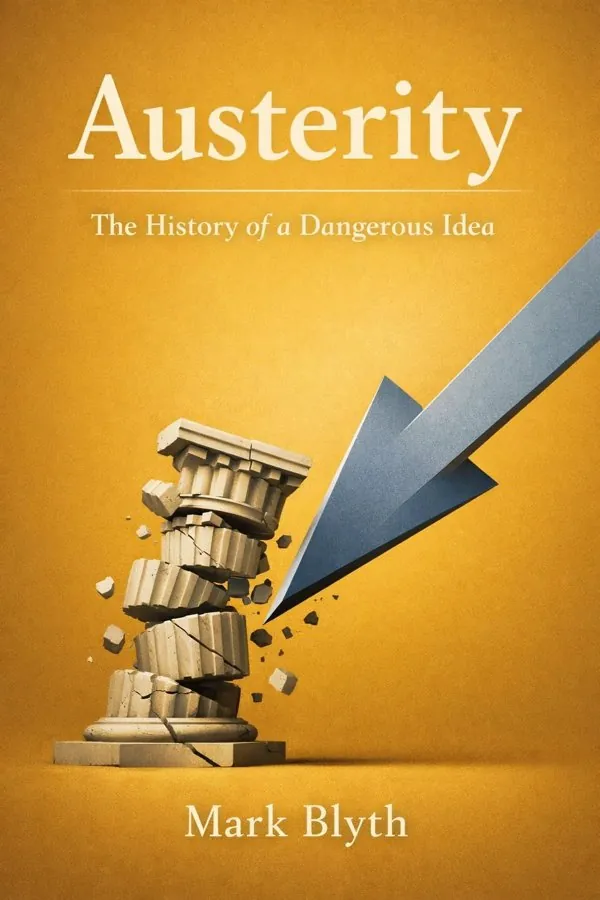
Austerity: The History of a Dangerous Idea: Summary & Key Insights
by Mark Blyth
 10 min11 chaptersAudio available
What Is Austerity: The History of a Dangerous Idea About?
Austerity: The History of a Dangerous Idea by Mark Blyth is a economics book spanning 11 pages. Austerity: The History of a Dangerous Idea es un análisis exhaustivo de cómo las políticas de austeridad —recortes del gasto público y reducción del déficit— se han convertido en una respuesta dominante a las crisis económicas, a pesar de su ineficacia histórica. Mark Blyth examina los orígenes intelectuales de la austeridad, su aplicación en Europa y Estados Unidos, y las consecuencias sociales y políticas que ha generado. El libro combina historia económica, teoría política y análisis contemporáneo para demostrar que la austeridad, lejos de ser una solución, agrava las crisis que pretende resolver.
This FizzRead summary covers all 11 key chapters of Austerity: The History of a Dangerous Idea in approximately 10 minutes, distilling the most important ideas, arguments, and takeaways from Mark Blyth's work. Also available as an audio summary and Key Quotes Podcast.
Austerity: The History of a Dangerous Idea
Austerity: The History of a Dangerous Idea es un análisis exhaustivo de cómo las políticas de austeridad —recortes del gasto público y reducción del déficit— se han convertido en una respuesta dominante a las crisis económicas, a pesar de su ineficacia histórica. Mark Blyth examina los orígenes intelectuales de la austeridad, su aplicación en Europa y Estados Unidos, y las consecuencias sociales y políticas que ha generado. El libro combina historia económica, teoría política y análisis contemporáneo para demostrar que la austeridad, lejos de ser una solución, agrava las crisis que pretende resolver.
Who Should Read Austerity: The History of a Dangerous Idea?
This book is perfect for anyone interested in economics and looking to gain actionable insights in a short read. Whether you're a student, professional, or lifelong learner, the key ideas from Austerity: The History of a Dangerous Idea by Mark Blyth will help you think differently.
- ✓Readers who enjoy economics and want practical takeaways
- ✓Professionals looking to apply new ideas to their work and life
- ✓Anyone who wants the core insights of Austerity: The History of a Dangerous Idea in just 10 minutes
Want the full summary?
Get instant access to this book summary and 100K+ more with Fizz Moment.
Get Free SummaryAvailable on App Store • Free to download
Key Chapters
To grasp why austerity persists, we must first understand where it came from. The idea traces back to classical economics, to thinkers like Adam Smith and David Ricardo, whose work reflected both moral philosophy and emerging market logic. For Smith, self-restraint and thrift were virtues in a commercial society; for Ricardo, balanced budgets and sound money were guarantees of stability. These ideas were perfectly suited to an age that valued order, discipline, and limited government. Yet they were also responses to a fear—the fear that excess, debt, and state intervention might corrupt commerce and morality alike.
In the nineteenth century, this moral-economic fusion hardened into a doctrine. Economists and politicians alike began to see the state as a potential source of moral decay. Spending too much became not just imprudent but sinful. Classical liberalism thus produced a lasting association: economic virtue was equated with fiscal conservatism. This logic carried into the twentieth century, strengthened by theories that stressed market equilibrium and rational expectations. To many economists, markets naturally correct imbalances, while states introduce distortions.
By the time neoliberalism emerged in the late twentieth century—with figures like Friedrich Hayek and Milton Friedman—the moral argument had been reborn as a scientific one. Austerity was no longer only about virtue; it was about restoring efficiency. Public spending, they argued, created moral hazard and distorted markets. The best way forward was to shrink the state, reduce debt, and liberate enterprise. Thus, what began as a moral code evolved into a technocratic creed. My argument is that both forms obscure a deeper truth: markets are not moral entities, and governments are not households. Economic aggregates behave differently from personal budgets, and treating them as equivalent has led repeatedly to crisis.
Under the gold standard, from the late nineteenth century up to the interwar period, austerity’s ideals became institutionalized. Currencies were pegged to gold, and governments were required to maintain fiscal and monetary stability to preserve the value of their money. This rigid framework meant that economic adjustment fell not on markets or states, but on people. When economies faltered, governments could not devalue their currencies; instead, they slashed spending and wages to restore balance.
This system rewarded creditors and punished debtors. It was built on the principle that economic discipline must be absolute. Nations that violated these rules faced capital flight and loss of credibility. The gold standard thus embedded austerity into global economics, transforming it from a philosophy into a hard law. Yet its consequences were devastating. Social unrest grew as workers and farmers bore the cost of deflation, and economic inequality widened as wealth accumulated in financial centers.
The 1920s exposed the fragility of this arrangement. When crises hit—like in postwar Britain and Germany—governments that tried to restore gold parity through austerity amplified depression. The political fallout was tremendous, giving rise to mass movements and ultimately contributing to the collapse of international monetary cooperation. From this era, we learn a crucial lesson: austerity tied to rigid monetary discipline sacrifices economic stability for nominal credibility. Its faith in punishment over flexibility turned economic management into an exercise in moral theater rather than pragmatic policy.
+ 9 more chapters — available in the FizzRead app
All Chapters in Austerity: The History of a Dangerous Idea
About the Author
Mark Blyth es un economista político escocés y profesor en la Universidad de Brown. Su trabajo se centra en la economía política de Europa y Estados Unidos, las ideas económicas y su impacto en la política pública. Es conocido por su crítica a las políticas de austeridad y su análisis de las crisis financieras globales.
Get This Summary in Your Preferred Format
Read or listen to the Austerity: The History of a Dangerous Idea summary by Mark Blyth anytime, anywhere. FizzRead offers multiple formats so you can learn on your terms — all free.
Available formats: App · Audio · PDF · EPUB — All included free with FizzRead
Download Austerity: The History of a Dangerous Idea PDF and EPUB Summary
Key Quotes from Austerity: The History of a Dangerous Idea
“To grasp why austerity persists, we must first understand where it came from.”
“Under the gold standard, from the late nineteenth century up to the interwar period, austerity’s ideals became institutionalized.”
Frequently Asked Questions about Austerity: The History of a Dangerous Idea
Austerity: The History of a Dangerous Idea by Mark Blyth is a economics book that explores key ideas across 11 chapters. Austerity: The History of a Dangerous Idea es un análisis exhaustivo de cómo las políticas de austeridad —recortes del gasto público y reducción del déficit— se han convertido en una respuesta dominante a las crisis económicas, a pesar de su ineficacia histórica. Mark Blyth examina los orígenes intelectuales de la austeridad, su aplicación en Europa y Estados Unidos, y las consecuencias sociales y políticas que ha generado. El libro combina historia económica, teoría política y análisis contemporáneo para demostrar que la austeridad, lejos de ser una solución, agrava las crisis que pretende resolver.
More by Mark Blyth
You Might Also Like
Business Adventures
John Brooks
10 min
Nudge
Richard H. Thaler, Cass R. Sunstein
10 min
The Hitchhiker"s Guide to the Galaxy
Douglas Adams
10 minThe Muqaddimah
Ibn Khaldun
10 minThe Outsiders
William N. Thorndike
10 min
A Little History of Economics
Niall Kishtainy
10 minFeatured In
Browse by Category
Ready to read Austerity: The History of a Dangerous Idea?
Get the full summary and 100K+ more books with Fizz Moment.