
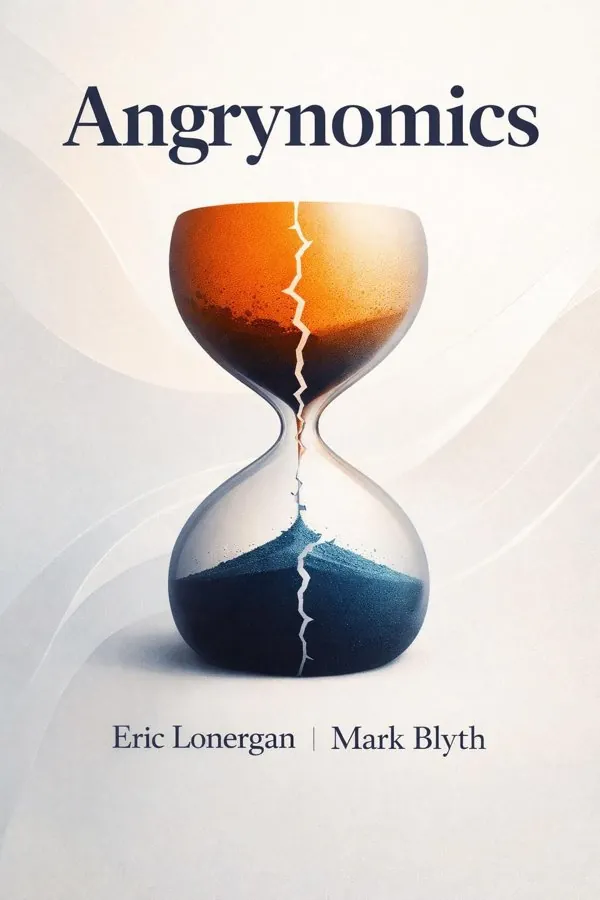
Angrynomics: Summary & Key Insights
 10 min8 chaptersAudio available
What Is Angrynomics About?
Angrynomics by Eric Lonergan, Mark Blyth is a economics book spanning 8 pages. Angrynomics explores the rise of public anger in modern economies and politics, analyzing how economic inequality, financial crises, and political polarization have fueled widespread frustration. The authors propose innovative policy solutions to rebuild trust and address systemic imbalances in capitalism.
This FizzRead summary covers all 8 key chapters of Angrynomics in approximately 10 minutes, distilling the most important ideas, arguments, and takeaways from Eric Lonergan, Mark Blyth's work. Also available as an audio summary and Key Quotes Podcast.
Angrynomics
Angrynomics explores the rise of public anger in modern economies and politics, analyzing how economic inequality, financial crises, and political polarization have fueled widespread frustration. The authors propose innovative policy solutions to rebuild trust and address systemic imbalances in capitalism.
Who Should Read Angrynomics?
This book is perfect for anyone interested in economics and looking to gain actionable insights in a short read. Whether you're a student, professional, or lifelong learner, the key ideas from Angrynomics by Eric Lonergan, Mark Blyth will help you think differently.
- ✓Readers who enjoy economics and want practical takeaways
- ✓Professionals looking to apply new ideas to their work and life
- ✓Anyone who wants the core insights of Angrynomics in just 10 minutes
Want the full summary?
Get instant access to this book summary and 100K+ more with Fizz Moment.
Get Free SummaryAvailable on App Store • Free to download
Key Chapters
The first thing we must do, before prescribing cures, is to diagnose the emotion itself. Not all anger is the same, and failing to recognize its types leads to confusion and missteps. In *Angrynomics*, we draw a crucial distinction between two forms: moral outrage and tribal anger. Moral outrage arises when someone perceives injustice—when the basic social contract, the promise that effort will be rewarded fairly and rules apply equally, appears broken. Tribal anger, on the other hand, is the fury of identity, the anger that emerges when people define themselves in opposition to others and feel their group’s status or dignity threatened.
Moral outrage is often healthy. When citizens rise up against corruption, unfair laws, or elite impunity, that anger isn’t destructive; it’s a moral force demanding justice. Think of protests against inequality or the climate movements that call out governments for inaction. This kind of anger can unite strangers under a common call for fairness. But tribal anger is its dark twin—it thrives on division. It tells us that ‘our’ people are virtuous and ‘they’ are corrupt, whether or not the facts support it. It transforms legitimate grievances into resentments aimed at scapegoats. When economic distress combines with tribal identity, politics becomes polarized and reason gives way to vilification.
The difference between these two types is crucial because governments and leaders often misread public anger. When politicians treat moral outrage as mere noise or label it irrational, they miss an opportunity for reform. And when tribal anger is cynically manipulated—when fear and resentment are stoked for power—societies enter a self-reinforcing cycle of hostility. The core insight of *Angrynomics* is that we cannot fix our economies without first understanding the emotional economies we live in. People don’t react to GDP statistics; they respond to fairness, trust, and dignity. That’s why distinguishing these forms of anger isn’t a psychological exercise—it’s the foundation for rebuilding political legitimacy.
Once we recognize that anger signals systemic injustice, we have to ask: where does that sense of injustice originate? The answer lies in the deep structures of our economies. Over the past forty years, economic growth in advanced nations has become increasingly skewed. For most workers, real wages have stagnated or fallen behind living costs, even as asset prices and executive compensation soared. Productivity gains no longer translate into quality of life improvements for the majority. Meanwhile, job insecurity—once rare—has become normal, and housing has turned from a basic need into an investment commodity.
Mark and I argue that this corrosion of fairness has created an emotional economy of resentment. When people feel the system consistently tilts toward elites—when a banker’s mistake leads to bailouts while a worker’s struggle leads to eviction—anger becomes rational. Economies, after all, aren’t just about numbers; they’re social contracts that convey dignity through participation. If that dignity erodes, emotion replaces trust. The data are clear: income inequality has widened dramatically since the 1980s, mobility has stalled, and the concentration of wealth has left large segments of society feeling alienated from economic success.
Underlying this is the failure of political narratives. Policymakers promised that globalization and free markets would benefit everyone. Yet in reality, skilled urban professionals gained, while many rural and working-class communities lost. As these gaps persisted, anger ceased to be episodic—it became structural. People no longer blamed specific politicians; they lost faith in the entire system of capitalism and representative democracy. From this perspective, anger isn’t an irrational emotional outburst—it’s the logical reaction of citizens whose expectations have been systematically disappointed.
Understanding these economic roots helps us move from symptom to cause. It explains why populism rises not in poor nations but in rich ones where prosperity feels unfairly distributed. It reminds us that trust is an economic variable—no less vital than interest rates or inflation. And it sets the stage for the reforms we propose later: because restoring fairness isn’t just moral necessity, it’s economic stabilization.
+ 6 more chapters — available in the FizzRead app
All Chapters in Angrynomics
About the Authors
Eric Lonergan is a macro hedge fund manager, economist, and writer based in London. Mark Blyth is a political economist and professor of international economics at Brown University, known for his work on political economy and economic crises.
Get This Summary in Your Preferred Format
Read or listen to the Angrynomics summary by Eric Lonergan, Mark Blyth anytime, anywhere. FizzRead offers multiple formats so you can learn on your terms — all free.
Available formats: App · Audio · PDF · EPUB — All included free with FizzRead
Download Angrynomics PDF and EPUB Summary
Key Quotes from Angrynomics
“The first thing we must do, before prescribing cures, is to diagnose the emotion itself.”
“Once we recognize that anger signals systemic injustice, we have to ask: where does that sense of injustice originate?”
Frequently Asked Questions about Angrynomics
Angrynomics by Eric Lonergan, Mark Blyth is a economics book that explores key ideas across 8 chapters. Angrynomics explores the rise of public anger in modern economies and politics, analyzing how economic inequality, financial crises, and political polarization have fueled widespread frustration. The authors propose innovative policy solutions to rebuild trust and address systemic imbalances in capitalism.
You Might Also Like
Business Adventures
John Brooks
10 min
Nudge
Richard H. Thaler, Cass R. Sunstein
10 min
The Hitchhiker"s Guide to the Galaxy
Douglas Adams
10 minThe Muqaddimah
Ibn Khaldun
10 minThe Outsiders
William N. Thorndike
10 min
A Little History of Economics
Niall Kishtainy
10 minFeatured In
Browse by Category
Ready to read Angrynomics?
Get the full summary and 100K+ more books with Fizz Moment.