
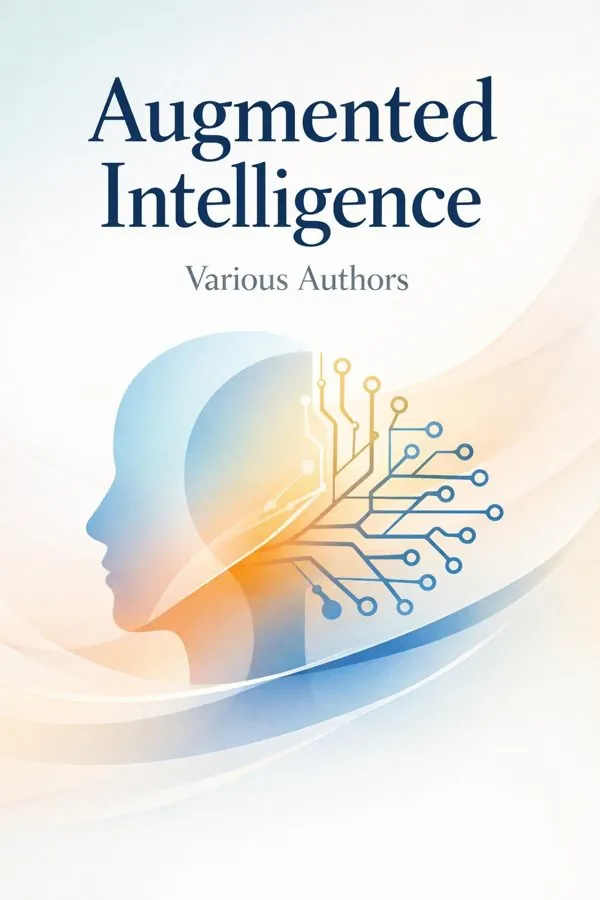
Augmented Intelligence: Summary & Key Insights
 10 min5 chaptersAudio available
What Is Augmented Intelligence About?
Augmented Intelligence by Various Authors is a ai_ml book spanning 5 pages. This book explores the concept of augmented intelligence, focusing on how human cognition can be enhanced through collaboration with artificial intelligence systems. It presents interdisciplinary perspectives from computer science, psychology, and ethics, discussing practical applications in business, healthcare, and education.
This FizzRead summary covers all 5 key chapters of Augmented Intelligence in approximately 10 minutes, distilling the most important ideas, arguments, and takeaways from Various Authors's work. Also available as an audio summary and Key Quotes Podcast.
Augmented Intelligence
This book explores the concept of augmented intelligence, focusing on how human cognition can be enhanced through collaboration with artificial intelligence systems. It presents interdisciplinary perspectives from computer science, psychology, and ethics, discussing practical applications in business, healthcare, and education.
Who Should Read Augmented Intelligence?
This book is perfect for anyone interested in ai_ml and looking to gain actionable insights in a short read. Whether you're a student, professional, or lifelong learner, the key ideas from Augmented Intelligence by Various Authors will help you think differently.
- ✓Readers who enjoy ai_ml and want practical takeaways
- ✓Professionals looking to apply new ideas to their work and life
- ✓Anyone who wants the core insights of Augmented Intelligence in just 10 minutes
Want the full summary?
Get instant access to this book summary and 100K+ more with Fizz Moment.
Get Free SummaryAvailable on App Store • Free to download
Key Chapters
The story of augmented intelligence begins not in the labs of modern AI, but much earlier—in the tools that humans have always used to extend their minds. From the abacus to the printing press, from the first computers to neural networks, every technological leap has been an attempt to supplement cognition. But unlike the automation narrative that focuses on substitution, augmentation emphasizes amplification.
In the middle of the 20th century, thinkers like J.C.R. Licklider and Douglas Engelbart envisioned computers as 'thinking assistants.' Licklider’s idea of a 'man-computer symbiosis' described systems designed to empower human decision-making, not replace it. Engelbart, in his groundbreaking work on human-computer interaction, saw computing as a way to collectively augment knowledge work—a vision embodied in the invention of the mouse and hypertext. Their ideas planted the seeds for a field that would eventually intertwine cognitive science and digital design.
As computing power grew, the focus shifted toward autonomy—AI that could act independently. Yet, by the mid-2010s, researchers and practitioners began to rediscover Licklider’s wisdom. Machine learning and deep neural networks, though extraordinary in analytic capacity, revealed their limitations in context, empathy, and ethical judgment. The pendulum began to swing back toward systems that explicitly keep humans in the loop.
Today’s augmented intelligence systems thrive on symbiosis: they analyze data patterns while human users interpret meaning; they process vast streams of information while we bring intuition and values. In finance, algorithms detect hidden correlations in markets, but humans still weigh strategic and ethical implications. In design, generative models propose novel forms, but human taste decides what resonates. This collaborative loop—iterative, interpretive, and situated—is the essence of augmentation.
By tracing this historical lineage, we see that augmented intelligence is not a technological revolution alone—it is a philosophical one. It asks not, 'What can machines do instead of us?' but 'What can we do better with them?'
To understand what it means to augment intelligence, we must understand intelligence itself—not just as a computational process, but as a living, embodied experience. Cognitive psychology and neuroscience reveal that intelligence is not a single faculty but a distributed system: perception, memory, reasoning, emotion, and social understanding work in continuous loops. These loops are shaped not only by brain architecture but also by tools, context, and collaboration.
The theoretical foundation of augmented cognition lies in the principle of distributed cognition—the idea that thinking extends beyond the individual mind into the environment, the tools we use, and the social systems we inhabit. When you use a GPS to navigate, cognition is shared: you contribute situational awareness and judgment; the device contributes precision and timing. Together, you achieve a result neither could alone.
Neuroscience has shown that feedback loops are essential to intelligence. Similarly, augmented intelligence systems thrive on feedback—between data and user, prediction and interpretation. These loops enable a co-adaptive partnership, where each side learns from the other over time. In healthcare diagnostics, for instance, a radiologist’s expertise helps train the algorithm, while the algorithm’s outputs refine the radiologist’s perceptual sensitivity. Each iteration strengthens the combined system.
Such theories challenge the myth of the solitary genius. In reality, intelligence is emergent, relational, and adaptive. Augmented systems formalize this reality through design. They build scaffolds around human cognition—interfaces that extend memory, networks that enhance reasoning, simulations that amplify foresight.
In essence, the science of augmented intelligence recognizes that intelligence is not a fixed trait but a dynamic ecology. By building systems that respect the brain’s rhythms, biases, and creative capacities, we create technology that does not dominate us but completes us.
+ 3 more chapters — available in the FizzRead app
All Chapters in Augmented Intelligence
About the Author
The contributing authors are experts in artificial intelligence, cognitive science, and technology ethics, representing academic and industry backgrounds from around the world.
Get This Summary in Your Preferred Format
Read or listen to the Augmented Intelligence summary by Various Authors anytime, anywhere. FizzRead offers multiple formats so you can learn on your terms — all free.
Available formats: App · Audio · PDF · EPUB — All included free with FizzRead
Download Augmented Intelligence PDF and EPUB Summary
Key Quotes from Augmented Intelligence
“The story of augmented intelligence begins not in the labs of modern AI, but much earlier—in the tools that humans have always used to extend their minds.”
“To understand what it means to augment intelligence, we must understand intelligence itself—not just as a computational process, but as a living, embodied experience.”
Frequently Asked Questions about Augmented Intelligence
Augmented Intelligence by Various Authors is a ai_ml book that explores key ideas across 5 chapters. This book explores the concept of augmented intelligence, focusing on how human cognition can be enhanced through collaboration with artificial intelligence systems. It presents interdisciplinary perspectives from computer science, psychology, and ethics, discussing practical applications in business, healthcare, and education.
More by Various Authors



You Might Also Like
Life 3.0
Max Tegmark
10 min
Superintelligence
Nick Bostrom
10 min
TensorFlow in Action
Thushan Ganegedara
10 min
AI Made Simple: A Beginner’s Guide to Generative AI, ChatGPT, and the Future of Work
Rajeev Kapur
10 min
AI Snake Oil
Arvind Narayanan, Sayash Kapoor
10 min
AI Superpowers: China, Silicon Valley, and the New World Order
Kai-Fu Lee
10 minBrowse by Category
Ready to read Augmented Intelligence?
Get the full summary and 100K+ more books with Fizz Moment.