
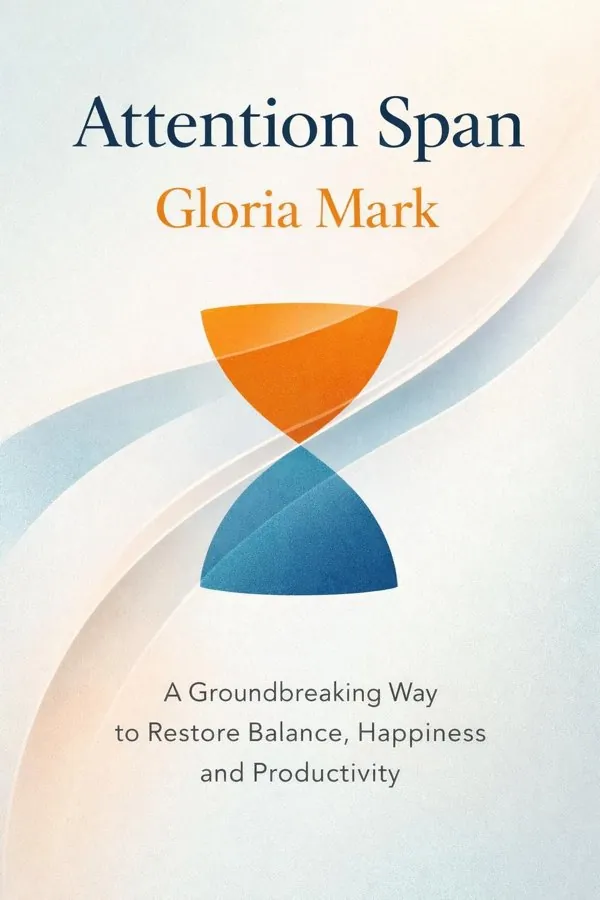
Attention Span: A Groundbreaking Way to Restore Balance, Happiness and Productivity: Summary & Key Insights
by Gloria Mark
 10 min6 chaptersAudio available
What Is Attention Span: A Groundbreaking Way to Restore Balance, Happiness and Productivity About?
Attention Span: A Groundbreaking Way to Restore Balance, Happiness and Productivity by Gloria Mark is a productivity book spanning 6 pages. In 'Attention Span', Gloria Mark, a professor of informatics at the University of California, Irvine, explores how our attention has been fragmented by digital technology and constant connectivity. Drawing on decades of empirical research, she reveals how multitasking and interruptions affect our mental well-being and productivity, and offers evidence-based strategies to regain focus, balance, and satisfaction in a world of endless distractions.
This FizzRead summary covers all 6 key chapters of Attention Span: A Groundbreaking Way to Restore Balance, Happiness and Productivity in approximately 10 minutes, distilling the most important ideas, arguments, and takeaways from Gloria Mark's work. Also available as an audio summary and Key Quotes Podcast.
Attention Span: A Groundbreaking Way to Restore Balance, Happiness and Productivity
In 'Attention Span', Gloria Mark, a professor of informatics at the University of California, Irvine, explores how our attention has been fragmented by digital technology and constant connectivity. Drawing on decades of empirical research, she reveals how multitasking and interruptions affect our mental well-being and productivity, and offers evidence-based strategies to regain focus, balance, and satisfaction in a world of endless distractions.
Who Should Read Attention Span: A Groundbreaking Way to Restore Balance, Happiness and Productivity?
This book is perfect for anyone interested in productivity and looking to gain actionable insights in a short read. Whether you're a student, professional, or lifelong learner, the key ideas from Attention Span: A Groundbreaking Way to Restore Balance, Happiness and Productivity by Gloria Mark will help you think differently.
- ✓Readers who enjoy productivity and want practical takeaways
- ✓Professionals looking to apply new ideas to their work and life
- ✓Anyone who wants the core insights of Attention Span: A Groundbreaking Way to Restore Balance, Happiness and Productivity in just 10 minutes
Want the full summary?
Get instant access to this book summary and 100K+ more with Fizz Moment.
Get Free SummaryAvailable on App Store • Free to download
Key Chapters
Before the digital age, attention operated within rhythms shaped by slower, tangible tasks. Work was linear—letters arrived once daily, meetings were scheduled, and doing one thing at a time was not only normal but efficient. The industrial era rewarded endurance and concentration.
Then came digital connectivity—the email inbox, the desktop, the smartphone—collapsing time and expanding the possibilities for instant communication. For the first time in human history, we could be everywhere at once. Yet this freedom came with hidden costs. My early research in the 2000s revealed a stunning shift: the average attention span on a digital screen had fallen dramatically, from a few minutes to under a minute. We entered what I call the era of continuous partial attention.
The historical perspective helps us see that attention did not simply decay; it evolved under new pressures. Just as industrial workers had to adapt their bodies to repetitive work, we are adapting our minds to the demands of infinite connectivity. And just as industrial overwork led to burnout and labor reforms, our cognitive world now demands new forms of balance and protection. Understanding this history can free us from nostalgia and guide us toward new norms where digital attention can coexist with mental well-being.
Over two decades, my colleagues and I measured attention using eye-tracking, screen logs, and self-reports from thousands of knowledge workers. The findings were both consistent and concerning: on average, people switched tasks every 47 seconds. Once interrupted, it often took more than 20 minutes to return to the original task. Even more striking was how our emotional state followed these switches—rising anxiety, growing frustration, and eventually, mental exhaustion.
These numbers told a human story. People were not enjoying their work less; they were simply managing too many micro-demands at once. Digital multitasking gave the illusion of progress while quietly eroding quality and satisfaction. Our brains are not built to fragment attention endlessly. Each switch comes with a cognitive cost—a resetting of mental context—that drains energy and diminishes creative thinking.
Empirical research also revealed that interruptions are not purely external. Many are self-initiated. We check email or social media not always because we have to, but because our brains seek the small rewards of novelty and completion. This is the neuroscience of attention hijacking. By tracking our mental rhythms and digital behaviors, I came to understand that attention isn’t simply depleted by external forces—it’s enticed away by internal impulses conditioned by our technologies.
+ 4 more chapters — available in the FizzRead app
All Chapters in Attention Span: A Groundbreaking Way to Restore Balance, Happiness and Productivity
About the Author
Gloria Mark is a professor of informatics at the University of California, Irvine. Her research focuses on human-computer interaction, digital well-being, and the effects of multitasking and interruptions on productivity and mental health. She is recognized internationally for her pioneering studies on attention and technology use.
Get This Summary in Your Preferred Format
Read or listen to the Attention Span: A Groundbreaking Way to Restore Balance, Happiness and Productivity summary by Gloria Mark anytime, anywhere. FizzRead offers multiple formats so you can learn on your terms — all free.
Available formats: App · Audio · PDF · EPUB — All included free with FizzRead
Download Attention Span: A Groundbreaking Way to Restore Balance, Happiness and Productivity PDF and EPUB Summary
Key Quotes from Attention Span: A Groundbreaking Way to Restore Balance, Happiness and Productivity
“Before the digital age, attention operated within rhythms shaped by slower, tangible tasks.”
“Over two decades, my colleagues and I measured attention using eye-tracking, screen logs, and self-reports from thousands of knowledge workers.”
Frequently Asked Questions about Attention Span: A Groundbreaking Way to Restore Balance, Happiness and Productivity
Attention Span: A Groundbreaking Way to Restore Balance, Happiness and Productivity by Gloria Mark is a productivity book that explores key ideas across 6 chapters. In 'Attention Span', Gloria Mark, a professor of informatics at the University of California, Irvine, explores how our attention has been fragmented by digital technology and constant connectivity. Drawing on decades of empirical research, she reveals how multitasking and interruptions affect our mental well-being and productivity, and offers evidence-based strategies to regain focus, balance, and satisfaction in a world of endless distractions.
You Might Also Like

Featured In
Browse by Category
Ready to read Attention Span: A Groundbreaking Way to Restore Balance, Happiness and Productivity?
Get the full summary and 100K+ more books with Fizz Moment.