
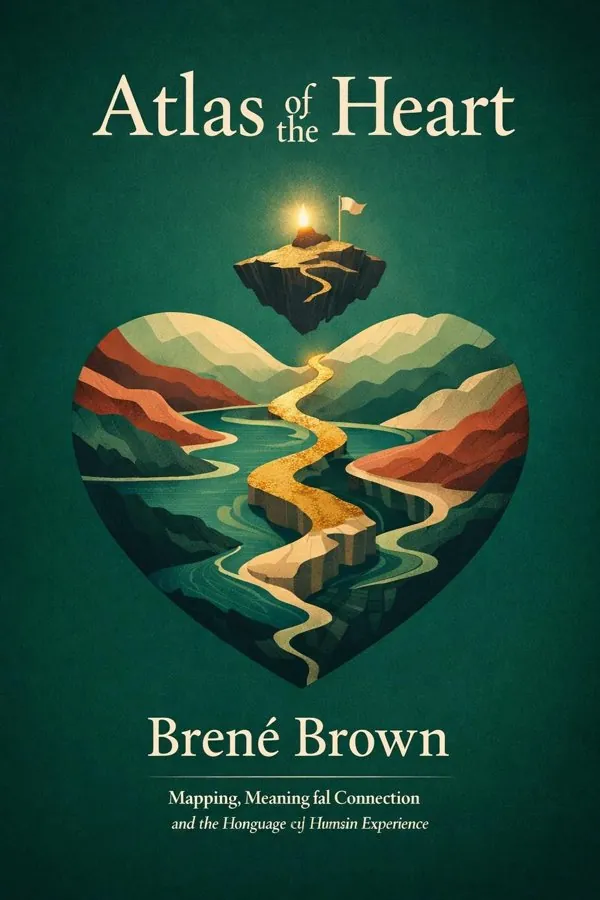
Atlas of the Heart: Mapping Meaningful Connection and the Language of Human Experience: Summary & Key Insights
by Brené Brown
 10 min6 chaptersAudio available
What Is Atlas of the Heart: Mapping Meaningful Connection and the Language of Human Experience About?
Atlas of the Heart: Mapping Meaningful Connection and the Language of Human Experience by Brené Brown is a psychology book spanning 6 pages. In 'Atlas of the Heart', Brené Brown explores eighty-seven emotions and experiences that define what it means to be human. Drawing on two decades of research, she maps the language of emotion and connection, helping readers understand how to navigate feelings, relationships, and vulnerability with greater clarity and compassion.
This FizzRead summary covers all 6 key chapters of Atlas of the Heart: Mapping Meaningful Connection and the Language of Human Experience in approximately 10 minutes, distilling the most important ideas, arguments, and takeaways from Brené Brown's work. Also available as an audio summary and Key Quotes Podcast.
Atlas of the Heart: Mapping Meaningful Connection and the Language of Human Experience
In 'Atlas of the Heart', Brené Brown explores eighty-seven emotions and experiences that define what it means to be human. Drawing on two decades of research, she maps the language of emotion and connection, helping readers understand how to navigate feelings, relationships, and vulnerability with greater clarity and compassion.
Who Should Read Atlas of the Heart: Mapping Meaningful Connection and the Language of Human Experience?
This book is perfect for anyone interested in psychology and looking to gain actionable insights in a short read. Whether you're a student, professional, or lifelong learner, the key ideas from Atlas of the Heart: Mapping Meaningful Connection and the Language of Human Experience by Brené Brown will help you think differently.
- ✓Readers who enjoy psychology and want practical takeaways
- ✓Professionals looking to apply new ideas to their work and life
- ✓Anyone who wants the core insights of Atlas of the Heart: Mapping Meaningful Connection and the Language of Human Experience in just 10 minutes
Want the full summary?
Get instant access to this book summary and 100K+ more with Fizz Moment.
Get Free SummaryAvailable on App Store • Free to download
Key Chapters
Language shapes how we experience life. When we have words to describe our internal world, we can engage with it, communicate it, and share it. Without these words, emotions become undifferentiated noise—confusing, overwhelming, and isolating. My research led to one clear conclusion: emotional literacy is the key to connection. Knowing the difference between words like stress and overwhelm, or between jealousy and envy, changes how we relate to ourselves and others.
In this section, I explain that learning emotional language isn’t about academic precision—it’s about empathy. When we name emotions accurately, we can understand the stories attached to them, and begin to shift those stories toward healing. For instance, when we confuse shame with guilt, we mistakenly label ourselves as ‘bad’ rather than recognizing that a particular behavior was harmful. That simple difference in language can change how we recover and connect.
Language becomes a form of self-compassion. It gives us the dignity of understanding ourselves rather than judging ourselves. When I say, “I feel disappointed,” I’m not collapsing into despair—I’m acknowledging an expectation that wasn’t met, and from that recognition, I can learn and grow. Our shared vocabulary of feelings is the foundation on which empathy stands. When we can speak about emotions clearly, we open space for belonging.
Uncertainty and overwhelm are some of the most common emotional landscapes we navigate. In my research, I learned that moments of stress, vulnerability, and anxiety are not signs of weakness—they are signals from our emotional systems asking for care and curiosity. When life feels 'too much,' we often try to control or escape, but what we truly need is connection.
These emotions show up when we face change, loss, or risk—when the outcome is unknown and our safety feels threatened. Anxiety is different from fear: fear is about something tangible, while anxiety is about what might happen. Vulnerability, in turn, is the willingness to show up even in uncertainty. Far from being a liability, vulnerability is the origin of courage.
Through examples from leadership and everyday life, I illustrate how embracing uncertainty allows us to build resilience. When we allow ourselves to feel overwhelmed, we can notice its patterns—our tendency to withdraw or shut down—and choose differently. Mapping this emotional space is an act of bravery. It’s saying, “I may not know what comes next, but I’m willing to face it.” That willingness changes everything.
+ 4 more chapters — available in the FizzRead app
All Chapters in Atlas of the Heart: Mapping Meaningful Connection and the Language of Human Experience
About the Author
Brené Brown is a research professor at the University of Houston, known for her pioneering work on vulnerability, courage, shame, and empathy. She is the author of several #1 New York Times bestsellers and the host of popular podcasts exploring human connection and leadership.
Get This Summary in Your Preferred Format
Read or listen to the Atlas of the Heart: Mapping Meaningful Connection and the Language of Human Experience summary by Brené Brown anytime, anywhere. FizzRead offers multiple formats so you can learn on your terms — all free.
Available formats: App · Audio · PDF · EPUB — All included free with FizzRead
Download Atlas of the Heart: Mapping Meaningful Connection and the Language of Human Experience PDF and EPUB Summary
Key Quotes from Atlas of the Heart: Mapping Meaningful Connection and the Language of Human Experience
“When we have words to describe our internal world, we can engage with it, communicate it, and share it.”
“Uncertainty and overwhelm are some of the most common emotional landscapes we navigate.”
Frequently Asked Questions about Atlas of the Heart: Mapping Meaningful Connection and the Language of Human Experience
Atlas of the Heart: Mapping Meaningful Connection and the Language of Human Experience by Brené Brown is a psychology book that explores key ideas across 6 chapters. In 'Atlas of the Heart', Brené Brown explores eighty-seven emotions and experiences that define what it means to be human. Drawing on two decades of research, she maps the language of emotion and connection, helping readers understand how to navigate feelings, relationships, and vulnerability with greater clarity and compassion.
More by Brené Brown




You Might Also Like
The Body Keeps the Score
Bessel van der Kolk
10 min
Surrounded by Idiots
Thomas Erikson
10 min
Emotional Intelligence
Daniel Goleman
10 min
Attached
Amir Levine
10 min
Why Does He Do That
Lundy Bancroft
10 min
Women Who Run with the Wolves
Clarissa Pinkola Estés
10 minBrowse by Category
Ready to read Atlas of the Heart: Mapping Meaningful Connection and the Language of Human Experience?
Get the full summary and 100K+ more books with Fizz Moment.