
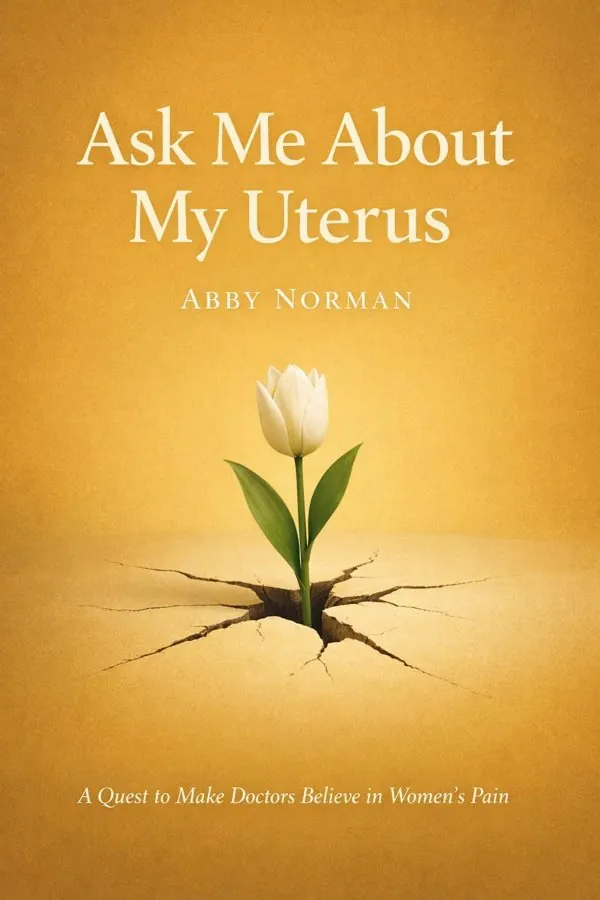
Ask Me About My Uterus: A Quest to Make Doctors Believe in Women's Pain: Summary & Key Insights
by Abby Norman
 10 min10 chaptersAudio available
Key Takeaways from Ask Me About My Uterus: A Quest to Make Doctors Believe in Women's Pain
One of the book’s most unsettling insights is that severe pain does not automatically lead to care; sometimes it leads to suspicion.
A striking truth runs through Norman’s story: when institutions fail, patients are often forced to become researchers.
To understand why women’s pain is so often doubted, Norman looks backward.
Illness is never only physical, and Norman’s memoir makes that impossible to ignore.
A central contribution of the book is its exposure of how bias can look calm, rational, and professional.
What Is Ask Me About My Uterus: A Quest to Make Doctors Believe in Women's Pain About?
Ask Me About My Uterus: A Quest to Make Doctors Believe in Women's Pain by Abby Norman is a biographies book spanning 10 pages. What happens when severe pain is treated not as a medical emergency, but as a credibility problem? In Ask Me About My Uterus, Abby Norman turns her struggle with endometriosis into a fierce, intelligent, and deeply humane investigation of how medicine has historically failed women. Part memoir and part reported inquiry, the book follows Norman from the onset of debilitating pelvic pain through years of misdiagnosis, dismissal, and self-education, showing how often patients must fight not only illness but also the systems meant to heal them. What makes the book especially powerful is that Norman does not stop at telling a personal story. She connects her own experience to a broader history of gender bias in medicine, the underfunding of women’s health research, and the cultural tendency to normalize female suffering. As a writer and science journalist, she brings both emotional honesty and investigative rigor to the subject. The result is a compelling account of chronic illness, medical sexism, and patient advocacy that challenges readers to rethink whose pain gets believed and why.
This FizzRead summary covers all 10 key chapters of Ask Me About My Uterus: A Quest to Make Doctors Believe in Women's Pain in approximately 10 minutes, distilling the most important ideas, arguments, and takeaways from Abby Norman's work. Also available as an audio summary and Key Quotes Podcast.
Ask Me About My Uterus: A Quest to Make Doctors Believe in Women's Pain
What happens when severe pain is treated not as a medical emergency, but as a credibility problem? In Ask Me About My Uterus, Abby Norman turns her struggle with endometriosis into a fierce, intelligent, and deeply humane investigation of how medicine has historically failed women. Part memoir and part reported inquiry, the book follows Norman from the onset of debilitating pelvic pain through years of misdiagnosis, dismissal, and self-education, showing how often patients must fight not only illness but also the systems meant to heal them. What makes the book especially powerful is that Norman does not stop at telling a personal story. She connects her own experience to a broader history of gender bias in medicine, the underfunding of women’s health research, and the cultural tendency to normalize female suffering. As a writer and science journalist, she brings both emotional honesty and investigative rigor to the subject. The result is a compelling account of chronic illness, medical sexism, and patient advocacy that challenges readers to rethink whose pain gets believed and why.
Who Should Read Ask Me About My Uterus: A Quest to Make Doctors Believe in Women's Pain?
This book is perfect for anyone interested in biographies and looking to gain actionable insights in a short read. Whether you're a student, professional, or lifelong learner, the key ideas from Ask Me About My Uterus: A Quest to Make Doctors Believe in Women's Pain by Abby Norman will help you think differently.
- ✓Readers who enjoy biographies and want practical takeaways
- ✓Professionals looking to apply new ideas to their work and life
- ✓Anyone who wants the core insights of Ask Me About My Uterus: A Quest to Make Doctors Believe in Women's Pain in just 10 minutes
Want the full summary?
Get instant access to this book summary and 100K+ more with Fizz Moment.
Get Free SummaryAvailable on App Store • Free to download
Key Chapters
One of the book’s most unsettling insights is that severe pain does not automatically lead to care; sometimes it leads to suspicion. Abby Norman’s early medical experiences reveal how women in pain are often asked, directly or indirectly, to prove that their suffering is real. As her pelvic pain intensifies, she moves through appointments, tests, and explanations that fail to capture what is happening in her body. Instead of receiving clarity, she encounters minimization, confusion, and the quiet implication that her symptoms may be exaggerated, psychological, or simply part of being female.
Norman shows that this pattern is not only personally devastating but structurally revealing. When pain cannot be easily measured, doctors often rely on assumptions, and those assumptions are shaped by gendered beliefs about emotionality, resilience, and what kinds of discomfort women are expected to endure. Menstrual pain, reproductive pain, and chronic pelvic pain are especially vulnerable to dismissal because they are culturally normalized before they are clinically investigated.
This idea has practical relevance for anyone navigating a difficult diagnosis. Patients with chronic symptoms often benefit from keeping a symptom journal, documenting when pain occurs, what worsens it, what treatments have failed, and how it affects work, sleep, and daily functioning. Specific evidence can sometimes help counter vague dismissal. Bringing an advocate to appointments can also shift the dynamic.
Norman’s experience makes one lesson unmistakable: if your pain is changing your life, it deserves serious attention. Actionable takeaway: document your symptoms carefully and insist that unexplained pain be evaluated, not normalized.
A striking truth runs through Norman’s story: when institutions fail, patients are often forced to become researchers. At one of her lowest points, after repeated appointments bring little progress, she begins reading medical journals, patient forums, and scientific articles in search of answers. That search leads her toward endometriosis, a disease in which tissue similar to the uterine lining grows outside the uterus and can cause severe pain, inflammation, infertility, and a range of systemic symptoms.
The significance of this discovery lies not only in the diagnosis itself but in the process. Norman is compelled to do what many chronically ill people know too well: translate her lived experience into the language medicine will recognize. She learns terminology, compares symptoms, studies treatment options, and enters clinical conversations better informed than some providers expect patients to be. This is empowering, but it is also an indictment. People in pain should not need to earn credibility through unpaid detective work.
Still, the book demonstrates the practical value of informed self-advocacy. Patients can benefit from learning key terms related to their symptoms, reading reputable medical sources, asking pointed questions, and requesting referrals to specialists rather than settling for repeated general reassurances. Knowledge also helps people assess treatment claims critically and avoid feeling trapped by a single dismissive opinion.
Norman never romanticizes this burden, yet she shows how information can become leverage. Actionable takeaway: if your symptoms remain unexplained, study credible sources and use that knowledge to ask more focused questions and pursue specialist care.
To understand why women’s pain is so often doubted, Norman looks backward. Her book makes the powerful argument that present-day medical bias did not appear out of nowhere; it has deep historical roots. For centuries, women’s bodies were interpreted through frameworks that cast them as unstable, overly emotional, or inherently defined by reproduction. Diagnoses like hysteria, along with cultural myths about female fragility and irrationality, shaped how doctors learned to perceive women’s complaints.
Norman places her own experience within this legacy, showing that when a clinician treats a woman’s pain as anxiety, dramatization, or hormonal overreaction, that response reflects a long tradition rather than an isolated misunderstanding. The history matters because it reveals that medicine is not a purely objective enterprise. It is built by people, institutions, and assumptions, and those assumptions can linger long after the language changes.
This historical lens has practical implications. It helps patients and clinicians recognize that bias is not always intentional. A doctor may sincerely care while still underestimating a patient’s pain because of inherited habits of thought. For healthcare professionals, this means reflecting on how pain complaints are interpreted differently across gender lines. For patients, it can be clarifying to see dismissal not as personal failure but as part of a broader pattern.
By naming the historical roots of disbelief, Norman transforms private frustration into public critique. Actionable takeaway: learn the historical patterns behind medical bias so you can identify dismissal more clearly and challenge it with confidence rather than self-doubt.
Illness is never only physical, and Norman’s memoir makes that impossible to ignore. Her experience with endometriosis affects school, work, relationships, finances, identity, and mental health. Pain interrupts concentration. Unpredictable symptoms disrupt plans. Repeated medical appointments consume time and energy. The body becomes both the source of suffering and the full-time project that organizes daily life.
One of the book’s strengths is that it refuses to isolate disease from its social consequences. A person with chronic pain is not merely dealing with symptoms; she is also managing doubt from others, reduced productivity, emotional exhaustion, and the grief of no longer living as she once did. Norman captures the loneliness of becoming difficult to explain to healthy people. She also reveals how chronic illness can destabilize one’s sense of self. When every decision must be filtered through pain, spontaneity shrinks and the future becomes harder to imagine.
Readers dealing with chronic conditions may recognize practical patterns here. It helps to build routines that conserve energy, communicate limitations clearly to trusted people, and distinguish between guilt and actual responsibility. Workplaces and schools often require explicit documentation before they offer accommodations, so obtaining records and asking early can make a difference. Emotional support matters too, whether through therapy, peer communities, or informed loved ones.
Norman’s story reminds us that treatment should address more than symptoms. It should consider the full human life affected by disease. Actionable takeaway: treat chronic illness management as life management too by seeking accommodations, support systems, and realistic routines that protect your well-being.
A central contribution of the book is its exposure of how bias can look calm, rational, and professional. Norman shows that medical sexism rarely appears as open hostility. More often, it is embedded in tone, timing, assumptions, and diagnostic shortcuts. A woman’s pain is attributed to stress more quickly. A complaint is reframed as emotional distress before physical causes are exhausted. A symptom that would trigger urgent investigation in another patient is treated as ordinary inconvenience.
This matters because bias that presents itself as neutral expertise is especially difficult to challenge. Patients often leave appointments wondering whether they were unclear, dramatic, or simply expecting too much. Norman demonstrates that these feelings are not accidental; they are part of what happens when authority is used to narrow the range of what counts as believable suffering.
The lesson extends beyond reproductive health. Similar dynamics affect pain treatment, autoimmune disease, cardiovascular symptoms, and other conditions where women are historically underdiagnosed or diagnosed later. In practical terms, patients may need to ask direct questions such as: What serious causes have been ruled out? What evidence supports this explanation? At what point should I return if symptoms persist? What specialist can evaluate this further? These questions push vague reassurance toward accountable reasoning.
For clinicians, the book is a call to examine whether they interrupt women more, psychologize symptoms faster, or underinvestigate chronic pain. Actionable takeaway: when a medical explanation feels dismissive, ask for the clinical reasoning behind it and request clear next steps rather than accepting ambiguity as closure.
Norman’s investigation moves beyond memoir into the science of pain, and in doing so she reveals how incomplete knowledge can become a form of neglect. Pain is not a simple signal with a single source; it is shaped by nerves, inflammation, hormones, previous trauma, central sensitization, and the brain’s interpretation of threat. Conditions like endometriosis are especially difficult because visible lesions do not always correlate neatly with the severity of pain, and symptoms can be systemic rather than neatly localized.
This scientific complexity is often used against patients. When tests are inconclusive or symptoms vary, doctors may shift toward doubt instead of curiosity. Norman argues that uncertainty should lead to more research, not less compassion. The problem is not that medicine lacks perfect answers; the problem is how often that lack of answers is borne by women whose suffering is then treated as questionable.
Practically, this idea encourages a more nuanced understanding of diagnosis and treatment. Patients may need multidisciplinary care rather than a single solution: gynecology, pain management, pelvic floor therapy, mental health support, nutrition guidance, or surgery depending on the case. It also underscores the importance of specialists familiar with complex pain conditions, since generalized care can overlook overlapping mechanisms.
Norman’s treatment of pain science helps readers reject false binaries. Pain can be real even when it is hard to measure. Biological complexity does not equal psychosomatic fiction. Actionable takeaway: seek providers who understand chronic pain as multifactorial and ask about integrated treatment options instead of expecting one test or one doctor to explain everything.
A painful illness often isolates people first and politicizes them later. Norman’s journey shows how community becomes essential once private suffering is recognized as part of a public pattern. Through the voices of other women, online forums, advocacy networks, and shared stories, she finds not only validation but a different framework for understanding her experience. What seemed like individual bad luck begins to look like systemic failure.
This shift is powerful because isolation intensifies self-doubt. When patients are repeatedly dismissed, they may start to question their own perceptions. Community interrupts that process. Hearing similar stories from others can confirm that delayed diagnosis, minimization, and poor treatment are not rare anomalies. It can also provide practical help: recommendations for knowledgeable specialists, guidance on navigating insurance, insight into surgeries or medications, and language for describing symptoms more effectively.
Norman also suggests that community can move beyond support into advocacy. Shared stories can influence public awareness, medical education, and research priorities. In that sense, solidarity is not only emotionally comforting but politically useful. The collective voice of patients can pressure institutions to treat neglected conditions with greater seriousness.
For readers living with chronic illness, this idea has immediate application. Joining a reputable support group, patient organization, or advocacy community can reduce loneliness and improve decision-making. The key is to balance peer wisdom with credible medical guidance.
Norman makes clear that healing does not happen in isolation. Actionable takeaway: find a trustworthy patient community that offers both emotional validation and practical knowledge, and use that connection to strengthen your care and your voice.
Before a doctor dismisses a woman’s pain, culture often trains her to dismiss it herself. One of the book’s most perceptive ideas is that women are socialized to normalize suffering related to menstruation, reproduction, and the body. Cramps are expected. Discomfort is minimized. Endurance is praised. As a result, many women delay seeking care or assume that what feels unbearable must still somehow be ordinary.
Norman shows how dangerous this script can be. When severe symptoms are treated as a routine burden of womanhood, disease hides in plain sight. Endometriosis can take years to diagnose precisely because the line between expected pain and pathological pain has been culturally blurred. The same narrative also shapes how others respond. Family members, partners, teachers, and employers may assume a woman should simply push through.
This insight has broad practical relevance. Patients benefit from reframing the question from Is this normal for me to tolerate? to Is this interfering with my ability to function? Pain that disrupts school, work, sleep, mobility, sex, digestion, or mental health deserves evaluation, whether or not others call it common. Parents and educators can also play a role by teaching adolescents that intense menstrual or pelvic pain is not something to automatically accept.
Norman’s critique is ultimately liberating: endurance is not a virtue when it blocks diagnosis. Actionable takeaway: stop using familiarity as a measure of normality; if pain repeatedly disrupts your life, seek medical assessment and do not let cultural expectations redefine suffering as routine.
At the heart of Norman’s memoir is a struggle not just for treatment, but for agency. Chronic illness can strip people of control by making the body unpredictable, but medical dismissal deepens that loss by undermining a person’s authority over her own experience. To be disbelieved in pain is to be separated from your own reality. Norman’s path toward reclaiming agency therefore begins with naming what is happening, insisting on the legitimacy of her symptoms, and refusing to let professional doubt become self-erasure.
This reclaiming of voice does not mean simplistic empowerment. Norman is honest about fear, exhaustion, and the unequal power between patients and institutions. Yet she shows that agency can take many forms: asking harder questions, changing doctors, seeking records, researching treatment options, consenting from an informed position, and telling one’s story publicly. Even when cure is uncertain, self-advocacy can restore a measure of dignity and direction.
For readers, this idea is highly actionable. Requesting copies of test results, maintaining a personal medical file, preparing questions before appointments, and clarifying treatment goals can all increase a sense of control. So can learning the difference between collaborative care and passive compliance. A good doctor should not demand silence; they should welcome informed participation.
Norman’s story ultimately reframes patienthood. It is not merely a role of waiting and receiving. It can also be a role of observing, questioning, and deciding. Actionable takeaway: protect your medical agency by keeping records, preparing for appointments, and treating your lived experience as essential evidence in every healthcare conversation.
Perhaps the book’s largest argument is that women should not need extraordinary persistence to receive ordinary care. Norman makes clear that while personal advocacy matters, it cannot be the final answer. A healthcare system that depends on patients being articulate, educated, financially stable, and relentless is a system that will continue to fail the most vulnerable. What is needed is not just more awareness, but structural change.
Norman points toward several areas where that change must occur: more research funding for women’s health conditions, better training on chronic pelvic pain and endometriosis, stronger attention to gender bias in medical education, shorter diagnostic delays, and more compassionate listening in clinical practice. She also suggests that medicine should value patient testimony as data rather than as an obstacle to objectivity.
This idea matters because it shifts the conversation from inspirational individual resilience to public responsibility. It is admirable that some patients eventually force their way to answers, but that does not make the system fair. Real progress means making accurate, respectful care standard rather than exceptional.
Readers can apply this insight beyond their own medical visits. Supporting women’s health advocacy organizations, pushing for workplace and school accommodations, amplifying credible education about endometriosis, and voting for policies that strengthen healthcare access all contribute to systemic improvement.
Norman ends not in resignation, but in demand. Actionable takeaway: use your experience or your influence to support reforms in women’s health research, education, and clinical care so belief does not depend on luck.
All Chapters in Ask Me About My Uterus: A Quest to Make Doctors Believe in Women's Pain
About the Author
Abby Norman is an American writer and science journalist whose work explores women’s health, chronic illness, pain, and the cultural assumptions embedded in medicine. She gained wide recognition with Ask Me About My Uterus, a book that blends memoir, investigative reporting, and medical history to examine why women’s pain is so often dismissed. Drawing on her own experience with endometriosis, Norman writes with both personal urgency and analytical depth, making complex scientific and social issues accessible to general readers. Her work is distinguished by its attention to patient experience, gender bias, and the gap between clinical knowledge and lived reality. Through her writing, she has become an important voice in conversations about healthcare equity, chronic pain, and the need for more compassionate, evidence-based treatment.
Get This Summary in Your Preferred Format
Read or listen to the Ask Me About My Uterus: A Quest to Make Doctors Believe in Women's Pain summary by Abby Norman anytime, anywhere. FizzRead offers multiple formats so you can learn on your terms — all free.
Available formats: App · Audio · PDF · EPUB — All included free with FizzRead
Download Ask Me About My Uterus: A Quest to Make Doctors Believe in Women's Pain PDF and EPUB Summary
Key Quotes from Ask Me About My Uterus: A Quest to Make Doctors Believe in Women's Pain
“One of the book’s most unsettling insights is that severe pain does not automatically lead to care; sometimes it leads to suspicion.”
“A striking truth runs through Norman’s story: when institutions fail, patients are often forced to become researchers.”
“To understand why women’s pain is so often doubted, Norman looks backward.”
“Illness is never only physical, and Norman’s memoir makes that impossible to ignore.”
“A central contribution of the book is its exposure of how bias can look calm, rational, and professional.”
Frequently Asked Questions about Ask Me About My Uterus: A Quest to Make Doctors Believe in Women's Pain
Ask Me About My Uterus: A Quest to Make Doctors Believe in Women's Pain by Abby Norman is a biographies book that explores key ideas across 10 chapters. What happens when severe pain is treated not as a medical emergency, but as a credibility problem? In Ask Me About My Uterus, Abby Norman turns her struggle with endometriosis into a fierce, intelligent, and deeply humane investigation of how medicine has historically failed women. Part memoir and part reported inquiry, the book follows Norman from the onset of debilitating pelvic pain through years of misdiagnosis, dismissal, and self-education, showing how often patients must fight not only illness but also the systems meant to heal them. What makes the book especially powerful is that Norman does not stop at telling a personal story. She connects her own experience to a broader history of gender bias in medicine, the underfunding of women’s health research, and the cultural tendency to normalize female suffering. As a writer and science journalist, she brings both emotional honesty and investigative rigor to the subject. The result is a compelling account of chronic illness, medical sexism, and patient advocacy that challenges readers to rethink whose pain gets believed and why.
You Might Also Like

An American Marriage
Tayari Jones
10 min
Benjamin Franklin: An American Life
Walter Isaacson
10 min
I Know Why The Caged Bird Sings
Maya Angelou
10 min
Long Walk to Freedom
Nelson Mandela
10 min
Persepolis
Marjane Satrapi
10 min
Surely You're Joking, Mr. Feynman!
Richard P. Feynman
10 minBrowse by Category
Ready to read Ask Me About My Uterus: A Quest to Make Doctors Believe in Women's Pain?
Get the full summary and 100K+ more books with Fizz Moment.