
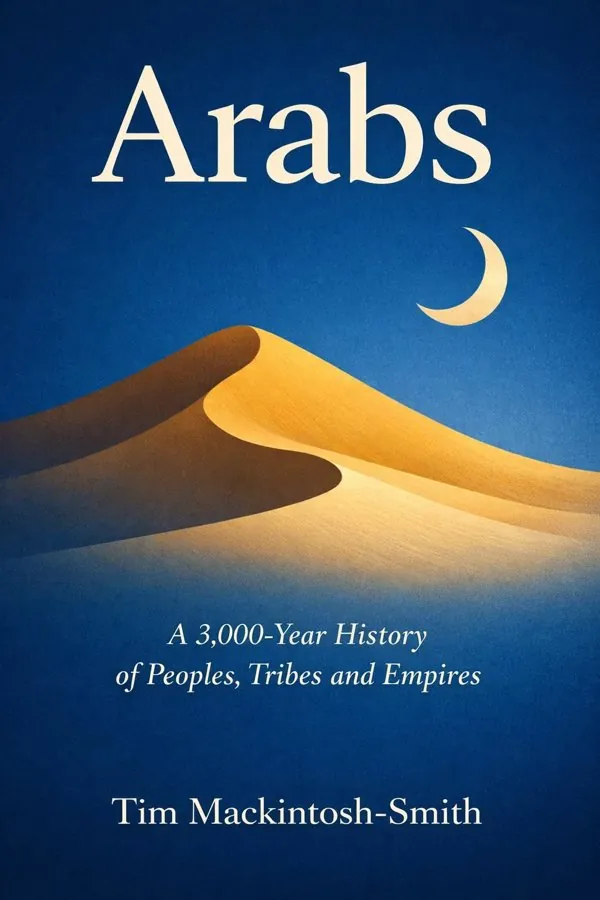
Arabs: A 3,000-Year History of Peoples, Tribes and Empires: Summary & Key Insights
 10 min9 chaptersAudio available
Key Takeaways from Arabs: A 3,000-Year History of Peoples, Tribes and Empires
A civilization can begin not with borders, but with habits of survival.
Some revolutions succeed because they offer better institutions; others because they offer a better story.
Empires often rise through unity but survive through adaptation.
When territory changes hands, language can become the most durable form of nationhood.
Unity is often strongest when it can survive difference.
What Is Arabs: A 3,000-Year History of Peoples, Tribes and Empires About?
Arabs: A 3,000-Year History of Peoples, Tribes and Empires by Tim Mackintosh-Smith is a world_history book spanning 9 pages. What does it mean to be Arab: to belong to a people defined not only by ancestry or geography, but by language, memory, mobility, and an unusually long historical consciousness? In Arabs: A 3,000-Year History of Peoples, Tribes and Empires, Tim Mackintosh-Smith tackles that question with ambition, wit, and deep erudition. Rather than treating Arab history as a story that begins with Islam, he reaches far back into ancient Arabia and follows the Arabs across tribal life, imperial expansion, literary brilliance, regional fragmentation, colonial intrusion, and modern political upheaval. The result is a sweeping portrait of continuity within change. What makes this book especially valuable is its refusal to flatten Arab history into cliché. Mackintosh-Smith shows that the Arab world has always been both unified and diverse, held together most powerfully by language and culture even when politics split it apart. A celebrated Arabist who spent many years living in Yemen, he writes with unusual intimacy about Arabic sources, landscapes, and sensibilities. This is not just a history of rulers and wars; it is a history of how a civilization imagined itself across three millennia.
This FizzRead summary covers all 9 key chapters of Arabs: A 3,000-Year History of Peoples, Tribes and Empires in approximately 10 minutes, distilling the most important ideas, arguments, and takeaways from Tim Mackintosh-Smith's work. Also available as an audio summary and Key Quotes Podcast.
Arabs: A 3,000-Year History of Peoples, Tribes and Empires
What does it mean to be Arab: to belong to a people defined not only by ancestry or geography, but by language, memory, mobility, and an unusually long historical consciousness? In Arabs: A 3,000-Year History of Peoples, Tribes and Empires, Tim Mackintosh-Smith tackles that question with ambition, wit, and deep erudition. Rather than treating Arab history as a story that begins with Islam, he reaches far back into ancient Arabia and follows the Arabs across tribal life, imperial expansion, literary brilliance, regional fragmentation, colonial intrusion, and modern political upheaval. The result is a sweeping portrait of continuity within change.
What makes this book especially valuable is its refusal to flatten Arab history into cliché. Mackintosh-Smith shows that the Arab world has always been both unified and diverse, held together most powerfully by language and culture even when politics split it apart. A celebrated Arabist who spent many years living in Yemen, he writes with unusual intimacy about Arabic sources, landscapes, and sensibilities. This is not just a history of rulers and wars; it is a history of how a civilization imagined itself across three millennia.
Who Should Read Arabs: A 3,000-Year History of Peoples, Tribes and Empires?
This book is perfect for anyone interested in world_history and looking to gain actionable insights in a short read. Whether you're a student, professional, or lifelong learner, the key ideas from Arabs: A 3,000-Year History of Peoples, Tribes and Empires by Tim Mackintosh-Smith will help you think differently.
- ✓Readers who enjoy world_history and want practical takeaways
- ✓Professionals looking to apply new ideas to their work and life
- ✓Anyone who wants the core insights of Arabs: A 3,000-Year History of Peoples, Tribes and Empires in just 10 minutes
Want the full summary?
Get instant access to this book summary and 100K+ more with Fizz Moment.
Get Free SummaryAvailable on App Store • Free to download
Key Chapters
A civilization can begin not with borders, but with habits of survival. Mackintosh-Smith argues that to understand the Arabs, we must begin before states and before scripture, in the ecology and psychology of Arabia itself. Desert conditions did not simply shape where people lived; they shaped how they organized trust, loyalty, honor, and movement. In this world, the tribe was not a romantic relic but a practical institution. It protected members, distributed obligations, and provided identity in landscapes where formal government was often absent.
Pre-Islamic Arab life was therefore structured around kinship, oral memory, and reputation. Poetry functioned as archive, newspaper, propaganda, and art all at once. A tribe’s poet preserved victories, mocked enemies, and encoded values such as generosity, courage, endurance, and loyalty. These values were not abstractions; they were mechanisms for survival in harsh environments and unstable alliances. Even the outsider’s image of the Arab as nomadic and fiercely independent emerges here, though Mackintosh-Smith complicates it by showing that Arabia also contained towns, trade routes, and sophisticated cultural exchange.
This origin story matters because later Arab political and religious developments did not erase tribal patterns; they absorbed and redirected them. You can see echoes of this today in modern Arab politics, where family networks, local loyalties, and inherited ideas of honor still interact with the formal structures of the state. For a reader, the practical application is clear: when studying Arab societies, do not start with contemporary national borders alone. Start with older social structures—tribe, lineage, oral culture, and ecology. Actionable takeaway: whenever you encounter a modern Arab political or social issue, ask what deeper tribal or regional loyalties may still be shaping it beneath the surface.
Some revolutions succeed because they offer better institutions; others because they offer a better story. The rise of Islam did both. Into a world of tribes, rivalries, sacred sites, and trading networks came Muhammad’s message, which transformed Arab history by giving it a unifying revelation, a sacred language, and a universal horizon. Mackintosh-Smith shows that Islam did not simply replace Arab identity with religious identity. Rather, it elevated Arabic into the vehicle of divine speech and turned previously dispersed Arab communities into participants in a shared civilizational mission.
The Qur’an was decisive not only because of its spiritual content, but because of its linguistic authority. Arabic became more than a spoken medium; it became the language of revelation, law, memory, and prestige. This gave the Arabs a unifying center strong enough to rival tribal fragmentation. Yet the older structures did not vanish overnight. Early Islamic history was shaped by negotiations between prophetic ideals and tribal realities, between universal faith and inherited loyalties.
Mackintosh-Smith emphasizes that the astonishing speed of Arab-Muslim expansion cannot be explained by military force alone. It was also powered by a compelling synthesis: moral purpose, disciplined community, and linguistic-cultural confidence. The early believers carried a message that could travel across tribes and regions because it offered a wider belonging without entirely erasing local identity.
For modern readers, this chapter is a reminder that transformative movements usually endure when they provide both meaning and structure. Religion, culture, and language can bind people more deeply than institutions built only on coercion. Actionable takeaway: if you want to understand the Arab world’s historical unity, study how Islam and Arabic reinforced one another, creating a civilizational bond stronger than any single dynasty or state.
Empires often rise through unity but survive through adaptation. After the first Islamic expansions, Arab power entered its imperial phase under the Rashidun, Umayyad, and Abbasid caliphates. Mackintosh-Smith presents this period not as a simple golden age, but as a dynamic and often unstable process in which Arab leadership expanded far beyond Arabia and then had to govern peoples vastly different from themselves. The early caliphates turned Arab identity into an imperial force, but empire also changed the Arabs in return.
Under the Umayyads, Arab dominance remained more visibly tied to conquest and ruling elites. Under the Abbasids, especially in Baghdad, the center of gravity shifted toward a more cosmopolitan civilization in which Persians, Turks, scholars, merchants, and administrators all shaped the Islamic world. Arabic remained central, but Arabness itself became more layered. The paradox is crucial: Arab civilization reached greater sophistication precisely as political control became less exclusively Arab.
This helps explain one of the book’s recurring insights: Arab history is not reducible to ethnicity. It is a history of language, prestige, institutions, and cultural influence that often extended beyond narrow Arab lineage. In practical terms, the caliphates show how a people can become globally influential not only by ruling others, but by creating frameworks others want to join—administrative, intellectual, and literary.
Modern parallels are easy to find. Global powers today also face the challenge of retaining core identity while managing diversity across vast territories or networks. Actionable takeaway: when evaluating any empire or large political order, look beyond military conquest and ask how it integrates outsiders, redistributes authority, and transforms the identity of the original ruling group.
When territory changes hands, language can become the most durable form of nationhood. One of Mackintosh-Smith’s strongest arguments is that Arabic, more than any empire or state, is the thread that most consistently ties Arab history together. Across centuries of conquest, dynastic collapse, migration, and colonial intervention, Arabic remained the medium through which Arabs argued, prayed, remembered, joked, traded, and imagined themselves. This made language not just a tool of communication, but a civilizational homeland.
The richness of Arabic literature proves the point. Pre-Islamic odes preserved tribal memory; Qur’anic Arabic established a linguistic standard of unmatched prestige; Abbasid prose and poetry displayed urban sophistication; later writers adapted Arabic to philosophy, science, theology, satire, biography, and historiography. Even when political centers shifted or fragmented, the language sustained a shared world of reference. A scholar in Cairo, a judge in Baghdad, and a poet in al-Andalus could all inhabit the same textual civilization.
Mackintosh-Smith is especially good at showing that Arabic has always existed in productive tension between classical form and local speech. Far from weakening Arab identity, this range has allowed both continuity and adaptation. Today’s Arab media sphere still depends on this interplay between formal Arabic and regional vernaculars.
The practical lesson is significant for anyone thinking about identity: political unity is fragile, but linguistic and cultural unity can endure for centuries. If you want to understand why Arab solidarity resurfaces even after repeated political failures, follow the language. Actionable takeaway: to grasp Arab history seriously, pay attention not only to rulers and wars, but to what Arabic texts, poetry, and public speech reveal about shared memory across time.
Unity is often strongest when it can survive difference. A central achievement of this book is its refusal to present the Arabs as a monolith. Mackintosh-Smith traces how Arab identity unfolded across many regions: the Arabian Peninsula, Iraq, the Levant, Egypt, North Africa, and al-Andalus, each with distinct ecologies, political traditions, and encounters with non-Arab populations. These regions produced different forms of Arabness, yet none stood entirely outside the larger Arab story.
Egypt, for example, became one of the Arab world’s great demographic and cultural centers, though its ancient civilizational depth always gave it a particular self-awareness. North Africa absorbed Arab migration and Arabic language over centuries through a complex interplay with Amazigh societies. Iraq and Syria became intellectual powerhouses, but also zones of repeated imperial contest. Al-Andalus revealed how Arab-Islamic civilization could flourish at Europe’s edge while remaining connected to wider Arabic literary and political traditions.
This diversity matters because it corrects simplistic assumptions. Arab identity has never depended on uniform race, one political system, or one local culture. It has been cumulative and layered, often formed through interaction with Persians, Turks, Africans, Berbers, Byzantines, and Europeans. In everyday terms, this is why a Moroccan, an Iraqi, and a Yemeni may differ dramatically in dialect, cuisine, and local history, yet still recognize a broader Arab cultural frame.
The application for readers is straightforward: avoid treating the Arab world as a single block, but avoid the opposite error too—assuming diversity means there is no meaningful shared identity. Actionable takeaway: whenever you study an Arab country, place it in two frames at once—its local history and the wider Arabic-speaking civilizational network to which it belongs.
Civilizations often understand themselves more sharply when confronted by powerful outsiders. Mackintosh-Smith shows that Arab encounters with Europe were not a simple story of decline meeting progress, but a long, uneven process of conflict, imitation, resistance, and reinterpretation. The Crusades, Mediterranean trade, Ottoman-European rivalry, Napoleon’s invasion of Egypt, and later colonial penetration all forced Arab societies to reassess military weakness, political fragmentation, and technological lag. Yet these encounters also generated intellectual renewal.
What changed was not only power, but perspective. European expansion introduced new categories—nation, progress, reform, secular administration, modern education, and print culture—that Arab thinkers had to absorb, contest, or adapt. The Arab world did not passively receive Western modernity; it filtered it through local traditions, Islamic thought, and Arabic linguistic revival. This helped produce the Nahda, or Arab renaissance, in which writers, translators, reformers, and journalists sought to renew Arab civilization without surrendering its core identity.
Mackintosh-Smith avoids easy binaries here. The West was at once admired and feared, imitated and opposed. Colonialism damaged Arab autonomy, but it also provoked sharper questions: What had been lost? What could be revived? What did modernity require? These remain live questions today in debates over governance, education, religion, and cultural authenticity.
For readers, the practical insight is that outside pressure often accelerates internal self-examination. Societies rarely modernize in pure isolation. Actionable takeaway: when analyzing Arab modern history, do not ask only what Europe did to the Arab world; also ask how Arabs selectively reinterpreted foreign ideas to redefine themselves.
Renewal begins when a culture decides its past is not a burden, but a resource. In the nineteenth and early twentieth centuries, Arab thinkers launched one of the most important intellectual revivals in modern history. The Nahda was not merely a literary awakening; it was an effort to rethink Arab identity under the pressures of Ottoman reform, European imperialism, missionary education, print capitalism, and the rise of modern political thought. Mackintosh-Smith presents this period as a crucial hinge between classical Arab civilization and contemporary Arab politics.
Writers and reformers in Beirut, Cairo, Damascus, and elsewhere revived interest in Arabic prose style, translation, journalism, historical writing, and political vocabulary. They debated constitutionalism, citizenship, women’s education, religious reform, and the place of science. In doing so, they expanded what Arabic could express in a modern age. This was not simply imitation of Europe. It was an attempt to prove that Arabic language and Arab culture could carry modern institutions without dissolving into dependency.
The Nahda also fed Arab nationalism. As Ottoman authority weakened and European powers encroached, educated elites increasingly imagined Arabs as a historical community deserving political expression. Newspapers, schools, and literary societies became tools for building this consciousness. Modern Arab identity, in other words, was not inherited intact from the past; it was actively reconstructed.
Today, whenever debates arise over whether tradition and modernity can coexist, the Nahda offers a powerful example of cultural synthesis. Actionable takeaway: if you want to understand present-day Arab political and cultural debates, study the Nahda as the moment when Arabs first tried to modernize in their own language, on their own intellectual terms.
The twentieth century promised independence, but often delivered a more complicated bargain. As European empires receded, Arab lands were reorganized into modern states with flags, borders, constitutions, armies, and bureaucracies. Mackintosh-Smith shows that postcolonial nationhood was both empowering and constraining. It gave Arabs formal sovereignty, yet it also hardened boundaries across a civilization that had long exceeded them. Arab unity became an aspiration, while individual states pursued their own interests, often under authoritarian rule.
Oil magnified these changes dramatically. In the Gulf especially, petroleum transformed local societies from marginal desert polities into globally strategic states of immense wealth. Elsewhere, oil revenues shaped regional politics, labor migration, and international alliances. But wealth did not automatically create stable political communities. In many places, state power expanded faster than civic institutions. Regimes promised modernization through infrastructure, education, and welfare, while also centralizing authority, limiting dissent, and cultivating personality cults or security states.
This chapter helps explain why many Arab societies appear modern in material form yet remain politically strained. Airports, skyscrapers, highways, universities, and media systems can coexist with fragile legitimacy and weak participation. Mackintosh-Smith’s broader point is that the state became a dominant actor in Arab life, but never fully replaced older identities—tribal, sectarian, regional, linguistic, and religious.
The practical lesson applies beyond the Arab world: modernization from above can build capacity without building consent. Actionable takeaway: when judging any modern Arab state, distinguish between state strength and social cohesion; the presence of wealth and infrastructure does not necessarily mean the political community beneath them is secure.
Moments of crisis reveal whether a shared identity is real or merely rhetorical. In the modern Arab world, wars, occupations, revolutions, and uprisings have repeatedly tested the idea of Arab solidarity. Mackintosh-Smith traces how the Arab-Israeli conflict, military coups, civil wars, sectarian tensions, superpower intervention, and the disappointments of authoritarian nationalism all strained the promise of a common Arab destiny. Yet they also kept that promise alive, because people continued to interpret local events through a wider Arab lens.
The Arab Spring offered one of the clearest examples. Beginning in 2010–2011, protest movements spread rapidly across borders not because all Arab states were identical, but because people recognized one another’s grievances: corruption, repression, inequality, humiliation, and political exclusion. The very speed of imitation—from Tunisia to Egypt, Libya, Syria, Yemen, and beyond—showed that an Arab public sphere still existed. Shared language, media circulation, and historical memory made local revolt regionally legible.
But the aftermath was sobering. Some uprisings were crushed; some descended into war; some produced only partial reform. This did not invalidate Arab identity so much as expose how difficult it is to convert cultural solidarity into durable political transformation. Mackintosh-Smith’s perspective is therefore neither cynical nor naive. Arab history contains resilience, but also recurring fragmentation.
For readers, the key insight is that identity alone does not solve institutional problems. Shared feeling must be matched by functioning political systems. Actionable takeaway: when evaluating the Arab Spring or similar movements, ask not only what ideals animated them, but what institutions were available to carry those ideals beyond the moment of protest.
All Chapters in Arabs: A 3,000-Year History of Peoples, Tribes and Empires
About the Author
Tim Mackintosh-Smith is a British Arabist, historian, traveler, and acclaimed nonfiction writer whose work centers on the Arabic-speaking world. He is especially known for his long residence in Yemen, where years of immersion gave him a rare familiarity with Arabic language, literature, and everyday culture. His writing blends scholarship with a vivid, literary style, making complex historical subjects accessible without oversimplifying them. Mackintosh-Smith has written widely on Arab history, travel, and classical figures such as Ibn Battuta, and he is respected for bringing deep textual knowledge together with firsthand experience of the region. In Arabs: A 3,000-Year History of Peoples, Tribes and Empires, his strengths are fully visible: wide historical range, sensitivity to language, and a nuanced understanding of how Arab identity has evolved across centuries.
Get This Summary in Your Preferred Format
Read or listen to the Arabs: A 3,000-Year History of Peoples, Tribes and Empires summary by Tim Mackintosh-Smith anytime, anywhere. FizzRead offers multiple formats so you can learn on your terms — all free.
Available formats: App · Audio · PDF · EPUB — All included free with FizzRead
Download Arabs: A 3,000-Year History of Peoples, Tribes and Empires PDF and EPUB Summary
Key Quotes from Arabs: A 3,000-Year History of Peoples, Tribes and Empires
“A civilization can begin not with borders, but with habits of survival.”
“Some revolutions succeed because they offer better institutions; others because they offer a better story.”
“Empires often rise through unity but survive through adaptation.”
“When territory changes hands, language can become the most durable form of nationhood.”
“Unity is often strongest when it can survive difference.”
Frequently Asked Questions about Arabs: A 3,000-Year History of Peoples, Tribes and Empires
Arabs: A 3,000-Year History of Peoples, Tribes and Empires by Tim Mackintosh-Smith is a world_history book that explores key ideas across 9 chapters. What does it mean to be Arab: to belong to a people defined not only by ancestry or geography, but by language, memory, mobility, and an unusually long historical consciousness? In Arabs: A 3,000-Year History of Peoples, Tribes and Empires, Tim Mackintosh-Smith tackles that question with ambition, wit, and deep erudition. Rather than treating Arab history as a story that begins with Islam, he reaches far back into ancient Arabia and follows the Arabs across tribal life, imperial expansion, literary brilliance, regional fragmentation, colonial intrusion, and modern political upheaval. The result is a sweeping portrait of continuity within change. What makes this book especially valuable is its refusal to flatten Arab history into cliché. Mackintosh-Smith shows that the Arab world has always been both unified and diverse, held together most powerfully by language and culture even when politics split it apart. A celebrated Arabist who spent many years living in Yemen, he writes with unusual intimacy about Arabic sources, landscapes, and sensibilities. This is not just a history of rulers and wars; it is a history of how a civilization imagined itself across three millennia.
You Might Also Like
The Age of Capital
Eric Hobsbawm
10 min
The Gulag Archipelago
Aleksandr Solzhenitsyn
10 min
Jerusalem: The Biography
Simon Sebag Montefiore
10 min
The Anglo-Saxons
James Campbell
10 min
The Boer War
Thomas Pakenham
10 min
The Industrial Revolutionaries: The Making of the Modern World 1776–1914
Gavin Weightman
10 minBrowse by Category
Ready to read Arabs: A 3,000-Year History of Peoples, Tribes and Empires?
Get the full summary and 100K+ more books with Fizz Moment.