
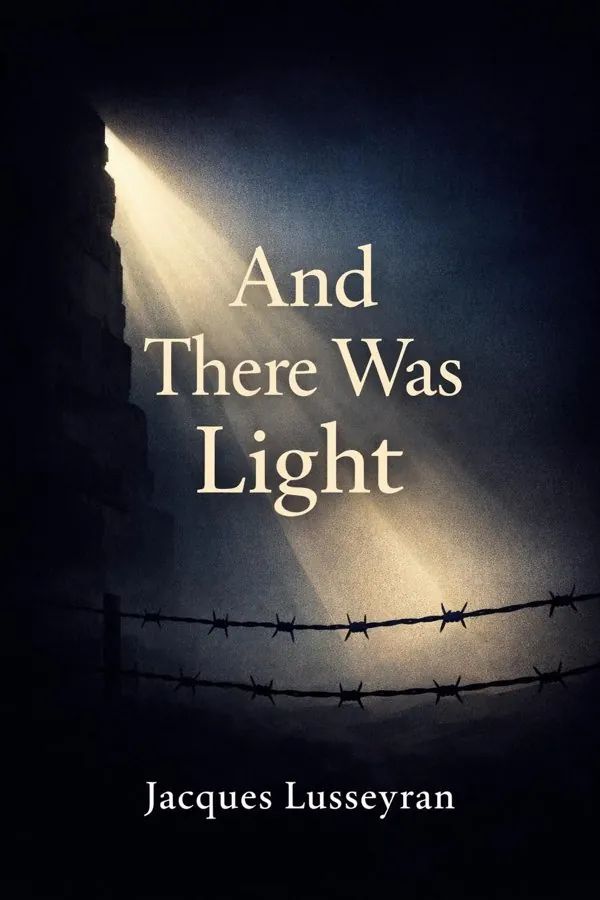
And There Was Light: Summary & Key Insights
 10 min6 chaptersAudio available
What Is And There Was Light About?
And There Was Light by Jacques Lusseyran is a biographies book spanning 6 pages. An autobiography by Jacques Lusseyran, a young Frenchman who became blind at the age of eight and discovered an inner light that guided him through the darkness of war and captivity. He recounts his involvement in the French Resistance during the Nazi occupation and his survival in Buchenwald concentration camp, offering a profound testimony of courage, faith, and spiritual perception.
This FizzRead summary covers all 6 key chapters of And There Was Light in approximately 10 minutes, distilling the most important ideas, arguments, and takeaways from Jacques Lusseyran's work. Also available as an audio summary and Key Quotes Podcast.
And There Was Light
An autobiography by Jacques Lusseyran, a young Frenchman who became blind at the age of eight and discovered an inner light that guided him through the darkness of war and captivity. He recounts his involvement in the French Resistance during the Nazi occupation and his survival in Buchenwald concentration camp, offering a profound testimony of courage, faith, and spiritual perception.
Who Should Read And There Was Light?
This book is perfect for anyone interested in biographies and looking to gain actionable insights in a short read. Whether you're a student, professional, or lifelong learner, the key ideas from And There Was Light by Jacques Lusseyran will help you think differently.
- ✓Readers who enjoy biographies and want practical takeaways
- ✓Professionals looking to apply new ideas to their work and life
- ✓Anyone who wants the core insights of And There Was Light in just 10 minutes
Want the full summary?
Get instant access to this book summary and 100K+ more with Fizz Moment.
Get Free SummaryAvailable on App Store • Free to download
Key Chapters
My story begins in Paris, where I was a lively boy surrounded by movement and color. The accident that took my sight was sudden—a fall in a classroom, a collision, a sharp piece of furniture. My parents were devastated, yet in those early days after blindness, I began to notice that life had only changed its doorway. The world was still there, but I had to learn to enter it differently.
Without sight, sound became dimension. The air itself seemed to carry presence. I could sense the weight of people nearby, their intent and mood like currents in the atmosphere. I realized that I could still receive—and perhaps even perceive more fully—because my attention was undivided. The more I attended, the more the world revealed itself. Soon I was no longer looking for light outside, for I felt it inside me. A golden radiance filled the space of awareness, like a living flame behind my forehead. It was not imagination. It was the world itself shining, responding to love.
Blindness taught me to expand perception beyond physical sight. When I approached friends or familiar rooms, my inner light changed—brightened, softened, sometimes dimmed. People often asked how I could recognize them; I said I could see their warmth, their rhythm, their sincerity. The eyes were not needed for this kind of vision.
This discovery shaped everything that came after. It gave me confidence that openness creates connection. It taught me that trust and receptivity are forms of sight. And it grounded me in the awareness that the world is luminous—not in spite of darkness but through it.
In the years leading to war, Paris was changing. The sound of tension was everywhere—arguments at cafés, radios filled with propaganda, neighbors anxious and uncertain. As I grew into adolescence, I watched my friends become divided by fear and political slogans. My blindness, paradoxically, freed me from illusion. I could not be deceived by appearances or uniforms; I sensed truth through atmosphere and tone.
When France fell under Nazi occupation, it was as though the outer world had gone blind. People stopped seeing one another, consumed by survival and suspicion. I knew that only an inner light could resist this shadow. Along with other young men, I formed a group called Volontaires de la Liberté—the Volunteers of Liberty. We were not soldiers; we were witnesses. We distributed underground newspapers, carried messages, and encouraged our countrymen to remember themselves as free beings.
Blindness became an advantage. My perception told me whom to trust. I could sense disloyalty as a dull heaviness, honesty as a clear radiance. My companions learned to listen when I said, 'This one brings light' or 'This one darkens the room.' These were not mystical judgments. They were the felt qualities of intention.
Through these years, the inner light taught me leadership not based on command but on communion. We learned that courage is born from seeing beyond outcomes. I was asked many times how I could fight in such a world, being blind. My answer remained the same: seeing with the heart opens doors that fear keeps closed.
+ 4 more chapters — available in the FizzRead app
All Chapters in And There Was Light
About the Author
Jacques Lusseyran (1924–1971) was a French writer and member of the Resistance. Blinded in childhood, he founded a resistance group during World War II and survived deportation to Buchenwald. After the war, he taught literature and philosophy in France and the United States.
Get This Summary in Your Preferred Format
Read or listen to the And There Was Light summary by Jacques Lusseyran anytime, anywhere. FizzRead offers multiple formats so you can learn on your terms — all free.
Available formats: App · Audio · PDF · EPUB — All included free with FizzRead
Download And There Was Light PDF and EPUB Summary
Key Quotes from And There Was Light
“My story begins in Paris, where I was a lively boy surrounded by movement and color.”
“In the years leading to war, Paris was changing.”
Frequently Asked Questions about And There Was Light
And There Was Light by Jacques Lusseyran is a biographies book that explores key ideas across 6 chapters. An autobiography by Jacques Lusseyran, a young Frenchman who became blind at the age of eight and discovered an inner light that guided him through the darkness of war and captivity. He recounts his involvement in the French Resistance during the Nazi occupation and his survival in Buchenwald concentration camp, offering a profound testimony of courage, faith, and spiritual perception.
You Might Also Like
An American Marriage
Tayari Jones
10 min
Benjamin Franklin: An American Life
Walter Isaacson
10 min
I Know Why The Caged Bird Sings
Maya Angelou
10 min
Long Walk to Freedom
Nelson Mandela
10 min
Persepolis
Marjane Satrapi
10 min
Surely You're Joking, Mr. Feynman!
Richard P. Feynman
10 minBrowse by Category
Ready to read And There Was Light?
Get the full summary and 100K+ more books with Fizz Moment.