
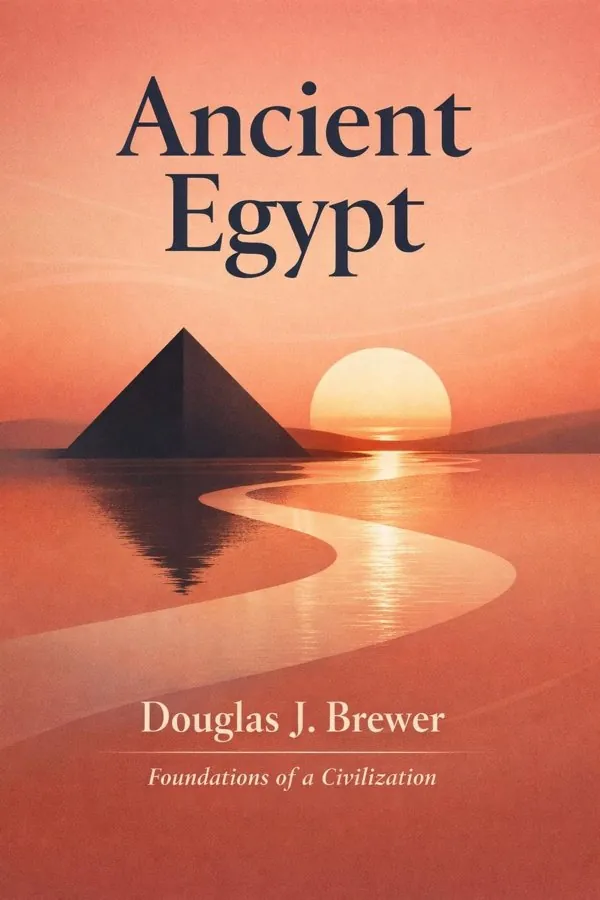
Ancient Egypt: Foundations of a Civilization: Summary & Key Insights
 10 min13 chaptersAudio available
What Is Ancient Egypt: Foundations of a Civilization About?
Ancient Egypt: Foundations of a Civilization by Douglas J. Brewer is a world_history book spanning 13 pages. Ancient Egypt: Foundations of a Civilization offers a comprehensive overview of Egyptian history from the earliest settlements along the Nile to the end of the pharaonic period. Brewer explores the social, political, and economic structures that shaped Egyptian civilization, emphasizing archaeological evidence and cultural development over three millennia.
This FizzRead summary covers all 13 key chapters of Ancient Egypt: Foundations of a Civilization in approximately 10 minutes, distilling the most important ideas, arguments, and takeaways from Douglas J. Brewer's work. Also available as an audio summary and Key Quotes Podcast.
Ancient Egypt: Foundations of a Civilization
Ancient Egypt: Foundations of a Civilization offers a comprehensive overview of Egyptian history from the earliest settlements along the Nile to the end of the pharaonic period. Brewer explores the social, political, and economic structures that shaped Egyptian civilization, emphasizing archaeological evidence and cultural development over three millennia.
Who Should Read Ancient Egypt: Foundations of a Civilization?
This book is perfect for anyone interested in world_history and looking to gain actionable insights in a short read. Whether you're a student, professional, or lifelong learner, the key ideas from Ancient Egypt: Foundations of a Civilization by Douglas J. Brewer will help you think differently.
- ✓Readers who enjoy world_history and want practical takeaways
- ✓Professionals looking to apply new ideas to their work and life
- ✓Anyone who wants the core insights of Ancient Egypt: Foundations of a Civilization in just 10 minutes
Want the full summary?
Get instant access to this book summary and 100K+ more with Fizz Moment.
Get Free SummaryAvailable on App Store • Free to download
Key Chapters
If there is one protagonist in Egypt’s story apart from its people, it is the Nile. Every feature of ancient life was anchored to this river — geographically, economically, and spiritually. Without the Nile’s annual inundation, there would have been no agriculture, no stable settlement, and no Egypt as we know it. Its predictable flood turned an inhospitable desert into a narrow ribbon of fertility. People learned to interpret the river not merely as a natural phenomenon but as a divine order, a symbol of regeneration and continuity.
Archaeological and environmental studies reveal that early Egyptian life was shaped by cycles of abundance and control. The rhythm of receding floodwaters determined the agricultural calendar, and with it emerged communal projects — channels, dikes, and storage systems — that required collective organization. These cooperative ventures laid the social groundwork for centralized authority. Even the geography of the Nile Valley itself, confined between deserts yet open along its course, fostered both unity and isolation. Settlement patterns show clusters of village communities dependent on one another for technological innovation and food exchange.
The desert was not merely a barrier but a protective shell. It provided building material, minerals, and a defense against invasion. Meanwhile, the valley’s narrowness created an almost linear civilization, one that imagined life and death as a journey between east and west — the sunrise and sunset mirrored in the geography of the living and the tombs of the dead. The physical world thus became a metaphorical framework for social and religious order. Egypt’s foundation, in this sense, was ecological long before it was political.
Before the rise of the pharaohs, Egypt was a mosaic of small, autonomous communities strung along the Nile. Excavations at sites such as Naqada, Hierakonpolis, and Merimda have given us vivid glimpses of these people — farmers, potters, and herders who slowly developed more complex social structures. Their artifacts tell us that by the fourth millennium BCE, Egypt was far from primitive. Pottery designs became sophisticated, trade networks extended to Nubia and the Near East, and symbols of status and ritual power began to appear in graves.
It was during this period that we first witness the formation of elite classes. Differences in grave goods and settlement architecture suggest a shift toward hereditary leadership and control over surplus production. Power, wealth, and religion became entwined. Ceremonial palettes and mace heads show scenes of conquest and ritual dominance — the first visual language of authority that would later crystallize into kingship. Yet the roots of this transformation are everyday ones: continued successes in food production, defense, and trade created the need for coordination, and with coordination came hierarchy.
For me as an archaeologist, the fascination lies in watching abstraction turn into institution. Symbols of control — a falcon, a crown, a ritual offering — emerge decades, even centuries, before there was any formal concept of a 'state.' The predynastic world therefore represents Egypt in incubation, where the seeds of kingship and national identity were being sown.
+ 11 more chapters — available in the FizzRead app
All Chapters in Ancient Egypt: Foundations of a Civilization
About the Author
Douglas J. Brewer is an American Egyptologist and archaeologist known for his research on ancient Egyptian society and material culture. He has served as curator and professor at the University of Illinois, contributing extensively to the study of early Egyptian civilization.
Get This Summary in Your Preferred Format
Read or listen to the Ancient Egypt: Foundations of a Civilization summary by Douglas J. Brewer anytime, anywhere. FizzRead offers multiple formats so you can learn on your terms — all free.
Available formats: App · Audio · PDF · EPUB — All included free with FizzRead
Download Ancient Egypt: Foundations of a Civilization PDF and EPUB Summary
Key Quotes from Ancient Egypt: Foundations of a Civilization
“If there is one protagonist in Egypt’s story apart from its people, it is the Nile.”
“Before the rise of the pharaohs, Egypt was a mosaic of small, autonomous communities strung along the Nile.”
Frequently Asked Questions about Ancient Egypt: Foundations of a Civilization
Ancient Egypt: Foundations of a Civilization by Douglas J. Brewer is a world_history book that explores key ideas across 13 chapters. Ancient Egypt: Foundations of a Civilization offers a comprehensive overview of Egyptian history from the earliest settlements along the Nile to the end of the pharaonic period. Brewer explores the social, political, and economic structures that shaped Egyptian civilization, emphasizing archaeological evidence and cultural development over three millennia.
You Might Also Like
The Age of Capital
Eric Hobsbawm
10 min
The Gulag Archipelago
Aleksandr Solzhenitsyn
10 min
Jerusalem: The Biography
Simon Sebag Montefiore
10 min
The Anglo-Saxons
James Campbell
10 min
The Boer War
Thomas Pakenham
10 min
The Industrial Revolutionaries: The Making of the Modern World 1776–1914
Gavin Weightman
10 minBrowse by Category
Ready to read Ancient Egypt: Foundations of a Civilization?
Get the full summary and 100K+ more books with Fizz Moment.