
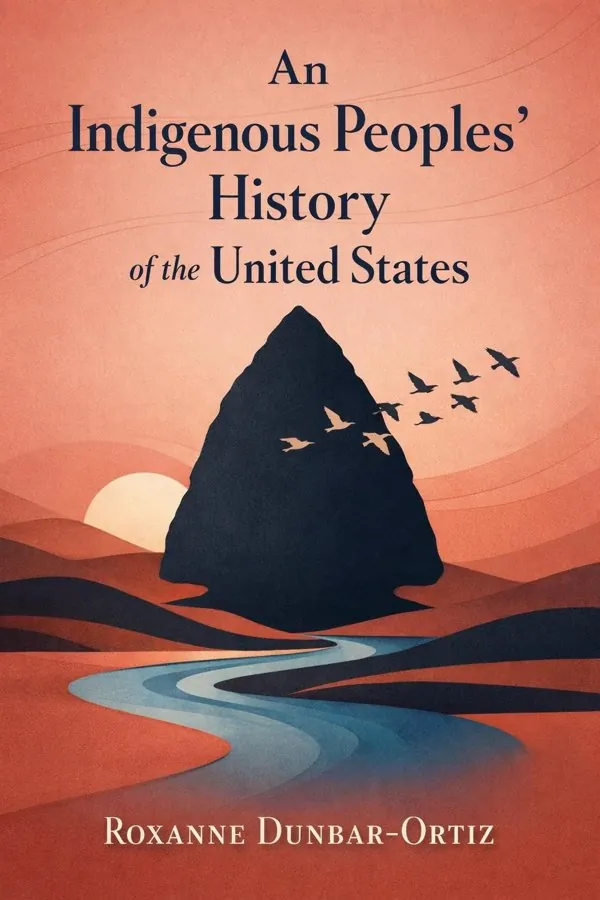
An Indigenous Peoples' History of the United States: Summary & Key Insights
 10 min9 chaptersAudio available
What Is An Indigenous Peoples' History of the United States About?
An Indigenous Peoples' History of the United States by Roxanne Dunbar-Ortiz is a world_history book spanning 9 pages. Este libro ofrece una historia de los Estados Unidos contada desde la perspectiva de los pueblos indígenas. Roxanne Dunbar-Ortiz examina más de cuatro siglos de resistencia, resiliencia y lucha de los pueblos nativos contra la colonización y las políticas genocidas, desafiando los mitos fundacionales de la nación estadounidense y revelando cómo el colonialismo de asentamiento moldeó su identidad nacional.
This FizzRead summary covers all 9 key chapters of An Indigenous Peoples' History of the United States in approximately 10 minutes, distilling the most important ideas, arguments, and takeaways from Roxanne Dunbar-Ortiz's work. Also available as an audio summary and Key Quotes Podcast.
An Indigenous Peoples' History of the United States
Este libro ofrece una historia de los Estados Unidos contada desde la perspectiva de los pueblos indígenas. Roxanne Dunbar-Ortiz examina más de cuatro siglos de resistencia, resiliencia y lucha de los pueblos nativos contra la colonización y las políticas genocidas, desafiando los mitos fundacionales de la nación estadounidense y revelando cómo el colonialismo de asentamiento moldeó su identidad nacional.
Who Should Read An Indigenous Peoples' History of the United States?
This book is perfect for anyone interested in world_history and looking to gain actionable insights in a short read. Whether you're a student, professional, or lifelong learner, the key ideas from An Indigenous Peoples' History of the United States by Roxanne Dunbar-Ortiz will help you think differently.
- ✓Readers who enjoy world_history and want practical takeaways
- ✓Professionals looking to apply new ideas to their work and life
- ✓Anyone who wants the core insights of An Indigenous Peoples' History of the United States in just 10 minutes
Want the full summary?
Get instant access to this book summary and 100K+ more with Fizz Moment.
Get Free SummaryAvailable on App Store • Free to download
Key Chapters
When Europeans arrived in the Americas, they did not encounter a wilderness; they entered onto lands meticulously governed, cultivated, and inhabited by diverse nations—each with its own laws, languages, and spiritual systems. The colonial venture was never benign exploration. It was, from its inception, a military and theological campaign. The Spaniards brought the Doctrine of Discovery, sanctioned by papal decree, asserting that Christian nations held the divine right to claim lands and peoples not under Christian rule. The English adapted this logic into their own imperial practice. In the English colonies that became the United States, the settlers came not as guests but as conquerors.
The early colonial period was defined by two parallel processes: invasion and resistance. From New England to the Southwest, Indigenous nations resisted encroachment through diplomacy, alliances, and war. The first century of colonization in North America was soaked in blood—not only of Indigenous people but also of settlers who found themselves in perpetual conflict on stolen land. The myth of peaceful settlement obscures this reality. Every colony depended on the taking of Indigenous territory by force, justified by religious and racial ideology. Settler colonialism differs from other forms of imperialism because it seeks to eliminate Indigenous people rather than simply exploit them. Whether through massacre, forced displacement, or disease, the goal remained the same: clear the land for European possession.
But even in the midst of catastrophic loss, Indigenous nations preserved their collective identities. Diplomacy among tribes, intermarriage, and resistance movements kept alive the principle of sovereignty. The Powhatan Confederacy, the Wampanoag, and countless others understood the threat clearly—they were not facing temporary rulers but permanent occupiers. European settlement spread like a slow wildfire, but Indigenous firebreaks of resistance continued to shape the landscape of power.
As a historian, I emphasize that the narrative of encounter must be replaced with the narrative of invasion. The framing matters. “Encounter” suggests negotiation between equals; “invasion” acknowledges domination. The early colonial period set the template for every U.S. policy that would follow: criminalize Indigenous independence, justify violence as defense, and rename conquest as civilization.
The colonies that became the United States were built on a foundation of land theft. What distinguished this emerging state from its European predecessors was its dedication to settler expansion—what I call the logic of elimination. Land seizure was not an accidental byproduct of growth; it was the organizing principle of society and economy. The colonies developed a political identity rooted in ownership and dispossession. Property rights replaced diplomacy as the measure of legitimacy.
By the late 18th century, settler colonies envisioned themselves as independent republics not only in relation to Britain but also to the Indigenous nations surrounding them. When the United States declared independence, the revolutionaries presented their rebellion as a struggle for liberty—but liberty for whom? The Declaration of Independence itself accuses King George of inciting “merciless Indian savages,” revealing that the revolution was simultaneously a war of territorial expansion.
The formation of the United States as a settler state institutionalized the frontier myth: the idea that freedom came through conquest. This notion became central to American exceptionalism. Land became a sacred entitlement; conquest, a duty. This ideology shaped every branch of government. From Congress’s appropriation of funds for militias attacking Indigenous communities to judicial decisions that defined Indigenous nations as “domestic dependent nations,” settler colonial logic permeated governance.
The United States was not born as a democracy inclusive of all but as a colonial project designed to perpetuate white supremacy and control territory. The “frontier” was not a natural phenomenon but a manufactured process of invasion. This is what I mean when I argue that the United States perfected colonialism—it internalized it as the essence of national character.
+ 7 more chapters — available in the FizzRead app
All Chapters in An Indigenous Peoples' History of the United States
About the Author
Roxanne Dunbar-Ortiz es una historiadora y activista estadounidense nacida en 1938. Conocida por su trabajo sobre historia indígena y derechos humanos, ha sido profesora universitaria y autora de varios libros sobre política, historia y movimientos sociales en América.
Get This Summary in Your Preferred Format
Read or listen to the An Indigenous Peoples' History of the United States summary by Roxanne Dunbar-Ortiz anytime, anywhere. FizzRead offers multiple formats so you can learn on your terms — all free.
Available formats: App · Audio · PDF · EPUB — All included free with FizzRead
Download An Indigenous Peoples' History of the United States PDF and EPUB Summary
Key Quotes from An Indigenous Peoples' History of the United States
“The colonial venture was never benign exploration.”
“The colonies that became the United States were built on a foundation of land theft.”
Frequently Asked Questions about An Indigenous Peoples' History of the United States
An Indigenous Peoples' History of the United States by Roxanne Dunbar-Ortiz is a world_history book that explores key ideas across 9 chapters. Este libro ofrece una historia de los Estados Unidos contada desde la perspectiva de los pueblos indígenas. Roxanne Dunbar-Ortiz examina más de cuatro siglos de resistencia, resiliencia y lucha de los pueblos nativos contra la colonización y las políticas genocidas, desafiando los mitos fundacionales de la nación estadounidense y revelando cómo el colonialismo de asentamiento moldeó su identidad nacional.
You Might Also Like
The Age of Capital
Eric Hobsbawm
10 min
The Gulag Archipelago
Aleksandr Solzhenitsyn
10 min
Jerusalem: The Biography
Simon Sebag Montefiore
10 min
The Anglo-Saxons
James Campbell
10 min
The Boer War
Thomas Pakenham
10 min
The Industrial Revolutionaries: The Making of the Modern World 1776–1914
Gavin Weightman
10 minBrowse by Category
Ready to read An Indigenous Peoples' History of the United States?
Get the full summary and 100K+ more books with Fizz Moment.