
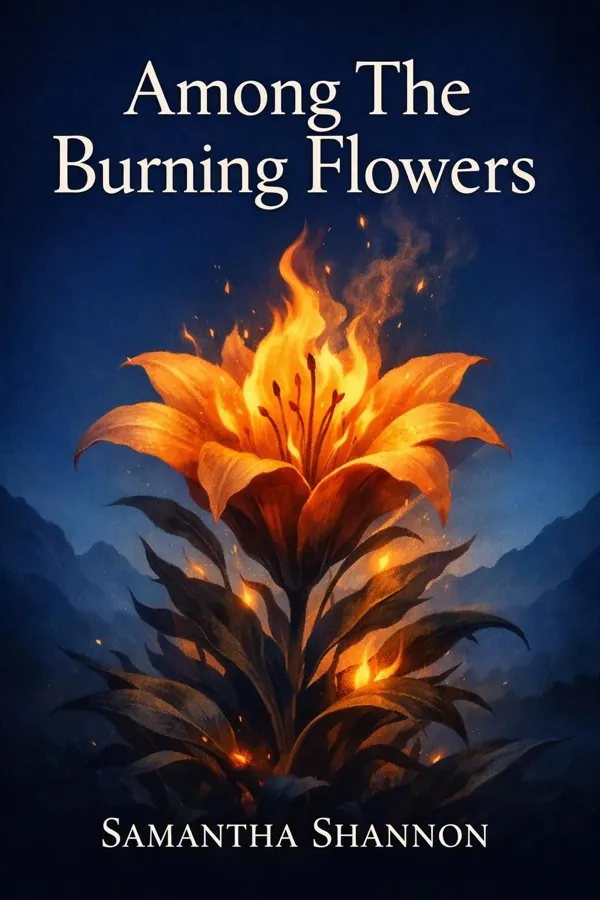
Among The Burning Flowers: Summary & Key Insights
 10 min9 chaptersAudio available
Key Takeaways from Among The Burning Flowers
This matters because the strongest fantasy does not merely add new locations or characters; it reveals what was always simmering beneath the visible order.
The most enduring fantasy asks not who holds power, but what power does to truth, memory, and the self.
A great fantasy conflict becomes memorable when it is not merely political, but personal.
In sophisticated fantasy, world-building is never decoration; it is the visible shape of a civilization’s values.
Symbols matter most when they carry contradiction, and the image of “burning flowers” is powerful precisely because it joins tenderness with destruction.
What Is Among The Burning Flowers About?
Among The Burning Flowers by Samantha Shannon is a scifi_fantasy book spanning 5 pages. Among The Burning Flowers is a fantasy work set in the expansive universe Samantha Shannon has built across her celebrated epic fiction, a world where political power, mythic inheritance, religious memory, and personal identity are never separate forces. Though tied to the wider setting that readers know from The Priory of the Orange Tree, this story stands on its own as an exploration of what happens when beauty and destruction grow side by side. The title itself suggests one of Shannon’s central fascinations: that the most fragile things—belief, love, loyalty, selfhood—often survive in the fiercest historical fires. At its core, the book promises a richly imagined struggle over who gets to shape the future: rulers, storytellers, priests, rebels, or the haunted people caught between them. That question matters because Shannon’s fiction consistently treats fantasy not as escapism, but as a lens for examining empire, gender, memory, and moral courage. As one of contemporary fantasy’s most accomplished world-builders, she brings literary depth, emotional complexity, and political intelligence to every page, making this a title of real interest for readers of ambitious modern fantasy.
This FizzRead summary covers all 9 key chapters of Among The Burning Flowers in approximately 10 minutes, distilling the most important ideas, arguments, and takeaways from Samantha Shannon's work. Also available as an audio summary and Key Quotes Podcast.
Among The Burning Flowers
Among The Burning Flowers is a fantasy work set in the expansive universe Samantha Shannon has built across her celebrated epic fiction, a world where political power, mythic inheritance, religious memory, and personal identity are never separate forces. Though tied to the wider setting that readers know from The Priory of the Orange Tree, this story stands on its own as an exploration of what happens when beauty and destruction grow side by side. The title itself suggests one of Shannon’s central fascinations: that the most fragile things—belief, love, loyalty, selfhood—often survive in the fiercest historical fires. At its core, the book promises a richly imagined struggle over who gets to shape the future: rulers, storytellers, priests, rebels, or the haunted people caught between them. That question matters because Shannon’s fiction consistently treats fantasy not as escapism, but as a lens for examining empire, gender, memory, and moral courage. As one of contemporary fantasy’s most accomplished world-builders, she brings literary depth, emotional complexity, and political intelligence to every page, making this a title of real interest for readers of ambitious modern fantasy.
Who Should Read Among The Burning Flowers?
This book is perfect for anyone interested in scifi_fantasy and looking to gain actionable insights in a short read. Whether you're a student, professional, or lifelong learner, the key ideas from Among The Burning Flowers by Samantha Shannon will help you think differently.
- ✓Readers who enjoy scifi_fantasy and want practical takeaways
- ✓Professionals looking to apply new ideas to their work and life
- ✓Anyone who wants the core insights of Among The Burning Flowers in just 10 minutes
Want the full summary?
Get instant access to this book summary and 100K+ more with Fizz Moment.
Get Free SummaryAvailable on App Store • Free to download
Key Chapters
Every fantasy world expands from a deeper artistic impulse, and Among The Burning Flowers appears to grow from Samantha Shannon’s long-running interest in how myth shapes political reality. Rather than inventing a secondary-world story for spectacle alone, Shannon typically builds narratives that emerge from pressure points already present in her universe: old loyalties, unresolved histories, sacred institutions, and the hidden cost of power. This matters because the strongest fantasy does not merely add new locations or characters; it reveals what was always simmering beneath the visible order.
Seen in that light, this book’s creative origin likely lies in Shannon’s desire to revisit familiar terrain from a fresh angle. In works like The Priory of the Orange Tree, she demonstrated a gift for combining court politics, religious tension, dragon lore, and intimate emotional stakes. A story such as Among The Burning Flowers can therefore be understood as part of a broader artistic project: to show that even in legendary worlds, history is unfinished. The “burning flowers” image suggests exactly that tension between splendor and ruin, fertility and destruction, hope and violence.
For readers, this origin point offers a useful way to approach the book. Instead of expecting only a side story or companion text, it helps to read it as an act of enlargement—one that deepens the moral architecture of Shannon’s world. In practical terms, pay attention to recurring symbols, inherited myths, and contested versions of the past. These are often the clues to what the story is really doing beneath the plot.
Actionable takeaway: Read the novel with one key question in mind—what buried history or unresolved belief is this story trying to bring to the surface?
The most enduring fantasy asks not who holds power, but what power does to truth, memory, and the self. Among The Burning Flowers appears built around that exact insight. In Shannon’s fiction, authority is rarely simple. Thrones, temples, bloodlines, prophecies, and military institutions all claim legitimacy, yet each carries distortions of its own. Power can preserve order, but it can also fossilize injustice. Myth can inspire courage, yet it can also become a tool of manipulation. Identity can ground a person, yet it can fracture under social expectation.
These three themes—power, myth, and identity—work together. A ruler may justify violence through sacred tradition. A religious order may define belonging so narrowly that individuals must betray themselves to survive. A character raised on one version of history may discover that their own role in the world has been shaped by omission and propaganda. Shannon excels at dramatizing these tensions through personal choices rather than abstract lectures, which is why her stories feel emotionally immediate even when their scale is epic.
This thematic structure has practical relevance beyond fantasy. In ordinary life, institutions also tell stories about who matters, what is honorable, and what must be protected. Readers can use the novel as a mirror for examining how identities are formed by family, culture, nation, and inherited narrative. Which stories make us brave? Which stories make us obedient? Which ones have outlived their truth?
Actionable takeaway: As you read, track one myth or public belief in the story and ask how it shapes individual identity—then reflect on a comparable belief in your own world.
A great fantasy conflict becomes memorable when it is not merely political, but personal. One of the most compelling expectations for Among The Burning Flowers is that its characters will be forced to choose between the roles assigned to them and the lives they actually want to live. That tension—between duty and desire—is a defining strength of Samantha Shannon’s storytelling. Her protagonists are rarely free agents. They are heirs, servants, guardians, outcasts, diplomats, believers, or survivors, and each social role comes with obligations that may clash with conscience.
This creates narrative depth because the central question becomes not simply “What will happen?” but “What will this person sacrifice to remain whole?” A character may be loyal to a crown but increasingly horrified by the crown’s methods. Another may long for intimacy in a culture that prizes ceremony over honesty. Someone raised to revere a tradition may discover that preserving it requires complicity in harm. These are not generic fantasy dilemmas; they are human ones, sharpened by the high stakes of a mythic setting.
For readers, this is where the emotional power of the novel is likely to reside. Pay attention not only to external actions but to hesitation, silence, ritual, and divided loyalty. Shannon often reveals character through what people cannot safely say. In practical terms, such reading helps illuminate how systems constrain moral agency in both fiction and life. Many people know the feeling of being praised for fulfilling a role while privately questioning its cost.
Actionable takeaway: Choose one major character and map their obligations versus their desires; this simple comparison will often reveal the story’s deepest conflict.
In sophisticated fantasy, world-building is never decoration; it is the visible shape of a civilization’s values. Among The Burning Flowers is likely to continue Shannon’s talent for creating settings where geography, religion, court culture, and mythic history all exert pressure on human choice. The result is a world that feels alive not because it has many details, but because its details matter morally. A sanctuary means something different in a society ruled by fear. A border means something different in a land divided by ancient trauma. A ceremonial flower can become a symbol of devotion, mourning, resistance, or erasure depending on who controls its meaning.
This is why Shannon’s settings resonate so strongly. They are structured by beliefs. Architecture reflects hierarchy. Ritual reveals ideology. Legends preserve collective memory while concealing historical violence. Even natural elements—forests, seas, dragons, fire—often carry political and spiritual significance. That makes the world readable in the same way a culture is readable: through its symbols, exclusions, and habits.
Readers can apply this approach beyond the novel. When evaluating any fictional world, ask not only “What exists here?” but “Who benefits from how this world is organized?” That question turns fantasy into social analysis. It also increases enjoyment, because patterns emerge: who gets educated, who is silenced, who travels freely, who is sacred, who is expendable.
Actionable takeaway: While reading, note three recurring details—such as a ritual, emblem, or law—and ask what each one reveals about the society’s moral priorities.
Symbols matter most when they carry contradiction, and the image of “burning flowers” is powerful precisely because it joins tenderness with destruction. Samantha Shannon often writes in ways that make imagery do thematic work, and this title suggests a story in which beauty is not separate from danger. Flowers usually evoke life, memory, ceremony, growth, and transience. Fire evokes purification, war, revelation, punishment, transformation, and uncontrollable change. Together they imply a world where what is most precious is also most vulnerable—or where destruction becomes the condition for renewal.
This symbolic logic can guide interpretation of the whole novel. A court adorned with blossoms may conceal political rot. A garden may become a site of remembrance or rebellion. Fire may represent both tyranny and liberation depending on who wields it. Characters themselves may embody this duality: gentle yet formidable, cultivated yet furious, loyal yet combustible. Such imagery allows the novel to communicate emotional and philosophical stakes without stating them directly.
There is also a practical reading lesson here. Strong fantasy often rewards symbolic attention as much as plot attention. If a flower, color, season, or natural force appears repeatedly, it is rarely accidental. Readers who follow these patterns often discover the book’s deeper argument earlier and more clearly. In everyday life too, symbols shape public feeling—flags, monuments, uniforms, memorials, ceremonies—so fiction trains us to read power through image.
Actionable takeaway: Keep a short note of repeated symbols in the story and write one sentence on how each changes meaning over time; that will sharpen your understanding of the novel’s emotional arc.
Civilizations fracture not only over resources or territory, but over whose version of reality becomes official. One of the richest dimensions likely present in Among The Burning Flowers is the conflict between political authority and sacred narrative. Shannon’s fantasy worlds are often marked by rival traditions, partial histories, and institutions that present themselves as guardians of order while concealing selective truths. In such settings, faith is never merely private belief; it is entangled with legitimacy, law, inheritance, and social control.
This creates a compelling kind of drama because characters must navigate not just danger, but interpretation. If prophecies conflict, which one is authentic? If a dynasty claims divine sanction, who benefits from that belief? If a holy story contains omissions, what happens when someone uncovers the missing parts? These questions turn the novel into more than an adventure. They make it a study of how power survives by managing what people think the past means.
Readers can take this as an invitation to resist simplistic moral categories. A religious institution may preserve wisdom and still be implicated in oppression. A rebel movement may expose lies and still create new dogmas. The most interesting stories do not ask us to reject belief altogether; they ask us to distinguish living truth from institutional self-protection.
That insight has practical application in modern life, where political and cultural debates often revolve around stories of national purpose, moral legitimacy, and historical memory. The novel’s value lies partly in making those mechanisms visible through fantasy.
Actionable takeaway: Whenever two factions disagree in the story, identify the underlying story each one tells about the past; that is often the real source of conflict.
Epic fantasy becomes more convincing when it treats women not as symbols within history, but as makers of history. Samantha Shannon has built her reputation in part on writing female characters with political intelligence, emotional depth, and differing forms of strength. Among The Burning Flowers is therefore likely to continue a vital aspect of her work: showing women as strategists, believers, fighters, archivists, rulers, and dissenters whose decisions shape the world’s future.
This matters because agency is more complex than battlefield prowess. A character may wield authority through diplomacy, knowledge, ritual influence, or the refusal to submit to a narrative imposed upon her. Another may be constrained by marriage, rank, religion, or tradition yet still alter events through timing, alliances, and moral clarity. Shannon’s stories often recognize that power is relational and unevenly distributed, which makes victories feel earned rather than symbolic.
For readers, this opens a useful interpretive frame. Instead of asking which woman in the story is “strongest,” ask how each character negotiates the structures around her. Who bends tradition from within? Who breaks it outright? Who pays the highest price for autonomy? This produces a more nuanced understanding of both gender and power.
Outside fiction, the same lesson applies. People exercise agency under constraint all the time, and their forms of resistance are not always loud or visible. The novel can therefore deepen a reader’s sensitivity to strategic courage, especially in systems designed to limit it.
Actionable takeaway: Track how at least two female characters pursue influence differently; comparing their methods will reveal the novel’s broader vision of power and resistance.
Large-scale fantasy endures when the fate of kingdoms is anchored in the texture of individual feeling. Among The Burning Flowers is likely to balance sweeping stakes with intimate emotional relationships, one of Samantha Shannon’s signature strengths. Battles, dynastic tensions, and mythic threats may drive the plot, but what gives such events meaning is how they alter trust, love, grief, loyalty, and self-understanding. The fall of a city matters more when it breaks a promise. A political alliance matters more when it requires emotional concealment. A revelation about history matters more when it changes how one person sees another.
Shannon often understands that intimacy is itself political. Who can love openly? Who must hide? Who can grieve in public? Who is expected to suppress feeling for duty’s sake? These questions reveal social order just as clearly as laws and armies do. They also keep the fantasy human. Readers are not moved by scale alone; they are moved by vulnerability inside scale.
Practically, this means the novel should not be read only for plot mechanics. Emotional beats—hesitation before confession, tenderness in dangerous spaces, resentment buried under ceremony—often carry the real force of the narrative. Readers who attend to these quieter moments usually come away with a fuller grasp of what the story is defending or mourning.
In life as in fiction, systems become real through their effect on relationships. The novel’s emotional architecture can therefore help readers see how public conflict enters private experience.
Actionable takeaway: After each major plot turn, ask how it changes a key relationship; this habit will keep you connected to the story’s emotional core.
Fantasy feels urgent when it illuminates contemporary anxieties without collapsing into allegory. Among The Burning Flowers matters because its likely concerns—identity under pressure, contested history, institutional power, ecological or civilizational fragility, and the search for belonging—speak directly to modern readers. Samantha Shannon’s work often shows that societies are held together by stories as much as by armies or laws. When those stories fail, people do not simply lose certainty; they lose orientation. That makes fantasy a powerful medium for asking how communities survive periods of upheaval.
The image of burning flowers resonates especially strongly in a time marked by crisis and transformation. It evokes worlds in which beauty persists under threat, but also worlds where cherished traditions may themselves be combustible. Readers today live amid rapid change, ideological conflict, and renewed debates over identity, memory, and legitimacy. A novel that stages these issues in a mythic register can provide both emotional distance and moral clarity.
This relevance is not only thematic. Shannon’s popularity also reflects a broader shift in fantasy toward inclusiveness, psychological richness, and political sophistication. Readers now expect speculative fiction to deliver not just wonder, but depth. Among The Burning Flowers fits that expectation by promising a story that is sensuous, intelligent, and ethically engaged.
The practical lesson is simple: read fantasy not as escape from reality, but as a rehearsal space for thinking through reality’s hardest questions. That is where books like this become most valuable.
Actionable takeaway: When you finish the novel, identify one conflict from the story that echoes a current social or personal issue; use that parallel to deepen your reflection on both.
All Chapters in Among The Burning Flowers
About the Author
Samantha Shannon is a British novelist renowned for her ambitious fantasy and speculative fiction. Born in London in 1991, she studied English Language and Literature at St Anne’s College, Oxford, where she developed the literary foundations that would later shape her richly textured storytelling. She first gained major attention with The Bone Season series, a dystopian fantasy saga that established her as a bold new voice in the genre. She went on to achieve wider acclaim with The Priory of the Orange Tree and A Day of Fallen Night, works celebrated for their expansive world-building, political complexity, and powerful female characters. Shannon’s fiction often explores myth, power, identity, and institutional belief, blending epic scope with emotional precision. She is widely regarded as one of the defining fantasy authors of her generation.
Get This Summary in Your Preferred Format
Read or listen to the Among The Burning Flowers summary by Samantha Shannon anytime, anywhere. FizzRead offers multiple formats so you can learn on your terms — all free.
Available formats: App · Audio · PDF · EPUB — All included free with FizzRead
Download Among The Burning Flowers PDF and EPUB Summary
Key Quotes from Among The Burning Flowers
“Every fantasy world expands from a deeper artistic impulse, and Among The Burning Flowers appears to grow from Samantha Shannon’s long-running interest in how myth shapes political reality.”
“The most enduring fantasy asks not who holds power, but what power does to truth, memory, and the self.”
“A great fantasy conflict becomes memorable when it is not merely political, but personal.”
“In sophisticated fantasy, world-building is never decoration; it is the visible shape of a civilization’s values.”
“Symbols matter most when they carry contradiction, and the image of “burning flowers” is powerful precisely because it joins tenderness with destruction.”
Frequently Asked Questions about Among The Burning Flowers
Among The Burning Flowers by Samantha Shannon is a scifi_fantasy book that explores key ideas across 9 chapters. Among The Burning Flowers is a fantasy work set in the expansive universe Samantha Shannon has built across her celebrated epic fiction, a world where political power, mythic inheritance, religious memory, and personal identity are never separate forces. Though tied to the wider setting that readers know from The Priory of the Orange Tree, this story stands on its own as an exploration of what happens when beauty and destruction grow side by side. The title itself suggests one of Shannon’s central fascinations: that the most fragile things—belief, love, loyalty, selfhood—often survive in the fiercest historical fires. At its core, the book promises a richly imagined struggle over who gets to shape the future: rulers, storytellers, priests, rebels, or the haunted people caught between them. That question matters because Shannon’s fiction consistently treats fantasy not as escapism, but as a lens for examining empire, gender, memory, and moral courage. As one of contemporary fantasy’s most accomplished world-builders, she brings literary depth, emotional complexity, and political intelligence to every page, making this a title of real interest for readers of ambitious modern fantasy.
You Might Also Like
Red Rising
Pierce Brown
10 min
Stranger in a Strange Land
Robert A. Heinlein
10 min
AI Valley
Chen Qiufan
10 min
Bloodchild
Octavia E. Butler
10 min
Do Androids Dream of Electric Sheep?
Philip K. Dick
10 min
Jujutsu Kaisen, Vol. 24
Gege Akutami
10 minBrowse by Category
Ready to read Among The Burning Flowers?
Get the full summary and 100K+ more books with Fizz Moment.