
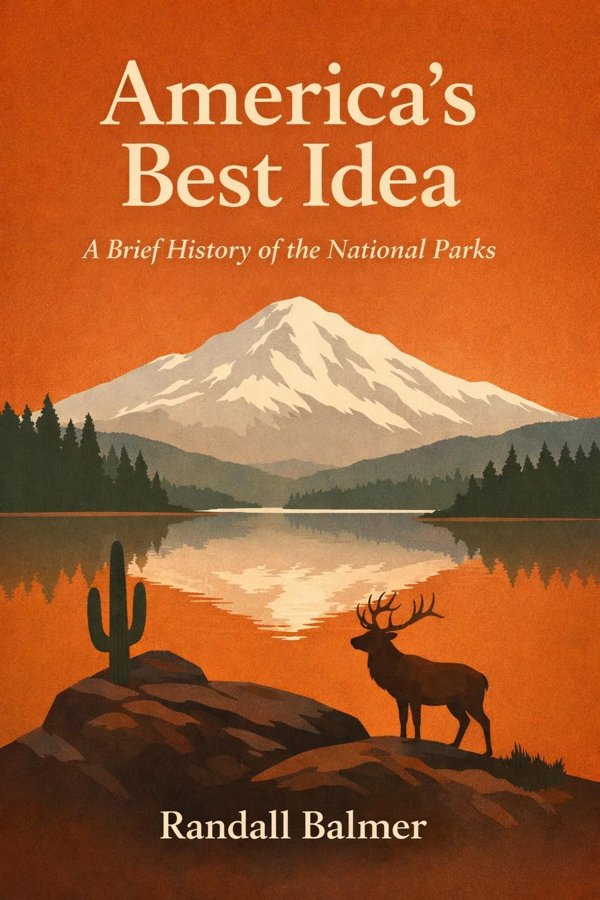
America's Best Idea: A Brief History of the National Parks: Summary & Key Insights
 10 min9 chaptersAudio available
What Is America's Best Idea: A Brief History of the National Parks About?
America's Best Idea: A Brief History of the National Parks by Randall Balmer is a world_history book spanning 9 pages. This book offers a concise historical overview of the United States National Park system, exploring its origins, development, and cultural significance. Randall Balmer traces how the idea of preserving natural landscapes for public enjoyment became a defining feature of American identity, highlighting key figures, policies, and moments that shaped the parks into a national treasure.
This FizzRead summary covers all 9 key chapters of America's Best Idea: A Brief History of the National Parks in approximately 10 minutes, distilling the most important ideas, arguments, and takeaways from Randall Balmer's work. Also available as an audio summary and Key Quotes Podcast.
America's Best Idea: A Brief History of the National Parks
This book offers a concise historical overview of the United States National Park system, exploring its origins, development, and cultural significance. Randall Balmer traces how the idea of preserving natural landscapes for public enjoyment became a defining feature of American identity, highlighting key figures, policies, and moments that shaped the parks into a national treasure.
Who Should Read America's Best Idea: A Brief History of the National Parks?
This book is perfect for anyone interested in world_history and looking to gain actionable insights in a short read. Whether you're a student, professional, or lifelong learner, the key ideas from America's Best Idea: A Brief History of the National Parks by Randall Balmer will help you think differently.
- ✓Readers who enjoy world_history and want practical takeaways
- ✓Professionals looking to apply new ideas to their work and life
- ✓Anyone who wants the core insights of America's Best Idea: A Brief History of the National Parks in just 10 minutes
Want the full summary?
Get instant access to this book summary and 100K+ more with Fizz Moment.
Get Free SummaryAvailable on App Store • Free to download
Key Chapters
The impulse toward preservation began in the midst of America’s rapid westward expansion, when economic opportunity often came at the expense of wilderness. By the mid-1800s, landscapes of astonishing beauty were being transformed or destroyed in service of industry. Yet even then, voices arose urging restraint. Some travelers and painters returning from the western frontier were so moved by what they saw that they began to speak of nature in moral and even spiritual terms.
This sentiment culminated in the establishment of Yellowstone in 1872, when the U.S. Congress declared that a vast region spanning Wyoming and Montana would be kept “for the benefit and enjoyment of the people.” In that moment, a new national ethic was born. No one had done such a thing before — not Europe with its private estates or royal hunting grounds, not the industrial nations that saw land only as resource. Yellowstone represented a promise that America would set aside part of its greatness, not to use or consume, but to cherish.
Behind this act was a complex blend of romantic idealism and practical politics. Railroad companies supported preservation for tourism; artists like Thomas Moran and photographers like William Henry Jackson supplied images of transcendence that captured the nation's imagination. The public began to see wilderness not as wasted space but as a sacred inheritance. The Yellowstone legislation quietly signaled a radical shift: land could be public, beauty could be democratic, and conservation could be patriotic.
To understand the soul of the national parks, we must listen to their prophets — thinkers like Henry David Thoreau and John Muir, who taught America to see nature as a source of moral truth. Thoreau, writing from Walden Pond, declared that wildness was the essential element of life and freedom. For him, nature was not an obstacle to be conquered but a teacher to be heeded. His writings helped to frame wilderness as a place of spiritual renewal, where democracy could cleanse itself from material excess.
John Muir transformed that philosophical impulse into activism. As the founder of the Sierra Club and tireless advocate for wilderness preservation, he saw the divine reflected in granite cliffs and soaring trees. His voice was instrumental in pushing national policy beyond mere admiration toward legal protection. Muir’s friendship with Theodore Roosevelt became one of the most consequential alliances in conservation history. He took Roosevelt to Yosemite, showing him firsthand the majesty of untouched land. That encounter convinced the president that beauty itself was worth defending in law.
What Thoreau and Muir accomplished was a moral reframing of nature in American consciousness. They made us see that wilderness was not empty — it was alive with value and meaning. Their work continues to resonate because it reminds us that the national parks are not just scenic backdrops; they are sanctuaries for the human spirit, places where democratic equality meets divine wonder.
+ 7 more chapters — available in the FizzRead app
All Chapters in America's Best Idea: A Brief History of the National Parks
About the Author
Randall Balmer is an American historian and author specializing in American religious history. He is a professor at Dartmouth College and has written extensively on religion and culture in the United States, including works on evangelicalism and the intersection of faith and politics.
Get This Summary in Your Preferred Format
Read or listen to the America's Best Idea: A Brief History of the National Parks summary by Randall Balmer anytime, anywhere. FizzRead offers multiple formats so you can learn on your terms — all free.
Available formats: App · Audio · PDF · EPUB — All included free with FizzRead
Download America's Best Idea: A Brief History of the National Parks PDF and EPUB Summary
Key Quotes from America's Best Idea: A Brief History of the National Parks
“The impulse toward preservation began in the midst of America’s rapid westward expansion, when economic opportunity often came at the expense of wilderness.”
“To understand the soul of the national parks, we must listen to their prophets — thinkers like Henry David Thoreau and John Muir, who taught America to see nature as a source of moral truth.”
Frequently Asked Questions about America's Best Idea: A Brief History of the National Parks
America's Best Idea: A Brief History of the National Parks by Randall Balmer is a world_history book that explores key ideas across 9 chapters. This book offers a concise historical overview of the United States National Park system, exploring its origins, development, and cultural significance. Randall Balmer traces how the idea of preserving natural landscapes for public enjoyment became a defining feature of American identity, highlighting key figures, policies, and moments that shaped the parks into a national treasure.
You Might Also Like
The Age of Capital
Eric Hobsbawm
10 min
The Gulag Archipelago
Aleksandr Solzhenitsyn
10 min
Jerusalem: The Biography
Simon Sebag Montefiore
10 min
The Anglo-Saxons
James Campbell
10 min
The Boer War
Thomas Pakenham
10 min
The Industrial Revolutionaries: The Making of the Modern World 1776–1914
Gavin Weightman
10 minBrowse by Category
Ready to read America's Best Idea: A Brief History of the National Parks?
Get the full summary and 100K+ more books with Fizz Moment.