
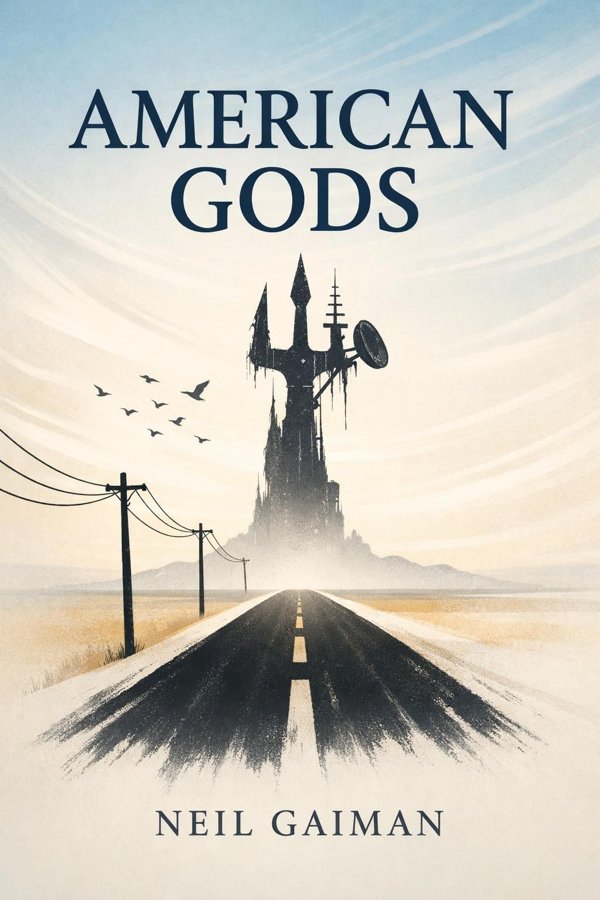
American Gods: Summary & Key Insights
by Neil Gaiman
 10 min9 chaptersAudio available
Key Takeaways from American Gods
A life can change not when freedom arrives, but when the world stops making sense.
Power in American Gods does not come from omnipotence; it comes from attention.
A nation is built not only by laws and borders, but by the stories people carry into it.
People may think they have become secular, but they have not stopped worshipping.
Stillness can reveal what spectacle hides.
What Is American Gods About?
American Gods by Neil Gaiman is a scifi_fantasy book spanning 5 pages. What people worship reveals what they fear, desire, and trust most. In American Gods, Neil Gaiman turns that idea into a vast, strange, and unforgettable road novel, following Shadow Moon, an ex-convict who is pulled into a hidden conflict between fading deities of old myth and powerful new gods born from media, technology, money, and modern obsession. As Shadow travels across the United States with the enigmatic Mr. Wednesday, the country becomes more than a setting: it becomes a spiritual battleground shaped by immigration, storytelling, loneliness, and belief itself. The novel matters because it uses fantasy to ask sharp cultural questions. What happens when traditions are uprooted and transplanted into a new land? What replaces ancient faith when people stop believing in old stories but devote themselves to screens, brands, and systems? Gaiman, one of contemporary fantasy’s most respected voices, brings deep knowledge of mythology, folklore, and symbolic storytelling to these questions. The result is a book that feels at once epic and intimate, philosophical and playful. American Gods is not just about gods at war. It is about America’s fractured identity, and about the stories people need in order to survive.
This FizzRead summary covers all 9 key chapters of American Gods in approximately 10 minutes, distilling the most important ideas, arguments, and takeaways from Neil Gaiman's work. Also available as an audio summary and Key Quotes Podcast.
American Gods
What people worship reveals what they fear, desire, and trust most. In American Gods, Neil Gaiman turns that idea into a vast, strange, and unforgettable road novel, following Shadow Moon, an ex-convict who is pulled into a hidden conflict between fading deities of old myth and powerful new gods born from media, technology, money, and modern obsession. As Shadow travels across the United States with the enigmatic Mr. Wednesday, the country becomes more than a setting: it becomes a spiritual battleground shaped by immigration, storytelling, loneliness, and belief itself.
The novel matters because it uses fantasy to ask sharp cultural questions. What happens when traditions are uprooted and transplanted into a new land? What replaces ancient faith when people stop believing in old stories but devote themselves to screens, brands, and systems? Gaiman, one of contemporary fantasy’s most respected voices, brings deep knowledge of mythology, folklore, and symbolic storytelling to these questions. The result is a book that feels at once epic and intimate, philosophical and playful. American Gods is not just about gods at war. It is about America’s fractured identity, and about the stories people need in order to survive.
Who Should Read American Gods?
This book is perfect for anyone interested in scifi_fantasy and looking to gain actionable insights in a short read. Whether you're a student, professional, or lifelong learner, the key ideas from American Gods by Neil Gaiman will help you think differently.
- ✓Readers who enjoy scifi_fantasy and want practical takeaways
- ✓Professionals looking to apply new ideas to their work and life
- ✓Anyone who wants the core insights of American Gods in just 10 minutes
Want the full summary?
Get instant access to this book summary and 100K+ more with Fizz Moment.
Get Free SummaryAvailable on App Store • Free to download
Key Chapters
A life can change not when freedom arrives, but when the world stops making sense. Shadow Moon begins American Gods as a man defined by endurance rather than ambition. He is about to leave prison, hoping for a modest, stable future with his wife, Laura. Instead, he learns she has died, and the life he planned vanishes before it can begin. In that emotional vacuum, he meets the mysterious Mr. Wednesday, a charismatic grifter who seems to know far too much about him and offers him a job that is part bodyguard work, part apprenticeship, and part initiation into a reality Shadow does not yet understand.
This opening matters because Gaiman makes Shadow an ideal entry point into the novel’s mythic world. Shadow is not a chosen hero in the traditional fantasy sense. He is quiet, skeptical, observant, and wounded. He does not seek transcendence; it finds him. Wednesday, meanwhile, represents the seduction of story itself: he is persuasive, theatrical, manipulative, and impossible to pin down. Their partnership sets the tone for the whole novel, where truth is always layered and trust is always unstable.
In practical terms, this dynamic mirrors how many people encounter life-changing ideas. We rarely begin from certainty. More often, we begin from loss, confusion, or transition. A new job, a move, a bereavement, or a personal crisis can expose us to worlds we never imagined. Shadow’s journey reminds us that uncertainty is often the doorway to deeper perception.
Actionable takeaway: Pay attention to the unsettling transitions in your life. They may be forcing you to see hidden structures, motives, and beliefs that routine once kept invisible.
Power in American Gods does not come from omnipotence; it comes from attention. One of the novel’s central ideas is that gods exist because people believe in them, remember them, fear them, or make offerings to them. The old gods crossed oceans with immigrants who carried fragments of ritual, prayer, and cultural memory into America. But once those communities assimilated, scattered, or forgot, the gods weakened. They did not disappear entirely. Instead, they became shabby, compromised, and diminished, surviving on scraps of devotion in a country that has little patience for inherited reverence.
This makes belief feel less like theology and more like energy allocation. What a society repeatedly notices becomes powerful. What it neglects fades. Gaiman translates that abstract truth into vivid characters: once-mighty gods become hustlers, laborers, prostitutes, undertakers, or drifters, trying to preserve relevance in a nation driven by novelty. Their fragility highlights a larger truth about culture: traditions do not die only because they are disproved. They die because they are ignored.
You can see this principle in ordinary life. Institutions, values, and even personal identities are strengthened by repeated investment. A family tradition survives because people keep enacting it. A friendship deepens because attention is consistently given. A skill grows because time is offered to it. Belief, in this sense, is not just doctrine. It is practice.
Actionable takeaway: Ask yourself where your attention goes every day. Whatever receives your repeated focus is becoming one of the ruling gods of your life, whether you intended it or not.
A nation is built not only by laws and borders, but by the stories people carry into it. The 'Coming to America' interludes are some of the most powerful parts of American Gods because they widen the novel’s scope beyond Shadow’s immediate plot. In these sections, Gaiman shows how different gods arrived in America with slaves, explorers, immigrants, and wanderers. They did not descend from heaven into a prepared kingdom. They came in cramped ships, terrified crossings, desperate migrations, and acts of violence. Their arrival stories are deeply tied to human suffering and hope.
These episodes matter because they reveal that America’s spiritual landscape is fragmented by design. There is no unified mythology here, only imported fragments trying to survive in a place that consumes and remakes everything. Each god arrives with a community and a worldview, yet over time both are altered by the American environment. Belief becomes thinner, stranger, more transactional. The sacred must adapt or decay.
The idea has clear real-world parallels. Immigrant cultures often preserve traditions intensely at first, then transform them across generations. Foods change. Languages erode. Rituals become symbolic rather than central. Yet even diluted traditions can carry profound meaning, especially when they connect people to memory and identity. The interludes show that cultural inheritance is never static. It is portable, vulnerable, and always under pressure.
Actionable takeaway: Investigate one tradition, ritual, or story from your own background. Understanding where it came from and how it changed can help you understand what parts of identity you are unconsciously preserving or losing.
People may think they have become secular, but they have not stopped worshipping. They have simply changed altars. One of Gaiman’s most brilliant moves in American Gods is to imagine new deities born from contemporary obsession: media, technology, highways, globalization, celebrity, and finance. These new gods are not ancient beings with mythic gravitas. They are sleek, self-aware, and deeply American in their hunger for constant engagement. They thrive because they are fed every hour by attention, dependence, and desire.
This idea transforms the novel from mythic adventure into cultural diagnosis. The conflict is not just old versus new in a simplistic sense. It is about competing modes of meaning. The old gods ask for memory, ritual, and continuity. The new gods thrive on speed, consumption, distraction, and networked power. They do not merely replace older beliefs; they reorganize reality so that older beliefs seem inconvenient or irrelevant.
The concept is strikingly applicable outside the novel. Think about how often people structure their day around notifications, market shifts, streaming feeds, traffic systems, and public image. These forces shape mood, time, identity, and community. They are not literally gods, but Gaiman’s metaphor works because they command devotion and sacrifice. People lose sleep, attention, privacy, relationships, and peace in service of them.
Actionable takeaway: Notice which modern systems you serve automatically. Try one small act of resistance, such as setting device-free time, interrupting compulsive scrolling, or choosing presence over constant connectivity.
Stillness can reveal what spectacle hides. The Lakeside section of American Gods shifts the novel’s rhythm dramatically. After the chaos of the road and the mounting tension of divine conflict, Shadow spends time in a small Midwestern town where life appears gentle, orderly, and almost timeless. On the surface, Lakeside offers refuge. Beneath that calm, however, Gaiman layers unease, secrecy, grief, and the persistence of death. Shadow’s dreams, visions, and encounters during this period deepen the novel’s spiritual atmosphere while also forcing him into a more reflective relationship with himself.
This section matters because it shows that mystery does not belong only to epic events. It also lives in ordinary communities, where rituals of normalcy can conceal profound violence or denial. Lakeside becomes a microcosm of America itself: charming, communal, and haunted. The town’s routines create belonging, but they also depend on selective blindness. Shadow, who has often drifted passively through events, becomes more attentive here. He watches, listens, and gradually understands that beneath surface comfort lies a bargain people rarely examine too closely.
In everyday life, many communities operate in similar ways. Workplaces, families, neighborhoods, and institutions often preserve stability by refusing to confront what is painful or ethically troubling. People prefer pleasant stories to disruptive truths. Lakeside asks what it costs to sustain innocence when innocence is built on silence.
Actionable takeaway: If a place or system seems unusually calm, ask what tensions, losses, or compromises might be hidden beneath that calm. Real understanding begins when you look past comforting surfaces.
Death does not end Laura Moon’s influence; it clarifies it. In lesser stories, Laura would remain a motivating loss, the dead wife whose memory propels the hero forward. Gaiman refuses that simplicity. Laura returns in altered form: physically dead, emotionally volatile, unexpectedly devoted, and impossible to reduce to either saint or villain. Her presence destabilizes Shadow’s grief because she is no longer an idealized absence. She is active, damaged, funny, and morally complicated.
Laura matters because she challenges the romantic myths that often underpin heroic narratives. Shadow loved her, but their marriage was not pure. She betrayed him. She also cares for him in ways that become brutally concrete after death. Gaiman uses her to show that love can survive disappointment without becoming sentimental. Loyalty can persist even when trust is broken. The result is a richer portrayal of intimacy, where people remain entangled not because they are perfect for one another, but because history, need, guilt, and feeling are messy and durable.
This idea has practical resonance. Many relationships, romantic or otherwise, are burdened by the false expectation that real affection should be clean, resolved, and morally simple. In truth, people often care deeply for those who have hurt them. Recognizing complexity does not mean accepting harm without boundaries. It means understanding that human attachment is not governed by tidy narratives.
Actionable takeaway: Re-examine one important relationship without flattening it into hero-and-villain terms. Honest clarity about contradictions can help you set better boundaries while preserving what is genuinely meaningful.
Some conflicts continue not because they are necessary, but because someone profits from keeping them alive. As American Gods moves toward its apparent climax, the looming war between old gods and new gods appears inevitable. Alliances form, resentments harden, and both sides prepare for a final confrontation. Yet one of the novel’s most important revelations is that the war is not what it seems. It has been engineered, staged, and manipulated by those who understand that conflict itself can be harvested as power.
This twist reframes the entire novel. The point is not simply that gods are battling for dominance. It is that spectacle, fear, tribalism, and grievance can be manufactured to feed larger systems. Gaiman suggests that many institutions of power do not need people to win; they need them to remain mobilized, emotionally invested, and unable to step outside the script. The war becomes a myth about myths: a story powerful enough to generate belief, sacrifice, and energy regardless of whether its stated purpose is genuine.
The lesson extends far beyond fantasy. Political media ecosystems, corporate rivalries, internet outrage cycles, and cultural polarization often function similarly. People are encouraged to choose sides quickly, react intensely, and remain engaged in endless combat, while the architects of the conflict benefit from the attention and division.
Actionable takeaway: When confronted with a seemingly unavoidable conflict, pause before choosing a side. Ask who benefits from escalation, what narrative is being sold, and whether the fight itself may be serving hidden interests.
A person is never only an individual; they are also a collection of stories they have accepted, rejected, and inherited. Shadow’s journey is not merely about surviving divine schemes. It is about discovering who he is when the ordinary structures of identity have been stripped away. Prisoner, husband, employee, bodyguard, mourner, outsider, son, believer, nonbeliever: these identities accumulate and dissolve over the course of the novel. Shadow becomes compelling precisely because he is difficult to categorize, and because he slowly learns that not knowing who you are can be a stage of transformation rather than a permanent weakness.
Gaiman treats identity as mythic in the broadest sense. People live inside narratives about race, nation, masculinity, destiny, work, grief, and belonging. These stories shape behavior long before they become conscious. Shadow’s task is not to adopt a glorious heroic role. It is to recognize which stories have been imposed on him and which truths he must claim for himself. His silence, often mistaken for emptiness, becomes a kind of observational strength. He is less enchanted by ready-made identities than many characters around him.
This is highly relevant in modern life, where people are constantly invited to define themselves through branding, affiliation, performance, or inherited labels. The novel suggests that maturity involves interrogating those labels rather than merely wearing them.
Actionable takeaway: Write down three identities you rely on most strongly. Then ask where each came from, who benefits from you holding it, and whether it still fits the person you are becoming.
Places are never just physical; they absorb memory, longing, violence, and imagination. One of the deepest achievements of American Gods is its portrait of America as spiritually unsettled terrain. Roadside attractions, motels, diners, small towns, city back alleys, and forgotten tourist traps become charged locations where belief gathers in odd, improvised forms. This is not a sacred geography built around cathedrals and formal pilgrimage. It is a sacred geography of billboards, empty roads, local legends, and accidental shrines.
Gaiman’s America is powerful because it feels both enchanted and emotionally accurate. The country is depicted as a place of movement, reinvention, amnesia, and loneliness. People arrive from somewhere else, invent themselves, discard pieces of the past, and seek meaning in temporary structures. That makes America fertile ground for new gods, but it also makes it a hard place for old traditions to survive intact. The landscape itself mirrors this instability: vast, commercial, beautiful, haunted, and difficult to unify into one story.
Readers can apply this insight by noticing how environments shape thought. A city office, a suburban mall, a church, a stadium, and a social media platform each create different forms of attention and communal feeling. Places guide belief as much as doctrines do.
Actionable takeaway: Look at one environment you move through regularly and ask what it encourages you to value, ignore, fear, or desire. Physical and cultural spaces are teaching you something, whether you notice it or not.
All Chapters in American Gods
About the Author
Neil Gaiman is a British writer whose work spans novels, short fiction, comics, screenwriting, and children’s literature. He first gained major recognition with The Sandman, a landmark comic series praised for its literary ambition and mythic imagination. He later became known for bestselling and acclaimed books including Neverwhere, Stardust, Coraline, The Graveyard Book, and Good Omens, co-written with Terry Pratchett. Gaiman’s fiction often blends folklore, horror, fantasy, and dark humor, with a distinctive ability to uncover the magical beneath the ordinary. Over the course of his career, he has received numerous honors, including Hugo, Nebula, and Bram Stoker Awards. American Gods remains one of his most influential novels, admired for its inventive use of mythology and its haunting portrait of belief in modern America.
Get This Summary in Your Preferred Format
Read or listen to the American Gods summary by Neil Gaiman anytime, anywhere. FizzRead offers multiple formats so you can learn on your terms — all free.
Available formats: App · Audio · PDF · EPUB — All included free with FizzRead
Download American Gods PDF and EPUB Summary
Key Quotes from American Gods
“A life can change not when freedom arrives, but when the world stops making sense.”
“Power in American Gods does not come from omnipotence; it comes from attention.”
“A nation is built not only by laws and borders, but by the stories people carry into it.”
“People may think they have become secular, but they have not stopped worshipping.”
“Stillness can reveal what spectacle hides.”
Frequently Asked Questions about American Gods
American Gods by Neil Gaiman is a scifi_fantasy book that explores key ideas across 9 chapters. What people worship reveals what they fear, desire, and trust most. In American Gods, Neil Gaiman turns that idea into a vast, strange, and unforgettable road novel, following Shadow Moon, an ex-convict who is pulled into a hidden conflict between fading deities of old myth and powerful new gods born from media, technology, money, and modern obsession. As Shadow travels across the United States with the enigmatic Mr. Wednesday, the country becomes more than a setting: it becomes a spiritual battleground shaped by immigration, storytelling, loneliness, and belief itself. The novel matters because it uses fantasy to ask sharp cultural questions. What happens when traditions are uprooted and transplanted into a new land? What replaces ancient faith when people stop believing in old stories but devote themselves to screens, brands, and systems? Gaiman, one of contemporary fantasy’s most respected voices, brings deep knowledge of mythology, folklore, and symbolic storytelling to these questions. The result is a book that feels at once epic and intimate, philosophical and playful. American Gods is not just about gods at war. It is about America’s fractured identity, and about the stories people need in order to survive.
More by Neil Gaiman
You Might Also Like
Red Rising
Pierce Brown
10 min
Stranger in a Strange Land
Robert A. Heinlein
10 min
AI Valley
Chen Qiufan
10 min
Bloodchild
Octavia E. Butler
10 min
Do Androids Dream of Electric Sheep?
Philip K. Dick
10 min
Jujutsu Kaisen, Vol. 24
Gege Akutami
10 minBrowse by Category
Ready to read American Gods?
Get the full summary and 100K+ more books with Fizz Moment.