
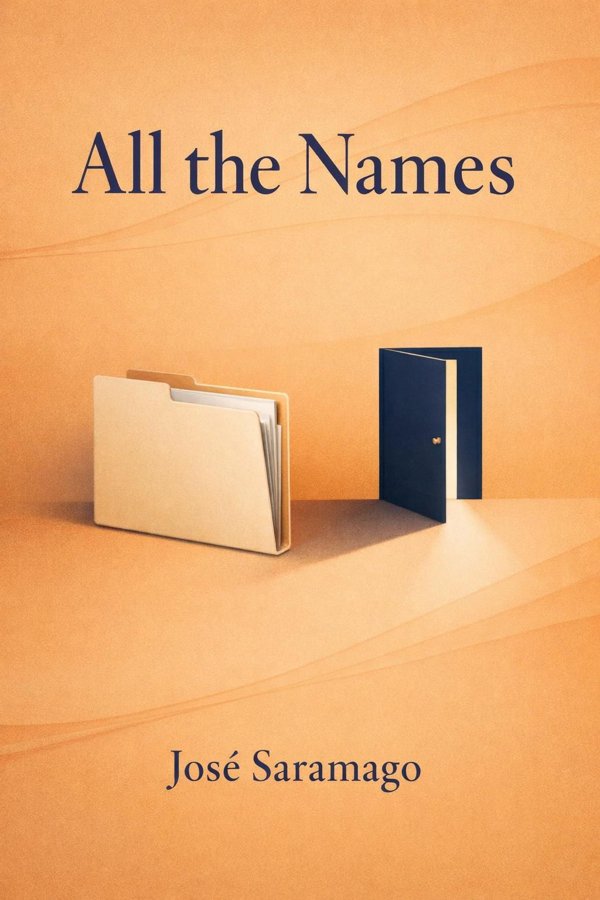
All the Names: Summary & Key Insights
 10 min9 chaptersAudio available
Key Takeaways from All the Names
One of the most unsettling truths in All the Names is that a person can disappear without ever leaving home.
A life can change because of something as small as a misplaced file.
Bureaucracy promises clarity, yet in All the Names it creates confusion, fear, and moral blindness.
At first, Senhor José is fascinated by famous people because fame makes identity seem easier to grasp.
To search for the unknown woman, Senhor José must leave the Registry and enter the city.
What Is All the Names About?
All the Names by José Saramago is a classics book spanning 6 pages. All the Names by José Saramago turns a small, almost trivial mystery into a profound meditation on identity, loneliness, and the systems that reduce human lives to paper records. The novel follows Senhor José, an unremarkable clerk in the vast Central Registry of Births, Marriages, and Deaths, where names are filed, categorized, and preserved with mechanical precision. His routine life changes when he accidentally comes across the file of an unknown woman and becomes determined to discover who she was. What begins as idle curiosity slowly becomes a moral and existential quest. Saramago uses this strange investigation to ask unsettling questions: What does it mean to truly know a person? Can a name preserve a life, or does bureaucracy erase individuality under the guise of order? Why do some people become unforgettable while others vanish into anonymity? Written in Saramago’s distinctive style—long flowing sentences, philosophical irony, and intimate psychological observation—the novel transforms a clerk’s obsession into a universal story about human dignity. As a Nobel Prize-winning author, Saramago brings rare authority to this exploration of how institutions shape, flatten, and sometimes obscure the lives they claim to record.
This FizzRead summary covers all 9 key chapters of All the Names in approximately 10 minutes, distilling the most important ideas, arguments, and takeaways from José Saramago's work. Also available as an audio summary and Key Quotes Podcast.
All the Names
All the Names by José Saramago turns a small, almost trivial mystery into a profound meditation on identity, loneliness, and the systems that reduce human lives to paper records. The novel follows Senhor José, an unremarkable clerk in the vast Central Registry of Births, Marriages, and Deaths, where names are filed, categorized, and preserved with mechanical precision. His routine life changes when he accidentally comes across the file of an unknown woman and becomes determined to discover who she was. What begins as idle curiosity slowly becomes a moral and existential quest.
Saramago uses this strange investigation to ask unsettling questions: What does it mean to truly know a person? Can a name preserve a life, or does bureaucracy erase individuality under the guise of order? Why do some people become unforgettable while others vanish into anonymity? Written in Saramago’s distinctive style—long flowing sentences, philosophical irony, and intimate psychological observation—the novel transforms a clerk’s obsession into a universal story about human dignity. As a Nobel Prize-winning author, Saramago brings rare authority to this exploration of how institutions shape, flatten, and sometimes obscure the lives they claim to record.
Who Should Read All the Names?
This book is perfect for anyone interested in classics and looking to gain actionable insights in a short read. Whether you're a student, professional, or lifelong learner, the key ideas from All the Names by José Saramago will help you think differently.
- ✓Readers who enjoy classics and want practical takeaways
- ✓Professionals looking to apply new ideas to their work and life
- ✓Anyone who wants the core insights of All the Names in just 10 minutes
Want the full summary?
Get instant access to this book summary and 100K+ more with Fizz Moment.
Get Free SummaryAvailable on App Store • Free to download
Key Chapters
One of the most unsettling truths in All the Names is that a person can disappear without ever leaving home. Senhor José is not physically imprisoned, yet his life has been reduced to repetitive gestures, predictable duties, and silent obedience. He works as a minor clerk in the Central Registry of Births, Marriages, and Deaths, an institution so large and impersonal that it feels less like an office than a machine built to process human existence. Day after day, he copies files, follows procedure, and returns to his lonely apartment, which is literally attached to the Registry. His private life is barely separate from the institution that defines him.
Saramago uses this routine to show how modern systems can shrink the human spirit. Senhor José is not evil, ambitious, or especially dramatic. He is ordinary in the most painful sense: a man who has accepted a narrow life because it feels safe. That is precisely why he matters. His emptiness is recognizable. Many people live in structures—offices, routines, social roles—that promise stability while quietly eroding curiosity, courage, and selfhood.
In practical terms, the novel invites us to ask where our own lives have become mechanical. Are we preserving ourselves through habit, or disappearing inside it? Routine is useful, but when it becomes identity, it can turn us into caretakers of systems rather than authors of our own lives.
The key takeaway is simple: pay attention to the habits that keep life orderly, but challenge the ones that make you smaller.
A life can change because of something as small as a misplaced file. Senhor José’s transformation begins not with a heroic decision but with an accident. He has a secret hobby: collecting records of famous people from the Registry. Their files allow him to imagine lives larger and more glamorous than his own. During one of these nighttime excursions, he accidentally takes the card of an unknown woman along with the documents he intended to steal. This error, trivial at first glance, becomes the center of the novel.
Saramago suggests that meaning rarely arrives in grand, obvious form. It often enters through error, interruption, or coincidence. The unknown woman matters precisely because she is not famous, not publicly significant, and not immediately useful. Her file awakens something in Senhor José that his collection of celebrated names never did: a desire to know an ordinary person for her own sake. Curiosity becomes attachment, and attachment becomes purpose.
This idea extends beyond the novel. In real life, personal transformation often begins with an accident we choose not to ignore: a wrong email, a chance meeting, an overlooked book, an unexpected question. What matters is not the randomness of the event but the seriousness with which we respond to it.
The accidental discovery also challenges our obsession with fame. We tend to treat celebrated lives as inherently meaningful and anonymous lives as interchangeable. Saramago reverses that logic. The unknown woman, because she lacks public recognition, demands a more intimate and ethical kind of attention.
The actionable takeaway: do not dismiss the small accidents that disturb your routine. Sometimes they reveal what your life has been missing.
Bureaucracy promises clarity, yet in All the Names it creates confusion, fear, and moral blindness. The Central Registry is designed to organize the most important facts of human life—birth, marriage, death—but its apparent order hides a deeper absurdity. Files pile up endlessly. The dead and the living are classified, archived, and rearranged according to rules that seem rational from a distance but feel surreal up close. Senhor José moves through corridors, shelves, and records as if wandering through a labyrinth where information exists in abundance but understanding remains scarce.
Saramago’s point is not merely that institutions are inefficient. It is that systems built to manage human life often substitute procedure for meaning. A record can tell you that someone existed, but not who they were. A file can preserve a name while losing the person. This is why Senhor José’s search becomes so difficult. The Registry contains data, but not intimacy; order, but not truth.
The image of the labyrinth has practical resonance. Many people experience schools, hospitals, governments, and corporations in similar ways. Forms multiply. Rules obscure responsibility. It becomes difficult to tell whether the system exists to serve people or whether people exist to feed the system. Saramago encourages readers to notice when administrative logic begins to overtake human judgment.
Yet the novel also shows that resistance is possible. Senhor José’s search is clumsy and ethically ambiguous, but it is motivated by a refusal to let a person remain only an entry in an archive. He insists, however awkwardly, that a life is more than its documentation.
Actionable takeaway: whenever rules become more visible than the people they affect, stop and ask what human reality the system is failing to see.
At first, Senhor José is fascinated by famous people because fame makes identity seem easier to grasp. Their names carry stories, images, and public recognition. By collecting their records, he borrows a sense of significance from lives that appear fuller than his own. But Saramago gradually exposes the emptiness of this fascination. Public visibility is not the same as human understanding. In fact, fame can become another kind of distortion, reducing a person to reputation just as bureaucracy reduces a person to paperwork.
The unknown woman changes the terms of Senhor José’s attention. She has no public aura, no celebrated achievements, no ready-made narrative. To pursue her means leaving behind the comforting shortcut of notoriety and entering the more difficult territory of ordinary existence. Saramago suggests that ethical attention begins here: not with people whom the world has already marked as important, but with those whose value must be recognized without social confirmation.
This theme remains strikingly relevant. Contemporary culture often trains us to notice what is visible, viral, prestigious, or publicly endorsed. We may know endless details about prominent figures while remaining indifferent to the people near us: coworkers, neighbors, aging relatives, or strangers whose lives never become headlines. The novel quietly asks what kind of society we create when attention follows status instead of humanity.
Practical application lies in daily habits of noticing. Listening carefully to someone overlooked in a meeting, learning the story of a lonely neighbor, or refusing to measure worth by popularity are small acts that push against the values Saramago critiques.
The takeaway: train your attention away from what is merely famous and toward what is genuinely human.
To search for the unknown woman, Senhor José must leave the Registry and enter the city. This movement is crucial. Inside the archive, lives appear static and complete; outside, they exist only in fragments—old addresses, school records, rumors, neighbors’ memories, disconnected impressions. The city does not reveal a whole person. It offers traces: signs of movement, absence, and loss. Through these encounters, Saramago shows how identity is never fully contained in official records or even in memory. A person survives in scattered pieces, and each witness preserves only a partial version.
This fragmented search gives the novel much of its emotional force. Senhor José wants certainty, but the world provides ambiguity. He meets people who remember little, or remember differently, or are themselves uncertain. The unknown woman becomes both more real and less knowable. The closer he gets, the more he learns that human beings cannot be reconstructed like files. They leave impressions, not formulas.
There is a practical wisdom in this. We often believe that if we gather enough information, we can fully understand another person—or even ourselves. Saramago argues otherwise. Understanding requires humility. Facts matter, but they do not dissolve mystery. Relationships, biographies, and social identities are always incomplete.
The city also functions as a moral education for Senhor José. By venturing beyond institutional walls, he begins to experience vulnerability, improvisation, and genuine contact. The world is messier than the Registry, but also more alive.
Actionable takeaway: when trying to understand someone, accept fragments with patience. Seek context, listen carefully, and resist the urge to force a neat story where reality remains unresolved.
Not every obsession is destructive in the same way. In All the Names, Senhor José’s pursuit of the unknown woman is irrational, intrusive, and morally questionable, yet it also awakens him from spiritual numbness. Before the search, he is passive, timid, and nearly interchangeable with his job. During the search, he lies, improvises, risks punishment, and enters spaces he would once have feared. His obsession gives his life direction, but more importantly, it reveals capacities that routine had buried.
Saramago treats obsession with deep ambiguity. He does not romanticize it as pure devotion, nor condemn it as simple madness. Instead, he shows how extreme attention can expose a hidden hunger for meaning. Senhor José is not only looking for the woman. He is looking for a reason to step beyond the narrow script assigned to him. The investigation becomes a strange apprenticeship in desire, courage, and moral complexity.
This matters because many people dismiss intense curiosity when it does not seem practical or socially approved. Yet sometimes a consuming question—about a person, a work of art, a family history, an injustice, a place—becomes the force that breaks spiritual inertia. The important issue is not whether one feels drawn intensely, but how that intensity is directed and examined.
In real life, obsession can become harmful if it erases boundaries or reality. Saramago keeps that tension visible. Senhor José’s growth is inseparable from ethical risk. The novel therefore invites readers to ask which of their fixations are escapist and which are calling them toward deeper life.
Takeaway: when something grips your attention, do not obey it blindly, but do ask what awakening it may be demanding from you.
A name seems simple until death enters the story. In the Registry, births, marriages, and deaths are all cataloged, but death has a special power: it seals a life, fixes the record, and turns the living person into an object of administration. Senhor José’s search increasingly moves under the shadow of mortality, and Saramago uses that movement to ask what remains when a person is gone. Is a name enough? Is memory enough? Is any system capable of doing justice to a vanished life?
The novel’s confrontation with death is not melodramatic. It is quiet, bureaucratic, and therefore even more unsettling. Death appears not only as personal loss but as filing, categorization, and institutional disposal. This is part of Saramago’s brilliance. He shows that mortality is not just a philosophical abstraction; it is processed socially through documents, permissions, archives, and official acts. Human grief enters administrative channels.
Yet death also deepens Senhor José’s sense of responsibility. The unknown woman can no longer speak for herself. That impossibility gives urgency to his search and raises the ethical stakes of remembering. To care for the dead, in Saramago’s view, is not merely to preserve a record but to resist indifference. The novel asks whether remembrance can be an act of dignity.
Readers can apply this insight by rethinking how they honor absent people. Preserving stories, asking older relatives about forgotten names, and refusing to let the dead become mere statistics are meaningful acts of resistance against erasure.
Actionable takeaway: treat names—especially of the absent and forgotten—not as labels, but as invitations to remember the irreducible human life behind them.
All the Names is not only about one clerk’s loneliness; it is also about how power operates through seemingly ordinary institutions. The Central Registrar, supervisors, filing rules, and physical architecture all shape what can be known, what can be done, and who matters. Saramago demonstrates that power does not always appear as open violence or political spectacle. Often it works through access, hierarchy, permission, and silence. A person’s fate can be influenced by who controls information, who interprets rules, and who decides whether an exception will be allowed.
This is why the novel feels larger than its plot. The Registry becomes a model of modern authority. It classifies lives, stores identities, and creates the illusion that social reality can be fully managed. Even Senhor José’s rebellion occurs within this atmosphere of dependence. He may break rules, but he remains shaped by the institution’s logic.
The insight is widely applicable. Much of contemporary life is governed by systems that appear neutral: databases, personnel files, legal categories, health records, academic credentials. These systems are necessary, but they are never purely objective. They carry assumptions about value, normality, legitimacy, and worth. Saramago encourages us to notice how administrative structures shape human possibility.
At the personal level, this means becoming more attentive to the institutions that mediate our lives. Understanding how records are kept, how decisions are made, and how exceptions happen can be a form of practical empowerment. It can also encourage compassion for people trapped inside systems they did not design.
Takeaway: whenever an institution claims neutrality, look closely at whose lives it simplifies, whose dignity it overlooks, and who benefits from its rules.
By the end of All the Names, the novel points toward a difficult but humane conclusion: perfect order is less valuable than compassion. The Registry wants completeness, accuracy, and control. It treats every life as a file that must be correctly placed. Senhor José’s journey exposes the limits of this ideal. Human beings do not fit neatly into administrative logic, and any system that pretends otherwise risks cruelty. Saramago suggests that true moral seriousness lies not in maintaining flawless classification, but in allowing room for mercy, ambiguity, and tenderness.
This does not mean rules are useless. Records matter. Institutions matter. But the novel insists they should remain subordinate to human dignity. One of its deepest achievements is showing how a seemingly trivial act—caring about one unknown woman—becomes a challenge to the entire worldview of bureaucratic certainty. Senhor José does not solve the mystery in the way a detective might. Instead, he arrives at a more unsettling wisdom: that to honor a person may require acts that exceed procedure.
This lesson has everyday relevance. In workplaces, schools, hospitals, and families, strict correctness can become a way of avoiding empathy. People may follow policy while ignoring suffering. Saramago asks readers to imagine another standard, one in which justice includes attention to context, fragility, and the irreducible singularity of each life.
Practically, this can mean making exceptions when they are humane, listening before judging, and resisting the temptation to reduce people to categories or cases.
The final takeaway: choose mercy whenever order asks you to forget the person standing in front of you.
All Chapters in All the Names
About the Author
José Saramago (1922–2010) was a Portuguese novelist, essayist, and playwright widely regarded as one of the most important literary voices of the modern era. Born into a poor rural family, he worked various jobs before establishing himself as a writer, and his late international success gave his work an unusual depth of social and moral perspective. Saramago received the Nobel Prize in Literature in 1998. His fiction is known for long, flowing sentences, minimal punctuation, irony, allegory, and philosophical engagement with politics, religion, power, and human vulnerability. Major works include Blindness, The Gospel According to Jesus Christ, Death with Interruptions, and Seeing. In All the Names, his signature style is fully on display, turning an ordinary clerk’s search into a profound inquiry into identity, memory, and the dignity of forgotten lives.
Get This Summary in Your Preferred Format
Read or listen to the All the Names summary by José Saramago anytime, anywhere. FizzRead offers multiple formats so you can learn on your terms — all free.
Available formats: App · Audio · PDF · EPUB — All included free with FizzRead
Download All the Names PDF and EPUB Summary
Key Quotes from All the Names
“One of the most unsettling truths in All the Names is that a person can disappear without ever leaving home.”
“A life can change because of something as small as a misplaced file.”
“Bureaucracy promises clarity, yet in All the Names it creates confusion, fear, and moral blindness.”
“At first, Senhor José is fascinated by famous people because fame makes identity seem easier to grasp.”
“To search for the unknown woman, Senhor José must leave the Registry and enter the city.”
Frequently Asked Questions about All the Names
All the Names by José Saramago is a classics book that explores key ideas across 9 chapters. All the Names by José Saramago turns a small, almost trivial mystery into a profound meditation on identity, loneliness, and the systems that reduce human lives to paper records. The novel follows Senhor José, an unremarkable clerk in the vast Central Registry of Births, Marriages, and Deaths, where names are filed, categorized, and preserved with mechanical precision. His routine life changes when he accidentally comes across the file of an unknown woman and becomes determined to discover who she was. What begins as idle curiosity slowly becomes a moral and existential quest. Saramago uses this strange investigation to ask unsettling questions: What does it mean to truly know a person? Can a name preserve a life, or does bureaucracy erase individuality under the guise of order? Why do some people become unforgettable while others vanish into anonymity? Written in Saramago’s distinctive style—long flowing sentences, philosophical irony, and intimate psychological observation—the novel transforms a clerk’s obsession into a universal story about human dignity. As a Nobel Prize-winning author, Saramago brings rare authority to this exploration of how institutions shape, flatten, and sometimes obscure the lives they claim to record.
More by José Saramago



You Might Also Like






Browse by Category
Ready to read All the Names?
Get the full summary and 100K+ more books with Fizz Moment.