
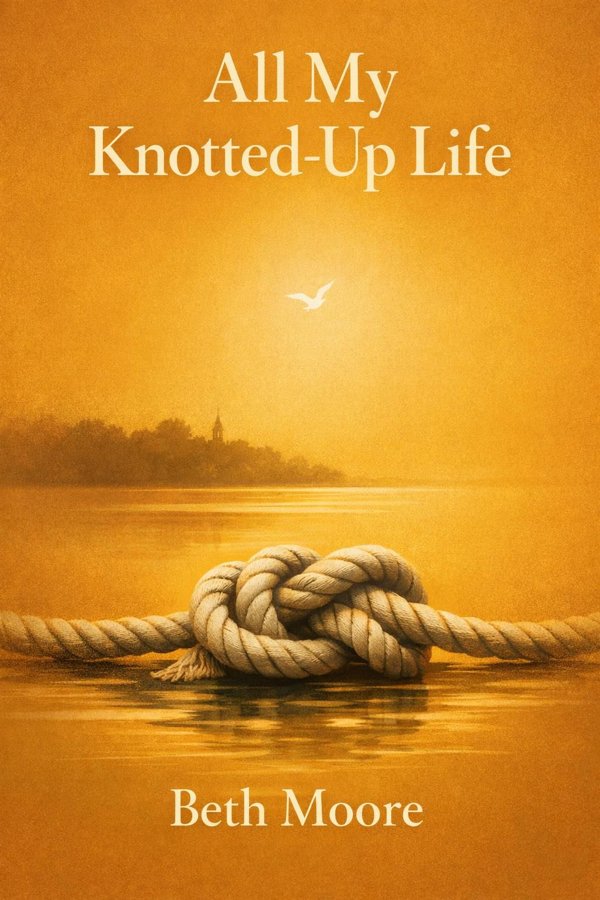
All My Knotted-Up Life: Summary & Key Insights
by Beth Moore
 10 min9 chaptersAudio available
Key Takeaways from All My Knotted-Up Life
One of the memoir’s strongest insights is that what remains unnamed often continues to govern a life from the shadows.
A striking theme in All My Knotted-Up Life is that mature faith is not fragile.
Beth Moore’s story reveals a paradox many people resist: some of the deepest sources of purpose emerge from places of deepest pain.
One of the memoir’s most sobering lessons is that visible success tells only part of the truth.
Another central idea in All My Knotted-Up Life is that family patterns exert immense influence, but they do not have absolute authority over a person’s future.
What Is All My Knotted-Up Life About?
All My Knotted-Up Life by Beth Moore is a biographies book. All My Knotted-Up Life is Beth Moore’s candid memoir about pain, faith, survival, calling, and the long work of becoming whole. Best known as a Bible teacher, speaker, and author whose studies have reached millions of readers, Moore steps away from the public platform to tell the far more vulnerable story behind her ministry. She writes about a childhood marked by instability and trauma, the hidden wounds that shaped her inner world, and the difficult path toward healing, truth-telling, and spiritual maturity. This is not a polished success story. It is a book about knots that do not disappear overnight: family pain, private shame, complicated church experiences, public scrutiny, and the struggle to remain honest before God and others. What makes the memoir matter is its emotional clarity and spiritual depth. Moore does not offer easy answers, but she does show how grace can meet a person in confusion, grief, and contradiction. For readers interested in memoir, faith, resilience, or the hidden cost of leadership, this book offers both a personal testimony and a searching reflection on what it means to live with courage.
This FizzRead summary covers all 9 key chapters of All My Knotted-Up Life in approximately 10 minutes, distilling the most important ideas, arguments, and takeaways from Beth Moore's work. Also available as an audio summary and Key Quotes Podcast.
All My Knotted-Up Life
All My Knotted-Up Life is Beth Moore’s candid memoir about pain, faith, survival, calling, and the long work of becoming whole. Best known as a Bible teacher, speaker, and author whose studies have reached millions of readers, Moore steps away from the public platform to tell the far more vulnerable story behind her ministry. She writes about a childhood marked by instability and trauma, the hidden wounds that shaped her inner world, and the difficult path toward healing, truth-telling, and spiritual maturity. This is not a polished success story. It is a book about knots that do not disappear overnight: family pain, private shame, complicated church experiences, public scrutiny, and the struggle to remain honest before God and others. What makes the memoir matter is its emotional clarity and spiritual depth. Moore does not offer easy answers, but she does show how grace can meet a person in confusion, grief, and contradiction. For readers interested in memoir, faith, resilience, or the hidden cost of leadership, this book offers both a personal testimony and a searching reflection on what it means to live with courage.
Who Should Read All My Knotted-Up Life?
This book is perfect for anyone interested in biographies and looking to gain actionable insights in a short read. Whether you're a student, professional, or lifelong learner, the key ideas from All My Knotted-Up Life by Beth Moore will help you think differently.
- ✓Readers who enjoy biographies and want practical takeaways
- ✓Professionals looking to apply new ideas to their work and life
- ✓Anyone who wants the core insights of All My Knotted-Up Life in just 10 minutes
Want the full summary?
Get instant access to this book summary and 100K+ more with Fizz Moment.
Get Free SummaryAvailable on App Store • Free to download
Key Chapters
One of the memoir’s strongest insights is that what remains unnamed often continues to govern a life from the shadows. Beth Moore shows that childhood trauma, family dysfunction, fear, and shame do not lose power simply because a person becomes productive, successful, or deeply religious. They often remain active beneath the surface, shaping relationships, self-worth, and even a person’s image of God. Her story reminds readers that healing does not begin with pretending the past was smaller than it was. It begins when a person tells the truth.
Throughout the book, Moore traces how early wounds created knots in her emotional and spiritual life. She does not reduce her identity to what happened to her, but she refuses to erase those experiences in order to appear stronger. That honesty is essential. Many people try to move on from pain by staying busy, serving others, or achieving visible success. Yet unexamined pain can leak out through anxiety, people-pleasing, anger, perfectionism, or emotional distance.
The practical lesson is clear: truth-telling is not self-indulgence; it is a step toward freedom. Naming painful experiences may happen through journaling, counseling, prayer, trusted friendship, or support groups. It can also involve learning language for experiences that once felt too confusing to describe. The goal is not to relive pain endlessly, but to stop allowing silence to define reality.
Moore’s example encourages readers to ask where they are still minimizing what hurt them or hiding what shaped them. A life can look functional and still be tied in knots internally. Actionable takeaway: identify one unresolved wound or recurring pain pattern, write down its honest name, and share it with one trustworthy person so healing can begin in the light.
A striking theme in All My Knotted-Up Life is that mature faith is not fragile. It can endure grief, doubt, confusion, disappointment, and unanswered questions. Beth Moore does not present belief as a neat upward climb from brokenness to certainty. Instead, she shows faith as something forged in contradiction: love and loss, calling and exhaustion, public fruitfulness and private pain, devotion to the church and heartbreak over its failures.
This matters because many readers have inherited an immature picture of spirituality. They may assume that strong faith means constant confidence, emotional steadiness, and simple answers. Moore’s memoir challenges that assumption. Her life shows that a person can trust God while also wrestling deeply. Faith is not the absence of turmoil; it is the refusal to let turmoil have the final word.
In practical terms, this idea frees readers from performative spirituality. Instead of hiding doubt or grief, they can bring it honestly into prayer. Instead of thinking every painful season signals spiritual failure, they can recognize that suffering often reveals what kind of faith they actually have. A parent facing a child’s crisis, a leader enduring burnout, or a believer disillusioned with church life may all find comfort in Moore’s testimony that spiritual life is rarely tidy.
The memoir suggests that contradiction can deepen faith when it drives a person toward greater dependence rather than greater cynicism. Questions do not automatically destroy belief; sometimes they refine it. Readers do not need to wait until they feel settled before approaching God.
Actionable takeaway: when facing a confusing or painful tension, stop trying to resolve it instantly and instead write a prayer that names both sides honestly, asking for endurance before clarity.
Beth Moore’s story reveals a paradox many people resist: some of the deepest sources of purpose emerge from places of deepest pain. This does not mean trauma is good or that suffering should be romanticized. Rather, the memoir shows how wounds can become sites of compassion, insight, and courage when they are brought into the redemptive work of healing. Moore’s ministry did not arise from a life untouched by hardship. It grew through the very terrain that once threatened to silence her.
Her memoir suggests that calling is rarely disconnected from biography. The things that break a person’s heart often shape what they notice, whom they care about, and how they speak. Someone who has known rejection may become unusually attentive to outsiders. Someone who has lived through chaos may become a stabilizing presence for others. Someone who has battled shame may be uniquely equipped to speak words of dignity and hope.
This insight is practical because many readers dismiss their own life stories as liabilities. They believe their past disqualifies them from leadership, creativity, service, or influence. Moore’s example argues the opposite. A painful history can become a source of wisdom if it is processed rather than buried. The key is transformation, not denial.
In everyday life, this may look like noticing recurring themes in your experiences and asking what they have prepared you to understand. It may mean serving people whose struggles you recognize from the inside. It may also mean setting boundaries so your wounds do not become your identity.
Calling is not always glamorous. Often it is simply the faithful use of hard-earned insight in service of others. Actionable takeaway: list three painful experiences that shaped you, then write one specific way each might equip you to help, encourage, or understand someone else today.
One of the memoir’s most sobering lessons is that visible success tells only part of the truth. Beth Moore became widely known as a gifted communicator and influential Bible teacher, yet her public effectiveness did not erase internal strain. The book exposes the dangerous assumption that fruitful people must therefore be fine. It reminds readers that applause, productivity, and impact can coexist with exhaustion, grief, and unresolved pain.
This insight matters in a culture that rewards image management. Leaders, parents, professionals, and caregivers often feel pressure to appear composed even when they are struggling. The more competent they seem, the less likely others are to ask whether they need help. Moore’s memoir breaks through that illusion. It shows how a person can carry tremendous responsibility while privately bearing fear, loneliness, or emotional overload.
The practical implication is twofold. First, readers should become more compassionate toward those they admire. Influence does not make someone invulnerable. Second, they should become more honest about their own limits. Sustainable strength requires rest, friendship, and self-awareness. It also requires resisting the temptation to confuse usefulness with health.
In daily life, this could mean checking in on the most capable person in the room rather than assuming they are fine. It could mean a leader admitting fatigue before burnout forces a collapse. It could also mean creating rhythms that protect inner life: therapy, sabbath, spiritual direction, exercise, or simply time away from performance.
Moore’s story shows that strong people still need care. The mask of competence can become another knot if it prevents vulnerability. Actionable takeaway: identify one area where you are maintaining an image of strength, and replace that performance this week with one honest conversation about what is actually going on.
Another central idea in All My Knotted-Up Life is that family patterns exert immense influence, but they do not have absolute authority over a person’s future. Beth Moore writes from within the complexity of inherited pain, relational confusion, and deeply formative childhood experiences. She does not pretend that family history can be shrugged off through willpower. At the same time, she refuses to believe that destructive patterns must continue unchanged across generations.
This is an important distinction. Many people swing between two extremes: blaming everything on the family system or denying that it had much effect at all. Moore’s memoir models a more mature path. She acknowledges the real imprint of family life while also emphasizing agency, grace, and the possibility of change. The knots may be old, but they are not destiny.
Practically, this invites readers to examine what they inherited emotionally, relationally, and spiritually. Did your home teach you to fear conflict, suppress emotion, distrust affection, overperform for approval, or stay silent about harm? Once those patterns are identified, they can be challenged. Change may involve therapy, spiritual practices, educational reading, healthier friendships, or deliberate choices in marriage and parenting.
For example, a person raised in volatility might learn to pause before reacting. Someone who grew up around secrecy might commit to direct communication. A parent may intentionally create a home where apology, listening, and emotional safety are normal rather than rare.
Moore’s life testifies that the influence of the past is real, but so is the power to respond differently. New patterns are often built one small act at a time. Actionable takeaway: identify one unhealthy family pattern you inherited and choose one concrete replacement behavior you will practice consistently for the next month.
Memoir at its best is not just recollection but risk, and Beth Moore’s book demonstrates how costly honesty can be. Telling the truth about one’s life, family, wounds, and public world often disrupts carefully maintained narratives. It can disappoint people who prefer a simpler story. It can expose the writer to misunderstanding, judgment, or rejection. Moore’s willingness to write candidly about pain and complexity underscores a larger lesson: truth-telling is an act of courage because it asks us to value integrity over image.
This theme reaches beyond personal storytelling. Many readers know what it is like to keep peace by staying vague, to preserve belonging by withholding what is real, or to avoid conflict by saying only what others can tolerate. Moore’s memoir suggests that while discretion has a place, chronic silence can become spiritually and emotionally costly. What is hidden for too long can distort the self.
In practice, courage does not mean saying everything to everyone. It means discerning what needs to be said, to whom, and why. Honest speech may involve naming abuse, confronting hypocrisy, setting boundaries, clarifying a misrepresentation, or simply describing your experience without apology. The goal is not spectacle but freedom and fidelity.
This is especially relevant in environments where authority, family loyalty, or public expectations discourage candor. Moore’s story encourages readers to consider whether their silence serves wisdom or fear. Sometimes the most healing sentence is the one a person has delayed for years.
Truth can complicate relationships, but falsehood complicates the soul. Actionable takeaway: think of one truth you have been avoiding out of fear, then plan a wise, specific, and respectful way to speak it within the next two weeks.
Beth Moore’s memoir quietly but firmly resists the tendency to turn spiritual leaders into symbols instead of people. Her life in public ministry exposed her to admiration, expectation, criticism, and projection. The book reveals how dangerous it can be when audiences prefer polished certainty over honest humanity. Leaders then feel pressure to remain exemplary at all costs, and followers forget that giftedness does not cancel limitation.
Moore’s story invites a healthier view of leadership. Spiritual leaders can teach, encourage, and influence others meaningfully, yet still need accountability, rest, friendship, repentance, and care. They do not become less credible by being human; in many cases they become more trustworthy when they stop pretending to be above ordinary struggle. The problem begins when either leaders or followers confuse platform with invulnerability.
Readers can apply this by rethinking how they relate to authority figures. Instead of idealizing them, they can appreciate their work while allowing room for complexity. Communities can create cultures where leaders are not rewarded for overextension or punished for appropriate weakness. Leaders themselves can resist building ministries on persona rather than reality.
This also applies beyond church settings. Teachers, executives, activists, coaches, and parents all occupy roles where others may expect them to be endlessly available and emotionally stable. But leadership that ignores human limits becomes brittle. Sustainable influence depends on integrity, humility, and truthful self-understanding.
Moore’s memoir shows that leadership is strongest when rooted in dependence rather than performance. Actionable takeaway: if you lead others, name one limit you have been ignoring and communicate a healthier boundary; if you follow a leader, offer support without demanding perfection.
A powerful undercurrent in All My Knotted-Up Life is that resilience is rarely a solo achievement. Beth Moore’s perseverance did not come from sheer toughness alone. It was sustained through faith, meaningful relationships, moments of divine kindness, and the gradual accumulation of grace over time. The memoir resists the myth of the self-made survivor. Strength, in her telling, is relational.
This is an important correction because resilience is often misunderstood as emotional invincibility. People assume that strong individuals simply push through hardship on their own. Moore’s story suggests something more humane. Resilience is the capacity to keep going without becoming hardened beyond recognition. It often depends on receiving help, telling the truth, being loved in weakness, and finding spiritual resources deeper than self-reliance.
In practical terms, readers can build this kind of resilience intentionally. They can cultivate friendships where honesty is safe. They can seek mentors, counselors, pastors, or peers who offer steadiness. They can develop spiritual practices that return them to hope: prayer, Scripture meditation, worship, rest, and gratitude. Even small routines can matter when life feels tangled.
Consider someone walking through grief, betrayal, or vocational upheaval. Endurance is more likely when that person has a circle of support and habits that anchor the soul. Isolation magnifies suffering; connection helps metabolize it. Moore’s memoir points repeatedly to the sustaining power of not being alone.
Resilience is not denial of weakness but wise cooperation with grace. The strongest people are often those who have learned how to receive. Actionable takeaway: strengthen your support system this week by reaching out to two people, scheduling one meaningful conversation, and identifying one daily practice that helps you stay spiritually and emotionally grounded.
Perhaps the memoir’s most memorable idea is embedded in its title: life can remain knotted even as healing unfolds. Beth Moore does not present wholeness as a final state in which all confusion disappears and every wound becomes neatly resolved. Instead, she portrays growth as an ongoing untangling. Some knots loosen quickly, others slowly, and some remain reminders of a complicated human story. This vision is both realistic and hopeful.
Many readers become discouraged because they expect transformation to be linear. They assume that once they have addressed a painful issue, it should never trouble them again. But emotional and spiritual growth often involves revisiting old themes at deeper levels. A person may have genuinely healed and still find certain seasons reactivating old fears or questions. That does not mean progress was fake. It means life is layered.
Moore’s memoir offers permission to keep becoming. Healing can coexist with vulnerability. Maturity can coexist with unfinished business. A meaningful life is not one without knots but one in which knots no longer wholly control direction. This perspective encourages patience with oneself and others.
Practically, readers can apply this by replacing perfectionist expectations with sustained practices of reflection and care. Instead of asking, “Why am I not over this yet?” they might ask, “What is this season revealing, and what kind of response would support continued growth?” Progress may involve apology, rest, deeper honesty, or renewed trust in God.
Wholeness is less like flipping a switch and more like tending a long, living process. Actionable takeaway: choose one area where you feel frustrated by slow growth, then redefine success as one faithful next step rather than complete resolution.
All Chapters in All My Knotted-Up Life
About the Author
Beth Moore is an American author, speaker, and Bible teacher best known for her decades of work in Christian ministry. She founded Living Proof Ministries and became widely recognized through bestselling Bible studies, books, and live teaching events that reached millions of readers and listeners. Her work has often focused on Scripture, spiritual growth, and practical faith, particularly for women, though her audience has grown far beyond that niche. Over time, Moore also became a significant public voice in conversations about church culture, leadership, justice, and integrity. In All My Knotted-Up Life, she turns from teaching to memoir, offering a deeply personal account of the experiences that formed her. The book reveals the vulnerable human story behind a prominent public ministry.
Get This Summary in Your Preferred Format
Read or listen to the All My Knotted-Up Life summary by Beth Moore anytime, anywhere. FizzRead offers multiple formats so you can learn on your terms — all free.
Available formats: App · Audio · PDF · EPUB — All included free with FizzRead
Download All My Knotted-Up Life PDF and EPUB Summary
Key Quotes from All My Knotted-Up Life
“One of the memoir’s strongest insights is that what remains unnamed often continues to govern a life from the shadows.”
“A striking theme in All My Knotted-Up Life is that mature faith is not fragile.”
“Beth Moore’s story reveals a paradox many people resist: some of the deepest sources of purpose emerge from places of deepest pain.”
“One of the memoir’s most sobering lessons is that visible success tells only part of the truth.”
“Another central idea in All My Knotted-Up Life is that family patterns exert immense influence, but they do not have absolute authority over a person’s future.”
Frequently Asked Questions about All My Knotted-Up Life
All My Knotted-Up Life by Beth Moore is a biographies book that explores key ideas across 9 chapters. All My Knotted-Up Life is Beth Moore’s candid memoir about pain, faith, survival, calling, and the long work of becoming whole. Best known as a Bible teacher, speaker, and author whose studies have reached millions of readers, Moore steps away from the public platform to tell the far more vulnerable story behind her ministry. She writes about a childhood marked by instability and trauma, the hidden wounds that shaped her inner world, and the difficult path toward healing, truth-telling, and spiritual maturity. This is not a polished success story. It is a book about knots that do not disappear overnight: family pain, private shame, complicated church experiences, public scrutiny, and the struggle to remain honest before God and others. What makes the memoir matter is its emotional clarity and spiritual depth. Moore does not offer easy answers, but she does show how grace can meet a person in confusion, grief, and contradiction. For readers interested in memoir, faith, resilience, or the hidden cost of leadership, this book offers both a personal testimony and a searching reflection on what it means to live with courage.
You Might Also Like

An American Marriage
Tayari Jones
10 min
Benjamin Franklin: An American Life
Walter Isaacson
10 min
I Know Why The Caged Bird Sings
Maya Angelou
10 min
Long Walk to Freedom
Nelson Mandela
10 min
Persepolis
Marjane Satrapi
10 min
Surely You're Joking, Mr. Feynman!
Richard P. Feynman
10 minBrowse by Category
Ready to read All My Knotted-Up Life?
Get the full summary and 100K+ more books with Fizz Moment.