
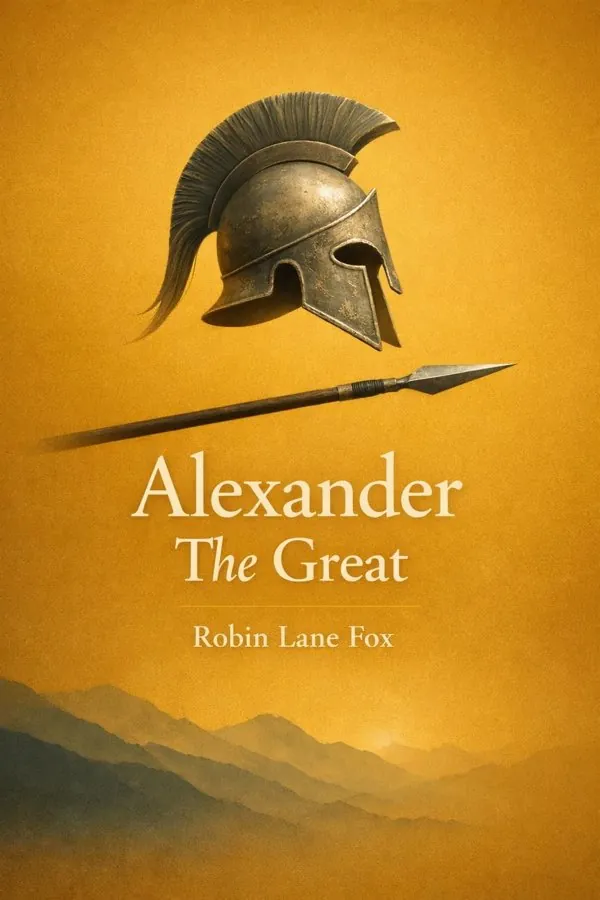
Alexander The Great: Summary & Key Insights
 10 min13 chaptersAudio available
What Is Alexander The Great About?
Alexander The Great by Robin Lane Fox is a biographies book spanning 13 pages. This biography of Alexander the Great, written by historian Robin Lane Fox, offers a detailed and vivid account of the life, conquests, and legacy of the Macedonian king who created one of the largest empires in ancient history. The book explores Alexander’s military genius, political ambition, and complex personality, drawing on classical sources to reconstruct his campaigns and the world he transformed.
This FizzRead summary covers all 13 key chapters of Alexander The Great in approximately 10 minutes, distilling the most important ideas, arguments, and takeaways from Robin Lane Fox's work. Also available as an audio summary and Key Quotes Podcast.
Alexander The Great
This biography of Alexander the Great, written by historian Robin Lane Fox, offers a detailed and vivid account of the life, conquests, and legacy of the Macedonian king who created one of the largest empires in ancient history. The book explores Alexander’s military genius, political ambition, and complex personality, drawing on classical sources to reconstruct his campaigns and the world he transformed.
Who Should Read Alexander The Great?
This book is perfect for anyone interested in biographies and looking to gain actionable insights in a short read. Whether you're a student, professional, or lifelong learner, the key ideas from Alexander The Great by Robin Lane Fox will help you think differently.
- ✓Readers who enjoy biographies and want practical takeaways
- ✓Professionals looking to apply new ideas to their work and life
- ✓Anyone who wants the core insights of Alexander The Great in just 10 minutes
Want the full summary?
Get instant access to this book summary and 100K+ more with Fizz Moment.
Get Free SummaryAvailable on App Store • Free to download
Key Chapters
To understand Alexander, one must begin with the Macedon that Philip II created. Before Philip’s reign, Macedonia was a rough kingdom perched on the northern fringes of the Greek world, scorned by southern city-states as semi-barbaric. Yet, within a generation, Philip transformed it into a disciplined and aggressive military machine capable of dominating all Greece. His genius lay not merely in ambition but in structural reform. He reorganized the army, replacing the old warrior nobility with a professional corps centered on the phalanx—a formation of tightly packed infantry bearing long pikes, the sarissae. This innovation rendered traditional hoplite tactics obsolete.
Philip also understood the subtle art of politics. Through marriage alliances, diplomacy, and calculated warfare, he unified the fragmented Macedonian aristocracy and asserted supremacy over Thessaly and the northern tribes. When he convened the League of Corinth after the Battle of Chaeronea in 338 BCE, Greece was nominally independent but effectively subordinate to Macedonian hegemony.
By the time Alexander came of age, he inherited far more than a throne. Philip bequeathed him a platform already poised for expansion. The army was loyal, seasoned, and well-equipped. The Kingdom enjoyed command over the Greek peninsula, and the Persian Empire loomed tantalizingly beyond the Aegean, divided by internal difficulties and ripe for invasion. If Alexander’s career became a blaze across continents, the fuse was Philip’s handiwork.
Alexander’s youth was marked by intellectual intensity and royal expectation. His mother, Olympias, taught him that he descended from divine ancestry—Achilles on one side, Heracles on the other—a lineage that fueled his belief in destiny. His father gave him a different gift: the example of relentless conquest. Between these two influences, Alexander’s imagination was nourished by myth and measured by achievement.
When Aristotle arrived in Pella as his tutor, a remarkable meeting of mind and will began. Aristotle, already the greatest philosopher of his generation, introduced Alexander to Homer, to ethics, and to science. But he also sowed an idea that would grow into an empire: that knowledge and order could expand through reasoned leadership. The young prince devoured Homer’s *Iliad*, carrying it into every campaign as his guide to heroism. Achilles became his model not just in warfare but in emotional yearning—for immortality through action.
Even as a teenager, Alexander’s instincts were commanding. At Chaeronea, fighting beside Philip, he led the cavalry charge that broke the Theban Sacred Band. His self-control and quick tactical perception were already apparent. Yet, beneath this precision burned a temper that could erupt in fierce pride—a combination that would define his leadership: intelligence guided by passion.
+ 11 more chapters — available in the FizzRead app
All Chapters in Alexander The Great
About the Author
Robin Lane Fox is a British historian and classicist, known for his expertise in ancient history and classical studies. He has taught at Oxford University and written extensively on Alexander the Great, ancient Greece, and early Christianity.
Get This Summary in Your Preferred Format
Read or listen to the Alexander The Great summary by Robin Lane Fox anytime, anywhere. FizzRead offers multiple formats so you can learn on your terms — all free.
Available formats: App · Audio · PDF · EPUB — All included free with FizzRead
Download Alexander The Great PDF and EPUB Summary
Key Quotes from Alexander The Great
“To understand Alexander, one must begin with the Macedon that Philip II created.”
“Alexander’s youth was marked by intellectual intensity and royal expectation.”
Frequently Asked Questions about Alexander The Great
Alexander The Great by Robin Lane Fox is a biographies book that explores key ideas across 13 chapters. This biography of Alexander the Great, written by historian Robin Lane Fox, offers a detailed and vivid account of the life, conquests, and legacy of the Macedonian king who created one of the largest empires in ancient history. The book explores Alexander’s military genius, political ambition, and complex personality, drawing on classical sources to reconstruct his campaigns and the world he transformed.
You Might Also Like

An American Marriage
Tayari Jones
10 min
Benjamin Franklin: An American Life
Walter Isaacson
10 min
I Know Why The Caged Bird Sings
Maya Angelou
10 min
Long Walk to Freedom
Nelson Mandela
10 min
Persepolis
Marjane Satrapi
10 min
Surely You're Joking, Mr. Feynman!
Richard P. Feynman
10 minBrowse by Category
Ready to read Alexander The Great?
Get the full summary and 100K+ more books with Fizz Moment.