
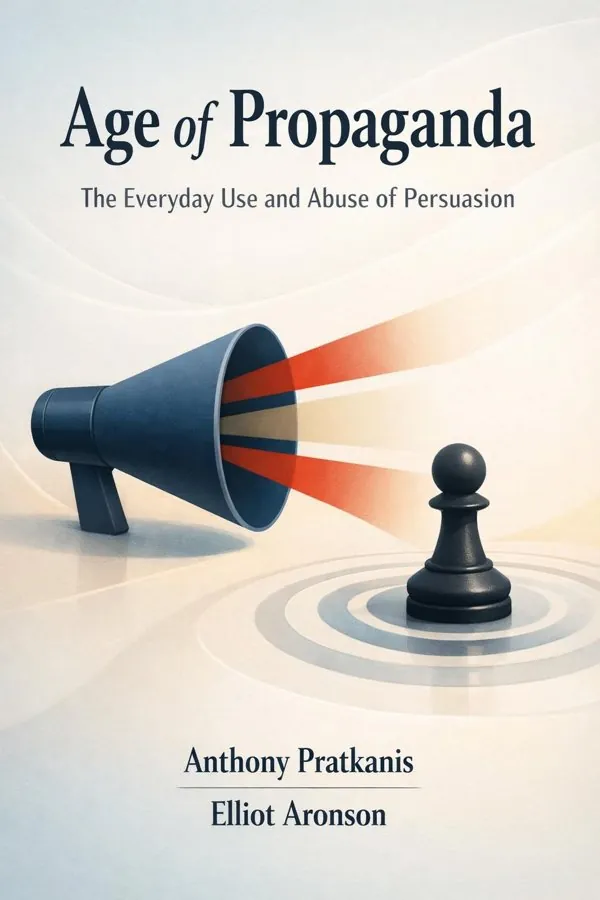
Age of Propaganda: The Everyday Use and Abuse of Persuasion: Summary & Key Insights
by Anthony Pratkanis, Elliot Aronson
 10 min4 chaptersAudio available
What Is Age of Propaganda: The Everyday Use and Abuse of Persuasion About?
Age of Propaganda: The Everyday Use and Abuse of Persuasion by Anthony Pratkanis, Elliot Aronson is a psychology book spanning 4 pages. Originally published in 1991, *Age of Propaganda* explores how persuasion operates in modern society, examining the psychological mechanisms behind advertising, political messaging, and media influence. The authors, both social psychologists, analyze how propaganda techniques shape public opinion and behavior, offering insights into resisting manipulative persuasion.
This FizzRead summary covers all 4 key chapters of Age of Propaganda: The Everyday Use and Abuse of Persuasion in approximately 10 minutes, distilling the most important ideas, arguments, and takeaways from Anthony Pratkanis, Elliot Aronson's work. Also available as an audio summary and Key Quotes Podcast.
Age of Propaganda: The Everyday Use and Abuse of Persuasion
Originally published in 1991, *Age of Propaganda* explores how persuasion operates in modern society, examining the psychological mechanisms behind advertising, political messaging, and media influence. The authors, both social psychologists, analyze how propaganda techniques shape public opinion and behavior, offering insights into resisting manipulative persuasion.
Who Should Read Age of Propaganda: The Everyday Use and Abuse of Persuasion?
This book is perfect for anyone interested in psychology and looking to gain actionable insights in a short read. Whether you're a student, professional, or lifelong learner, the key ideas from Age of Propaganda: The Everyday Use and Abuse of Persuasion by Anthony Pratkanis, Elliot Aronson will help you think differently.
- ✓Readers who enjoy psychology and want practical takeaways
- ✓Professionals looking to apply new ideas to their work and life
- ✓Anyone who wants the core insights of Age of Propaganda: The Everyday Use and Abuse of Persuasion in just 10 minutes
Want the full summary?
Get instant access to this book summary and 100K+ more with Fizz Moment.
Get Free SummaryAvailable on App Store • Free to download
Key Chapters
Propaganda did not begin with modern marketing; it’s as old as organized society itself. The word itself comes from the 17th century Congregatio de Propaganda Fide — the Catholic Church’s department for spreading the faith. But long before that, rulers, priests, and generals understood that mass persuasion could be as decisive as any weapon. In this section, we trace the lineage of propaganda from ancient political rhetoric to twentieth-century mass media. The goal is not historical curiosity, but perspective: understanding that the psychological tools used today were refined over centuries of trial and error.
During World War I, propaganda was systematized. Governments discovered that controlling information and emotion could mobilize entire populations. Posters, slogans, songs — all were designed with psychological precision to evoke pride, fear, or hatred. Edward Bernays, often called the father of modern public relations, was one of the first to recognize that propaganda’s techniques could be repurposed for commerce. His 1920s campaigns didn’t merely sell products; they sold lifestyles, aspirations, and self-images. The commercial world never looked back.
From the rise of totalitarian regimes to Cold War media strategies, propaganda became the art of shaping consent. It matured in tandem with technology — radio, film, television — each new medium offering fresh avenues to bypass rational scrutiny and speak directly to emotion. By the late 20th century, the line between information and persuasion had blurred. News programs adopted entertainment formats; political debate became marketing theater. What mattered wasn’t truth, but impact.
Recognizing this evolution helps us see that propaganda didn’t suddenly enter modern culture; it simply changed form. In our age, it thrives not only through government control but through commercial and digital ecosystems. What remains constant is the psychological logic: repetition breeds familiarity, familiarity breeds trust, and trust reduces critical thought. Our challenge, then, is not to abolish persuasion but to reclaim its ethical use.
To understand persuasion, we must first understand people. Persuasion works because it taps the underlying architecture of how humans form attitudes and make decisions. Aronson and I draw upon decades of social psychological research to show that our beliefs are rarely the product of logical deliberation; they emerge from emotional impulses, cognitive shortcuts, and social influence.
When someone tries to persuade us, our minds engage in two kinds of processing. The first is central — careful, reasoned evaluation of arguments. The second is peripheral — fast, intuitive, based on cues like attractiveness, credibility, or familiarity. Much of everyday persuasion, especially in advertising and politics, relies on this peripheral route. We respond not to what is said but who says it and how confidently it is delivered.
Emotions serve as the energy source for belief change. Fear mobilizes us; pride justifies our allegiances; belonging affirms our self-worth. Persuasive messages exploit these emotions. A product ad tells you that buying makes you loved. A politician warns that only they can save you from danger. These narratives bypass analysis and speak to our identity needs.
But persuasion doesn’t only work on ignorance — it thrives on intelligent people too. That’s because we all use heuristics: mental shortcuts like “experts know best” or “everyone seems to agree.” These cues are efficient but vulnerable to abuse. Once we recognize them, we begin to see how easily they can distort reasoning.
Ultimately, understanding persuasion’s psychological foundations means reclaiming our own cognition. The task is not to become coldly rational, but to appreciate the role of emotion without surrendering to manipulation. Awareness transforms emotion from vulnerability into insight.
+ 2 more chapters — available in the FizzRead app
All Chapters in Age of Propaganda: The Everyday Use and Abuse of Persuasion
About the Authors
Anthony Pratkanis is a professor of psychology at the University of California, Santa Cruz, known for his research on social influence and persuasion. Elliot Aronson is an eminent social psychologist and author, recognized for his contributions to cognitive dissonance theory and social behavior studies.
Get This Summary in Your Preferred Format
Read or listen to the Age of Propaganda: The Everyday Use and Abuse of Persuasion summary by Anthony Pratkanis, Elliot Aronson anytime, anywhere. FizzRead offers multiple formats so you can learn on your terms — all free.
Available formats: App · Audio · PDF · EPUB — All included free with FizzRead
Download Age of Propaganda: The Everyday Use and Abuse of Persuasion PDF and EPUB Summary
Key Quotes from Age of Propaganda: The Everyday Use and Abuse of Persuasion
“Propaganda did not begin with modern marketing; it’s as old as organized society itself.”
“To understand persuasion, we must first understand people.”
Frequently Asked Questions about Age of Propaganda: The Everyday Use and Abuse of Persuasion
Age of Propaganda: The Everyday Use and Abuse of Persuasion by Anthony Pratkanis, Elliot Aronson is a psychology book that explores key ideas across 4 chapters. Originally published in 1991, *Age of Propaganda* explores how persuasion operates in modern society, examining the psychological mechanisms behind advertising, political messaging, and media influence. The authors, both social psychologists, analyze how propaganda techniques shape public opinion and behavior, offering insights into resisting manipulative persuasion.
You Might Also Like
The Body Keeps the Score
Bessel van der Kolk
10 min
Surrounded by Idiots
Thomas Erikson
10 min
Emotional Intelligence
Daniel Goleman
10 min
Attached
Amir Levine
10 min
Why Does He Do That
Lundy Bancroft
10 min
Women Who Run with the Wolves
Clarissa Pinkola Estés
10 minBrowse by Category
Ready to read Age of Propaganda: The Everyday Use and Abuse of Persuasion?
Get the full summary and 100K+ more books with Fizz Moment.