
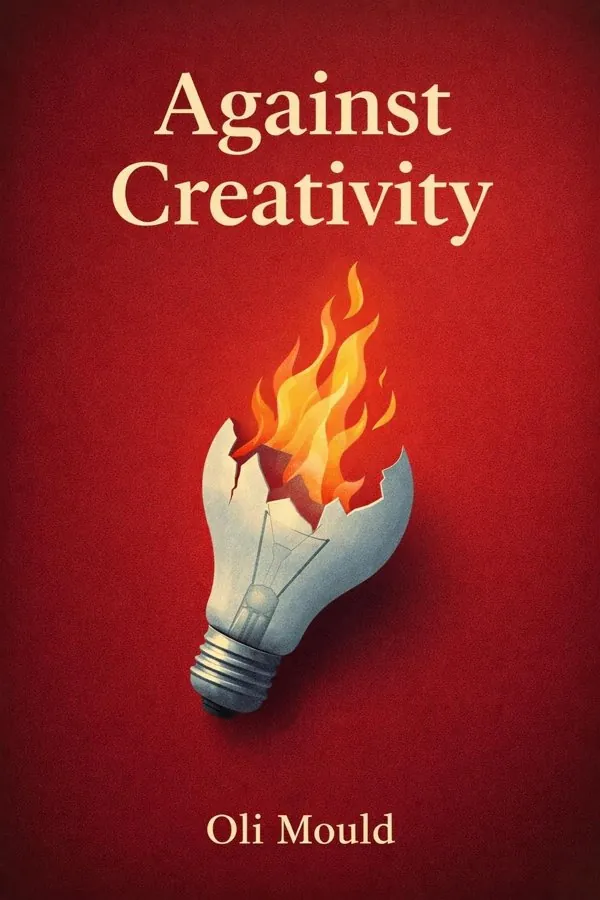
Against Creativity: Summary & Key Insights
by Oli Mould
 10 min8 chaptersAudio available
What Is Against Creativity About?
Against Creativity by Oli Mould is a sociology book spanning 8 pages. In this critical work, Oli Mould challenges the modern obsession with creativity as a driver of economic growth and personal success. He argues that creativity has been co-opted by neoliberal capitalism, turning what was once a radical and collective force into a tool for profit and control. Mould calls for reclaiming creativity as a means of resistance and social transformation, urging readers to imagine alternative futures beyond the constraints of market logic.
This FizzRead summary covers all 8 key chapters of Against Creativity in approximately 10 minutes, distilling the most important ideas, arguments, and takeaways from Oli Mould's work. Also available as an audio summary and Key Quotes Podcast.
Against Creativity
In this critical work, Oli Mould challenges the modern obsession with creativity as a driver of economic growth and personal success. He argues that creativity has been co-opted by neoliberal capitalism, turning what was once a radical and collective force into a tool for profit and control. Mould calls for reclaiming creativity as a means of resistance and social transformation, urging readers to imagine alternative futures beyond the constraints of market logic.
Who Should Read Against Creativity?
This book is perfect for anyone interested in sociology and looking to gain actionable insights in a short read. Whether you're a student, professional, or lifelong learner, the key ideas from Against Creativity by Oli Mould will help you think differently.
- ✓Readers who enjoy sociology and want practical takeaways
- ✓Professionals looking to apply new ideas to their work and life
- ✓Anyone who wants the core insights of Against Creativity in just 10 minutes
Want the full summary?
Get instant access to this book summary and 100K+ more with Fizz Moment.
Get Free SummaryAvailable on App Store • Free to download
Key Chapters
To understand what has gone wrong, we must begin with how neoliberalism operates. Neoliberalism, as I use the term, refers not simply to economics but to a way of seeing the world — an ideology that turns every form of value into market value. Within this framework, creativity becomes a commodity. Governments speak of 'creative economies'; universities train 'creative professionals'; corporations establish 'innovation labs.' Everywhere creativity is measured, quantified, and monetized.
This capture is systematic. The language of creativity has been rewritten to fit the logic of productivity. Once, to be creative meant to resist standardization; now, it means to optimize within it. The creative worker is expected to innovate, but only if their innovation yields profit. What was once a social force capable of challenging capitalism is now one of its engines. Neoliberalism prizes flexibility, disruption, and originality — yet always within controlled parameters that serve accumulation.
The tragedy here is not just theoretical. In practice, the co-optation of creativity results in new forms of inequality. Whole communities are encouraged to 'be creative' — through freelance work, start-up culture, or cultural enterprise — while bearing all the risk and none of the protection. The rhetoric of empowerment conceals exploitation. Creativity becomes an alibi for precarity, a moral justification for insecurity. 'You are free to create,' we are told, but in reality this freedom is conditional, market-driven, and surveilled.
The neoliberal capture does not destroy creativity outright; it reshapes it. By channeling imaginative energy into the pursuit of profit, capitalism ensures that radical ideas never fully escape its orbit. In reclaiming creativity, therefore, we must first recognize how deeply this system has infiltrated even our desires — the way we equate success with visibility, innovation with consumption, originality with market value.
Neoliberal culture trains us to think of ourselves as entrepreneurs of the self. We brand our identities, market our talents, and cultivate our networks as if our lives were start-ups in endless beta. Within this world, creativity is recast as the ultimate personal asset. The 'creative individual' is someone who monetizes their imagination, who turns passion into productivity, who manages themselves as a business. It sounds liberating, but it operates as subtle coercion.
The entrepreneurial ideology demands constant innovation and self-differentiation. To stagnate is to fail. Every moment must be productive, every thought potentially profitable. The creative self becomes a worker without boundaries — always online, always available, always improving. Here, creativity no longer offers escape; it becomes a regime of discipline. The rhetoric of passion naturalizes overwork; the promise of independence masks dependency on unstable contracts and digital platforms.
In this landscape, identity itself becomes a product. The creative worker curates their personality as carefully as a portfolio, presenting authenticity as a brand. Yet this authenticity is paradoxical — it must be unique but legible, distinctive yet marketable. When we internalize this logic, we cease to imagine beyond it; our creativity turns inward, toward self-optimization rather than collective transformation. The entrepreneurial self thus embodies the neoliberal fantasy: every person a CEO, every act a transaction.
To resist this, we must reclaim creativity as something that transcends the self. True imagination emerges when we cease to measure our worth through productivity. To be creative, in the emancipatory sense, is to think relationally — to imagine together, to invent worlds that cannot be owned or sold.
+ 6 more chapters — available in the FizzRead app
All Chapters in Against Creativity
About the Author
Oli Mould is a British cultural geographer and academic at Royal Holloway, University of London. His research focuses on urban creativity, cultural industries, and the politics of space. He is known for his critical perspectives on how creativity and innovation are shaped by neoliberal ideologies.
Get This Summary in Your Preferred Format
Read or listen to the Against Creativity summary by Oli Mould anytime, anywhere. FizzRead offers multiple formats so you can learn on your terms — all free.
Available formats: App · Audio · PDF · EPUB — All included free with FizzRead
Download Against Creativity PDF and EPUB Summary
Key Quotes from Against Creativity
“To understand what has gone wrong, we must begin with how neoliberalism operates.”
“Neoliberal culture trains us to think of ourselves as entrepreneurs of the self.”
Frequently Asked Questions about Against Creativity
Against Creativity by Oli Mould is a sociology book that explores key ideas across 8 chapters. In this critical work, Oli Mould challenges the modern obsession with creativity as a driver of economic growth and personal success. He argues that creativity has been co-opted by neoliberal capitalism, turning what was once a radical and collective force into a tool for profit and control. Mould calls for reclaiming creativity as a means of resistance and social transformation, urging readers to imagine alternative futures beyond the constraints of market logic.
You Might Also Like
Between the World and Me
Ta-Nehisi Coates
10 min
Half the Sky
Nicholas D. Kristof, Sheryl WuDunn
10 min
Men Explain Things To Me
Rebecca Solnit
10 min
Rational Ritual
Michael Suk-Young Chwe
10 min
The New Jim Crow
Michelle Alexander
10 min
Beyond Culture
Edward T. Hall
10 minBrowse by Category
Ready to read Against Creativity?
Get the full summary and 100K+ more books with Fizz Moment.