
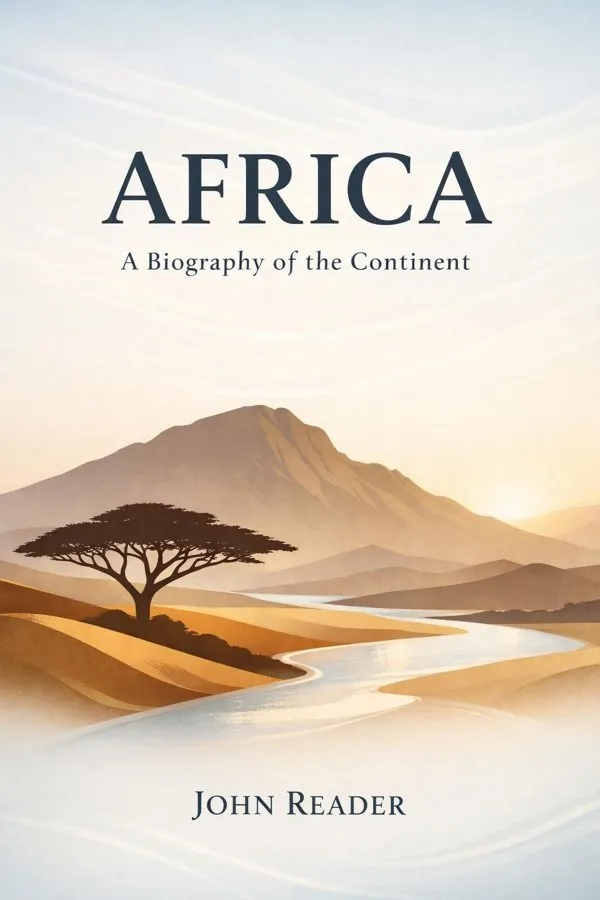
Africa: A Biography of the Continent: Summary & Key Insights
by John Reader
 10 min10 chaptersAudio available
Key Takeaways from Africa: A Biography of the Continent
The most important fact about Africa is also the one most likely to be forgotten: before Africa was a continent in world history, it was the birthplace of humanity itself.
History does not happen on a blank surface.
Civilization is often imagined as the triumph of stability, but Reader shows that in Africa, survival often depended on mobility, flexibility, and strategic adaptation.
When people begin to cultivate land, they do more than produce food; they reorganize society.
Power in African history did not emerge only from conquest; it often grew from connection.
What Is Africa: A Biography of the Continent About?
Africa: A Biography of the Continent by John Reader is a world_history book spanning 11 pages. Africa: A Biography of the Continent is an ambitious, panoramic history that treats Africa not as a backdrop to world events, but as one of the central engines of human history. John Reader begins at the deepest possible starting point: the geological formation of the continent and the evolutionary origins of life and humanity. From there, he follows Africa’s long development through climate shifts, migrations, agriculture, kingdoms, trade systems, colonial conquest, liberation movements, and the pressures of modern nationhood. The result is far more than a conventional history book. It is a work that blends archaeology, anthropology, ecology, linguistics, and political history to explain why Africa developed as it did and why its story matters to everyone. What makes the book especially valuable is Reader’s ability to connect environment and human choice without reducing one to the other. He shows how rivers, deserts, rainfall, soils, disease zones, and animal life shaped patterns of settlement and power, while also emphasizing the creativity and resilience of African societies. As a photojournalist and writer deeply engaged with human origins and environmental history, Reader brings both scholarly range and vivid narrative force to a subject too often oversimplified.
This FizzRead summary covers all 10 key chapters of Africa: A Biography of the Continent in approximately 10 minutes, distilling the most important ideas, arguments, and takeaways from John Reader's work. Also available as an audio summary and Key Quotes Podcast.
Africa: A Biography of the Continent
Africa: A Biography of the Continent is an ambitious, panoramic history that treats Africa not as a backdrop to world events, but as one of the central engines of human history. John Reader begins at the deepest possible starting point: the geological formation of the continent and the evolutionary origins of life and humanity. From there, he follows Africa’s long development through climate shifts, migrations, agriculture, kingdoms, trade systems, colonial conquest, liberation movements, and the pressures of modern nationhood. The result is far more than a conventional history book. It is a work that blends archaeology, anthropology, ecology, linguistics, and political history to explain why Africa developed as it did and why its story matters to everyone.
What makes the book especially valuable is Reader’s ability to connect environment and human choice without reducing one to the other. He shows how rivers, deserts, rainfall, soils, disease zones, and animal life shaped patterns of settlement and power, while also emphasizing the creativity and resilience of African societies. As a photojournalist and writer deeply engaged with human origins and environmental history, Reader brings both scholarly range and vivid narrative force to a subject too often oversimplified.
Who Should Read Africa: A Biography of the Continent?
This book is perfect for anyone interested in world_history and looking to gain actionable insights in a short read. Whether you're a student, professional, or lifelong learner, the key ideas from Africa: A Biography of the Continent by John Reader will help you think differently.
- ✓Readers who enjoy world_history and want practical takeaways
- ✓Professionals looking to apply new ideas to their work and life
- ✓Anyone who wants the core insights of Africa: A Biography of the Continent in just 10 minutes
Want the full summary?
Get instant access to this book summary and 100K+ more with Fizz Moment.
Get Free SummaryAvailable on App Store • Free to download
Key Chapters
The most important fact about Africa is also the one most likely to be forgotten: before Africa was a continent in world history, it was the birthplace of humanity itself. Reader opens with this enormous perspective, arguing that any serious account of Africa must begin not with empire, colonization, or even agriculture, but with the emergence of human ancestors across deep time. Fossil discoveries in East and Southern Africa, from Australopithecus to early Homo species, reveal that Africa preserves the most continuous record of human evolution anywhere on earth. This means Africa is not peripheral to human history. It is the original center of it.
Reader uses archaeology and paleoanthropology to show that human development was not a straight line but a long process of adaptation to changing environments. Rift Valley landscapes, shifting climates, and ecological pressures encouraged experimentation in movement, tool use, diet, and social cooperation. Early humans learned flexibility before they learned mastery. In that sense, Africa’s earliest history is a lesson in resilience rather than dominance.
This matters today because it changes how we frame Africa intellectually. Too often, discussions of the continent begin with modern poverty, conflict, or foreign intervention. Reader insists that the truer starting point is contribution: Africa gave rise to the species that populated the globe. In education, public discourse, or personal reading, this reframing can correct inherited biases and challenge outdated narratives of African dependency or marginality.
A practical way to apply this insight is to question any history of the world that treats Africa as an afterthought. When studying civilization, migration, or identity, begin by recognizing Africa as the foundational chapter of the human story. Actionable takeaway: replace the idea of Africa as “remote” with the more accurate idea of Africa as “original.”
History does not happen on a blank surface. One of Reader’s deepest insights is that Africa’s political and cultural development can only be understood through its physical structure: ancient rock formations, fragile soils, dramatic plateaus, immense river systems, deserts, and irregular rainfall. Africa is geologically old, and that age matters. In many regions, soils have been weathered over vast stretches of time, often making intensive agriculture difficult compared with younger, more fertile lands elsewhere. Climate volatility further complicated long-term settlement and state formation.
Reader is careful not to argue that geography determines everything. Instead, he shows that it creates opportunities and constraints. The Sahara could be a barrier, but in wetter periods it was also a corridor. Rivers could sustain dense populations, but waterfalls and rapids could limit navigation. Tsetse fly zones protected some regions from mounted invasion by restricting livestock, yet they also hindered agricultural productivity and transport. These ecological realities influenced where people settled, how they farmed, what they traded, and how power accumulated.
This framework helps explain why African societies developed along varied trajectories rather than following a single pattern. It also offers a more intelligent way to think about present-day development. Infrastructure projects, agricultural planning, and conservation policies still succeed or fail depending on how well they fit local ecological conditions. Reader’s long view reminds us that durable human systems work with landscapes, not against them.
For modern readers, the application is straightforward: when evaluating any region’s history or current challenges, ask what the land itself makes possible or difficult. Geography is not destiny, but ignoring it leads to shallow analysis. Actionable takeaway: before judging a society’s historical path, first understand its environmental constraints and resources.
Civilization is often imagined as the triumph of stability, but Reader shows that in Africa, survival often depended on mobility, flexibility, and strategic adaptation. Early African societies emerged across highly varied landscapes, from savannas and forests to floodplains and highlands, each demanding different lifeways. Hunter-gatherers, pastoralists, fishers, and early farmers all developed sophisticated systems of knowledge suited to local conditions. These were not primitive stopgaps waiting to be replaced by “advanced” models; they were intelligent responses to real ecological pressures.
Reader emphasizes that social organization in Africa cannot be understood through a single evolutionary ladder. In some areas, mobile pastoralism offered more security than fixed farming. In others, mixed economies reduced risk by combining cultivation, herding, hunting, and trade. Communities built customs, kinship systems, rituals, and technologies around uncertainty. Rainfall might fail, grazing lands might shift, or disease might threaten both humans and animals. The strength of many early societies lay in their ability to absorb shocks.
This is a powerful corrective to histories that equate complexity only with urban states or monumental architecture. Reader invites us to value knowledge systems that maintained human life over long periods in difficult environments. For example, seasonal migration routes, seed selection, oral transmission of ecological knowledge, and communal land-use practices were all forms of practical intelligence.
The modern application is clear: resilience should be measured not just by economic output, but by adaptability. Organizations, communities, and even individuals often benefit more from flexibility than from rigid optimization. Actionable takeaway: study how successful systems handle uncertainty, because adaptation is often a stronger foundation than apparent stability.
When people begin to cultivate land, they do more than produce food; they reorganize society. Reader traces how the spread of agriculture across parts of Africa transformed patterns of settlement, labor, population growth, and political authority. Yet he also shows that African agriculture did not unfold as a single “revolution.” It developed unevenly, shaped by rainfall patterns, soil fertility, crop suitability, and local innovation. Sorghum, millet, yams, oil palm, and later crops introduced from elsewhere all played different roles in different regions.
In some areas, farming encouraged denser populations and more permanent settlements. This made it easier to accumulate surplus, support specialists, and coordinate collective labor. Over time, those changes could foster hierarchy, ritual authority, and more formal leadership structures. But Reader avoids simplistic cause-and-effect. Agriculture brought vulnerability as well as growth. Settled life could expose communities to crop failure, land exhaustion, or raiding. Where conditions remained unstable, mixed strategies often persisted.
A major contribution of the book is its refusal to separate agricultural history from wider ecological and cultural history. Farming practices were linked to gender roles, seasonal rhythms, exchange networks, and local belief systems. Even the adoption of new crops from the Americas, such as maize and cassava, later reshaped demographics and political possibilities in important ways.
This idea has practical relevance far beyond ancient history. Food systems still underlie social stability, migration, and state capacity. Anyone interested in development, public policy, or sustainability should notice how agricultural choices influence everything from urbanization to conflict. Actionable takeaway: when analyzing the rise or fragility of any society, look closely at how it grows, stores, and distributes food.
Power in African history did not emerge only from conquest; it often grew from connection. Reader shows how trade networks linked communities across deserts, savannas, forests, coasts, and river corridors, giving rise to kingdoms and political systems that managed exchange, tribute, and strategic geography. Gold, salt, ivory, copper, iron, cloth, and enslaved people moved through these networks, and rulers who could secure routes or monopolize key goods often converted economic leverage into political authority.
The great states of West Africa, including Ghana, Mali, and Songhai, illustrate this pattern well. Their influence rested not simply on military strength but on control of commerce across the Sahara. Likewise, Swahili city-states on the East African coast flourished by linking African interiors to the Indian Ocean world. In Central and Southern Africa, other political formations grew around regional trade, metallurgy, and agricultural bases. Reader’s point is that Africa contained dynamic centers of statecraft and commercial sophistication long before European colonial rule.
Trade also moved ideas. Religions, artistic styles, technologies, and languages traveled alongside goods. Islam, for instance, entered many African societies through merchants and scholars, becoming woven into local political cultures in diverse ways. Reader resists the temptation to portray such interactions as one-way “influences.” African societies actively selected, adapted, and transformed what they encountered.
This matters today because it undermines stereotypes of precolonial isolation. Africa was connected, entrepreneurial, and politically inventive. For readers in business, history, or geopolitics, the lesson is that networks create power as reliably as territory does. Actionable takeaway: to understand any rising center of influence, follow the trade routes, the chokepoints, and the flows of ideas as carefully as the armies.
There is no single Africa in cultural terms, and Reader treats that not as a complication to be smoothed away, but as one of the continent’s central truths. Africa contains extraordinary linguistic, ethnic, ecological, and religious diversity, produced by millennia of migration, separation, exchange, adaptation, and reinvention. The continent’s size alone makes sweeping generalizations dangerous, but Reader goes further: he argues that diversity itself has been a driving force in African history.
Language families such as Niger-Congo, Afroasiatic, Nilo-Saharan, and Khoisan-related groupings reflect deep patterns of movement and interaction. Cultural traditions evolved in relation to local environments, producing different systems of kinship, spiritual life, political authority, and economic practice. Yet diversity did not mean fragmentation alone. Shared institutions, overlapping trade zones, intermarriage, migration, and multilingualism often created fluid frontiers rather than hard boundaries.
Reader’s treatment is especially valuable because it challenges both romantic simplification and colonial categorization. Colonial powers often froze complex identities into rigid “tribes” for administrative purposes, misunderstanding or distorting local realities. Reader helps the reader see that identities were often layered, negotiated, and historically shaped. This has obvious relevance to contemporary politics, where inherited borders and official ethnic labels still influence conflict and representation.
The practical application is intellectual humility. Whether discussing African politics, religion, literature, or economics, readers should resist continent-wide assumptions and ask which Africa, whose experience, and under what conditions. Diversity is not a footnote; it is the framework. Actionable takeaway: replace broad stereotypes with region-specific questions, because accurate understanding begins with attention to difference.
No continent develops in isolation, and Reader devotes serious attention to Africa’s long history of contact with the wider world. The key insight is that external influence was never a simple story of passive reception. Africans engaged with traders, migrants, missionaries, and empires from the Mediterranean, the Middle East, Europe, and Asia in ways that were selective, strategic, and often transformative. These contacts brought opportunities, disruptions, technologies, religions, and violence in uneven combinations.
The spread of Islam across North Africa, the Sahel, and parts of East Africa opened intellectual and commercial worlds while also reshaping political legitimacy and legal culture. Indian Ocean trade connected East African ports to Arabia, Persia, India, and beyond. Later, Atlantic engagement altered West and Central African coastal politics in profound ways, especially through the slave trade, which Reader treats as one of the most destructive forces in the continent’s history. External demand for enslaved labor intensified warfare, distorted institutions, and bled human capacity from vast regions.
Reader’s balanced approach is important. He neither denies African agency nor minimizes the scale of external exploitation. Instead, he shows that both realities coexisted. Some African elites profited from foreign trade; many communities paid devastating costs. Contact widened horizons but also opened pathways for domination.
This perspective helps modern readers avoid crude narratives of either total victimhood or total autonomy. Global integration can enrich and destabilize at the same time. The same is true today in trade, finance, media, and geopolitics. Actionable takeaway: whenever evaluating outside involvement in a society, ask who gains, who loses, and how local institutions are being reshaped beneath the surface.
Colonialism in Africa was not merely a political takeover; it was a sweeping reorganization of land, labor, identity, and economic purpose. Reader shows how the European scramble for Africa imposed borders that ignored existing societies, redirected economies toward extraction, and subordinated local priorities to imperial needs. Railways, ports, and administrative capitals were often built not to integrate African societies internally, but to move resources outward. Colonial rule transformed the map, but it also transformed how power worked on the ground.
One of Reader’s key contributions is to place colonialism within the longer African story rather than treating it as the beginning of modern history. This perspective reveals both rupture and continuity. Colonial states exploited preexisting divisions when useful, created new elites, and hardened flexible identities into fixed categories. They introduced legal systems, education structures, and bureaucratic hierarchies that would outlast formal empire. At the same time, colonial governments frequently misunderstood local ecologies and social systems, producing famines, labor coercion, environmental damage, and political resentment.
Reader is especially effective at explaining why colonial legacies have proven so persistent. Artificial borders, monocrop export economies, weak internal integration, and centralized coercive institutions did not disappear at independence. Many postcolonial states inherited structures designed for control rather than representation.
For contemporary readers, this is an essential lesson in institutional history. Present crises often have deep administrative roots. In public debate, it is tempting either to blame everything on colonialism or to dismiss it as past history. Reader avoids both extremes by showing how structural legacies constrain but do not predetermine outcomes. Actionable takeaway: when assessing modern African states, examine the colonial systems they inherited before judging the performance of the governments that followed.
The end of empire did not deliver a clean beginning. Reader presents African independence as a moment of immense hope shadowed by extraordinary difficulty. Nationalist movements mobilized against foreign rule, often drawing on ideas of dignity, self-determination, and pan-African solidarity. Across the continent, leaders and citizens envisioned political freedom as the foundation for social renewal. Yet the states they inherited were often economically dependent, administratively fragile, and territorially artificial.
Reader explains that many postcolonial challenges were built into the starting conditions. Export economies remained vulnerable to commodity swings. Ethnic or regional tensions were heightened by colonial administrative practices. Militaries and centralized bureaucracies could easily become instruments of authoritarian rule. Cold War rivalry further complicated nation-building by turning African states into arenas for external competition. As a result, independence often produced a mix of achievement and frustration: expanded education and symbolic sovereignty on one hand, coups, corruption, debt, and conflict on the other.
Still, Reader does not reduce postcolonial Africa to failure. He highlights the extraordinary ambition involved in trying to build viable states from difficult inheritances. Independence was not a finish line but a transfer of responsibility under severe constraints. That distinction matters because it encourages more serious analysis of governance, development, and accountability.
The modern application is broadly useful: liberation from an unjust system does not automatically create effective institutions. Whether in nations, organizations, or communities, transition requires capacity as well as vision. Actionable takeaway: celebrate political breakthroughs, but judge long-term success by the hard work of institution-building that follows.
Perhaps Reader’s most urgent message is that modern Africa cannot be understood through cliché. It is neither a single story of tragedy nor a simple tale of inevitable rise. The contemporary continent contains booming cities, technological innovation, democratic experimentation, cultural dynamism, environmental stress, demographic growth, and persistent inequality, often all at once. Reader’s long historical lens helps explain why Africa appears so contradictory: its present is the product of deep ecological realities, ancient diversity, violent interruptions, and remarkable endurance.
He encourages readers to see modern issues such as urbanization, food security, governance, public health, and migration in historical context. Population growth, for example, is not just a demographic statistic; it interacts with land use, labor markets, colonial boundaries, and global economic systems. Likewise, political instability in one region may reflect long-standing tensions between centralized state models and more decentralized social traditions. Reader’s method resists sensational headlines by reconnecting current events to long patterns.
Just as importantly, he restores African agency to the present. Africans are not merely responding to problems created elsewhere. They are building businesses, reshaping cultural industries, reviving intellectual traditions, negotiating religious change, and creating new forms of citizenship in rapidly changing societies. The continent’s future will matter globally, not only morally but economically, politically, and environmentally.
For readers, the practical lesson is to abandon simplistic frameworks. Better questions produce better understanding: which region, which historical legacy, which institutions, which ecological pressures, which local innovations? Actionable takeaway: approach modern Africa with curiosity instead of assumption, and let history deepen rather than flatten your view of the present.
All Chapters in Africa: A Biography of the Continent
About the Author
John Reader is a British photojournalist, historian, and author known for writing at the intersection of human origins, environmental history, and African studies. Over the course of his career, he developed a reputation for combining rigorous research with vivid, accessible storytelling, often drawing on archaeology, anthropology, geology, and ecology to illuminate large historical questions. His journalistic background gave him a strong visual sense and a talent for presenting complex subjects in concrete, compelling terms. Reader has written extensively about Africa and humanity’s evolutionary past, and his work is admired for challenging simplistic assumptions about both. In Africa: A Biography of the Continent, he brings these strengths together to produce a broad, deeply informed account of Africa as both the cradle of humankind and a continent shaped by long environmental and historical forces.
Get This Summary in Your Preferred Format
Read or listen to the Africa: A Biography of the Continent summary by John Reader anytime, anywhere. FizzRead offers multiple formats so you can learn on your terms — all free.
Available formats: App · Audio · PDF · EPUB — All included free with FizzRead
Download Africa: A Biography of the Continent PDF and EPUB Summary
Key Quotes from Africa: A Biography of the Continent
“The most important fact about Africa is also the one most likely to be forgotten: before Africa was a continent in world history, it was the birthplace of humanity itself.”
“History does not happen on a blank surface.”
“Civilization is often imagined as the triumph of stability, but Reader shows that in Africa, survival often depended on mobility, flexibility, and strategic adaptation.”
“When people begin to cultivate land, they do more than produce food; they reorganize society.”
“Power in African history did not emerge only from conquest; it often grew from connection.”
Frequently Asked Questions about Africa: A Biography of the Continent
Africa: A Biography of the Continent by John Reader is a world_history book that explores key ideas across 10 chapters. Africa: A Biography of the Continent is an ambitious, panoramic history that treats Africa not as a backdrop to world events, but as one of the central engines of human history. John Reader begins at the deepest possible starting point: the geological formation of the continent and the evolutionary origins of life and humanity. From there, he follows Africa’s long development through climate shifts, migrations, agriculture, kingdoms, trade systems, colonial conquest, liberation movements, and the pressures of modern nationhood. The result is far more than a conventional history book. It is a work that blends archaeology, anthropology, ecology, linguistics, and political history to explain why Africa developed as it did and why its story matters to everyone. What makes the book especially valuable is Reader’s ability to connect environment and human choice without reducing one to the other. He shows how rivers, deserts, rainfall, soils, disease zones, and animal life shaped patterns of settlement and power, while also emphasizing the creativity and resilience of African societies. As a photojournalist and writer deeply engaged with human origins and environmental history, Reader brings both scholarly range and vivid narrative force to a subject too often oversimplified.
You Might Also Like
The Age of Capital
Eric Hobsbawm
10 min
The Gulag Archipelago
Aleksandr Solzhenitsyn
10 min
Jerusalem: The Biography
Simon Sebag Montefiore
10 min
The Anglo-Saxons
James Campbell
10 min
The Boer War
Thomas Pakenham
10 min
The Industrial Revolutionaries: The Making of the Modern World 1776–1914
Gavin Weightman
10 minBrowse by Category
Ready to read Africa: A Biography of the Continent?
Get the full summary and 100K+ more books with Fizz Moment.