
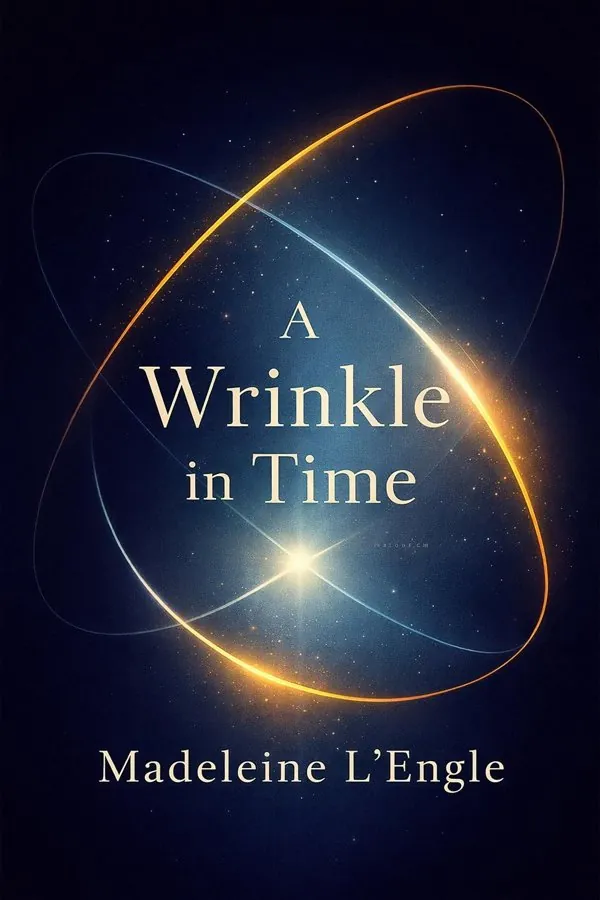
A Wrinkle in Time: Summary & Key Insights
 10 min9 chaptersAudio available
Key Takeaways from A Wrinkle in Time
The most important journeys often begin in discomfort rather than confidence.
Transformation often begins the moment we admit reality is larger than our current understanding.
A rescue mission becomes more powerful when it reveals that personal loss is connected to a much larger struggle.
Uniformity can look peaceful while hiding profound violence.
Brilliance is powerful, but it is not sufficient on its own.
What Is A Wrinkle in Time About?
A Wrinkle in Time by Madeleine L'Engle is a scifi_fantasy book spanning 4 pages. A Wrinkle in Time is a landmark work of science fantasy that transforms a child’s rescue mission into a sweeping meditation on identity, courage, evil, and the saving power of love. The novel follows Meg Murry, her brilliant younger brother Charles Wallace, and their friend Calvin O’Keefe as they journey across the universe to find Meg’s missing father, a scientist trapped by a dark force spreading through creation. Along the way, Madeleine L’Engle blends astrophysics, myth, theology, and emotional realism into a story that feels both cosmic and deeply personal. What makes the book endure is not only its imaginative premise, but its insistence that weakness can become strength, that nonconformity can be a gift, and that love is not sentimental weakness but active resistance to darkness. First published in 1962 and awarded the Newbery Medal, the novel remains one of the most influential children’s classics of the twentieth century. L’Engle writes with unusual authority because she refuses to separate intellect from spirit, or wonder from struggle, offering readers a story that challenges the mind while comforting the heart.
This FizzRead summary covers all 9 key chapters of A Wrinkle in Time in approximately 10 minutes, distilling the most important ideas, arguments, and takeaways from Madeleine L'Engle's work. Also available as an audio summary and Key Quotes Podcast.
A Wrinkle in Time
A Wrinkle in Time is a landmark work of science fantasy that transforms a child’s rescue mission into a sweeping meditation on identity, courage, evil, and the saving power of love. The novel follows Meg Murry, her brilliant younger brother Charles Wallace, and their friend Calvin O’Keefe as they journey across the universe to find Meg’s missing father, a scientist trapped by a dark force spreading through creation. Along the way, Madeleine L’Engle blends astrophysics, myth, theology, and emotional realism into a story that feels both cosmic and deeply personal. What makes the book endure is not only its imaginative premise, but its insistence that weakness can become strength, that nonconformity can be a gift, and that love is not sentimental weakness but active resistance to darkness. First published in 1962 and awarded the Newbery Medal, the novel remains one of the most influential children’s classics of the twentieth century. L’Engle writes with unusual authority because she refuses to separate intellect from spirit, or wonder from struggle, offering readers a story that challenges the mind while comforting the heart.
Who Should Read A Wrinkle in Time?
This book is perfect for anyone interested in scifi_fantasy and looking to gain actionable insights in a short read. Whether you're a student, professional, or lifelong learner, the key ideas from A Wrinkle in Time by Madeleine L'Engle will help you think differently.
- ✓Readers who enjoy scifi_fantasy and want practical takeaways
- ✓Professionals looking to apply new ideas to their work and life
- ✓Anyone who wants the core insights of A Wrinkle in Time in just 10 minutes
Want the full summary?
Get instant access to this book summary and 100K+ more with Fizz Moment.
Get Free SummaryAvailable on App Store • Free to download
Key Chapters
The most important journeys often begin in discomfort rather than confidence. When A Wrinkle in Time opens, Meg Murry is not a triumphant heroine but an angry, awkward, deeply insecure girl who feels out of place everywhere. She has trouble at school, resents how others judge her family, and cannot reconcile her intelligence with her emotional volatility. Her father has been missing for years, her mother’s scientific brilliance sets a high standard, and her younger brother Charles Wallace seems mysteriously gifted in ways she cannot understand. Meg’s frustration is not just teenage moodiness; it reflects the pain of believing you are defective in a world that rewards easy charm and neat behavior.
L’Engle makes this emotional starting point essential. Meg does not begin as a polished savior. She begins as someone who doubts her own worth. That is what makes her journey meaningful. Readers see that growth is not about becoming someone entirely different, but about recognizing hidden strength within qualities that once felt like flaws. Meg’s stubbornness, protectiveness, and intensity are not erased over the course of the story; they are redirected.
This idea has practical force beyond fiction. Many people spend years trying to conceal the parts of themselves that seem inconvenient, emotional, or socially awkward. Yet those very traits can contain resilience, loyalty, and originality. A student who feels misunderstood may have unusual insight. A person who asks difficult questions may be resisting easy falsehoods.
The novel’s opening reminds us that feeling out of place does not mean you are failing. It may mean you are being prepared for a task that requires exactly your unusual perspective. Actionable takeaway: Identify one personal trait you usually criticize in yourself and ask how it might become a strength in the right context.
Transformation often begins the moment we admit reality is larger than our current understanding. The mysterious arrival of Mrs. Whatsit at the Murry home turns a stormy night into the threshold of adventure. Her strange appearance, cryptic speech, and casual mention of a tesseract disrupt the ordinary world and signal that the universe is far more layered than it seems. Soon she is joined by Mrs. Who and Mrs. Which, celestial beings who guide the children toward a truth that combines science, intuition, and moral purpose.
What matters here is not just that supernatural helpers appear, but how they function. They do not remove uncertainty. They deepen it. The three Mrs. W’s invite Meg, Charles Wallace, and Calvin into mystery without giving them full control. This is crucial because L’Engle suggests that wisdom does not always arrive in tidy explanations. Sometimes it arrives as a challenge to expand our imagination and trust that understanding can grow through participation.
The tesseract itself symbolizes this leap. It is not magic opposed to science, but a concept that stretches science toward wonder. In everyday life, we experience smaller versions of this whenever a new idea changes our sense of what is possible: a child discovering astronomy, an adult reconsidering long-held assumptions, or a team solving a problem by refusing familiar limits.
The lesson is practical. Progress often requires us to tolerate confusion long enough to reach insight. New opportunities, relationships, and responsibilities rarely arrive fully explained. We have to step toward them before everything makes sense.
L’Engle encourages readers to remain open to realities beyond the obvious, whether intellectual, spiritual, or emotional. Actionable takeaway: The next time something unfamiliar unsettles you, pause before rejecting it and ask what new dimension of understanding it might reveal.
A rescue mission becomes more powerful when it reveals that personal loss is connected to a much larger struggle. Guided by the three celestial women, Meg, Charles Wallace, and Calvin travel by tessering through space-time in search of Mr. Murry. Their journey takes them first to Uriel, a planet radiant with harmony, where they glimpse the beauty of a universe sustained by light. There they learn that the darkness threatening one family is part of an ancient conflict between creative freedom and a destructive force known as the Black Thing.
This shift enlarges the story’s stakes. Meg’s father is not simply lost; he is entangled in a battle that affects whole worlds. L’Engle uses this cosmic frame to show that human suffering is rarely isolated. Fear, oppression, and despair can spread socially and spiritually, just as hope, courage, and compassion can. The image of stars sacrificing themselves in resistance to darkness also suggests that acts of goodness often involve cost. Light is not passive. It fights.
For readers, this idea has direct relevance. We may experience hardship as entirely personal: a family crisis, a mental health struggle, a workplace injustice. But these difficulties often connect to broader systems, patterns, or forces such as conformity, fear, indifference, or dehumanization. Recognizing that connection can be empowering. It helps us understand that our response matters beyond our private sphere.
The children’s quest also shows that ordinary people can participate in vast moral struggles without fully grasping everything at once. They do not need complete mastery to act faithfully. They need courage, guidance, and commitment.
L’Engle invites readers to see their own lives as part of a larger drama between life-giving and life-diminishing forces. Actionable takeaway: When facing a personal challenge, ask what larger values are involved and choose one concrete action that aligns you with light rather than fear.
Uniformity can look peaceful while hiding profound violence. On Camazotz, the children encounter a world of eerie order: houses are identical, schedules are synchronized, and even children bouncing balls move in exact rhythm. At first glance, such precision might seem efficient or desirable. But the unsettling perfection soon reveals its true purpose. Camazotz is ruled by IT, a disembodied intelligence that demands total submission and eliminates individuality in the name of harmony.
This section is one of the novel’s sharpest insights. L’Engle shows that evil does not always appear chaotic or monstrous. It can appear tidy, rational, and organized. The deepest threat on Camazotz is not physical violence alone, but the erasure of personhood. To live there safely, one must stop thinking independently, stop feeling deeply, and stop being distinct. Charles Wallace, confident in his intelligence, tries to confront IT and is overpowered, becoming a vehicle for the very force he sought to challenge.
The idea remains urgently relevant. Modern conformity can take many forms: social pressure to perform a certain identity, workplaces that reward silence over integrity, digital spaces that punish nuance, or communities that equate belonging with sameness. Efficiency, consensus, and standardization are not bad in themselves, but they become dangerous when they suppress conscience and creativity.
L’Engle does not argue for rebellion for its own sake. Instead, she defends the irreducible value of each person’s mind and soul. Real community allows difference. False harmony demands surrender.
Readers can apply this by noticing where they are tempted to mute their convictions just to avoid discomfort. The question is not whether you fit in, but whether fitting in costs your truth. Actionable takeaway: Identify one area where you are conforming out of fear and practice expressing one honest, respectful act of individuality.
Brilliance is powerful, but it is not sufficient on its own. A central surprise in A Wrinkle in Time is that extraordinary intelligence does not guarantee safety or wisdom. Mr. Murry is a gifted scientist, Charles Wallace is a child prodigy with startling perceptiveness, and Meg herself comes from a family defined by intellect. Yet when they confront IT on Camazotz, intellect by itself proves inadequate. Charles Wallace’s confidence becomes vulnerability because he believes he can outthink a force that manipulates mind itself. Mr. Murry, despite his knowledge, cannot instantly save his children or solve the moral crisis before him.
L’Engle is not dismissing reason. On the contrary, the novel respects science, curiosity, and analytical thought. But it refuses to treat intelligence as the highest human capacity. There are realities that logic alone cannot fully master: love, freedom, sacrifice, courage, and the dignity of the person. Evil in the novel is not merely an intellectual puzzle; it is a distortion of relationship and will.
This idea matters in everyday life. Smart people can make harmful choices. Highly educated institutions can become morally blind. A person may understand a problem clearly and still lack the humility, compassion, or bravery needed to address it well. In leadership, parenting, teaching, and friendship, technical competence matters, but character matters just as much.
The novel encourages a more integrated view of human strength. We need minds capable of understanding complexity, but we also need hearts capable of resisting domination and choosing love over control. Wisdom is not raw IQ; it is intelligence guided by moral clarity.
For readers, this is a useful corrective in achievement-driven cultures that treat mental performance as ultimate value. Actionable takeaway: In your next difficult decision, evaluate not only what is smartest, but also what is most humane, courageous, and loving.
What feels like weakness may become the very force that saves us. Near the novel’s climax, Meg is given the task no one else can perform: she must return alone to Camazotz and rescue Charles Wallace. She is not the strongest, the calmest, or the most intellectually formidable member of the group. In fact, she has spent much of the story feeling inferior to others. Yet precisely because of who she is, she possesses something IT cannot comprehend or control. Meg realizes that her love for Charles Wallace is stronger than the force trying to absorb him.
This revelation is not sentimental decoration. It is the novel’s moral center. L’Engle presents love as an active, liberating power that honors individuality rather than erasing it. IT can dominate through fear, rhythm, and mental pressure, but it cannot create genuine relationship. Meg reaches her brother not by overpowering him intellectually, but by loving him as himself. That love breaks the hold of conformity because it calls a person back into personhood.
In daily life, we often underrate this kind of strength. We may assume that only strategy, authority, or force can change difficult situations. But people are often transformed by steadfast presence, patient care, truthful affection, and refusal to reduce them to their worst moment. A struggling child, an anxious friend, or a conflicted colleague may respond less to argument than to being deeply seen.
This does not mean love is easy. In the novel, love requires Meg to act despite fear and pain. Real love is not passive feeling; it is costly commitment. It resists dehumanization by insisting that another person is more than what controls them.
L’Engle’s insight is timeless: love is not opposed to strength; it is strength in its most human form. Actionable takeaway: Think of one person who needs encouragement and offer a concrete act of loving attention that affirms their worth.
Some of the richest stories refuse the false choice between reason and wonder. One reason A Wrinkle in Time remains distinctive is its seamless blending of scientific concepts, spiritual imagination, and philosophical reflection. The novel speaks of dimensions, relativity, and tessering, yet it also includes quotations from religious thinkers, references to prayerful courage, and a universe charged with moral meaning. Madeleine L’Engle does not flatten these elements into a single system. Instead, she lets them coexist in productive tension.
This matters because many readers are taught that they must choose between scientific seriousness and spiritual depth. L’Engle challenges that assumption. For her, science expands awe rather than eliminating it. The cosmos is intelligible enough to study and mysterious enough to revere. The battle against darkness is both metaphysical and practical, both cosmic and ethical.
This integrated vision can be helpful in real life. A doctor can rely on research while honoring the emotional and spiritual dimensions of care. A student can pursue physics and still ask moral questions about meaning. A parent can encourage skepticism and imagination at the same time. The novel models intellectual humility: reality is vast, and no single mode of knowing exhausts it.
Importantly, this coexistence does not mean every idea is equally valid. Rather, it means human understanding is layered. Facts matter, and so do values. Measurement matters, and so does wisdom. Explanation matters, and so does mystery.
For readers who feel pressured to simplify their worldview, L’Engle offers permission to hold complexity with integrity. The universe may be stranger and more meaningful than narrow categories allow. Actionable takeaway: Explore one topic you usually treat in only one way—scientifically, emotionally, or spiritually—and deliberately ask what the other dimensions might reveal.
We are often strengthened not by flawless heroes but by companions who choose to stay beside us. Throughout A Wrinkle in Time, Meg is supported by a small but significant community: Charles Wallace believes in her long before she believes in herself, Calvin offers warmth and loyalty, the Mrs. W’s guide without controlling, and even Mr. Murry, despite his limitations, remains part of the effort to bring the family together. None of these relationships is perfect, but together they form a network of belonging that helps Meg endure fear and uncertainty.
This is especially important because Meg begins the novel feeling isolated. Her transformation does not come from solitary self-discovery alone. It emerges through connection. Calvin’s easy acceptance allows her to relax into herself. Charles Wallace’s vulnerability calls forth her protectiveness. The celestial guides provide perspective that Meg could never generate alone. Community, in this sense, is not mere companionship; it is the context in which hidden capacities are awakened.
The practical relevance is clear. People rarely become braver in isolation. We often need relationships that reflect our strengths back to us, challenge our distortions, and accompany us through confusion. This can happen in families, friendships, classrooms, support groups, or creative collaborations. The key is not perfection, but presence and truthfulness.
L’Engle also shows that help does not eliminate personal responsibility. Meg still must make her own choices. But she does not make them unsupported. That balance matters. Healthy belonging empowers agency rather than replacing it.
In a culture that alternates between hyper-independence and unhealthy dependence, the novel offers a better model: courageous interdependence. We become more ourselves, not less, when we are loved well.
Actionable takeaway: Strengthen one life-giving relationship this week by expressing appreciation or asking for the kind of support you genuinely need.
Being yourself is not just a personal preference; in this novel, it is an ethical act. A Wrinkle in Time argues that individuality matters because it protects freedom, conscience, and love from forces that seek control. Meg’s awkwardness, Calvin’s social adaptability, Charles Wallace’s unusual insight, and even Mrs. Who’s habit of speaking through quotations all underscore that distinctiveness is not accidental decoration. Difference is part of what makes resistance possible.
Camazotz provides the negative example. There, sameness is enforced until no one is truly a self anymore. But the novel’s deeper claim is that individuality carries responsibility. To be a person is to think, choose, and love in ways no system can do for you. This is why conformity is dangerous: it tempts us to surrender the burden of moral agency. It is easier to follow the rhythm, obey the crowd, or let an authority define reality for us.
In everyday terms, this idea applies whenever people hide their convictions, talents, or questions to maintain approval. A creative employee may suppress a needed innovation. A student may pretend not to care in order to belong. A citizen may stay silent in the face of injustice because speaking feels costly. L’Engle reminds us that distinctiveness is not vanity when it serves truth and goodness.
At the same time, individuality is not selfish self-expression detached from others. Meg’s uniqueness matters most when it becomes a vehicle for love. The self is fulfilled not by domination, but by faithful use of its particular gifts.
This is one of the novel’s enduring insights: your difference may be precisely what darkness cannot predict or control. Actionable takeaway: Name one gift, perspective, or conviction that makes you distinct and use it this week in service of something larger than yourself.
All Chapters in A Wrinkle in Time
About the Author
Madeleine L’Engle (1918–2007) was an American novelist, essayist, and poet whose work brought together science, fantasy, theology, and deep emotional insight. Born in New York City, she studied at Smith College and went on to write for both children and adults across a long and influential career. Her best-known novel, A Wrinkle in Time, won the Newbery Medal in 1963 after being rejected by numerous publishers, eventually becoming a beloved classic of children’s literature. L’Engle’s writing often explored faith, suffering, creativity, and the mystery of existence without sacrificing storytelling or imagination. She was admired for refusing rigid boundaries between intellect and spirit, realism and wonder. Her books continue to inspire readers with their compassion, originality, and belief in the dignity of the individual.
Get This Summary in Your Preferred Format
Read or listen to the A Wrinkle in Time summary by Madeleine L'Engle anytime, anywhere. FizzRead offers multiple formats so you can learn on your terms — all free.
Available formats: App · Audio · PDF · EPUB — All included free with FizzRead
Download A Wrinkle in Time PDF and EPUB Summary
Key Quotes from A Wrinkle in Time
“The most important journeys often begin in discomfort rather than confidence.”
“Transformation often begins the moment we admit reality is larger than our current understanding.”
“A rescue mission becomes more powerful when it reveals that personal loss is connected to a much larger struggle.”
“Uniformity can look peaceful while hiding profound violence.”
“Brilliance is powerful, but it is not sufficient on its own.”
Frequently Asked Questions about A Wrinkle in Time
A Wrinkle in Time by Madeleine L'Engle is a scifi_fantasy book that explores key ideas across 9 chapters. A Wrinkle in Time is a landmark work of science fantasy that transforms a child’s rescue mission into a sweeping meditation on identity, courage, evil, and the saving power of love. The novel follows Meg Murry, her brilliant younger brother Charles Wallace, and their friend Calvin O’Keefe as they journey across the universe to find Meg’s missing father, a scientist trapped by a dark force spreading through creation. Along the way, Madeleine L’Engle blends astrophysics, myth, theology, and emotional realism into a story that feels both cosmic and deeply personal. What makes the book endure is not only its imaginative premise, but its insistence that weakness can become strength, that nonconformity can be a gift, and that love is not sentimental weakness but active resistance to darkness. First published in 1962 and awarded the Newbery Medal, the novel remains one of the most influential children’s classics of the twentieth century. L’Engle writes with unusual authority because she refuses to separate intellect from spirit, or wonder from struggle, offering readers a story that challenges the mind while comforting the heart.
You Might Also Like
Red Rising
Pierce Brown
10 min
Stranger in a Strange Land
Robert A. Heinlein
10 min
AI Valley
Chen Qiufan
10 min
Bloodchild
Octavia E. Butler
10 min
Do Androids Dream of Electric Sheep?
Philip K. Dick
10 min
Jujutsu Kaisen, Vol. 24
Gege Akutami
10 minBrowse by Category
Ready to read A Wrinkle in Time?
Get the full summary and 100K+ more books with Fizz Moment.