
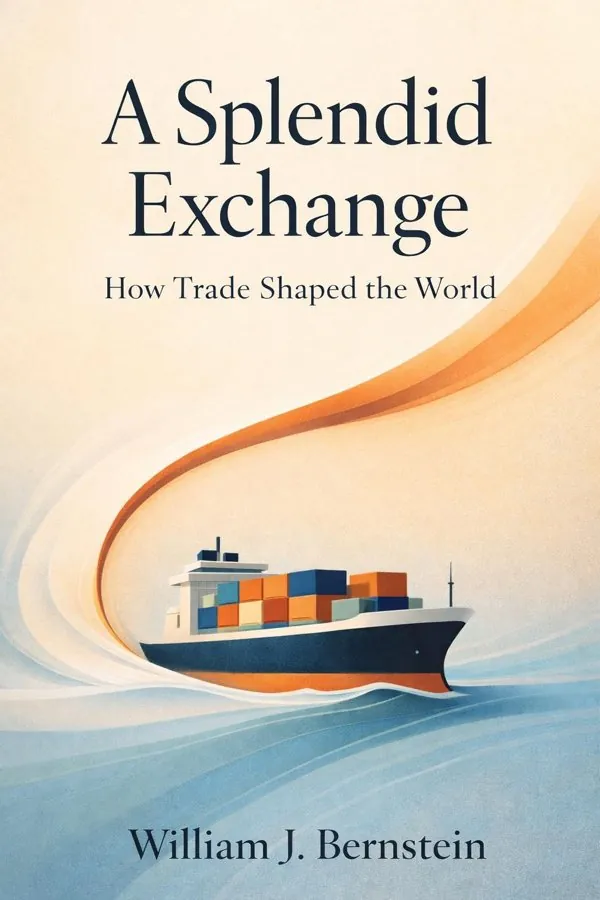
A Splendid Exchange: How Trade Shaped the World: Summary & Key Insights
 10 min11 chaptersAudio available
What Is A Splendid Exchange: How Trade Shaped the World About?
A Splendid Exchange: How Trade Shaped the World by William J. Bernstein is a economics book spanning 11 pages. A Splendid Exchange explores the history of trade from ancient Mesopotamia to the modern global economy. William J. Bernstein traces how commerce has shaped civilizations, driven exploration, and influenced political and cultural development. The book combines economic history with storytelling to show how trade has been both a source of prosperity and conflict throughout human history.
This FizzRead summary covers all 11 key chapters of A Splendid Exchange: How Trade Shaped the World in approximately 10 minutes, distilling the most important ideas, arguments, and takeaways from William J. Bernstein's work. Also available as an audio summary and Key Quotes Podcast.
A Splendid Exchange: How Trade Shaped the World
A Splendid Exchange explores the history of trade from ancient Mesopotamia to the modern global economy. William J. Bernstein traces how commerce has shaped civilizations, driven exploration, and influenced political and cultural development. The book combines economic history with storytelling to show how trade has been both a source of prosperity and conflict throughout human history.
Who Should Read A Splendid Exchange: How Trade Shaped the World?
This book is perfect for anyone interested in economics and looking to gain actionable insights in a short read. Whether you're a student, professional, or lifelong learner, the key ideas from A Splendid Exchange: How Trade Shaped the World by William J. Bernstein will help you think differently.
- ✓Readers who enjoy economics and want practical takeaways
- ✓Professionals looking to apply new ideas to their work and life
- ✓Anyone who wants the core insights of A Splendid Exchange: How Trade Shaped the World in just 10 minutes
Want the full summary?
Get instant access to this book summary and 100K+ more with Fizz Moment.
Get Free SummaryAvailable on App Store • Free to download
Key Chapters
Trade was born not in bustling ports but in river valleys where the first cities emerged. In ancient Mesopotamia, around 3000 BCE, people faced a simple yet profound problem: how to obtain what their land could not produce. The fertile plains between the Tigris and Euphrates yielded abundant grain, but they lacked timber, metals, and precious stones. Out of this scarcity grew one of humanity’s first acts of interdependence—commerce.
Merchants transformed from mere transporters to innovators. They developed contracts, prices, and tokens—a proto-currency long before coinage. In this fragile web of exchanges, trust had to be invented. The earliest clay tablets did not record poetry or law, but debts and deliveries. It was through these tablets that civilization learned accountability and foresight. Every shipment of copper from Oman or lapis lazuli from Afghanistan added not only wealth but the awareness that the world was larger and linked.
In the Near East, trade nurtured contact among Sumer, Akkad, Egypt, and the Indus Valley, forming the first recognizable commercial network. These connections were as much cultural as economic: art, writing, and religion spread along the arteries of exchange. Here began humanity’s first experiments with diplomacy and measurement—because trade required standardization, recordkeeping, and peace. You might say that commerce birthed civilization as much as writing did. The Mesopotamian merchant, driven by necessity and curiosity, became the prototype of all global traders to come.
The Silk Road was less a single path than a living organism—a constellation of routes stretching across deserts and mountains, linking East and West for millennia. Long before Marco Polo, Chinese silk had reached the Roman world, carrying with it tales of distant sophistication. As I recount in the book, silk was more than fabric; it was a catalyst of empire and imagination.
These overland routes traversed perilous terrain, connecting farmers in the Yellow River basin with merchants in Samarkand and Antioch. Every caravan brought not only goods—silk, spices, jade, and horses—but also philosophies, technologies, and diseases. Through the Silk Road, Buddhism flowed into China, paper spread westward, and even smallpox found new hosts. Trade was the great mixmaster of civilization—it dissolved boundaries and regenerated ideas.
Merchant cities like Palmyra and Kashgar became crucibles of diversity. Traders needed common languages, laws, and resting places; so the mechanics of globalization were invented anew in antiquity. Yet the Silk Road also revealed trade’s fragility: one marauding tribe or imperial collapse could rupture the world’s arteries. Nonetheless, the network revived again and again, embodying humanity’s stubborn desire for connection.
From my perspective, the Silk Road demonstrates that trade’s greatest gifts—innovation, tolerance, and interdependence—are inseparable from its risks. Commerce made cultures richer but also exposed them to contagion, competition, and dependency. Still, its endurance reminds us that the human spirit, when faced with isolation, will always find a route to exchange.
+ 9 more chapters — available in the FizzRead app
All Chapters in A Splendid Exchange: How Trade Shaped the World
About the Author
William J. Bernstein is an American financial theorist, neurologist, and author known for his works on economic history and investing. He has written several acclaimed books that blend finance, history, and human behavior, including The Birth of Plenty and The Four Pillars of Investing.
Get This Summary in Your Preferred Format
Read or listen to the A Splendid Exchange: How Trade Shaped the World summary by William J. Bernstein anytime, anywhere. FizzRead offers multiple formats so you can learn on your terms — all free.
Available formats: App · Audio · PDF · EPUB — All included free with FizzRead
Download A Splendid Exchange: How Trade Shaped the World PDF and EPUB Summary
Key Quotes from A Splendid Exchange: How Trade Shaped the World
“Trade was born not in bustling ports but in river valleys where the first cities emerged.”
“The Silk Road was less a single path than a living organism—a constellation of routes stretching across deserts and mountains, linking East and West for millennia.”
Frequently Asked Questions about A Splendid Exchange: How Trade Shaped the World
A Splendid Exchange: How Trade Shaped the World by William J. Bernstein is a economics book that explores key ideas across 11 chapters. A Splendid Exchange explores the history of trade from ancient Mesopotamia to the modern global economy. William J. Bernstein traces how commerce has shaped civilizations, driven exploration, and influenced political and cultural development. The book combines economic history with storytelling to show how trade has been both a source of prosperity and conflict throughout human history.
More by William J. Bernstein

The Intelligent Asset Allocator: How to Build Your Portfolio to Maximize Returns and Minimize Risk
William J. Bernstein
10 min
The Four Pillars of Investing: Lessons for Building a Winning Portfolio
William J. Bernstein
10 min
The Birth Of Plenty: How The Prosperity Of The Modern World Was Created
William J. Bernstein
10 minYou Might Also Like

Business Adventures
John Brooks
10 min
Nudge
Richard H. Thaler, Cass R. Sunstein
10 min
The Hitchhiker"s Guide to the Galaxy
Douglas Adams
10 minThe Muqaddimah
Ibn Khaldun
10 minThe Outsiders
William N. Thorndike
10 min
A Little History of Economics
Niall Kishtainy
10 minFeatured In
Browse by Category
Ready to read A Splendid Exchange: How Trade Shaped the World?
Get the full summary and 100K+ more books with Fizz Moment.